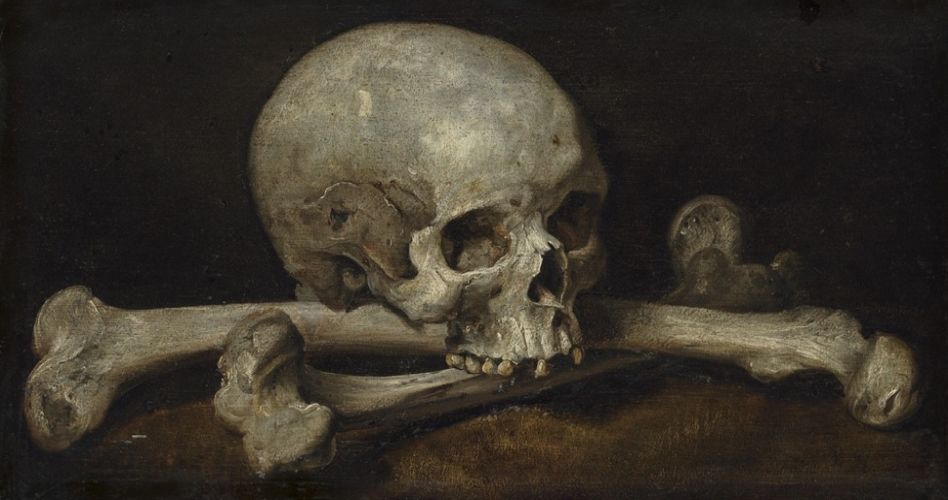
In the 17th. c., a style of painting known as "vanitas
painting" became popular. This style included elements that
represented temporal bounty - flowers, fruits, etc., and symbols of
riches, such as gold and jewels. These gorgeous gifts from God were
then juxtaposed with symbols that showed the reality of death, usually
a skull, or an hourglasses that symbolized the passage of time.
The point of this style is the moral of which Ecclesiasticus 1 reminds
us, "What profit hath a man of all his labour which he taketh under the
sun? One generation passeth away, and another generation cometh..." In
other words, the things of this world are transient, and Christians
must always keep one eye on the world to come.
Recalling this Truth is one of the principles behind the use of ashes
on the forehead on Ash Wednesday, the
first day of the Lenten Season of
penance: to remind us that we are mortal, subject to the rot and decay
our Western culture now desperately tries to euphemize away, and that
we are radically dependent on -- solely dependent on -- Jesus
Christ to overcome this fate.
They are like a yearly reading of the tombstone inscribed with:
Remember
friends as you pass by,
as you are now so once was I.
As I am now so you must be.
Prepare for death and follow me.
-- or as one
would say in Latin, "Hodie mihi, cras tibi" ("Today me, tomorrow you").
They are a liturgical "memento mori."
In Genesis 3:19 we hear God tell us "for dust thou art, and into dust
thou shalt return," but nowadays, when someone dies, they are rushed
from deathbed to funeral home to be embalmed and to be worked over by a
make-up artist so that that "dusty reality" is hidden from us. Their
deaths are spoken of as almost an embarrassment; "he passed," they say,
or "he is no longer with us." These comforting but sterile luxuries
weren't an option in the past when plagues felled so many people that
there weren't enough survivors to bury them, when bodies had to be
stored all winter until the ground was soft enough to dig, when most of
the children a woman bore died before they were able to grow up. In our
culture, with our medicines and "funeral sciences," we are afraid to
look at death, and we are a poorer people because of it. No matter how
long science can prolong life, no matter how much embalming fluid is
pumped into a corpse, Nature will have her way. This is the hideous
Truth. And when Nature has her way, we can either rest in the knowledge
that the ultimate Victor is Christ, Our Lord, Who walked out of His
tomb 2,000 years ago and offers resurrection to us, or we can believe
that decay is all that is left. This is the meaning of Ash Wednesday.
Ashes are used, too, to express the penitence necessary to come to
Christ so that we can experience bodily resurrection at the End of the
Age.
Job 42:6
Therefore I reprehend myself, and do penance in dust and ashes.
The Blessing and Disposition of the Ashes
The ashes used
on Ash Wednesday are
made by the burning of palms from last
year's Palm Sunday. The blessing of
the ashes begins with an antiphon and a verse of a psalm begging God's
grace and mercy. Then come four prayers which express what the ashes
symbolize and how they are to be seen and used by us:
1. To be a spiritual help for all who confess their sins.
2. To secure pardon of sins for those who receive the ashes.
3. To give us the spirit of contrition.
4. To give us the grace and strength to do penance.
After the priest sprinkles the ashes with holy
water and incenses them, he puts some
on his own head, and then on the heads of those present, the head being
the seat of pride. He puts them on our foreheads in the shape of a
Cross to remind us of our hope, and as he does so, he says the words of
Genesis 3:
Meménto, homo,
quia pulvis es, et in púlverem revertéris (Remember, man, that thou art
dust, and unto dust thou shalt return).
We make no
response to these words; we simply return to our pews.
Following the disposition of the ashes come two Antiphons and a
Response. Then the priest says another prayer for protection in the
coming combat.
After we leave the church, we leave the ashes on our foreheads until
they wear off naturally from the course of the day's activities. They
are a public witness to those things our society does not wish to
embrace: the reality of death, and the hope of resurrection in Our
Lord, Jesus Christ.
Note: another (informal) use of ashes by Catholics is the
saving of ashes from the bonfire built on the Eve of the Feast of the
Birth of St. John the Baptist (23 June) to mix with water to bless the
sick.
|