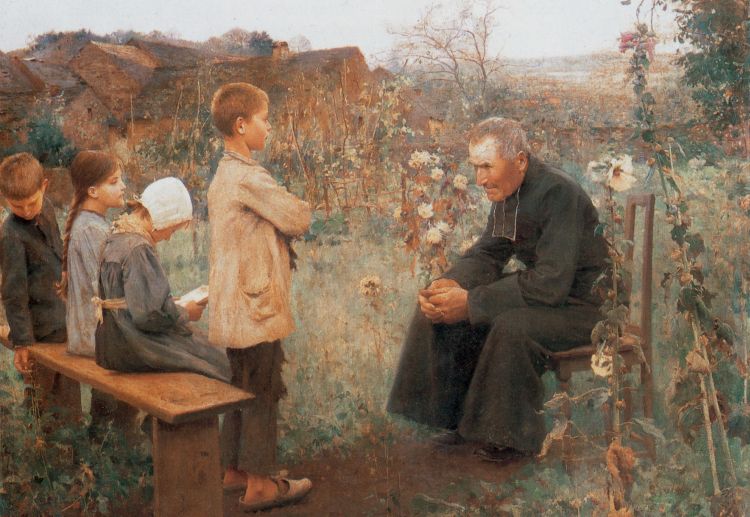
Matthew 23:1-12:
Then spake Jesus
to the multitude, and to his disciples, Saying The scribes and the
Pharisees sit in Moses' seat: All therefore whatsoever they bid you
observe, that observe and do; but do not ye after their works: for they
say, and do not. For they bind heavy burdens and grievous to be borne,
and lay them on men's shoulders; but they themselves will not move them
with one of their fingers. But all their works they do for to be seen
of men: they make broad their phylacteries, and enlarge the borders of
their garments, And love the uppermost rooms at feasts, and the chief
seats in the synagogues, And greetings in the markets, and to be called
of men, Rabbi, Rabbi. But be not ye called Rabbi: for one is your
Master, even Christ; and all ye are brethren. And call no man your
father upon the earth: for one is your Father, which is in heaven. Neither
be ye called masters: for one is your Master, even Christ. But he that
is greatest among you shall be your servant. And whosoever shall exalt
himself shall be abased; and he that shall humble himself shall be
exalted.
OK,
so what's He saying here? What's His point? He is admonishing those who
would raise themselves up as "holier than thou," are spiritually
prideful, and boasters. He is saying that we are not to put any man,
including ourselves, including the Pope, above God, simple as that. He
is not saying that we are not to literally ever call a man father or
rabbi or teacher or master; to believe otherwise is to call Him a liar
because He Himself calls people father, in both the physical and
spiritual sense (in that same chapter, even, in Mark 7, Mark 10, Mark
13, Luke 6, etc.) and doesn't admonish those who refer to "our father
David" as they greet Him during His triumphant entry into Jerusalem.
The four evangelists speak the same way, Christ's Mother speaks the
same way, as does Paul who refers numerous times to our "father
Abraham."
More important to the argument is Paul's acknowledging his
own spiritual fatherhood, I Corinthians 4:14-17 being among the
most explicit in which he says "I have begotten you through the
Gospel," translated in the NIV and NASB (among others) as "I became
your father through the Gospel." Tellingly, in this verse he even
distinguishes between people who teach about Christ and "fathers" in
Christ (see verse below) -- i.e., he differentiates between all
Christians, who are exhorted to teach about Christ, and "spiritual
fathers," who are ordained priests.
In addition, he is constantly referring to his "children," calls
Timothy and Oneismus his "sons," and indicates that the other elders
(presbyteros, priests) do the same: 1 Thessalonians 2:11-12: "As ye
know how we exhorted and comforted and charged every one of you, as
a father doth his children." Spiritual fatherhood is a New
Testament reality.
If you want to interpret the above verses to mean that Catholics are
woefully sinning by calling their priests "Father," and that Jesus
meant we are to never literally call anyone "father," "rabbi," "mater,"
or "teacher," then for consistency's sake you'd better stop using the
following words and phrases: Mister (means "Master"), Master of
Ceremonies, Maitre d', master of the house, master sergeant, magistrate
(from the Latin "magistratus" for "master"), Master of Arts (M.A.),
founding father, city father, snake doctor, and witch doctor, teacher,
substitute teacher, student teacher, and so forth. And you'd best never
let me hear you calling your Dad "father" and you'd better start
addressing the guy who works at the synagogue as "hey, you" and wax as
indignant toward Jews who won't buy your ideas as you are toward
Catholics. You might also want to start getting extremely indignant at
the forced blasphemy every time you fill in a government form asking
for "Father's Name."
So, decide: was Jesus being figurative in Matthew
23:1-12 and making a point about the spiritually prideful and those who
are impressed by them -- or did He contradict Himself when He went on
to refer to people as "fathers" in that very same chapter? Was He being
literal or were the evangelists correct in referring to both physical
and spiritual fathers? Is it OK to consider the presbyters "fathers" or
were Paul and the other priests making a big mistake?
|
RABBI:
Etymology: Middle English, from Old English, from Late Latin, from
Greek rhabbi, from Hebrew rabbI my master, from rabh master + -I my
Date: before 12th century
1 : MASTER, TEACHER — used by Jews as a term of address 2 : a Jew
qualified to expound and apply the halakah and other Jewish law 3 : a
Jew trained and ordained for professional religious leadership;
specifically : the official leader of a Jewish congregation
MISTER:
Etymology: alteration of [1]master
1 : capitalized : MR. — used sometimes in writing instead of Mr. 2 :
SIR — used without a name as a generalized term of direct address of a
man who is a stranger <hey, mister, do you want to buy a paper> 3
: a man not entitled to a title of rank or an honorific or professional
title <though he was only a mister, he was a greater scholar in his
field than any PhD> 4 : HUSBAND
DOCTOR:
Etymology: Middle English doctour teacher, doctor, from Middle French
and Medieval Latin; Middle French, from Medieval Latin doctor, from
Latin, teacher, from docEre to teach —more at DOCILE
1 a : an eminent theologian declared a sound expounder of doctrine by
the Roman Catholic Church; called also doctor of the church b : a
learned or authoritative teacher c : a person who has earned one of the
highest academic degrees (as a PhD) conferred by a university d : a
person awarded an honorary doctorate (as an LLD or Litt D) by a college
or university 2 a : one skilled or specializing in healing arts;
especially : a physician, surgeon, dentist, or veterinarian who is
licensed to practice
|
Relevant Scripture
Mark 11:9-10
And they that went before, and they that followed, cried, saying,
Hosanna; Blessed is he that cometh in the name of the Lord: Blessed be
the kingdom of our father David, that cometh in the name of the
Lord: Hosanna in the highest.
Matthew 23:29-31
[Jesus speaking in same chapter as the "Don't call men 'fathers' verse]
Woe unto you, scribes and Pharisees, hypocrites! because ye build the
tombs of the prophets, and garnish the sepulchres of the righteous, And
say, If we had been in the days of our fathers, we would not have been
partakers with them in the blood of the prophets. Wherefore ye be
witnesses unto yourselves, that ye are the children of them which
killed the prophets. Fill ye up then the measure of your fathers.
Luke 6:23
[Christ speaking] Rejoice ye in that day, and leap for joy: for,
behold, your reward is great in heaven: for in the like manner did their
fathers unto the prophets.
Romans 4:1
What then shall we say about Abraham, our forefather according
to the flesh?
Romans 4:11-18
And he received the sign of circumcision, a seal of the righteousness
of the faith which he had yet being uncircumcised: that he might be the
father of all them that believe, though they be not
circumcised; that righteousness might be imputed unto them also: And
the father of circumcision to them who are not of the circumcision
only, but who also walk in the steps of that faith of our father
Abraham, which he had being yet uncircumcised. For the promise,
that he should be the heir of the world, was not to Abraham, or to his
seed, through the law, but through the righteousness of faith. For if
they which are of the law be heirs, faith is made void, and the promise
made of none effect: Because the law worketh wrath: for where no law
is, there is no transgression. Therefore it is of faith, that it might
be by grace; to the end the promise might be sure to all the seed; not
to that only which is of the law, but to that also which is of the
faith of Abraham; who is the father of us all, (As it is
written, I have made thee a father of many nations,) before him
whom he believed, even God, who quickeneth the dead, and calleth those
things which be not as though they were. Who against hope believed in
hope, that he might become the father of many nations,
according to that which was spoken, So shall thy seed be.
Romans 9:3-5
For I could wish that myself were accursed from Christ for my brethren,
my kinsmen according to the flesh: Who are Israelites; to whom
pertaineth the adoption, and the glory, and the covenants, and the
giving of the law, and the service of God, and the promises; Whose are
the fathers, and of whom as concerning the flesh Christ came,
who is over all, God blessed for ever. Amen.
Romans 11:28
As concerning the gospel, they are enemies for your sakes: but as
touching the election, they are beloved for the father's sakes.
I
Corinthians 4:14-17
I write not these things to shame you, but as my beloved sons I warn
you. For though ye have ten thousand instructers in Christ, yet have ye
not many fathers: for in Christ Jesus I have begotten you through
the gospel. Wherefore I beseech you, be ye followers of me. For
this cause have I sent unto you Timotheus, who is my beloved son,
and faithful in the Lord, who shall bring you into remembrance of my
ways which be in Christ, as I teach every where in every church. [NIV:
"Even though you have ten thousand guardians in Christ, you do not have
many fathers, for in Christ Jesus I became your father through
the gospel."] [NASB: "For if you were to have countless tutors in
Christ, yet you would not have many fathers, for in Christ Jesus I
became your father through the gospel." -- He not only talks about
spiritual fatherhood in these verses, he differentiates the spiritual
fatherhood of the presbytery from common teachers about Christ.]
1 Corinthians 10:1
Moreover, brethren, I would not that ye should be ignorant, how that all
our fathers were under the cloud, and all passed through the sea;
Galatians 1:14
And profited in the Jews' religion above many my equals in mine own
nation, being more exceedingly zealous of the traditions of my
fathers.
Galatians 4:19-20
My little children, of whom I travail in birth again
until
Christ be formed in you, I desire to be present with you now, and to
change my voice; for I stand in doubt of you.
Philippians 2:19-22
But I trust in the Lord Jesus to send Timotheus shortly unto you, that
I also may be of good comfort, when I know your state. For I have no
man likeminded, who will naturally care for your state. For all seek
their own, not the things which are Jesus Christ's. But ye know the
proof of him, that, as a son with the father, he hath served
with me in the gospel.
1 Thessalonians 2:11-12
As ye know how we exhorted and comforted and charged every one of you, as
a father doth his children, That ye would walk worthy of God, who
hath called you unto his kingdom and glory.
1 Timothy 1:2
Unto Timothy, my own son in the faith: Grace, mercy, and peace,
from God our Father and Jesus Christ our Lord.
1 Timothy 5:1
Rebuke not an elder, but intreat him as a father; and the
younger men as brethren;
Philemon 1:10
I beseech thee for my son Onesimus, whom I have begotten in my
bonds: [ESV: "I appeal to you for my child, Onesimus, whose father
I became in my imprisonment.
|