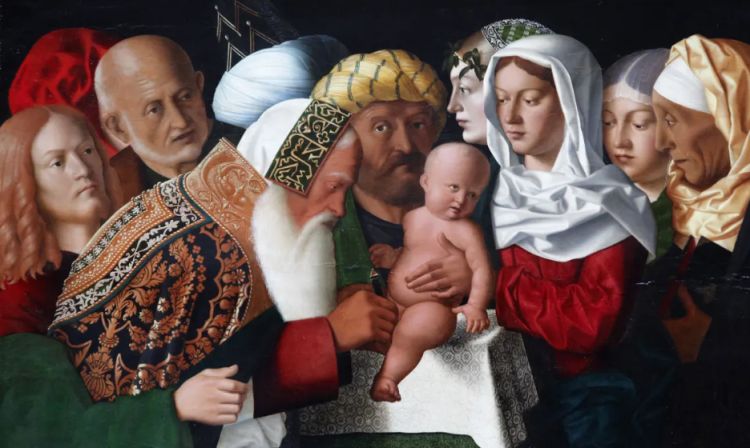
|
Galatians 5:6
"In Christ Jesus neither circumcision availeth any thing,
nor
uncircumcision: but faith that worketh by charity"
Philippians 3:3 "For we are the circumcision, who in spirit serve God;
and glory in Christ Jesus, not having confidence in the flesh."
What is a page on circumcision doing on a Catholic site? Because it's
important for
Catholics to be very clear about the Church's thoughts on the matter.
First, the Church's thoughts:
From the document, "Cantate Domino" (A.D. 1442), signed by Pope Eugene
IV, from the 11th session of the Council of Florence (A.D. 1439, a
continuation of the Council of Basle, A.D. 1431, and the Council of
Ferrara, A.D. 1438) :
[The Holy Roman
Church] firmly believes, professes and teaches that the legal
prescriptions of the Old Testament or the Mosaic law, which are divided
into ceremonies, holy sacrifices and sacraments, because they were
instituted to signify something in the future, although they were
adequate for the divine cult of that age, once our Lord Jesus Christ
who was signified by them had come, came to an end and the sacraments
of the new Testament had their beginning. Whoever, after the Passion,
places his hope in the legal prescriptions and submits himself to them
as necessary for salvation and as if faith in Christ without them could
not save, sins mortally. It does not deny that from Christ's passion
until the promulgation of the Gospel they could have been retained,
provided they were in no way believed to be necessary for salvation.
But it asserts that after the promulgation of the gospel they cannot be
observed without loss of eternal salvation. Therefore it denounces all
who after that time observe circumcision, the [Jewish] sabbath and
other legal prescriptions as strangers to the faith of Christ and
unable to share in eternal salvation, unless they recoil at some
time from these errors. Therefore it strictly orders all who glory
in the name of Christian, not to practise circumcision either before or
after baptism, since whether or not they place their hope in it, it
cannot possibly be observed without loss of eternal salvation.
The most recent
catechism is just as clear:
2297 ...Torture
which uses physical or moral violence to extract confessions, punish
the guilty, frighten opponents, or satisfy hatred is contrary to
respect for the person and for human dignity. Except when performed for strictly
therapeutic medical reasons, directly intended amputations,
mutilations, and sterilizations performed on innocent persons are
against the moral law.
Bottom line: there is no reason rooted in Catholic teaching
to support non-therapeutic circumcision.
Circumcision is
done routinely in the American West, as though it were almost a
"given"; a boy is born, cleaned up, circumcized, and sent home. In the
rest of the West, this isn't so, and most Western male children are not
circumcized; people from Italy, Scandinavia,
Germany, Brazil, etc. are amazed at the prevalence of circumcision of
Christian babies in America and, rightfully, find it odd indeed.
Thankfully, Americans are catching up with their Western brothers and
are refusing circumcision. In 1960, over 80% of American men were
circumcized, but between 1987 and 1996, "only" 37% of newborn males
were circumcised during their hospitalization as newborns.
Given that the American Medical Association, the American Academy of
Pediatrics, the American Cancer Society, the Canadian Paediatric
Society, among others, don't see value in routine circumcision, how'd
it happen that the American Christian parents of male children were for
so long actively encouraged by the medical establishment to have their
sons undergo a medically needless, excrutiatingly painful, Jewish
ceremonial rite? Why were even adult Catholic men encouraged to undergo
circumcision when they joined the Army during World War II? How, in
Victorian times, did circumcision come to be seen as a cure for
solitary sexual sins when studies on the topic have shown the exact
opposite desired effect -- a positive corellation between
circumcision and the sin of Onan? I leave those questions for you to
research.
To those who love to remind us that
Jesus was circumcized: first, the Old Law has passed away, fulfilled in
the New; Baptism has replaced circumcision. Roma locuta est
(and besides, we recall Christ's
circumcision each and every 1 January,
so you're telling Catholics nothing new). Second, while Jesus was
circumcized in obedience to the Law and as a foreshadowing of His
shedding His
Blood at Calvary, He did not undergo the procedure that is used
by modern, post-Temple Jews and by doctors in Western hospitals today.
The Biblical rite of circumcision, called brit milah (or brith
milah or bris milah), entailed the trimming of just the
very tip of the foreskin, only that amount that could be pulled down
over the tip of the glans. It did not destroy the entire foreskin, it
did not affect normal sexual functioning, it was not the brutal rite
that baby boys undergo today. The procedure was so less intrusive than
what is now practiced that many practitioners of the Old Testament
religion could, by pulling on the foreskin that remained, easily make
themselves appear to be uncircumcized -- and many did (1 Machabees
1:11-15, 1 Corinthians 7:18). Around A.D. 140 -- that is, around 110
years after Christ rose from the dead, and around 70 years after the
Temple was destroyed -- rabbis reacted to those
men who did this and instituted two procedures to follow brit
milah. Thereafter, a brit peri'ah and a brit mezizah
were to be performed on the child after the Biblical rite. All of these
procedures are described like this in the 1906 Jewish Encyclopedia:
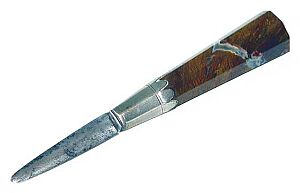
Milah:
The child having been placed upon a pillow resting upon the lap of the
godfather or "sandek" (he who is honored by being assigned to hold the
child), the mohel [the circumcizer] exposes the parts by removal of
garments, etc., and instructs the sandek how to hold the child's legs.
The mohel then grasps the prepuce between the thumb and index-finger of
his left hand, exerting sufficient traction to draw it from the glans,
and places the shield in position just before the glans. He now takes
his knife and with one sweep excises the foreskin. This completes the
first act. The knife most commonly used is double-edged, although one
like those ordinarily used by surgeons is also often employed. [Ed. This
is where the Biblical procedure ends. What follows is from the
Pharisees' Talmud.]
Peri'ah:
After the excision has been completed, the mohel seizes the inner
lining of the prepuce, which still covers the glans, with the
thumb-nail and index-finger of each hand, and tears it so that he can
roll it fully back over the glans and expose the latter completely. The
mohel usually has his thumb-nail suitably trimmed for the purpose. In
exceptional cases the inner lining of the prepuce is more or less
extensively adherent to the glans, which interferes somewhat with the
ready removal; but persistent effort will overcome the difficulty.
Mezizah:
By this is meant the sucking of the blood from the wound. The mohel
takes some wine in his mouth and applies his lips to the part involved
in the operation, and exerts suction, after which he expels the mixture
of wine and blood into a receptacle provided for the purpose. This
procedure is repeated several times, and completes the operation,
except as to the control of the bleeding and the dressing of the wound.
In modern
Western hospitals, it is not the simple, Biblical brit milah
that is performed, which is against Church teaching enough given that
the Old Law is finished; after that Biblical trimming of the foreskin,
the Pharisees' Brit Peri'ah is then carried out -- not with
fingernails and clumsy knives, but with either a Gomco Clamp or a
Plastibell, and scalpels -- and little or no anesthesia.
If you are over 18, see these black and
white line drawings of the
differences between Biblical circumcision (brit milah) and brit
per'iah. You will also find there information for new parents
on
caring for the uncircumcized penis.
I implore parents to not mindlessly, routinely circumcize their sons.
Reserve the procedure for valid medical reasons (circumcision under
such circumstances having been always allowed by the Church). Study
this issue and learn about the medical, psychological, and sexual
ramifications of this highly invasive and painful procedure. Dispel the
malicious myths about "hygiene" and "aesthetics." If you are a healthy,
faithful Catholic, the decision about circumcision has already been
made for you by the Church, as far back as the New Testament Council of
Jerusalem (Acts 15:1-21).
I Corinthians
7:18
Is any man called, being circumcised? let him not procure
uncircumcision. Is any man called in uncircumcision? let him not
be circumcised.
And, again, the Catechism prohibits it:
2297: ... Except
when performed for strictly therapeutic medical reasons, directly
intended amputations, mutilations, and sterilizations performed on
innocent persons are against the
moral law.
|
|