``Where the
Bishop is, there let the multitude of believers be;
even as where Jesus is, there is the Catholic Church'' Ignatius of
Antioch, 1st c. A.D
Feast of
the Immaculate Conception
Today is a Holy
Day of Obligation in the United States, a day on which we celebrate the
Immaculate Conception of the Virgin Mary (the Immaculate Conception has
been, since 1846, the Patroness of the United States). Note that it is she,
Mary herself, who is the Immaculate Conception; the day does not refer
to Mary's conceiving Jesus by the Holy Ghost (that we recall on the Feast of the Annunciation), but to the
conception of Mary in the womb of her mother, St. Anne, by
Mary's father, St. Joachim. What
makes her conception immaculate is not
that she was conceived by the Holy Ghost of a virgin, as was Christ Our
Lord, but that from the very moment of her conception, she was filled
with grace by God, Who knew, in His omniscience, that she would say
"yes" to the Angel Gabriel and become the Mother of the Savior. Exactly
nine months from now, on September 8, we will celebrate Mary's
birthday.
Most of what we know about Mary's parents is
derived from the apocryphal Protoevangelium
of St. James and the Gospel of the
Nativity of Mary. They tell us that St. Anne was an older woman,
and that she and Joachim were shamed for being childless, with Joachim
even being barred from the Temple. So Joachim went off to the desert to
fast and pray, and while he was gone, the
Archangel St. Gabriel appeared to each of them separately and told
them they will have a child, and that their seed will be "spoken of in
the whole world." The Golden Legend recounts the words of St.
Gabriel to St. Joachim like this:
I am the angel
of our Lord sent to thee for to denounce to thee that thy prayers have
availed thee and been heard, and thy alms be mounted tofore our Lord. I
have seen thy shame and heard the reproach. That thou art barren is to
thee no reproach by right, and God is venger of sin and not of nature.
And when he closeth the belly or womb, he worketh so that he openeth it
after, more marvellously. And the fruit that shall be born shall not be
seen to come forth by lechery, but that it be known that it is of the
gift of God. The first mother of your people was Sara, and she was
barren unto the ninetieth year, and had only Isaac, to whom the
benediction of all people was promised. And was not Rachel long barren?
And yet had she not after Joseph, that held all the seigniory of Egypt?
which was more strong than Samson, and more holy than Samuel? And yet
were their mothers barren. Thus mayst thou believe by reason and by
ensample that the childings long abiden be wont to be more marvellous.
And therefore Anne thy wife shall have a daughter, and thou shalt call
her Mary, and she, as ye have avowed, shall be from her infancy sacred
unto our Lord, and shall be full of the Holy Ghost sith the time that
she shall depart from the womb of her mother, and she shall dwell in
the temple of our Lord, and not without, among the other people,
because that none evil thing shall be had in suspicion of her, and
right as she shall be born of a barren mother, so shall be born of her
marvellously the son of a right high Lord. Of whom the name shall be
Jesus, and by him shall health be given to all the people.
And I give to thee the sign, that when thou shalt come to the Golden
Gate at Jerusalem, thou shalt meet there Anne thy wife, which is much
amoved of thy long tarrying, and shall have joy of thy coming.
When it was
time for Joachim to return home, Anne ran to meet him at the Eastern
Gate of Jerusalem1 -- the "Golden Gate" that Gabriel spoke
of, the same gate through which
their daughter's Son would later make His entry into Jerusalem on Palm Sunday. Joachim and Anne's kiss at
that gate symbolizes the immaculate conception of Our Lady and is
depicted often in Christian art.
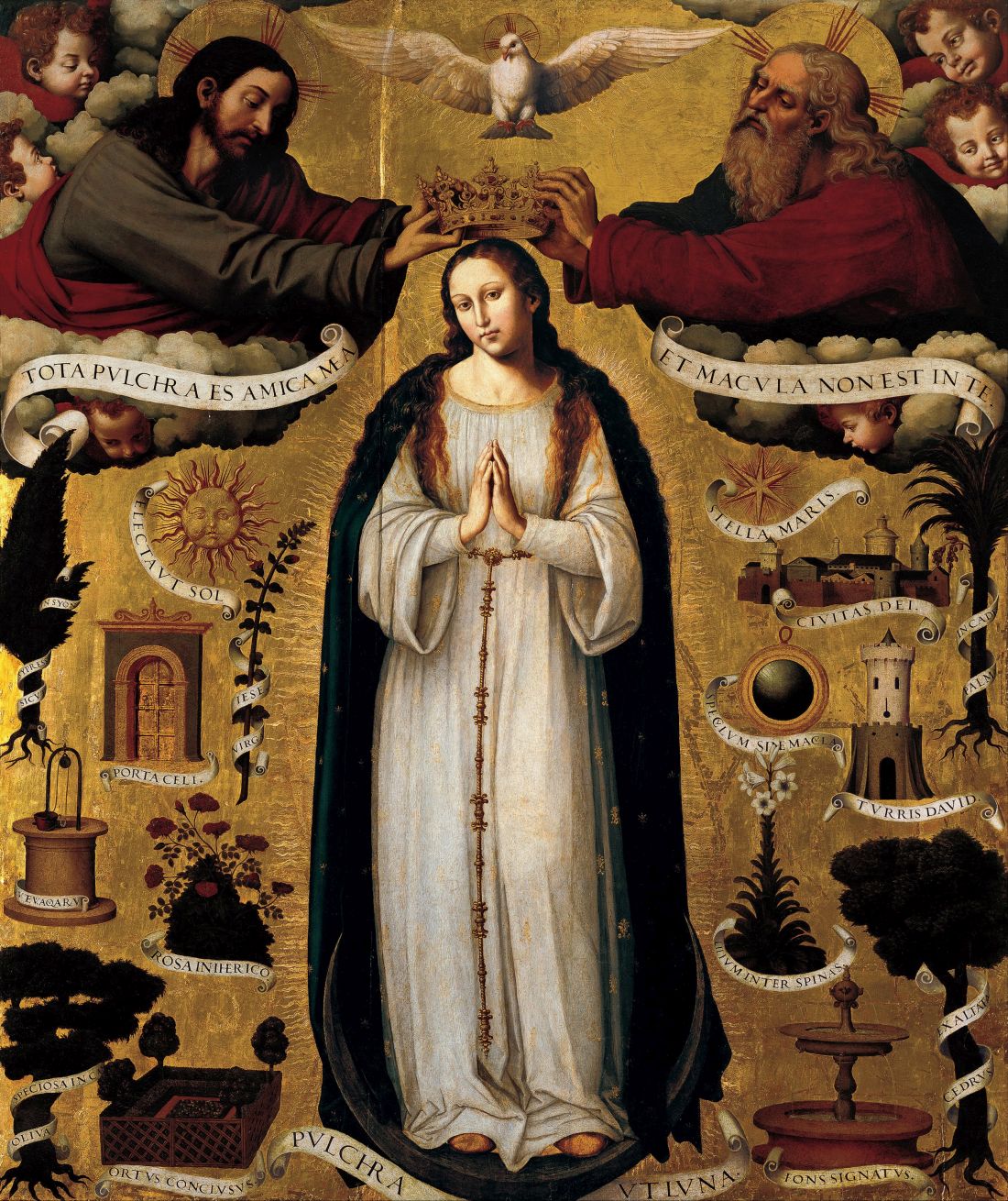
At the very moment of Mary's conception in St. Anne's womb,
God filled Mary with grace and preserved her from the stain of sin so
she might be a pure vessel by whom Christ could enter the world;
"Immaculate Conception," then is a title for Mary -- a title reflecting
her being and which reveals that the New Adam saved the New Eve from
the stain of original sin in an act foretold in the first Book of
Scripture:
Genesis 3:15
I will put enmities between thee and the woman, and thy seed and her
seed: she shall crush thy head, and thou shalt lie in wait for her
heel.
Adam and Eve,
Mary and Jesus -- the only four persons with human natures who were, in
their first moments, without sin (and, of course, Mary and Jesus
remained sinless).
Mary is the All Holy, and it was perfectly fitting for things to be
this way: Christ took from her His
very Flesh and Blood -- the Flesh that was scourged for us, the
Blood that was spilt for us, the Bread of Life that saves us!
The Epistle reading today will be from Proverbs 8:23-25, the
Gradual will be Judith 13:23, the Tract will be Psalm 86:1, and the
Gospel will be Luke 1:26-28.
Customs
Some may prepare for this feast by praying the Novena to the Immaculate Conception
beginning on November 29 and ending on December 7, the eve of this
feast. For the feast itself, the Litany of the Immaculate
Conception, written in 1476 by Pope Sixtus IV, would be perfect.
For a simple prayer, this one by St.Maximilian Kolbe is a good one:
Allow me to
praise Thee, O most holy Virgin Mary, with my personal commitment and
sacrifice.
Allow me to live, work, suffer, be consumed and die for Thee, just for
Thee.
Allow me to bring the whole world to Thee.
Allow me to contribute to your ever-greater exaltation, to Thine
greatest possible exaltation.
Allow me to give Thee such glory that no one else has ever given up to
now.
Allow others to surpass me in zeal for Thine exaltation and me to
surpass them, so that by means of such noble rivalry, your glory may
increase ever more profoundly, ever more rapidly, ever more intensely
as He Who has exalted Thee so indescribably, above all other beings
Himself desires. Amen.
Symbols for the day are any of the usual Marian symbols (the
color
blue, roses, her crown of 12 stars representing the 12 Tribes of Israel
and
the 12 Apostles, etc.), but especially those which emphasize her
purity, such
as lilies and her Immaculate Heart.
There are no special family practices today that I know of aside from
making "the Hour of Grace." This is done from noon to 1:00pm by
kneeling, stretching out one's arms, and praying Psalm 50 (Psalm 51 in
Bibles with Masoretic numbering) three times:
Unto the end, a
psalm of David, When Nathan the prophet came to him after he had sinned
with Bethsabee. Have mercy on me, O God, according to thy great mercy.
And according to the multitude of thy tender mercies blot out my
iniquity. Wash me yet more from my iniquity, and cleanse me from my
sin. For I know my iniquity, and my sin is always before me.
To thee only have I sinned, and have done evil before thee: that thou
mayst be justified in thy words and mayst overcome when thou art
judged. For behold I was conceived in iniquities; and in sins did my
mother conceive me. For behold thou hast loved truth: the uncertain and
hidden things of thy wisdom thou hast made manifest to me. Thou shalt
sprinkle me with hyssop, and I shall be cleansed: thou shalt wash me,
and I shall be made whiter than snow. To my hearing thou shalt give joy
and gladness: and the bones that have been humbled shall rejoice.
Turn away thy face from my sins, and blot out all my iniquities. Create
a clean heart in me, O God: and renew a right spirit within my bowels.
Cast me not away from thy face; and take not thy holy spirit from me.
Restore unto me the joy of thy salvation, and strengthen me with a
perfect spirit. I will teach the unjust thy ways: and the wicked shall
be converted to thee.
Deliver me from blood, O God, thou God of my salvation: and my tongue
shall extol thy justice. O Lord, thou wilt open my lips: and my mouth
shall declare thy praise. For if thou hadst desired sacrifice, I would
indeed have given it: with burnt offerings thou wilt not be
delighted. A sacrifice to God is an afflicted spirit: a contrite
and humbled heart, O God, thou wilt not despise. Deal favourably,
O Lord, in thy good will with Sion; that the walls of Jerusalem may be
built up. Then shalt thou accept the sacrifice of justice, oblations
and whole burnt offerings: then shall they lay calves upon thy altar.
When done praying the Psalm three times, pray otherwise as
you wish (e.g., the Rosary, etc.) or meditate on Christ's Passion, sing
hymns, read Sacred Scripture or Saints' writings, etc. until the hour
is up. Another option is to read Ineffabilis
Deus, the 1854 encyclical of Pope Blessed Pius IX which formally
defined the teaching about the Immaculate Conception.
As to music, the song "O, Purest of Creatures," written by Father
Frederick William Faber (1814-1863), is a good
one for the day.
O purest of
creatures! sweet Mother, sweet Maid;
The one spotless womb wherein Jesus was laid.
Dark night hath come down on us, Mother, and we
Look out for thy shining, sweet Star of the Sea.
Deep night hath come down on this rough-spoken world.
And the banners of darkness are boldly unfurled;
And the tempest-tossed Church - all her eyes are on thee.
They look to thy shining, sweet Star of the Sea.
He gazed on thy soul, it was spotless and fair;
For the empire of sin, it had never been there;
None had e'er owned thee, dear Mother, but He,
And He blessed thy clear shining, sweet Star of the Sea.
Earth gave Him one lodging; `twas deep in thy breast,
And God found a home where the sinner finds rest;
His home and His hiding-place, both were in thee;
He was won by thy shining, sweet Star of the Sea.
Oh, blissful and calm was the wonderful rest
That thou gavest thy God in thy virginal breast;
For the heaven He left He found heaven in thee,
And He shone in thy shining, sweet Star of the Sea.
In Rome today, the Pope will go to the Column of the
Immaculate Conception (la Colonna
della Immacolata Concezione) in the Piazza Mignanelli, near the
Spanish Steps (la Scalinata di
Trinitŕ dei Monti). This 19th century statue stands on top of a
tall column, and at its base sit Moses, Ezeckiel, Isaias, and King
David. The Pope will lay white roses at the pedestal of the Virgin's
statue, and then the firemen of Rome will hang a wreath from the arm of
the Virgin, using a firetruck so they can reach her.
In Seville, Spain there takes place today (and also on the
Feast of
Corpus Christi) the "Dance of the Six" (or "Dance of the Sixes"), a
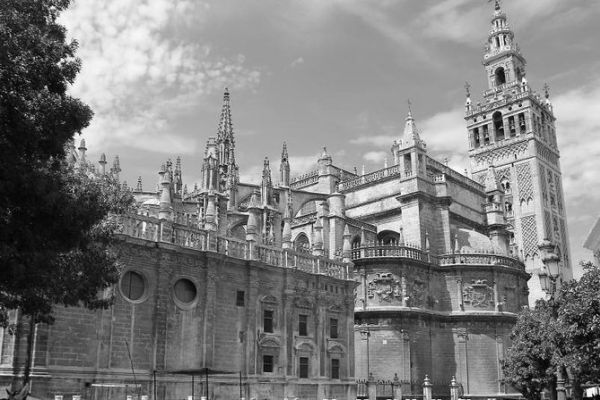
tradition that's taken place since A.D. 1439. A group of twelve boys
(originally sixteen boys) sing and dance in front of the Cathedral of
Santa Maria in Seville -- the largest Gothic cathedral in the world,
the
third largest of any church in the world, and the church wherein
Ferdinand and Isabella's only son was baptized (W. B. Yeats mentions
this dance in one of his letters to Maud Gonne).
Cathedral
of Santa Maria
The people in some areas of Spain, especially Catalonia, have a
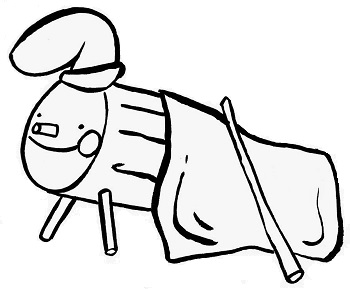
bizarre, hilarious custom called Tió
de Nadal. On the Feast of the
Immaculate Conception, they get a foot-long, hollowed-out log, paint a
happy, smiling face on one end, and call it "Tió." Tió is given little
wooden arms such that the face-end of the log is propped up a bit
(sometimes he is given legs as well), and
then he is made dapper with a red hat. Children cover Tió with a
blanket, and they
"feed" it each night (i.e., they leave foods around it, which
"disappear" overnight, the way Santa's cookies and milk "disappear"
for American children). Then, on
Christmas Eve or Christmas Day, they
sing a song (see below) and beat poor Tió with a stick until it -- and
this
is what they call it -- "poops" out candies, nuts, figs, turrón
(nougat), and, little toys. "Caga, Tió!" ("Poop, Tio!") is the
command.
Caga tió, tió de
Nadal;
posarem el porc en sal,
la gallina a la pastera
i el poll a dalt del pi.
Toca, toca Valentí.
Passen bous i vaques,
gallines amb sabates
i galls amb sabatons.
Correu, correu minyons,
que la teta fa torrons,
el vicari els ha tastat,
diu que són un poc salats.
Ai el brut, ai el porc,
ai el cara, cara, cara,
ai el brut, ai el porc,
ai el cara de pebrot.
Another
version:
Caga tió,
Tió de Nadal,
No caguis arengades,
Que són massa salades,
Caga torrons,
Que són més bons!
Yet another
version:
Caga tió,
Caga torró,
Avellanes i mató,
Si no cagues bé
Et daré un cop de bastó.
Caga tió!
Poop tió, tió de
Nadal;
we’ll put the pig in salt,
the hen in the patera
and the louse on top of the pine tree.
Play, play Valentin.
Oxen and cows pass by,
hens with shoes
and roosters with shoes.
Run, run, boys,
the teat makes nougat,
the vicar has tasted them,
he says they’re a bit salty.
Ai the dirty, ay the pig,
ai the face, face, face, face,
ai the dirty, ay the pig,
ai the bell pepper face.
Another
version:
Poop, log,
Log of Christmas,
Don't poop herrings,
Which are too salty,
Poop nougats,
Which are much better!
Yet another
version:
Poop, log,
Poop nougats,
Hazelnuts and mató cheese,
If you don't poop well,
I'll hit you with a stick,
Poop, log!
The, um,
"pooping
out of the candies" is usually handled by the children leaving the room
to pray for presents and heat up their sticks over a fire or the stove
while their parents place the goods under Tió's
blanket. The children return, sing their song and beat Tió, get their
candies, and then the log is
burned in the fireplace. Large-sized Caga Tiós can often be seen in
Spanish
Christmas markets and villages at this time of year.
In Lyon, France, this feast is called La
Fęte des Lumičres (the "Festival of Lights"). The people of the
city place lots of candles in their windows -- candles often contained
in colored glass -- in thanks to the Blessed Virgin for sparing their
city from the bubonic plague in 1643. Their Basilica of Notre-Dame de
Fourvičre -- site of the founding of the Society of Mary (Marists), the
Brothers of the Sacred Heart, and the Congregation of the Blessed
Sacrament -- is also colorfully illuminated, and a great light show is
had at the town's square.
I don't have any special food recipes for you, but the "Drinking with
the Saints" blog recommends a cocktail called a White Lady to recall
Our Lady's purity, and I'm not going to argue with that. Be warned that
it contains a raw egg whites, so if you're scared of salmonella, maybe
you can try it without -- but the texture will be very different:
White Lady Cocktails for Two
2 oz gin
2 oz vodka
2 oz Cointreau
2 egg whites
4 tsp powdered sugar
juice from 1 lemon
4 oz water
crushed ice (enough to chill. Will be strained out when
serving,)
Put all but the crushed ice in a cocktail shaker and shake 40
times. Add the ice and shake again until the mixture is cold. Strain
into two cocktail glasses (coupe-style glasses, if you have them).
The
Immaculate Conception of the Most Blessed Virgin
by Dom Gueranger, O.S.B.
At length, on
the distant horizon, rises, with a soft and radiant light, the aurora
of the Sun which has been so long desired. The happy Mother of the
Messias was to be born before the Messias Himself; and this is the day
of the Conception of Mary. The earth already possesses a first pledge
of the divine mercy; the Son of Man is near at hand. Two true
Israelites, Joachim and Anne, noble branches of the family of David,
find their union, after a long barrenness, made fruitful by the divine
omnipotence. Glory be to God, who has been mindful of His promises, and
who deigns to announce, from the high heavens, the end of the deluge of
iniquity, by sending upon the earth the sweet white dove that bears the
tidings of peace!
The feast of the blessed Virgin's Immaculate Conception is the most
solemn of all those which the Church celebrates during the holy time of
Advent; and if the first part of the cycle had to offer us the
commemoration of some one of the mysteries of Mary, there was none
whose object could better harmonize with the spirit of the Church in
this mystic season of expectation. Let us, then, celebrate this
solemnity with joy; for the Conception of Mary tells us that the Birth
of Jesus is not far off.
The intention of the Church, in this feast, is not only to celebrate
the anniversary of the happy moment in which began, in the womb of the
pious Anne, the life of the ever-glorious Virgin Mary; but also to
honour the sublime privilege, by which Mary was preserved from the
original stain, which, by a sovereign and universal decree, is
contracted by all the children of Adam the very moment they are
conceived in their mother's womb. The faith of the Catholic Church on
the subject of the Conception of Mary is this: that at the very instant
when God united the soul of Mary, which He had created, to the body
which it was to animate, this ever-blessed soul did not only not
contract the stain, which at that same instant defiles every human
soul, but was filled with an immeasurable grace which rendered her,
from that moment, the mirror of the sanctity of God Himself, as far as
this is possible to a creature. The Church with her infallible
authority, declared, by the lips of Pius IX., that this article of her
faith had been revealed by God Himself. The Definition was received
with enthusiasm by the whole of Christendom, and the eighth of December
of the year 1854: was thus made one of the most memorable days of the
Church's history.
It was due to His own infinite sanctity that God should suspend, in
this instance, the law which His divine justice had passed upon all the
children of Adam. The relations which Mary was to bear to the Divinity,
could not be reconciled with her undergoing the humiliation of this
punishment. She was not only daughter of the eternal Father; she was
destined also to become the very Mother of the Son, and the veritable
bride of the Holy Ghost, Nothing defiled could be permitted to enter,
even for an instant of time, into the creature that was thus
predestined to contract such close relations with the adorable Trinity;
not a speck could be permitted to tarnish in Mary that perfect purity
which the infinitely holy God requires even in those who are one day to
be admitted to enjoy the sight of His divine majesty in heaven; in a
word, as the great Doctor St. Anselm says, 'it was just that this holy
Virgin should be adorned with the greatest purity which can be
conceived after that of God Himself, since God the Father was to give
to her, as her Child, that only-begotten Son, whom He loved as Himself,
as being begotten to Him from His own bosom; and this in such a manner,
that the selfsame Son of God was, by nature, the Son of both God the
Father and this blessed Virgin, This same Son chose her to be
substantially His Mother; and the Holy Ghost willed that in her womb He
would operate the conception and birth of Him from whom He Himself
proceeded.
Moreover, the close ties which were to unite the Son of God with Mary,
and which would elicit from Him the tenderest love and the most filial
reverence for her, had been present to the divine thought from all
eternity: and the conclusion forces itself upon us that therefore the
divine Word had for this His future Mother a love infinitely greater
than that which He bore to all His other creatures. Mary's honour was
infinitely dear to Him, because she was to be His Mother, chosen to be
so by His eternal and merciful decrees. The Son's love protected the
Mother. She, indeed, in her sublime humility, willingly submitted to
whatever the rest of God's creatures had brought on themselves, and
obeyed every tittle of those laws which were never meant for her: but
that humiliating barrier, which confronts every child of Adam at the
first moment of his existence, and keeps him from light and grace until
he shall have been regenerated by a new birth—oh! this could not be
permitted to stand in Mary's way, her Son forbade it.
The eternal Father would not do less for the second Eve than He had
done for the first, who was created, as was also the first Adam, in the
state of original justice, which she afterwards forfeited by sin. The
Son of God would not permit that the woman, from whom He was to take
the nature of Man, should be deprived of that gift which He had given
even to her who was the mother of sin. The Holy Ghost, who was to
overshadow Mary and produce Jesus within her by His divine operation,
would not permit that foul stain, in which we are all conceived, to
rest, even for an instant, on this His Bride. All men were to contract
the sin of Adam; the sentence was universal; but God's own Mother is
not included. God who is the author of that law) God who was free to
make it as He willed, had power to exclude from it her whom He had
predestined to be His own in so many ways; He could exempt her, and it
was just that He should exempt her; therefore, He did it.
Was it not this grand exemption which God Himself foretold, when the
guilty pair, whose children we all are, appeared before Him in the
garden of Eden? In the anathema which fell upon the serpent, there was
included a promise of mercy to us. 'I will put enmities,' said the
Lord, 'between thee and the Woman, and thy seed and her seed: she shall
crush thy head.' Thus was salvation promised the human race under the
form of a victory over satan; and this victory is to be gained by the
Woman, and she will gain it for us also. Even granting, as some read
this text, that it is the Son of the Woman that is alone to gain this
victory, the enmity between the Woman and the serpent is clearly
expressed, and she, the Woman, with her own foot, is to crush the head
of the hated serpent. The second Eve is to be worthy of the second
Adam, conquering and not to be conquered. The human race is one day to
be avenged not only by God made Man, but also by the Woman miraculously
exempted from every stain of sin, in whom the primeval creation, which
was in justice and holiness, will thus reappear, just as though the
original sin had never been committed.
Raise up your heads, then, ye children of Adam, and shake off your
chains! This day the humiliation which weighed you down is annihilated.
Behold! Mary, who is of the same flesh and blood as yourselves, has
seen the torrent of sin, which swept along all the generations of
mankind, flow back at her presence and not touch her: the infernal
dragon has turned away his head, not daring to breathe his venom upon
her; the dignity of your origin is given to her in all its primitive
grandeur. This happy day, then, on which the original purity of your
race is renewed, must be a feast to you. The second Eve is created; and
from her own blood (which, with the exception of the element of sin, is
the same as that which makes you to be the children of Adam), she is
shortly to give you the God-Man, who proceeds from her according to the
flesh, as He proceeds from the Father according to the eternal
generation.
And how can we do less than admire and love the incomparable purity of
Mary in her Immaculate Conception, when we hear even God, who thus
prepared her to become His Mother, saying to her, in the divine
Canticle, these words of complacent love: 'Thou art all fair, O my
love, and there is not a spot in thee! It is the God of all holiness
that here speaks; that eye, which sees all things, finds not a vestige,
not a shadow of sin; therefore does He delight in her, and admire in
her that gift of His own condescending munificence. We cannot be
surprised after this, that Gabriel, when he came down from heaven to
announce the Incarnation to her, should be full of admiration at the
sight of that purity, whose beginning was so glorious and whose
progress was immeasurable; and that this blessed spirit should bow down
profoundly before this young Maid of Nazareth, and salute her with,
'Hail, O full of grace!' And who is this Gabriel? An Archangel, that
lives amidst the grandest magnificences of God's creation, amidst all
the gorgeous riches of heaven; who is brother to the Cherubim and
Seraphim, to the Thrones and Dominations; whose eye is accustomed to
gaze on those nine angelic choirs with their dazzling brightness of
countless degrees of light and grace; he has found on earth, in a
creature of a nature below that of angels, the fulness of grace of that
grace which had been given to the angels measuredly. This fulness of
grace was in Mary from the very first instant of her existence. She is
the future Mother of God, and she was ever holy, ever pure, ever
Immaculate.
This truth of Mary's Immaculate Conception_ which was revealed to the
apostles by the divine Son of Mary, inherited by the Church, taught by
the holy fathers, believed by each generation of the Christian people
with an ever increasing explicitness—was implied in the very notion of
a Mother of God. To believe that Mary was Mother of God, was implicitly
to believe that she, on whom this sublime dignity was conferred, had
never been defiled with the slightest stain of sin, and that God had
bestowed upon her an absolute exemption from sin. But now the
Immaculate Conception of Mary rests on an explicit definition dictated
by the Holy Ghost. Peter has spoken by the mouth of Pius; and when
Peter has spoken, every Christian should believe; for the Son of God
has said: 'I have prayed for thee, Peter, that thy faith fail not.' And
again: 'The Holy Ghost, whom the Father will send in My name, He will
teach you all things, and bring all things to your mind, whatsoever I
shall have said to you."
The Symbol of our faith has therefore received not a new truth, but a
new light on a truth which was previously the object of the universal
belief. On that great day of the definition, the infernal serpent was
again crushed beneath the victorious foot of the Virgin-Mother, and the
Lord graciously gave us the strongest pledge of His mercy. He still
loves this guilty earth, since He has deigned to enlighten it with one
of the brightest rays of His Mother's glory. How this earth of ours
exulted! The present generation will never forget the enthusiasm with
which the entire universe received the tidings of the definition. It
was an event of mysterious importance which thus marked this second
half of our century; and we shall look forward to the future with
renewed confidence; for if the Holy Ghost bids us tremble for the days
when truths are diminished among the children of men, He would,
consequently, have us look on those times as blessed by God in which we
receive an increase of truth; an increase both in light and authority.
The Church, even before the solemn proclamation of the grand dogma,
kept the feast of this eighth day of December; which was, in reality, a
profession of her faith. It is true that the feast was not called the
Immaculate Conception, but simply the Conception of Mary. But the fact
of such a feast being instituted and kept, was an unmistakable
expression of the faith of Christendom in that truth. St. Bernard and
the angelical doctor, St. Thomas, both teach that the Church cannot
celebrate the feast of what is not holy; the Conception of Mary,
therefore, was holy and immaculate, since the Church has, for ages
past, honoured it with a special feast. The Nativity of the same holy
Virgin is kept as a solemnity in the Church, because Mary was born full
of grace; therefore, had the first moment of Mary's existence been one
of sin, as is that of all the other children of Adam, it never could
have been made the subject of the reverence of the Church. Now, there
are few feasts so generally and so firmly established in the Church as
this which we are keeping today.
The Greek Church, which, more easily than the Latin, could learn what
were the pious traditions of the east, kept this feast even in the
sixth century, as is evident from the ceremonial or, as it is called,
the Type, of St. Sabas. In the west, we find it established in the
Gothic Church of Spain as far back as the eighth century. A celebrated
calendar which was engraved on marble, in the ninth century for the use
of the Church of Naples, attests that it had already been introduced
there. Paul the deacon secretary to the emperor Charlemagne, and
afterwards monk at Monte-Cassino, composed a celebrated hymn on the
mystery of the Immaculate Conception we will insert this piece later
on, as it is given in the manuscript copies of Monte-Cassino and
Benevento. In 1066, the feast was first established in England, in
consequence of the pious Abbot Helsyn's being miraculously preserved
from shipwreck; and shortly after that, was made general through the
whole island by the zeal of the great St. Anselm, monk of the Order of
St. Benedict, and archbishop of Canterbury. From England it passed into
Normandy, and took root in France. We find it sanctioned in Germany, in
a council hold in 1049, at which St. Leo IX. was present; in Navarre,
1090, at the abbey of Irach; in Belgium, at Liege, in 1142. Thus did
the Churches of the west testify their faith in this mystery, by
accepting its feast, which is the expression of faith.
Lastly, it was adopted by Rome herself, and her doing so rendered the
united testimony of her children, the other Churches, more imposing
than ever. It was Pope Sixtus IV. who, in the year 1476, published the.
decree of the feast of our Lady's Conception for the city of St. Peter.
In the next century. 1568, St. Pius V. published the universal edition
of the Roman breviary, and in its calendar was inserted this feast as
one of those Christian solemnities which the faithful are every year
bound to observe. It was not from Rome that the devotion of the
Catholic world to this mystery received its first impulse; she
sanctioned it by her liturgical authority, just as she has confirmed it
by her doctrinal authority in these our own days.
The three great Catholic nations of Europe, Germany, France, and Spain,
vied with each other in their devotion to this mystery of Mary's
Immaculate Conception. France, by her king Louis XIV., obtained from
Clement IX. that this feast should be kept with an octave throughout
the kingdom; which favour was afterwards extended to the universal
Church by Innocent XII. For centuries previous to this, the theological
faculty of Paris had always exacted from its professors the oath that
they would defend this privilege of Mary; a pious practice which
continued as long as the university itself.
As regards Germany, the emperor Ferdinand III, in 1647, ordered a
splendid monument to be erected in the great square of Vienna. It is
covered with emblems and figures symbolical of Mary's victory over sin,
and on the top is the statue of the Immaculate Queen, with this solemn
and truly Catholic inscription
To God, infinite
in goodness and power,
King of heaven and earth, by whom kings reign;
to the Virgin Mother of God, conceived without sin,
by whom princes command, whom Austria,
devoutly loving, holds as her Queen and Patron;
Ferdinand III, Emperor, confides, gives, consecrates himself,
children, people, armies, provinces, and all that is his,
and erects in accomplishment of a vow
this statue, as a perpetual memorial.
But the zeal of
Spain for the privilege of the holy Mother of God surpassed that of all
other nations. In the year 1398, John I., king of Arragon, issued, a
chart in which he solemnly places his person and kingdom under the
protection of Mary Immaculate. Later on, kings Philip III. and Philip
IV. sent ambassadors to Rome, soliciting, in their names, the solemn
definition, which heaven reserved, in its mercy for our days. King
Charles III., in the eighteenth century, obtained permission from
Clement XIII. that the Immaculate Conception should be the patronal
feast of Spain. The people of Spain, which is so justly called the
Catholic kingdom, put over the door, or on the front of their houses, a
tablet with the words of Mary's privilege written on it; and when they
meet, they greet each other with an expression in honour of the same
dear mystery. It was a Spanish nun, Mary of Jesus, abbess of the
convent of the Immaculate Conception of Agreda, who wrote God's Mystic
City, which inspired Murillo with his Immaculate Conception, the
masterpiece of the Spanish school.
But, whilst thus mentioning the different nations which have been
foremost in their zeal for this article of our holy faith, the
Immaculate Conception, it were unjust to pass over the immense share
which the seraphic Order, the Order of St. Francis of Assisi, has had
in the earthly triumph of our blessed Mother, the Queen of heaven and
earth. As often as this feast comes round, is it not just that we
should think with reverence and gratitude on him, who was the first
theologian that showed how closely connected with the divine mystery of
the Incarnation is this dogma of the Immaculate Conception? First,
then, all honour to the name of the pious and learned John Duns Scotus!
And when at length the great day of the definition of the Immaculate
Conception came, how justly merited was that grand audience, which the
Vicar of Christ granted to the Franciscan Order, and with which closed
the pageant of the glorious solemnity! Pius IX. received from the hands
of the children of St. Francis a tribute of homage and thankfulness,
which the Scotist school, after having fought four hundred years in
defence of Mary's Immaculate Conception, now presented to the Pontiff.
In the presence of the fifty-four Cardinals, forty-two archbishops, and
ninety-two bishops; before an immense concourse of people that filled
St. Peter's, and had united in prayer, begging the assistance of the
Spirit of truth; the Vicar of Christ had just pronounced the decision
which so many ages had hoped to hear. The Pontiff had offered the holy
Sacrifice on the Confession of St. Peter. He had crowned the statue of
the Immaculate Queen with a splendid diadem. Carried on his lofty
throne, and wearing his triple crown, he had reached the portico of the
basilica; there he is met by the two representatives of St. Francis:
they prostrate before the throne: the triumphal procession halts: and
first, the General of the Friars Minor Observantines advances, and
presents to the holy Father a branch of silver lilies: he is followed
by the General of the Conventual Friars, holding in his hand a branch
of silver roses. The Pope graciously accepted both. The lilies and the
roses were symbolical of Mary's purity and love; the whiteness of the
silver was the emblem of the lovely brightness of that orb, on which is
reflected the light of the Sun; for, as the Canticle says of Mary, 'she
is beautiful as the moon. The Pontiff was overcome with emotion at
these gifts of the family of the seraphic patriarch, to which we might
justly apply what was said of the banner of the Maid of Orleans: 'It
had stood the brunt of the battle; it deserved to share in the glory of
the victory.' And thus ended the glories of that grand morning of the
eighth of December, eighteen hundred and fifty-four.
It is thus, O thou the humblest of creatures, that thy Immaculate
Conception has been glorified on earth! And how could it be other than
a great joy to men, that thou art honoured by them, thou the aurora of
the Sun of justice? Dost thou not bring them the tidings of their
salvation? Art not thou, O Mary, that bright ray of hope, which
suddenly bursts forth in the deep abyss of the world's misery? What
should we have been without Jesus? And thou art His dearest Mother, the
holiest of God's creatures, the purest of virgins, and our own most
loving Mother!
How thy gentle light gladdens our wearied eyes, sweet Mother!
Generation had followed generation on this earth of ours. Men looked up
to heaven through their tears, hoping to see appear on the horizon the
star which they had been told should disperse the gloomy horrors of the
world's darkness; but death came, and they sank into the tomb, without
seeing even the dawn of the light, for which alone they cared to live.
It is for us that God had reserved the blessing of seeing thy lovely
rising, O thou fair morning star! which sheddest thy blessed rays on
the sea, and bringest calm after the long stormy night! Oh! prepare our
eyes that they may behold the divine Sun which will soon follow in thy
path, and give to the world His reign of light and day. Prepare our
hearts, for it is to our hearts that this Jesus of thine wishes to show
Himself. To see Him, our hearts must be pure: purify them, O thou
Immaculate Mother! The divine wisdom has willed that of the feasts
which the Church dedicates to thee, this of thy Immaculate Conception
should be celebrated during Advent; that thus the children of the
Church, reflecting on the jealous care wherewith God preserved thee
from every stain of sin because thou wast to be the Mother of His
divine Son, might prepare to receive this same Jesus by the most
perfect renunciation of every sin and of every attachment to sin. This
great change must be made; and thy prayers, O Mary! will help us to
make it. Pray— we ask it of thee by the grace God gave thee in thy
Immaculate Conception—that our covetousness may be destroyed, our
concupiscence extinguished, and our pride turned into humility. Despise
not our prayers, dear Mother of that Jesus who chose thee for His
dwelling-place, that He might afterwards find one in each of us.
O Mary! Ark of the covenant, built of an incorruptible wood, and
covered over with the purest gold! help us to correspond with those
wonderful designs of our God, who, after having found His glory in
thine incomparable purity, wills now to seek His glory in our
unworthiness, by making us, from being slaves of the devil, His temples
and His abode, where He may find His delight. Help us to this, O thou
that by the mercy of thy Son hast never known sin! and receive this day
our devoutest praise. Thou art the ark of salvation; the one creature
unwrecked in the universal deluge; the white fleece filled with the dew
of heaven, whilst the earth around is parched; the flame which the many
waters could not quench; the lily blooming amidst thorns; the garden
shut against the infernal serpent; the fountain sealed, whose limpid
water was never ruffled; the house of the Lord, whereon His eyes were
ever fixed, and into which nothing defiled could ever enter; the mystic
city, of which such glorious things are said. We delight in telling all
thy glorious titles, O Mary! for thou art our Mother, and we love thee,
and the Mother's glory is the glory of her children. Cease not to bless
and protect all those that honour thy immense privilege, O thou who
wert conceived on this day! May this feast fit us for that mystery, for
which thy Conception, thy Birth, and thy Annunciation, are all
preparations—the Birth of thy Jesus in Bethlehem: yea, dear Mother, we
desire thy Jesus, give Him to us and satisfy the longings of our love.
Footnotes:
1 The Golden Gate -- the Eastern gate of
Jerusalem -- is now a part of the Temple Mount -- i.e., it is in Muslim
hands. It was sealed by Muslims in A.D. 810, re-opened by Crusaders in
1102, sealed again by Muslims in 1187, rebuilt in the early 16th
century, and sealed again in 1541. It's remained sealed ever since.



 Cathedral
of Santa Maria
Cathedral
of Santa Maria