|
We often hear that Christmas is "pagan," given the date of December 25
because that date is that of the Winter Solstice.
Well, wrong. The Winter Solstice is December 21. But even if the
Solstice were on the 25th, what difference would it make? There are 365
days in a year, and something has happened or does happen on each and
every one of them.
Then we're told that the Church "chose" December 25 because of the
Roman Saturnalia. Wrong again. The Roman Saturnalia took place December
17 to the 23rd. That's not the 25th.
Now, there used to be a festival celebrated in Rome on December 25
-- Dies Natalis Solis Invicti
("Birthday of the Unconquered Sun") -- but it wasn't made a holiday
until the mid-4th century, hundreds of years
after Jesus was born, during the reign of Julian the Apostate -- a
Christ-hater who quashed Christianity and tried to rebuild the Jewish
Temple. So who was copying whom?
If you ask me, though, I'd think it
highly appropriate that the Lord of Lords would be born on a day that
the Romans, inhabitants of the greatest empire of the world at that
time, were celebrating "the Unconquered Sun" even if the feast had
been around when Christ was born. But it wasn't.
In any case, for many good reasons, December 25 is seen as the date on
which
Christ
was born, and pagan holidays have not a thing to do with it. Consider
the date of John the Baptist's birth relative to the
Temple schedule. From 30
Days, an
Italian Catholic publication:
December 25 is
an historical date," Professor Tommaso Federici, Professor at the
Pontifical Urbanian University and a consultant to two Vatican
Congregations, has stressed.
In an article in the Osservatore
Romano on December 24, he wrote: "December 25 is explained as the
'Christianization' of a pagan feast, 'birth of the Sol Invictus'; or as
the symmetrical balance, an aesthetic balance between the winter
solstice (Dec. 21-22) and the spring equinox (March 23-24). But a
discovery of recent years has shed definitive light on the date of the
Lord's birth.
As long ago as 1958, the Israeli scholar Shemaryahu
Talmon published an in-depth study on the calendar of the Qumran sect [Ed.
based , in part, on Parchment  Number 321 -- 4 Q 321 --
of the Qumran Dead Sea Scrolls, see picture at left], and he
reconstructed without the shadow of doubt the order of the sacerdotal
rota system for the temple of Jerusalem (1 Paralipomenon/Chronicles 24,
7-18) in New Testament times. Number 321 -- 4 Q 321 --
of the Qumran Dead Sea Scrolls, see picture at left], and he
reconstructed without the shadow of doubt the order of the sacerdotal
rota system for the temple of Jerusalem (1 Paralipomenon/Chronicles 24,
7-18) in New Testament times.
Here the family of Abijah, of which
Zechariah (Zachary) was a descendant, father of John the herald
and forerunner (Luke 1, 5), was required to officiate twice a year, on
the days 8-14 of the third month, and on the days 24-30 of the eighth
month.
This latter period fell at about the end of September. It is not
without reason that the Byzantine calendar celebrated 'John's
conception' on September 23 and his birth nine months later, on June
24. The 'six months' after the Annunciation established as a liturgical
feast on March 25, comes three months before the forerunner's birth,
prelude to the nine months in December: December 25 is a date of
history.
Or, to sum up:
|
end of September
|
Zachary
(Zechariah), father of St. John the Baptist, "executed his priestly
function" (Luke 1:8) according to
his class. His wife, Elizabeth, conceived around this time (the Church
traditionally
holds St. John's conception to have taken place on 23 September) just
as St. Gabriel said (Luke 1:24), and then hid herself away for 5 months.
|
|
25 March,
the
Feast of the Annunciation
|
In the sixth
month of Elizabeth's pregnancy (Luke 1:26),
St. Gabriel appears to Mary
to tell her she is to have a child.
|
April 3
|
The date of
Christ's conception by the Holy Ghost -- after a novena of days from
March 25 when Mary
uttered her fiat to God (and the date of His Crucifixion in A.D. 33).
There followed a normal 266 day pregnancy -- 80% of women deliver
between 261 and 280 days after conception -- 'til His Nativity on
December
25. |
|
24 June, the
Feast of St. John the Baptist
|
Three months
after the Annunciation, St. John the
Baptist was born, at a time when the days were becoming
shorter
|
|
25 December
|
Approximately
nine months
after the Annunciation, and the conception of Christ, Jesus was born,
at a
time when the days were
becoming longer.
|
Then there's the ancient "integral age" tradition -- the
belief that the Prophets died on
the same day they were conceived, and all evidence points to Our Lord
having been crucified on April 3, A.D. 33.
With the Annunciation at 25 March,
His Conception would've taken place a novena of days later on April 3,
and His
Nativity would've taken place some 9 months after that, on 25 December
(266 days, or 267 days inclusive. Note that the average pregnancy lasts
for 268 days -- 38 weeks and two days).
Now, some think that Christ couldn't have been born in
December because the shepherds were out in their fields, and it
would've been too cold for them to be there. This is untrue. First, the
average Winter temperature in Israel is 55 degrees Fahrenheit. Second,
the shepherds would have been with their sheep in the fields because
the sheep in Israel give birth then, not in the Spring. The breed of
sheep that is most commonly found in that area of the world is the
Awassi sheep, who give birth in
December-January. From the Food
and Agriculture Organization of the United Nations (link will open
in a new browser window):
The Awassi ewe
displays few outward signs of oestrus. Pro-oestrus is short and rather
indefinite and the onset of oestrus abrupt, while the cessation is
gradual. In Iraq, the principal lambiing season of Awassi ewes is in
November, and in Lebanon, the Syrian Arab Republic and Israel in
December-January.
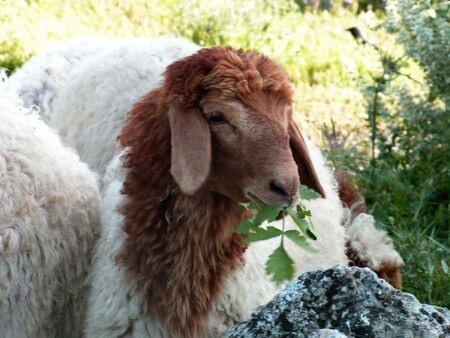
Awassi sheep
There's
this, too, from the
Anglican scholar, Alfred Edersheim, in his "The Life and Times of Jesus
The Messiah":
And yet Jewish
tradition may here prove both illustrative and helpful. That the
Messiah was to be born in Bethlehem, was a settled conviction. Equally
so, was the belief , that He was to be revealed from Migdal Eder, 'the
tower of the flock.' This Migdal Eder was not the watchtower for the
ordinary flocks which pastured on the barren sheepground beyond
Bethlehem, but lay close to the town, on the road to Jerusalem.
A passage in the
Mishnah [951] leads to the conclusion, that the flocks,
which pastured there, were destined for Temple-sacrifices [952], and,
accordingly, that the shepherds, who watched over them, were not
ordinary shepherds. The latter were under the ban of Rabbinism, on
account of their necessary isolation from religious ordinances, and
their manner of life, which rendered strict legal observance unlikely,
if not absolutely impossible. The same Mishnaic passage also leads us
to infer, that these flocks lay out all the year round, since
they are spoken of as in the fields thirty days before the Passover --
that is, in the month of February, when in Palestine the average
rainfall is nearly greatest.
Thus, Jewish tradition in some dim manner apprehended the
first
revelation of the Messiah from that Migdal Eder, where shepherds
watched the Temple-flocks all the year round. Of the deep symbolic
significance of such a coincidence, it is needless to speak.
It was, then, on that ‘wintry night’ of the 25th of December,
that
shepherds watched the flocks destined for sacrificial services, in the
very place consecrated by tradition as that where the Messiah was to be
first revealed. Of a sudden came the long-delayed, unthought-of
announcement.
951: Shek. vii. 4.
952: In
fact the Mishnah (Baba K. vii. 7) expressly
forbids
the keeping of flocks throughout the land of Israel, except in the
wilderness - and the only flocks otherwise kept, would be those for the
Temple-services (Baba K. 80 a).
Finally, there
is Tradition. December 25 is the date on which the Church has
celebrated the birth of Christ for two thousand years. That's good
enough for me.
|
|


