``Where the
Bishop is, there let the multitude of believers be;
even as where Jesus is, there is the Catholic Church'' Ignatius of
Antioch, 1st c. A.D
Trinity Sunday
We have thus far lived out the drama of Christ's earthly life
-- His Nativity at Christmas, His revealing Himself as God at the
Epiphany, His time in the desert at Lent, His Passion and Resurrection
at Good Friday and Easter. We recalled His glorious Ascension, and at
last week's Pentecost, the Holy Ghost has descended upon the Church,
sent by the Father and the Son.
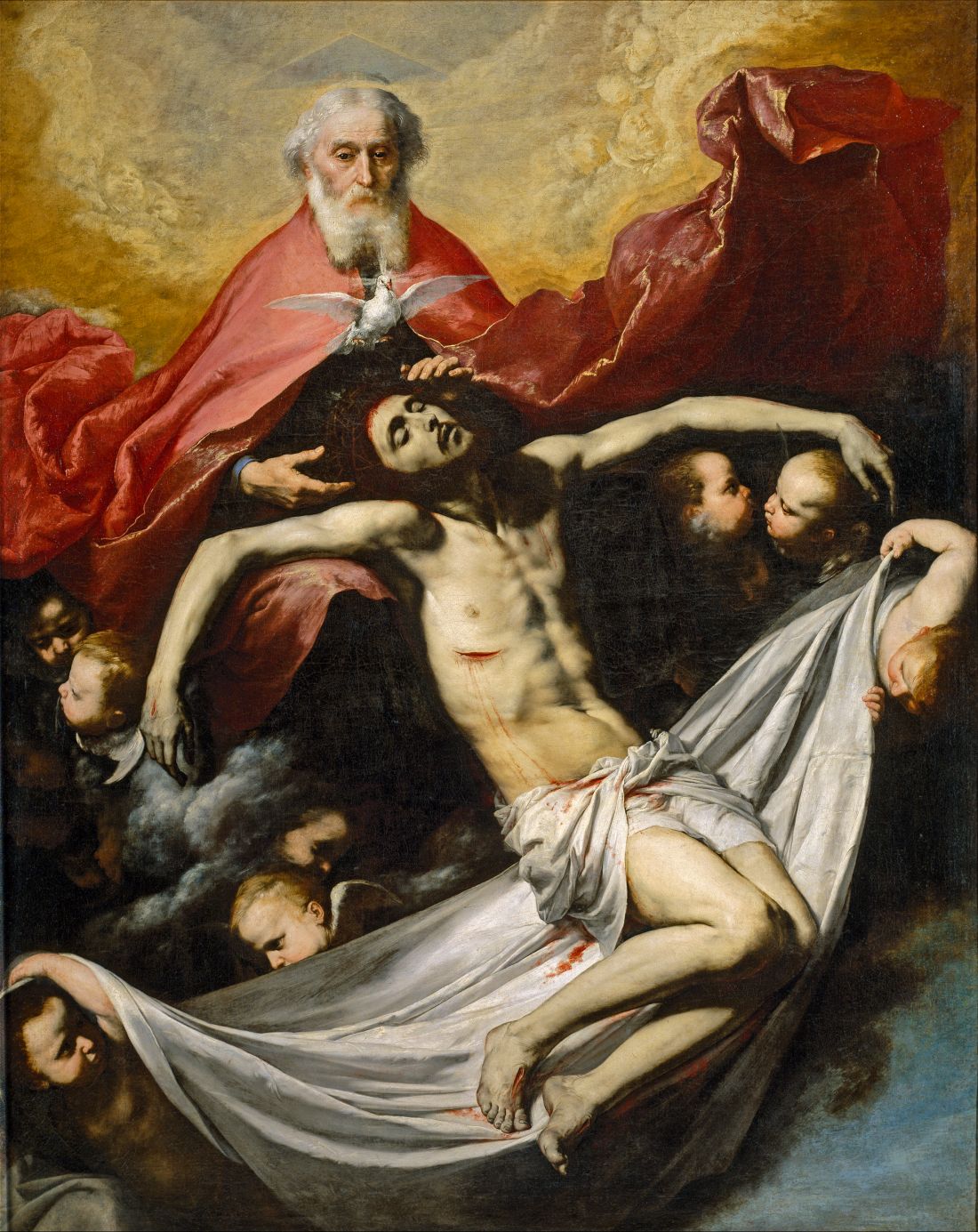
God's Triune Nature has been fully revealed, and now we celebrate the
Most Holy Trinity on this day, hearing in today's Gospel, "All power is
given to Me in heaven and on earth. Going therefore, teach ye all
nations, baptizing them in the Name of the Father and of the Son and of
the Holy Ghost. Teaching them to observe all the things whatsoever I
have commanded you; and behold I am with you all days even to the
consummation of the world" (this is known as the "Great Commission").
And with this Mass, the Time After Pentecost, the season that
represents the Church Age, begins. Vestments today will be white.
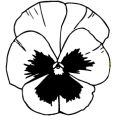
Symbols for the day include the
shamrock used by St. Patrick to
explain the Trinity to the ancient
Irish, the pansy -- Viola tricolor
-- called the "Trinity Flower," a
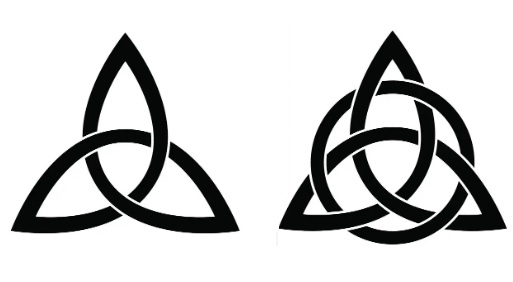
candle with 3 flames, the triangle, the trefoil, 3 interlocking
circles, etc. The Celtic knot known as a Triquetra, or "Trinity Knot"
-- sometimes made with a circle -- is another classic symbol of the
Trinity.
All might help you teach your children about the reality
of "One God, Three Persons" (have some fun! Give your kids a piece of
string and see if they can make with it the Triquetria knot shape at
the left above).
Another thing you can do to teach your children is to get a tray of ice
cubes and explain to them that the ice is water -- H20. Let the ice
melt in a pan, show it to them, and explain that the water is still
made of H20 (hydrogen and oxygen). Then put the pan on the stove so it
boils, show them the water vapor, and explain to them that the steam is
also simply H20. All three of these things -- ice, water, steam -- are
of the same substance. But to
avoid the heresy of Modalism, be sure to explain that, unlike H20, the
Three Persons of the Trinity are of the same substance at the same time; one doesn't morph
into the other; the Three Persons always are, and always were, and
always will be, all at the same time.
Another way to help your children have a hint of understanding of the
Most Holy Trinity is to ask them what their last name is. Then ask them
what Daddy's last name is. Then ask them what your last name is. Point
out to them that all of you are, say, "Smiths" -- but you're all
different persons. You are equal in your "Smith-ness," not one of you
is more a "Smith" than another, but you are different in how you relate
to each other.You're all equally "Smith," but there is only one who is
the Dad, one who is the Mom, etc.There is only one type of "Smith-ness"
that makes you all Smiths, but you are still three different persons.
Ultimately though, all analogies for the Trinity fall short; the Most
Holy Trinity is a Mystery -- the Mystery of Mysteries.
A traditional prayer for the day:
With our whole
hearts and lips we acknowledge, praise and bless Thee, O Father
unbegotten; Thee, O only begotten Son; Thee, O Holy Spirit and
Paraclete; O holy and undivided Trinity; to Thee be glory for ever.
V. Let us bless the Father, Son, and Holy Spirit.
R. Let us praise and exalt Him for ever.
Let us pray. O almighty and everlasting God, Who hast granted
to Thy servants in the confession of the true faith to acknowledge the
glory of the eternal Trinity, and in the power of Thy Majesty to adore
the Unity; we beseech Thee that by the strength of the same faith we
may ever be defended from all adversity; through Christ our Lord. Amen.
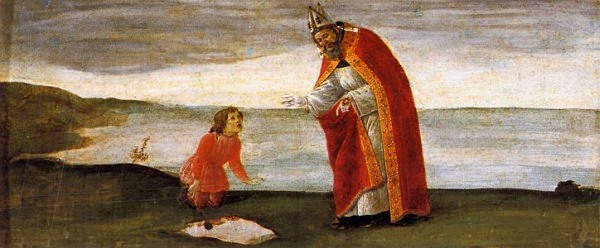
Whatever you pray, I urge meditating on the short, poetic tale of St.
Augustine's
encounter
with the mysterious boy at the seashore, and reading the 4th c.
Athanasian Creed -- the statement of Faith that best summarizes
Catholic teaching on the Trinity (both are below).
In Italy, many Catholics make pilgrimage
to the Santuario della Santissima
Trinità in Vallepietra, Lazio, about 35 miles East of Rome. The
sanctuary (which was among St. Philip Neri's favorites) is built
in a grotto haflway up the slope of Mt. Autore -- one of the Sambruini
Mountains. There, a miracle occurred in the 11th century: a farmer saw
two oxen fall with their plow into a deep precipice. He went after
them, expecting to find the animals dead, but he found them unharmed
instead -- and gazing at an image of the Trinity that suddenly appeared
on a rock. A church was built on the site, and pilgrims have been
coming ever since. There is a set of 33 stairsteps at the church's
entrance: one enters the church in the normal way, but one leaves the
church walking down the steps backwards, in honor of the Most Holy
Trinity. If you visit the place on the Feast of the Trinity, you might
see il pianto delle zitelle1
-- "the lamentations of the virgins" -- a late 17th/early 18th. century
dramatic representation of
Christ's Passion given by a group of women dressed in white and holding
symbols of the Passion (the chalice, the ropes, the hand, the column,
the lashes, the crown of thorns, the nails, the gall, the spear, the
cross, etc.), with one in black representing the Madonna. A bit of an
early 20th.recording of this drama:
Finally, I present to you some music. First, there are these
three musical works by the great
Johann Sebastian Bach -- a Lutheran, alas, but musically inspired by
the Catholicism that informed Western music in his time. He wrote three
works for
Trinity Sunday, and they are here, in mp3 format:
Gelobet sei der
Herr, mein Gott (Praised be the Lord, my God), BWV 129:
O heilges Geist-
und Wasserbad (O holy bath of Spirit and water), BWV 165:
Es ist ein
trotzig und verzagt Ding (There is something defiant and fainthearted),
BWV 176:
And then there is the hymn "Holy, Holy, Holy" -- written by an
Anglican, but perfectly orthodox and beautiful, a song your children
should know:
Holy, Holy, Holy
Holy, Holy, Holy! Lord God Almighty!
Early in the morning our song shall rise to Thee;
Holy, Holy, Holy! Merciful and Mighty!
God in Three Persons, blessed Trinity!
Holy, Holy, Holy! All the saints adore Thee,
Casting down their golden crowns around the glassy sea;
Cherubim and seraphim falling down before Thee,
Which wert, and art, and evermore shalt be.
Holy, Holy, Holy! though the darkness hide Thee,
Though the eye of sinful man, Thy glory may not see:
Only Thou art holy, there is none beside Thee,
Perfect in power, in love, and purity.
Holy, holy, holy! Lord God Almighty!
All thy works shall praise Thy name in earth, and sky, and
sea;
Holy, Holy, Holy! merciful and mighty,
God in Three Persons, blessed Trinity!
Readings
The Story of
St. Augustine and the Boy at the Beach
as recounted in the Golden Legend,
written in A.D. 1275 by Jacobus de Voragine, Archbishop of Genoa
Many other
miracles hath God showed by his [St. Augustine's] life, and also after
his death, which were overlong to write in this book, for they would, I
suppose, contain a book as much as all this and more, but among other
corrections, I will set herein one miracle, which I have seen painted
on an altar of St. Austin at the black friars at Antwerp, howbeit I
find it not in the legend, mine exemplar, neither in English, French,
ne in Latin.
It was so that this glorious doctor made and compiled many volumes, as
afore is said, among whom he made a book of the Trinity, in which he
studied and mused sore in his mind, so far forth that on a time as he
went by the sea-side in Africa, studying on the Trinity, he found by
the sea-side a little child which had made a little pit in the sand,
and in his hand a little spoon. And with the spoon he took out water of
the large sea and poured it into the pit.
And when St. Augustin beheld him he marvelled, and demanded him what he
did. And he answered and said: "I will lade out and bring all this
water of the sea into this pit."
"What?" said he, "it is impossible, how may it be done, sith the sea is
so great and large, and thy pit and spoon so little?"
"Yes, forsooth," said he, "I shall lightlier and sooner draw all the
water of the sea and bring it into this pit than thou shalt bring the
mystery of the Trinity and His Divinity into thy little understanding
as to the regard thereof; for the Mystery of the Trinity is greater and
larger to the comparison of thy wit and brain than is this great sea
unto this little pit."
And therewith the child vanished away. Then here may every man take
ensample that no man, and especially simple lettered men, ne unlearned,
presume to intermit ne to muse on high things of the Godhead, farther
than we be informed by our faith, for our only faith shall suffice us.
The Athanasian Creed
Whoever wishes
to be saved must, above all, keep the Catholic faith. For unless a
person keeps this faith whole and entire, he will undoubtedly be lost
forever. This is what the catholic faith teaches: we worship one God in
the Trinity and the Trinity in unity. Neither confounding the Persons,
nor dividing the substance. For there is one Person of the Father,
another of the Son, another of the Holy Spirit.
But the Father and the Son and the Holy Spirit have one divinity, equal
glory, and coeternal majesty. What the Father is, the Son is, and the
Holy Spirit is.
The Father is uncreated, the Son is uncreated, and the Holy Spirit is
uncreated. The Father is boundless, the Son is boundless, and the Holy
Spirit is boundless. The Father is eternal, the Son is eternal, and the
Holy Spirit is eternal.
Nevertheless, there are not three eternal beings, but one eternal
being. So there are not three uncreated beings, nor three boundless
beings, but one uncreated being and one boundless being. Likewise, the
Father is omnipotent, the Son is omnipotent, the Holy Spirit is
omnipotent.
Yet there are not three omnipotent beings, but one omnipotent
being. Thus the Father is God, the Son is God, and the Holy Spirit is
God.
However, there are not three gods, but one God. The Father is Lord, the
Son is Lord, and the Holy Spirit is Lord. However, there are not three
lords, but one Lord. For as we are obliged by Christian truth to
acknowledge every Person singly to be God and Lord, so too are we
forbidden by the Catholic religion to say that there are three Gods or
Lords.
The Father was not made, nor created, nor generated by anyone. The Son
is not made, nor created, but begotten by the Father alone. The Holy
Spirit is not made, nor created, nor generated, but proceeds from the
Father and the Son. There is, then, one Father, not three Fathers; one
Son, not three sons; one Holy Spirit, not three holy spirits. In this
Trinity, there is nothing before or after, nothing greater or less. The
entire three Persons are coeternal and coequal with one another. So
that in all things, as is has been said above, the Unity is to be
worshiped in Trinity and the Trinity in Unity.
He, therefore, who wishes to be saved, must believe thus
about the Trinity. It is also necessary for eternal salvation that he
believes steadfastly in the incarnation of our Lord Jesus Christ. Thus
the right faith is that we believe and confess that our Lord Jesus
Christ, the Son of God, is both God and man. As God, He was begotten of
the substance of the Father before time; as man, He was born in time of
the substance of His Mother. He is perfect God; and He is perfect man,
with a rational soul and human flesh. He is equal to the Father in His
divinity, but inferior to the Father in His humanity. Although He is
God and man, He is not two, but one Christ. And He is one, not because
His divinity was changed into flesh, but because His humanity was
assumed unto God. He is one, not by a mingling of substances, but by
unity of person. As a rational soul and flesh are one man: so God and
man are one Christ. He died for our salvation, descended into Hell, and
rose from the dead on the third day. He ascended into Heaven, sits at
the right hand of God the Father almighty. From there He shall come to
judge the living and the dead. At His coming, all men are to arise with
their own bodies; and they are to give an account of their own deeds.
Those who have done good deeds will go into eternal life; those who
have done evil will go into the everlasting fire.
This is the Catholic faith. Everyone must believe it, firmly and
steadfastly; otherwise He cannot be saved. Amen.
Footnotes:
1 This dramatic presentation was filmed
as a documentary in 1939. It's title: Il Pianto delle Zitelle (1939)