|
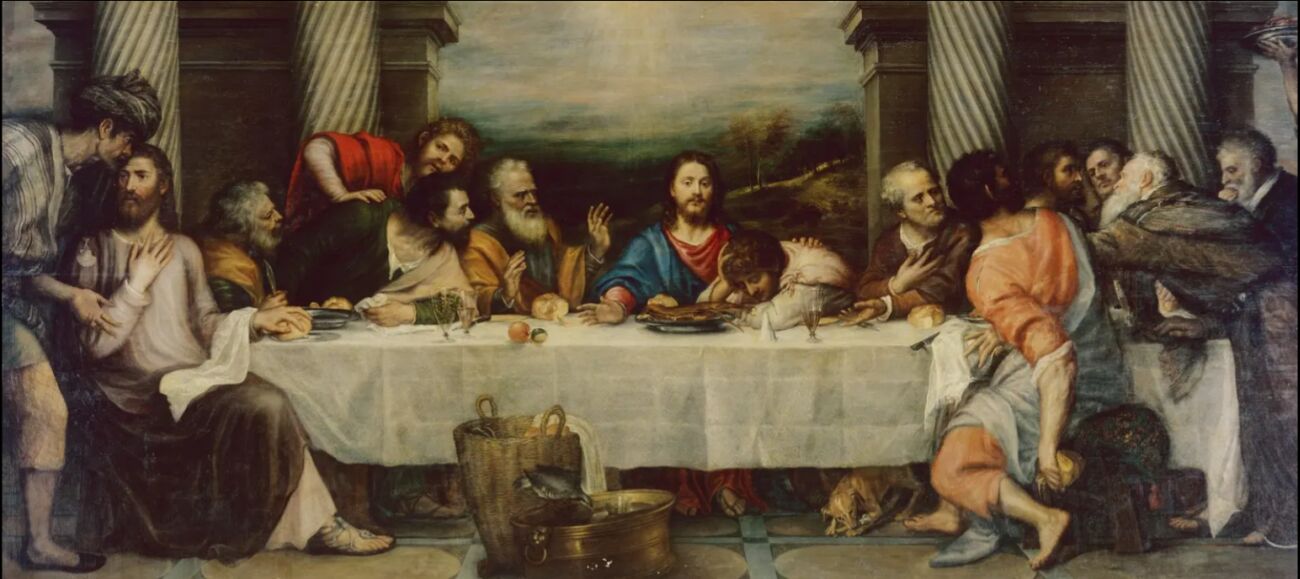
This day, Maundy Thursday (also "Holy Thursday" or "Shire
Thursday"1) commemorates Christ's
Last Supper,
the initiation of the Eucharist, the institution of the priesthood, and
our Lord's Agony in the Garden of Gethsemani on the Mount of Olives.
Its name of "Maundy" comes from the
Latin word mandatum, meaning "command." This stems from Christ's words
in John 13:34, "A new commandment I give unto you." It is the first of
the three days known as the "Triduum," and after the Vigil tonight, and
until the Vigil of Easter, a more profoundly somber attitude prevails
(most especially during the hours between Noon and 3:00 PM on Good
Friday). Raucous amusements should be set aside...
The Last Supper took place in "the upper room" of the house believed to
have been owned by John Mark and his mother, Mary (Acts 12:12). This
room, also the site of the Pentecost,
is known as the "Coenaculum" or
the "Cenacle" and is referred to as "Holy and glorious Sion, mother of
all churches" in St. James' Liturgy. At the site of this place -- our
first Christian church -- a basilica was built in the 4th century. It
was destroyed by Muslims and later re-built by the Crusaders.
Underneath the place is the tomb of David.
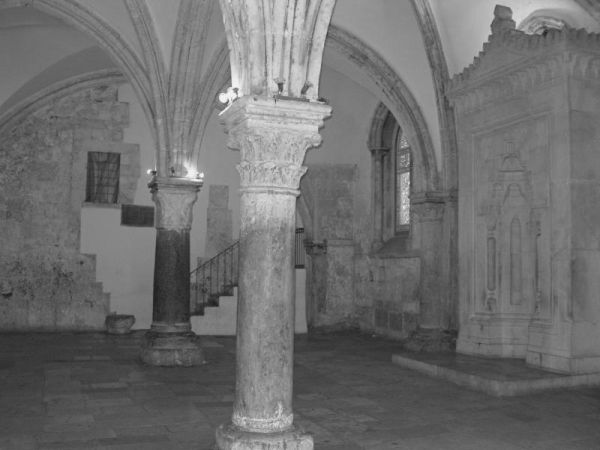
The Cenacle, or "The Upper Room"
Please know that this supper was not
a seder, which is a memorial meal ritual invented by rabbis long after
the destruction of the Temple in A.D. 70; it was a Paschal (Passover)
meal
commemorating the original Passover which took place when the
ancient Israelites painted lamb's blood over their doorways, thereby
preventing their firstborn from dying (Exodus 12). Lambs were taken
yearly to
the Temple and slaughtered, becoming the korban pesach, their blood being
sprinkled by priests on
the altar. Then the lamb meat was taken and eaten by those who brought
them as an
offering. After
the destruction of the Temple, this sort of sacrifice ceased; it is
fulfilled in the New Covenant by the once and for all time sacrifice of
the Lamb of God, Jesus Christ, which we re-present at each Mass. Ever
since then, faithless Jews no
longer have a priesthood, a Temple, or sacrifices; their korban pesach has been replaced by
a piece of matzoh called an afikoman,
eaten at the end of the seder meal. The Old
Testament
religion was fulfilled by Christianity (see Malachias 1:10-11 and
Jeremias 31:31-34), and those who rejected Christ came up with a new
religion (post-Temple Judaism) based on rabbinical rather than priestly
authority.
Also know that this last supper won't truly be finished until tomorrow:
during the Paschal meal itself,
Christ handed the cup to His disciples, bade them drink, and told them,
"I will not drink from henceforth of this fruit of the vine, until that
day when I shall drink it with you new in the kingdom of my Father."
Tomorrow, just before He dies on the Cross, He is given vinegar to
drink, and then says, "It is
finished."
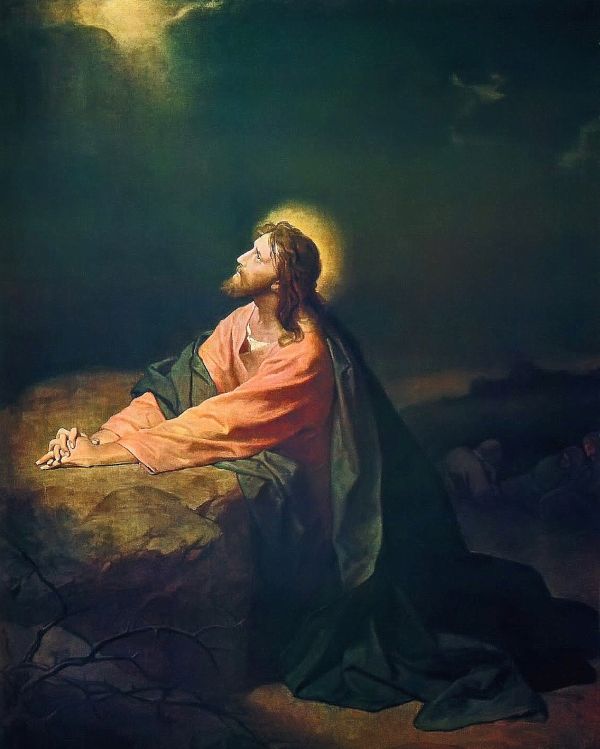
After the Supper, He went outside the Old City of Jerusalem, crossed
the Kidron Valley, and came to the Garden of Gethsemani, a place whose
name means "Olive Press," and where olives still grow today. There He
suffered in three ineffable ways: He knew exactly what would befall Him
physically and mentally -- every stroke, every thorn in the crown He
would wear, every labored breath He would try to take while hanging on
the Cross, the pain in each glance at His mother; He knew that He was
taking on all the sins of the world -- all the sins that had ever been
or ever will be committed; and, finally, He knew that, for some people,
this Sacrifice would not be fruitful because they would reject Him.
Here He was let down by His Apostles when they fell asleep instead of
keeping watch, here is where He was further betrayed by Judas with a
kiss, and where He was siezed by "a great multitude with swords and
clubs, sent from the chief Priests and the ancients of the people" and
taken before Caiphas, the high priest, where he was accused of
blasphemy, beaten, spat upon, and prepared to be taken to Pontius
Pilate tomorrow morning.
As for today's liturgies, in the morning, the local Bishop
will offer a
special Chrism Mass during which blesses the oils used in Baptism,
Confirmation, Holy Orders, Unction, and the consecration of Altars and
churches.
At the evening Mass, after the bells ring during the Gloria, they are
rung no more until the Easter Vigil (a wooden clapper called a
"crotalus" is used insead). French parents explain this to their
children by
saying that the all the bells fly to Rome after the Gloria of the Mass
on Maundy Thursday to visit the Pope. Children are told that the bells
sleep on the roof of St. Peter's Basilica, and, bringing Easter eggs
with them, start their flight home at the Gloria at the Easter Vigil,
when when they peal wildly.
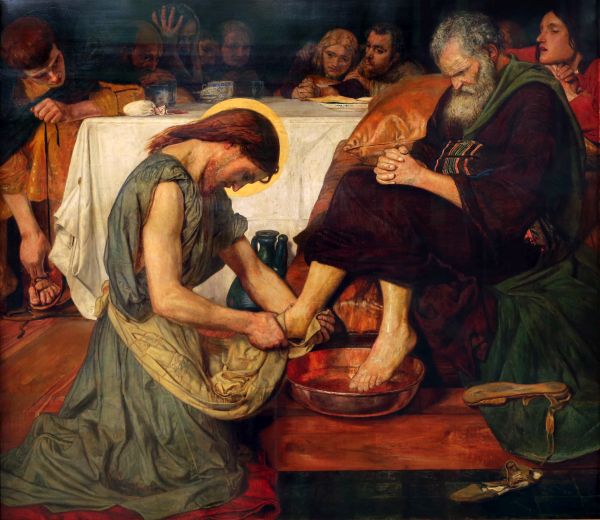
Then comes the Washing of the Feet after the homily, a rite performed
by Christ upon His disciples to prepare them for the priesthood and the
marriage banquet they will offer, and which is rooted in the Old
Testament practice of foot-washing in preparation for the marital
embrace (II Kings 11:8-11, Canticles 5:3) and in the ritual ablutions
performed by the High Priest of the Old Covenant (contrast Leviticus
16:23-24 with John 13:3-5). The priest girds himself with a cloth and
washes the feet of 12 men he's chosen to represent the Apostles for the
ceremony.
As an aside, back when Kings and Queens of England were Catholic, they,
too, would emulate Christ by washing the feet of 12 subjects, seeing
the footwashing rite also as an example of service and humility. They
would also give money to the poor on this day, a practice said to have
begun with St. Augustine of Canterbury in A.D. 597, and performed by
Kings since Edward II. Now the royal footwashing isn't done (it was
given up in the 18th c.), but a special coin called "Maundy Money" is
still minted and given to the selected elderly of a representative town.
The rest of the Mass after the Washing of the Feet has a special form,
unlike all other Masses. After the Mass, the priest takes off his
chasuble, and vests in a white cope. He returns to the Altar, incenses
the Sacred Hosts in the ciborium, and, preceded by the Crucifer and
torchbearers, carries the Ciborium to the "Altar of Repose," also
called the "Holy Sepulchre," where it will remain "entombed" until the
Mass of the Presanctified on Good Friday.
Then there follows the Stripping of the Altars, during which everything
is removed as Antiphons and Psalms are recited. All the glorious
symbols of Christ's Presence are removed to give us the sense of His
entering most fully into His Passion. Christ enters the Garden of
Gethsemani; His arrest is imminent. Fortescue's "Ceremonies of the
Roman Rite Described" tells us: "From now till Saturday no lamps in the
church are lit. No bells are rung. Holy Water should be removed from
all stoups and thrown into the sacrarium. A small quantity is kept for
blessing the fire on Holy Saturday or for a sick
call." The joyful
signs of His Presence won't return until Easter begins with the Easter
Vigil Mass on Saturday evening.
And, of course, tomorrow's Matins and Lauds may be read as part of the
"tenebrae service" (see Spy Wednesday).
Customs
A prayer for the
day:
O Jesus, through
the abundance of Thy love, and in order to overcome our
hardheartedness, Thou pourest out torrents of Thy graces over those who
reflect on Thy most Sacred Sorrow in the Garden of Gethsemane, and who
spread devotion to it. I pray Thee, move my soul and my heart to think
often, at least once a day, of Thy most bitter Agony in the Garden of
Gethsemane, in order to communicate with Thee and to be united with
Thee as closely as possible.
O Blessed Jesus, Thou, who carried the immense burden of our sins that
night, and atoned for them fully; grant me the most perfect gift of
complete repentant love over my numerous sins, for which Thou didst
sweat blood.
O Blessed Jesus, for the sake of Thy most bitter struggle in the Garden
of Gethsemane, grant me final victory over all temptations, expecially
over those to which I am most subjected.
O suffering Jesus, for the sake of Thy inscrutable and indescribable
agonies, during that night of betrayal, and of Thy bitterest anguish of
mind, enlighten me, so that I may recognise and fulfil Thy will; grant
that I may ponder continually on Thy heart-wrenching struggle on how
Thou didst emerge victoriously, in order to fulfil, not Thy will, but
the will of Thy Father.
Be Thou blessed, O Jesus, for all Thy sighs on that holy night; and for
the tears which Thou didst shed for us.
Be Thou blessed, O Jesus, for Thy sweat of blood and the terrible
agony, which Thou dist suffer lovingly in coldest abandonment and in
inscrutable loneliness.
Be Thou blessed, O sweetest Jesus, filled with immeasurable bitterness,
for the prayer which flowed in trembling agony from Thy Heart, so truly
human and divine.
Eternal Father, I offer Thee all the past, present, and future Masses
together with the blood of Christ shed in agony in the Garden of Sorrow
at Gethsemane.
Most Holy Trinity, grant that the knowledge and thereby the love, of
the agony of Jesus on the Mount of Olives will spread throughout the
whole world.
Grant, O Jesus, that all who look lovingly at Thee on the Cross, will
also remember Thy immense Suffering on the Mount of Olives, that they
will follow Thy example, learn to pray devoutly and fight victoriously,
so that, one day, they may be able to glorify Thee eternally in Heaven.
Amen.
As to customs,
many Catholics have a practice -- begun by St.
Philip Neri -- of visiting the tabernacles of seven
churches altogether, starting on this day and on through Holy Saturday,
as a sort of
"mini pilgrimage." In Rome, the list of
the seven churches was chosen
centuries ago and consists of the Basilica di San Giovanni in Laterano;
Basilica di San Pietro in Vaticano; Basilica di San Paolo fuori le
mura; Basilica di Santa Maria Maggiore; Basilica di San Lorenzo fuori
le mura; Basilica di Santa Croce in Gerusalemme; and San Sebastiano
fuori le mura. Check here to see
these seven churches on Google maps.
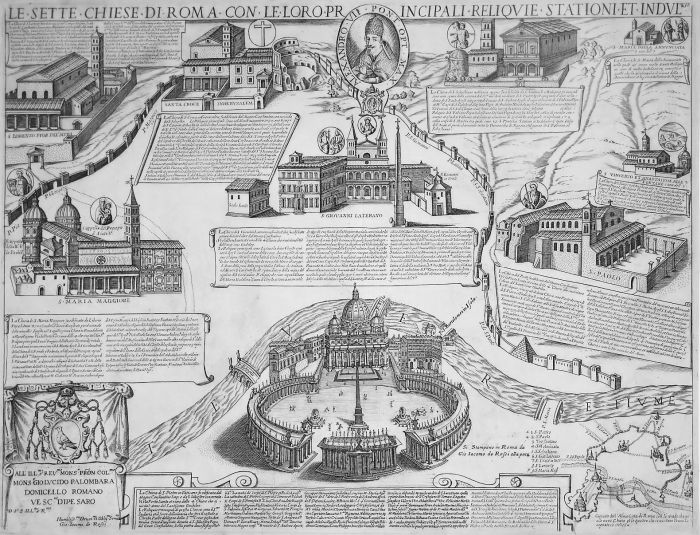
Map of
the Seven Churches. Click to enlarge
Outside of Rome, any seven Catholic churches would do. Some families
visit the churches directly after the evening Mass; others go home and
wake up in the middle of the night to make the visits (though since
churches are rarely open all night these days, this would be hard to
do). The spirit of the visits to the churches is keeping vigil with
Jesus in the
Garden of Gethsemani while He prayed before His arrest.
As to foods for the day, some Catholics engage in a Black Fast, eating
nothing from sundown tonight to after the Easter Vigil on Saturday -- a
fast of roughly 40 hours. Others have special foods: in Latin
countries, Jordan almonds (confetti)
are eaten today and
also throughout Eastertide. In Germany, Maundy Thursday is known as
"Green Thursday"
(Grundonnerstag), and the
traditional foods are green vegetables and
green salad (especially spinach salad), an herb-heavy green soup, or
Frankfurter Green Sauce served
with boiled eggs and potatoes:
Frankfurter Grüne Soße (Frankfurter Green
Sauce)
4 large hard-boiled eggs, peeled
1 cup plain Greek yogurt
2 cups quark (or sour cream)
1 tablespoon lemon juice
2 tablespoons olive oil
2 green onions, finely chopped
1/2 teaspoon sugar
salt and freshly ground pepper (white pepper, if possible), to taste
3 cups finely chopped mixed herbs: borage, chervil, cress,
parsley, salad burnet, sorrel, and chives*
Halve the eggs and mash the yolks up with everything else but the egg
whites (you can put everything in a blender, if you like. Some add a
tablespoon of hot German mustard as well). Let it sit in the fridge for
an hour or so, then chop the egg whites and sprinkle on top. Serve over
halved boiled eggs, boiled new potatoes (the small, waxy kind), and/or
flaky white fish.
* If you have trouble finding some of the herbs, you can replace some
of them with some combination of cilantro, tarragon, summer
savory, lovage, lemon balm, spinach leaves, or arugula. It won't be the
same, but will be delicious.
In Czechoslovakia, the food of the day is Jidáše, or "Judas
Buns" -- little buns made of sweet pastry that are said to resemble
spirals of the rope Judas used to hang himself with. The eating of
honey on Maundy Thursday is considered good luck in Czechoslovakia, and
these buns make use of that lore:
Jidáše (Judas Buns)
4 cups all-purpose flour
1 1/4 cups whole milk, slightly warmed - divided
2 teaspoons active dry yeast
2/3 stick unsalted butter
2 egg yolks, at room temperature
1 tsp lemon zest
1/3 cup granulated sugar - divided
pinch of salt
1 whole egg
1 tablespoon honey, warmed
Put the flour into a bowl and make a well. Pour into the well
2/3 c. of the lukewarm milk. Add 1/2 teaspoon of sugar. Add the yeast.
Stir the flour in from the sides until a thick, doughy batter forms.
Dust lightly with flour and let it rise for 30 minutes.
Meanwhile, melt the stick of butter and let it cool to just warm. When
the 30 minutes are up, add the butter to the dough along with the egg
yolks, lemon zest, salt, remaining milk, and sugar. Stir everything up
and then knead for about 10 minutes on a floured surface. Then let the
dough rise for another 30 minutes.
Divide the dough into 10 pieces. Roll each piece into a rope that's
about 10 inches long, then form each rope into a spiral, tucking the
end up and underneath the spiral. Place onto a parchment-lined sheet,
cover them with a moist tea towel, and let them rise for another 45
minutes.
Heat oven to 350F. While the oven's heating, beat up the whole egg and
baste the tops of the pastries with it. When the oven's ready, bake the
buns for about 15-25 minutes until golden. Glaze the tops of the buns
with the warmed honey while they're still hot.
On this day, one may gain a
plenary
indulgence, under the usual
conditions, by reciting the Tantum Ergo
(Down in Adoration Falling).
Note, too, that this is a good day to especially remember priests and
express gratitude toward them.
Relevant Scripture for Maundy Thursday: Matthew 26:17-56; Mark
14:12-52; Luke 22:7-54; John 12:20-50, 13, 14, 15, 16, 17, and 18:1-13.
For further spiritual reading, you might benefit from The Agony of Our Lord in
the Garden (pdf) by Padre Pio, from
this site's Catholic
Library.
And for your children: Maundy Thursday Coloring Pages (pdf)
Reading
From The Life of Christ, Volume III
by E. Le Camus,
Bishop of La Rochelle and Saintes, France
It must have been about ten o’clock in the evening. Through the already
deserted streets of the city Jesus and the Apostles descended into the
valley of Cedron towards the Mount of Olives. This was the road to
Bethany; but on that evening Jesus was not to return to His friends’
house.
Crossing the bed of the river the Apostolic group halted before a
garden called Gethsemane or the Oil-press.” The grove, which was
probably enclosed, contained a kind of pleasure resort." It may be that
the proprietor was a friend of Jesus. Many have thought that Gethsemane
belonged to the family of Lazarus. In any case, it was not the first
time that the Master came there, and no doubt it was the custom to
assemble there as at a meeting place on leaving Jerusalem and before
setting out for the village of Martha and Mary. Although He foresaw
that Judas would bring His enemies to this spot, He was not led to
modify this usual evening programme.
Jesus entered the enclosure, and, inviting the Apostles to sit down and
await Him near the entrance, perhaps in the dwelling-house, He advanced
into the middle of the grove, with Peter, James and John, to pray. The
great drama was beginning. Perceiving the approach of the fatal hour,
the Redeemer sought to meet His Father face to face to hold converse
with Him. The great voice of God which long ago in the shades of Eden
had summoned fallen man: “Adam, Adam, where art thou?” had been for
four thousand years without ananswer. No son of sinful humanity had had
the courage to respond: “Here am I!” It was for the New Man to break
that silence. For Jesus, indeed, ready to pay for all, seems to advance
towards the divine wrath, exclaim ing: Ecce Venio ! Adam awaits his
judge!
By this free and generous act He meant to assume humanity entire
together with the responsibility for its crimes, and to speak, to act,
to expiate as if He alone were mankind. Thus He constituted Himself
really a New Man summing up by substitution in His life the lives of
all, in His heart the hearts of all, and in His soul the souls of all.
But what crushing responsibilities such an acceptance involved! By
saying to His Father: “Forget Thy Son now, and behold in Me only fallen
humanity asking that it may expiate its long-continued faithlessness;
let Thy justice have full play!” He gave Himself up to every torture,
for the crimes of humanity are most varied and countless. If each one
of these required a special reparation, how terrible was the blow which
all of them together could inflict upon the body, the heart, and the
soul of Him Who presented Himself as an atonement for them all! The
more so, since, however hard the labour, Jesus, in order to furnish it,
could look for help from no one. He alone, according to the prophet’s
words, was to enter the press of the divine wrath.
There was an added circumstance in His sufferings that made His agony a
trial as intolerable for Him as it is mysterious to us. Suddenly, into
His soul which, of its own right and from the moment of His birth, had
enjoyed the beatific vision, there came a strange eclipse. God seemed
to withdraw Himself, He seemed to abandon the Man to His own resources
with a rigour that knew no pity; He concealed Himself so completely as
to provoke that heart-rending cry which was afterwards heard from the
Cross: “My God, why hast thou forsaken me?” How may we understand this
prodigious phenomenon, since the hypostatic union is indissoluble? Our
eye cannot penetrate the cloud; our curiosity must halt before problems
of so transcendent an order. It is a mystery. Whatever one may say, one
cannot explain it, one can only run the risk of compromising its
harmony. Let us be firmly content with these two data of the problem,
both of which are equally incontestable: the divine nature in Jesus was
inseparable from the human nature, and yet the latter underwent the
trial, struggled and suffered as if it had been separated from the
former. For we cannot imagine a more bitter and more real agony than
that which causes a sweating of blood.
The picture traced for us by the Synoptics of Jesus’ condition at the
moment when He leaves His disciples is striking. The humanity of our
Lord is there fully seen in all its reality and its holiness. A vague
terror weighs Him down and crushes Him. A loathing soon follows, and
moves Him to profound sadness. This trembling of the whole being
belongs to the essential phenomena of life. The purer and the more
guarded humanity is from the violent passions, the more delicate and
sensible it is beneath the embrace of moral woe. No longer checking His
emotion, the Master began to speak: “My soul is sorrow ful even unto
death!” It was a quick transition from that sweet peace, which had
inspired in Him the last farewell at the Supper, to a sudden agitation
that disturbs His whole moral being. But does not the stone suddenly
loosed from the mountainside spoil the clearness of the spring by
stirring it to its depths? Does not the hurricane on a sudden hurl up
the waves of the ocean and the sands of the desert? To hide the sight
of His agony from the three privileged disciples, the Master withdraws
a few steps away. It seems that although he derived a human consolation
from their presence, He preferred to stand apart from them through fear
of doing them harm.
“Stay ye here,” He said to them, “and watch with Me. Pray lest ye enter
into temptation.” His thought was then, to associate them, though at a
distance, in the great act of love, of obedience, of sacrifice which He
was about to accomplish. Alas! He was to find in them, who were the
elect of the Apostolic college, only drowsy men with out any true sense
of the solemnity of this occasion. He withdrew perhaps a stone's throw,
says the Evangelist, and fell on His knees. This attitude befitted the
Victim awaiting the mortal blow, and testing it in advance, as if to
know its full violence. Even if He had not with His prophetic glance
sounded the abyss of woes into which He was about to descend, Satan
would have taken care to place before His eyes this dark repulsive
picture. We know that the tempter, after his first vain struggle, had
held himself in reserve awaiting a favourable" opportunity later on for
a fresh attack. The present hour was once more his,” and Jesus desired
in vain to escape it.”
As he had been in the desert, Satan was also in Gethsemane. Temptation
is directed against man’s heart sometimes by violent desires, sometimes
by foolish fears. Jesus had long ago been insensible to covetousness,
would He allow Himself now to be overcome by fear? Satan, in the midst
of light mingled with darkness, might have asked himself this. When he
is desirous of capturing man through fear, his cleverness consists in
injecting a vague terror into the soul, repugnance into the heart,
hesitation into the will. Thus he often overturns our resolutions, our
aspirations and our strongest convictions.
To Jesus, Who had come into the presence of His Father to confer
concerning our redemption, he represented first of all in the liveliest
colours all the physical and moral sufferings that His enemies held in
store for Him. From Judas’ kiss to the gall mixed with myrrh and
vinegar, from the scene of derision to the final desolation on the
Cross, not forgetting the bloody rods of the flag ellation and the
crown of thorns, from the insulting pride of Caiphas, the cynical
contempt of Herod, the selfish cowardice of Pilate to the insults that
re-echoed on the rock of Calvary, nothing was omitted. Jesus knew
better than he how frightfully severe it all was, and as He beheld the
hideous picture, His first movement of fright was changed into a
sentiment of stupefaction that rendered Him motionless. Immediately, to
make the assault more formidable, Satan seemed to hurl down upon His
soul, one by one, all the crimes of mankind, and to strive to crush Him
beneath the weight of so much infamy. The Just One looked upon His
hands and saw them reeking with the blood shed by the homicides of all
ages. In His astonished soul thundered, as it were, the voices of
impiety and of blasphemy, the abominable outcries of humanity so long
in rebellion, and now suddenly taking refuge in Him to make Him
responsible for its scandalous excesses. His pure heart shook with the
tumult of the most violent passions. The most profound sanctuary of His
soul belonged to God, no doubt, more than ever; but a thick atmosphere
of evil surrounded Him, was overwhelming Him. With quick energy His
unalterable sanctity shook off the horrible cloak of crimes which human
malice was throwing about His shoulders; Satan replaced it on Him with
the words: “If thou wilt wash them away, thou must bear them.” Thus in
famously transformed, the Son would merit naught but the just severity
of His Father. The Well-Beloved became the Accursed. What heroism in
assuming such a responsibility, in accepting the punishment though
guilt less of the fault!
Under the crushing burden which He now received, Jesus had
unconsciously bent His head to earth. The angry countenance of the
Father upon which He has just looked has overwhelmed His soul. He can
bear it no longer, and, rising up: “Father,” He cries out, “if it be
possible, and all things are possible" to Thee, let this chalice pass
from Me! But not what I will, but what Thou wilt.” Satan then has
nothing to do here. It is with His Father alone that Jesus will
conclude the awful contract. Cannot the justice of God remove in some
measure the frightful bitterness of this overflowing chalice? Is sin
then so great an injury that it must be expiated by so terrible a
reparation? Death He has long since accepted, and nothing can prevent
Him from saving the world; but death together with the malediction of
His Father, how can He endure both? And yet He must, because, Lamb of
God though He is, never having known sin, He assumes the place of
sinners. It is because He has taken this place that His suppliant cry
has not penetrated the skies, and the name of the Father uttered with
so much love has remained powerless on His lips.
In reality, He prays with earnestness, but He does not desire to force
the Father’s will which, in this instance, is not in accord with His,
without there being, however, in this divergency even the shadow of an
imperfection. The Father desires the sacrifice; from the viewpoint of
His justice, this is His right. The Son does not desire it, giving ear
to the claims of His human nature, and this is His right. Human nature
was not created for suffering and it instinctively and energetically
rejects it. Without this innate repugnance, the accept ance of grief
would never be a sacrifice. Face to face with the immolation suggested,
nature inevitably and spontaneously cries out: No! This may be called
the will, but it is not the whole will, nor even a part of the true
will, for this instinctive movement is subject to a superior command of
the soul which perceives its duty where the exigencies of a higher
order point it out. This superior command silences the otherwise
legitimate cry of nature, and this it is that adds to the first part of
Jesus’ supplication: “If it be possible, let this chalice pass from
Me!” the second part which reduces it to its true proportions by
removing every possibility of a conflict: “But not what I will, but
what Thou wilt!”
It has been said that the Saviour then suffered all the pains of hell
save despair. It is certain that the emotion of His soul disturbed His
whole physical being. His blood in lively ferment finally broke through
its conducting vessels, and escaped with the abundant perspiration that
was streaming from His whole body. The combat became more and more
violent. His flesh, His soul, His mind, all sought to fly the awful
sacrifice; His will alone stood fast, and holding, so to speak, the
three victims beneath the hand, it dragged them on in spite of
themselves to the immolation, in conformity with that which the
Father’s good pleasure exacted. In Jesus’ life there was nothing
greater than the superhuman struggle so justly called His agony.
As if to fortify Himself by the sight of those He loves, and from whom
He expects perhaps an affectionate word in the midst of this fearful
combination of hate and fury that surrounds Him, the Master rises and
goes to the three disciples whom He had invited to watch and pray with
Him. They had fallen asleep. In a tenderly reproachful tone He turned
to the most devoted among them, to Peter, who promised to go with Him
even to death, were it necessary, and who is not even able to watch
with Him: “Simon, sleepest thou?” He says. “Couldst thou not watch one
hour with me?” He perceives, as if with painful astonishment, but it
is, alas! true, that every one is forsaking Him, even His most
cherished friends for whom He had lived and for whom He was going to
die. Their indifference at so solemn a moment foreboded their
approaching desertion. “Watch ye and pray,” He added, “that ye enter
not into temptation.” Sleep is dangerous when one must decide with
energy. The sleeper no longer sees his duty clearly and he loses
somewhat of the liberty necessary for its fulfilment. In the
solemnevents of life the senses must be on the alert and the soul in
prayer. “The spirit indeed is willing, but the flesh is weak. These
words spoke of the terrible trial which He Himself was undergoing. Had
their eyes, less heavy with sleep, beheld the Master's august face in
the pale light of the moon, they would have discovered it to be cruelly
transfigured, not with glory now, as on the mountain, but with grief.
Where formerly a radiant light had shone, there now shone a sweat of
blood. He had reason to say that the flesh is weak, and that a strong
will is necessary to lead it on to death.
Unaided by the Apostles, whom He leaves a second time, Jesus turns once
more to God. Again He prostrates Him self to pour forth lovingly before
Him His desolate soul and His most ardent prayers. His tears and His
blood bathed and sanctified the earth that had remained cursed for
forty centuries. What admirable symbolism! It was in a garden that the
first man had ruined his posterity, it is in a garden that the New Man
prays and suffers that He may save the new humanity; and this garden is
planted with olive-trees, as if this latest sign of peace were
necessary to give true meaning to the treaty that is being concluded
between heaven and earth. Adam had lost us by lifting up His head in
pride, in covetousness, in sensuality, towards the forbidden tree;
Jesus saves us with His face upon the ground in humiliation, in
suffering, in renouncement, under the pacific olive-tree of Gethsemane.
However urgent the august Suppliant may be in His woe, no one seems to
hear Him. He therefore sends forth another cry to heaven, but in it He
gives greater emphasis to His resignation. The Father’s severity, in
fact, seems to make Him more timid. “My Father,” He says, “if this
chalice may not pass away, but I must drink it, Thy will be done!”* It
may not; hence heaven is still silent above Him. Satan at this moment
perhaps explains to Him the uselessness of His sacrifice. The men for
whom He is going to die will mock His sufferings even at the foot of
His Cross. Few only will come to sit and to pray beneath the Tree of
Life. Is it, in truth, worth the trouble to plant it with so much woe
and to bedew it thus with His blood? And Jesus replies: “I will die
nevertheless, and My Father shall be glorified, and My friends shall be
saved.”
He arises to go once more to find the three disciples, the cherished
nucleus of the future Church. To look upon them even sleeping will be a
solace to Him. The silence of the night, in which He hears only the
violent throbbing of His own heart is intolerable. Peter, James, and
John were sleeping more soundly than before. One never sleeps better
than after a deep moral agitation. The emotions of that evening,
sadness, the advanced hour of the night, could not but add to the
heaviness of their eyelids. When the Master spoke, they knew not what
to answer. Jesus, distressed at such a sight, did not insist.
For the last time He withdrew to pray. It may be that this threefold
prayer really corresponded with the sentiments of fear, of loathing,
and of sorrow which, as a threefold temptation, had invaded His heart.
Inexorable and silent, as before, the Father held Himself invisible to
the anxious eyes of the wretched Victim. However, as He seemed almost
undone, He sent an angel to strengthen Him. Like Him the great ones of
earth, that they may the better refuse a favour, withdraw themselves
from the importunities of suppliants, and send their servants with
useless encouragement to those whom they are deputed to dismiss.”
The angel declared that Jesus had conquered. For the struggle was over.
Nature’s last repugnance had just yielded before the justice of heaven
which was inexorable. The human will had been completely broken by the
will of God. Jesus arose resolutely and, rejoining His disciples, still
covered with traces of His bloody strife like an athlete returning
victorious from the combat, He appeared once more possessed of His
usual serenity and strength of soul: “Sleep now,” He said to them, “and
take your rest. It is enough.”
His transition from despondency to courage is as speedy as was that
from tranquillity to anguish. He has seen or heard the enemy
approaching, and He resumes His wonted manner, not without some trace
of trouble or emotion in the rapidity with which His soul and His words
leap as it were from one warning or invitation to another; but it is
evident that His will leads on the Victim in triumph and that mankind
shall be redeemed. “The hour is come,” He exclaims, “Behold the Son of
man shall be betrayed into the hands of sinners. Rise up, let us go.
Behold, he that will betray Me is at hand.”
At the same time, He turned towards the rest of the Apostles who were
at the entrance of the garden. He was eager to protect them against the
enemy who approached. It was about midnight.
Footnotes:
1 The name "Shire
Thursday" is explained in "Festival" printed by Wynkyn de Worde in
1511: "Yf a man aske why Shere Thursday is called so, ye may saye that
in Holy Churche it is called (Cena Domini) our Lordes Souper daye; for
that day he souped with this Discyples openly; and after souper he gave
them his flesshe and his blode to ete and drynke. It is also in
Englysshe called Sher Thursdaye, for in olde faders dayes the people
wold that daye sher there heedes, and clyppe theyr berdes, and poll
theyr heedes, and so make them honest ayenst Ester Day."
|