``Where the
Bishop is, there let the multitude of believers be;
even as where Jesus is, there is the Catholic Church'' Ignatius of
Antioch, 1st c. A.D
Feast of St. Martin
(Martinmas)
St. Martin of Tours -- "The Glory of Gaul" -- was born around
A.D. 316 in Szombathely, Hungary (known then as Sabaria, Pannonia) and
grew up the son of a Roman military officer in Pavia, Italy. He joined
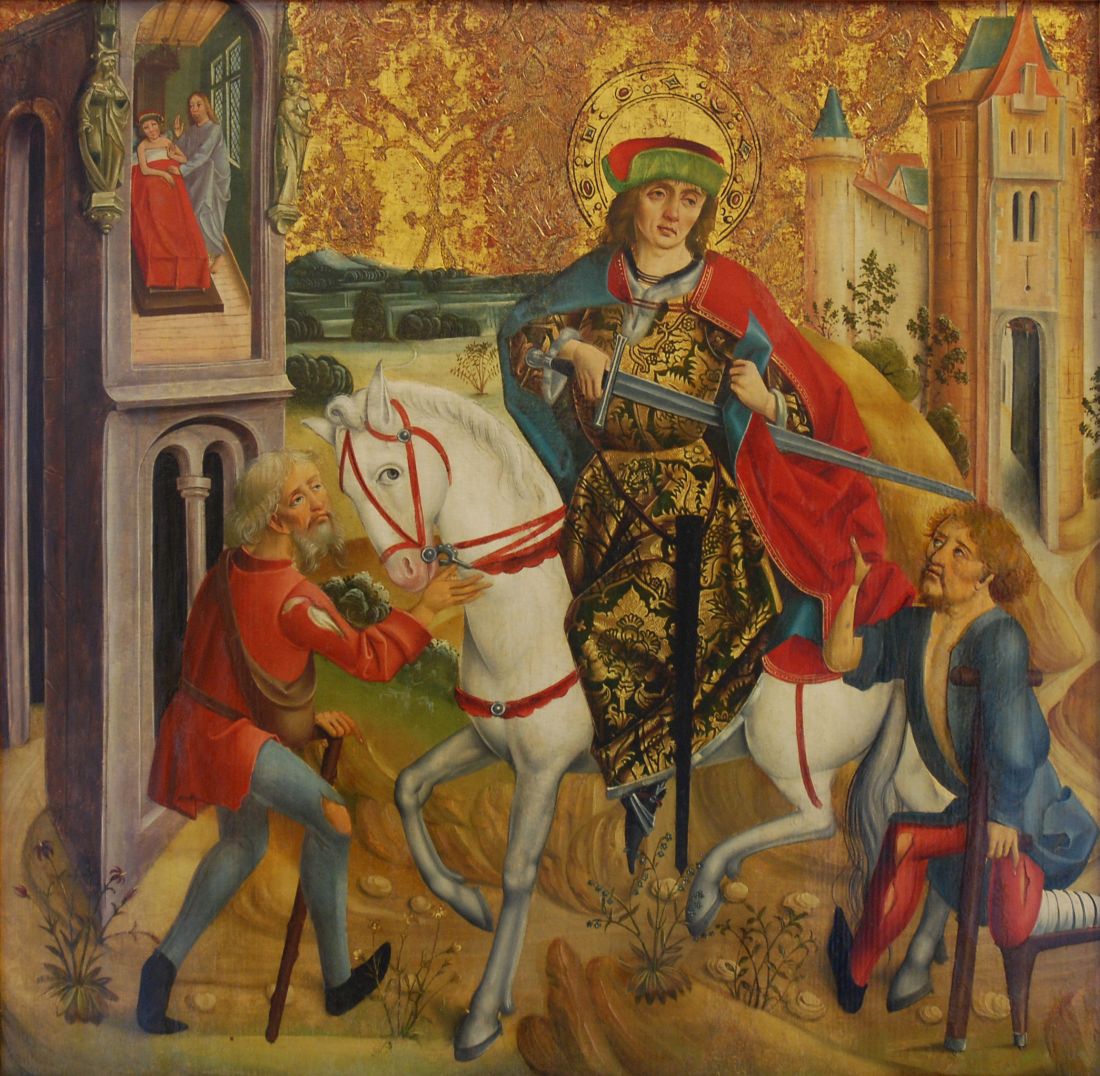
the Roman army and was sent to Amiens, where, on horseback, he met a
starving man begging alms at the city gates. Moved by deep compassion,
he tore his red, woolen his cloak in two with his sword and gave half
to the beggar. The next night, he had a dream in which he saw Jesus
wearing the half of the cloak he'd given away, surrounded by angels. In
the dream, Our Lord asked him to look at it and to see if he recognized
it. He did, of course, and realized that he must convert and devote his
life to Christ. (St. Martin's remaining piece of cloak became a very
revered relic. In fact, the building where his cloak -- "cappa" in
Latin -- was preserved was known as the "cappella," the root of our
words "chapel" and "chaplain.")
When he was around 20 years of age, some Teutons invaded Gaul and were
repelled. When he went before Emperor Julian to receive his reward, he
was moved to refuse the bounty, saying "Up to now, I have served you
as a soldier; allow me henceforth to serve Christ. Give the bounty to
these others who are going out to battle. I am a soldier of Christ and
it is not lawful for me to fight." Julian accused him of cowardice and
had him imprisoned, but he was released after a truce was called.
He got out of the army in Worms and, after spending time at Isola
d'Albenga (then Gallinaria), met up with St. Hilary, Bishop of Poitiers
and became his disciple, living a solitary life until others gathered
around him, forming the Benedictine Abbey of Ligugé. After a decade of
this life, he went on journeys around the area to preach the Gospel,
and his popularity grew to such an extent that when St. Hilary of
Poitier's successor died, the people of the town elected St. Martin to
succeed him as Bishop, in spite of St. Martin's protests. Indeed, St.
Martin was rather "tricked" into the position. According to the
Catholic Encyclopedia
When St.
Lidorius, second Bishop of Tours, died in 371 or 372, the clergy of
that city desired to replace him by the famous hermit of Ligugé [St.
Martin]. But, as Martin remained deaf to the prayers of the deputies
who brought him this message, it was necessary to resort to a ruse to
overcome his resistance. A certain Rusticius, a rich citizen of Tours,
went and begged him to come to his wife, who was in the last extremity,
and to prepare her for death. Without any suspicions, Martin followed
him in all haste, but hardly had he entered the city when, in spite of
the opposition of a few ecclesiastical dignitaries, popular acclamation
constrained him to become Bishop of the Church of Tours.
As Bishop, he
led an exemplary simple life, a life that inspired the formation of yet
another monastery, one called Marmoutier. He fought battles against the
Priscillianists and Ithacians, evangelized and set up religious
communities as far away as Paris and Vienne, visited every parish in
his large diocese each year, and died around the age of 81, so loved
that he became known as "The Glory of Gaul." St. Martin is the patron
of beggars, vintners, equestrians, soldiers, tailors, innkeepers,
alcoholics, and geese. He is usually depicted in art on horseback,
handing half of his cloak to a beggar, or relinquishing his arms. His
symbol is the goose. You may also see him riding on a donkey based on
the apocryphal story of him walking to Rome and meeting up with the
devil, who mocked him for not riding on a donkey as a Bishop should.
St. Martin is said to have turned the devil into a donkey and ridden
him all the way to
Rome, urging him on with the Sign of the Cross. The angered devil
cursed him with this palindrome:
Signa te Signa:
temere me tangis et angis:
Roma tibi subito motibus ibit amor
("Cross, cross thyself, you plague and vex me without need
For by my labors you shall soon reach Rome, the object of your wishes")
St. Martin's
Feast is considered the first day of Winter for practical purposes, so,
alluding to the snows of that season, the Germans say that "St Martin
comes riding on a white horse." Of course, it might not feel like
Winter if one is experiencing a "St. Martin's Summer" -- the equivalent
of an "Indian Summer." It is said, too, that one can predict what sort
of Winter one will have by the conditions of St. Martin's Day: "If the
geese at Martin’s Day stand on ice, they will walk in mud at Christmas."
The Feast coincides not only with the end of the Octave of All Souls,
but with harvest time, the time when
newly-produced wine is ready for drinking, and the end of winter
preparations, including the butchering of animals (an old English
saying is "His Martinmas will come as it does to every hog," meaning
"he will get his comeuppance" or "everyone must die"). Because of this,
St. Martin's Feast is much like the American Thanksgiving (celebrated
on the 4th Thursday in November) -- a celebration of the earth's
bounty. Because it also comes before the penitential season of Advent,
it is seen as a mini "carnivale" with all the feasting and bonfires.
As
at Michaelmas on 29
September, goose is eaten in most places (the goose
is a symbol for St. Martin himself. It is said that as he was hiding
from the people who wanted to make him Bishop, a honking goose gave
away his hiding spot), but unlike most Catholics, those of Britain and
Ireland prefer pork or beef on this day.
Goose with
Apple Stuffing
(Martinsgans mit Apfelfüllung) (Serves 6 to 8)
1 ready-to-cook goose (8 to 10 pounds)
2 cups water
1 small onion, sliced
1 1/4 teaspoon salt
6 cups soft bread crumbs
3 tart apples, chopped
2 stalks celery (with leaves), chopped
1 medium onion, chopped
1/4 cup margarine or butter, melted
2 teaspoons salt
1 teaspoon ground sage
1/2 teaspoon ground thyme
1/4 teaspoon pepper
1 teaspoon salt
1/4 cup all-purpose flour
Trim excess fat from goose. Heat giblets, water, sliced onion and 1 1/4
teaspoons salt to boiling; reduce heat. Cover and simmer until giblets
are done, about 1 hour. Strain broth; cover and refrigerate. Chop
giblets; toss with remaining ingredients except 1 teaspoon salt and the
flour. Rub cavity of goose with 1 teaspoon salt. Fold wings across back
with tips touching. Fill neck and body cavities of goose lightly with
stuffing. Fasten neck skin of goose to back with skewers. Fasten
opening with skewers; lace with string. Tie drumsticks to tail. Prick
skin all over with fork. Place goose breast side up on rack in shallow
roasting pan. Roast uncovered in 350° oven until done, 3 to 3 1/2
hours, removing excess fat from pan occasionally. Place a tent of
aluminium foil loosely over goose during last hour to prevent excessive
browning. Goose is done when drumstick meat feels very soft. Place
goose on heated platter. Let stand 15 minutes for easier carving.
Meanwhile, pour drippings from pan into bowl. Return 1/4 cup drippings
to pan. Stir in flour. Cook over low heat, stirring constantly, until
smooth and bubbly. Remove from heat. If necessary, add enough water to
reserved broth to measure 2 cups. Stir into flour mixture. Heat to
boiling, stirring constantly. Boil and stir 1 minute. Serve goose with
apple stuffing and gravy. Guten Appetit! (Recipe from the German
Embassy)
If you eat
goose, save the furcula -- the "wish bone" -- from the bird's chest.
Physician Johannes Hartlieb wrote in 1455,
When the goose
has been
eaten on St. Martin's Day or Night, the oldest and most sagacious keeps
the breast-bone and allowing it to dry until the morning examines it
all around, in front, behind and in the middle. Thereby they divine
whether the winter will be severe or mild, dry or wet, and are so
confident in their prediction that they will wager their goods and
chattels on its accuracy.
Afterward, the dried wish bone -- which, in essence, can be
seen as the birds' fused clavicles, or collar bones -- can be tugged on
by
a person at each end as they each silently make a wish. The person who
ends up
with the larger part after the bone breaks is the person whose wish is
said to come true.
Also note the pygostlye -- more often called the "Pope's
nose," "Bishop's nose," or "parson's nose": this is the shield-shaped
bit of meat that hangs off the bird's posterior, the part that holds
its tail feathers, and is said by some to be the tastiest part of a
goose, turkey, chicken, or other fowl (others remove this bit before
roasting).
In many countries, including Germany, Martinmas celebrations
begin at
the eleventh minute of the eleventh hour of this eleventh day of the
eleventh month. Bonfires are built, and
children carry lanterns in the streets after dark (often led by a man
on horseback who is dressed as St. Martin), singing songs for
which they are rewarded with candy. One of the songs those German
children might sing is "Sankt Martin ritt durch Schnee und Wind":
Sankt Martin,
Sankt Martin, Sankt Martin
ritt durch Schnee und Wind,
sein Roß das trug ihn fort geschwind.
Sankt Martin ritt mit leichtem Mut:
sein Mantel deckt' ihn warm und gut.
Im Schnee saß, im Schnee saß,
im Schnee da saß ein armer Mann,
hatt' Kleider nicht, hatt' Lumpen an.
"O helft mir doch in meiner Not,
sonst ist der bittre Frost mein Tod!"
Sankt Martin, Sankt Martin,
Sankt Martin zog die Zügel an,
sein Roß stand still beim armen Mann,
Sankt Martin mit dem Schwerte teilt'
den warmen Mantel unverweilt.
Sankt Martin, Sankt Martin
Sankt Martin gab den halben still,
der Bettler rasch ihm danken will.
Sankt Martin aber ritt in Eil'
hinweg mit seinem Mantelteil.
Sankt Martin, Sankt Martin,
Sankt Martin legt sich müd' zur Ruh
da tritt im Traum der Herr dazu.
Er trägt des Mantels Stück als Kleid
sein Antlitz strahlet Lieblichkeit.
Sankt Martin, Sankt Martin,
Sankt Martin sieht ihn staunend an,
der Herr zeigt ihm die Wege an.
Er führt in seine Kirch' ihn ein,
und Martin will sein Jünger sein.
Sankt Martin, Sankt Martin,
Sankt Martin wurde Priester gar
und diente fromm an dem Altar,
das ziert ihn wohl bis an das Grab,
zuletzt trug er den Bischofsstab.
Sankt Martin, Sankt Martin,
Sankt Martin, o du Gottesmann,
nun höre unser Flehen an,
O bitt' für uns in dieser Zeit
und führe uns zur Seligkeit.
Saint Martin,
Saint Martin, Saint Martin
rode through snow and wind,
his horse carried him away swiftly.
Saint Martin rode with light courage:
his cloak covered him warmly and well.
In the snow sat, sat
in the snow, there sat a poor man in the snow,
had no clothes, wore rags.
"Oh help me in my need,
otherwise the bitter frost will be my death!"
Saint Martin, Saint Martin,
Saint Martin pulled on the reins,
his horse stood still with the poor man,
Saint Martin with the sword
parted his warm cloak without stopping.
Saint Martin, Saint Martin
Saint Martin gave the half still,
the beggar wanted to thank him quickly.
But Saint Martin rode
away in haste with his cloak part.
Saint Martin, Saint Martin,
Saint Martin lays down wearily to rest
, and in the dream the Lord entered.
He wears the piece of the cloak as a
robe, his countenance radiates loveliness.
Saint Martin, Saint Martin,
Saint Martin looks at him in amazement,
the Lord shows him the way.
He introduces him to his church,
and Martin wants to be his disciple.
Saint Martin, Saint Martin,
Saint Martin even became a priest
and served devoutly at the altar,
which probably adorns him right up to the grave, at
last he carried the bishop's staff.
Saint Martin, Saint Martin,
Saint Martin, O you man of God,
now listen to our prayers,
O pray for us at this time
and lead us to salvation.
Those same German children might also enjoy "Martin's Horns"
-- known in Germany as Martinshörnchen:
Put the flour in a mixing bowl and make a well. Put the yeast
in the well and pour onto 5 TBSP milk and a TBSP sugar. Mix lightly
with a fork, then let it rest for 15 minutes.
Add the sugar, egg, butter, and salt and knead until a soft
dough is formed that comes away from the sides of the bowl. Cover with
a damp tea towel and let it rest for another 15 minutes.
Rolll it out into a rectangle and cut it into 12 triangles.
Take a piece of the almond paste that's about the size of a walnut and
place on each triangle. Fold the triangles, rolling from the long end
toward the tip and form into a crescent shape. Preheat oven to 350F.
Place the crescents on a parchment-lined tray and let rest for another
15 minutes while the oven is heating. Then bake the crescents for 15-20
minutes until golden and crispy. Mix a teaspoon or so of water into the
powdered sugar and brush onto the rolls. Let dry.
On on a macabre final note, old superstitious folklore (not
Catholic
teaching, of course) says that if you stand in the back of the church
and look out over the congregants on St. Martin's Day, you can see
auras of light around the heads of those who will not be among the
living at the next Martinmas.
Readings
Matthew 25:14-46
For even as a man going into a far country, called his
servants, and delivered to them his goods; And to one he gave five
talents, and to another two, and to another one, to every one according
to his proper ability: and immediately he took his journey.
And he that had received the five talents, went his way, and traded
with the same, and gained other five. And in like manner he that had
received the two, gained other two. But he that had received the one,
going his way digged into the earth, and hid his lord's money. But
after a long time the lord of those servants came, and reckoned with
them. And he that had received the five talents coming, brought other
five talents, saying: Lord, thou didst deliver to me five talents,
behold I have gained other five over and above.
His lord said to him: Well done, good and faithful servant, because
thou hast been faithful over a few things, I will place thee over many
things: enter thou into the joy of thy lord. And he also that had
received the two talents came and said: Lord, thou deliveredst two
talents to me: behold I have gained other two. His lord said to him:
Well done, good and faithful servant: because thou hast been faithful
over a few things, I will place thee over many things: enter thou into
the joy of thy lord. But he that had received the one talent, came and
said: Lord, I know that thou art a hard man; thou reapest where thou
hast not sown, and gatherest where thou hast not strewed. And being
afraid I went and hid thy talent in the earth: behold here thou hast
that which is thine.
And his lord answering, said to him: Wicked and slothful servant, thou
knewest that I reap where I sow not, and gather where I have not
strewed: Thou oughtest therefore to have committed my money to the
bankers, and at my coming I should have received my own with usury.
Take ye away therefore the talent from him, and give it to him that
hath ten talents.
For to every one that hath shall be given, and he shall abound: but
from him that hath not, that also which he seemeth to have shall be
taken away. And the unprofitable servant cast ye out into the exterior
darkness. There shall be weeping and gnashing of teeth. And when the
Son of man shall come in his majesty, and all the angels with him, then
shall he sit upon the seat of his majesty. And all nations shall be
gathered together before him, and he shall separate them one from
another, as the shepherd separateth the sheep from the goats: And he
shall set the sheep on his right hand, but the goats on his left. Then
shall the king say to them that shall be on his right hand: Come, ye
blessed of my Father, possess you the kingdom prepared for you from the
foundation of the world. For I was hungry, and you gave me to eat; I
was thirsty, and you gave me to drink; I was a stranger, and you took
me in: Naked, and you covered me: sick, and you visited me: I was in
prison, and you came to me.
Then shall the just answer him, saying: Lord, when did we see thee
hungry, and fed thee; thirsty, and gave thee drink? And when did we see
thee a stranger, and took thee in? or naked, and covered thee? Or when
did we see thee sick or in prison, and came to thee?
And the king answering, shall say to them: Amen I say to you, as long
as you did it to one of these my least brethren, you did it to me.
Then he shall say to them also that shall be on his left hand: Depart
from me, you cursed, into everlasting fire which was prepared for the
devil and his angels. For I was hungry, and you gave me not to eat: I
was thirsty, and you gave me not to drink. I was a stranger, and you
took me not in: naked, and you covered me not: sick and in prison, and
you did not visit me. Then they also shall answer him, saying: Lord,
when did we see thee hungry, or thirsty, or a stranger, or naked, or
sick, or in prison, and did not minister to thee? Then he shall answer
them, saying: Amen I say to you, as long as you did it not to one of
these least, neither did you do it to me.
And these shall go into everlasting punishment: but the just, into life
everlasting.
Footnotes:
Note: In America, November 11 is also Veterans
Day -- the day to remember those who've served their country in the
Armed Forces. In the United Kingdom and Commonwealth countries such as
Canada and Australia, the day is known as Remembrance Day, and focuses
more strictly on those who've died while serving their country in the
Armed Forces (for Americans, this more strict focus is observed on
Memorial Day, the last Monday in May). Veterans Day and Remembrance Day
both began as "Armistice Day," which is the anniversary of the
World War I Armistice (truce) signed in the Forest of Compiegne by the
Allies and the Germans in 1918 -- on the 11th hour of the 11th day of
the 11th month. In all of these
countries, red poppies are worn to honor the fallen.