|
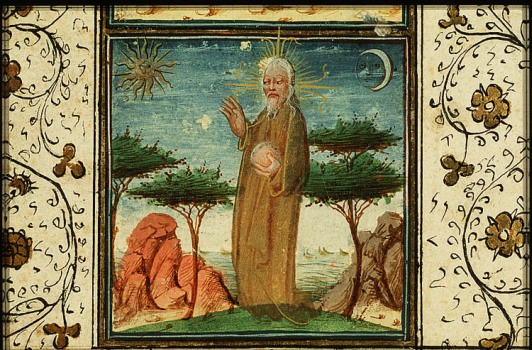
The creation of
luminous bodies.
1. At the shows
in the circus the spectator must join in the efforts of the athletes.
This the laws of the show indicate, for they prescribe that all should
have the head uncovered when present at the stadium. The object of
this, in my opinion, is that each one there should not only be a
spectator of the athletes, but be, in a certain measure, a true athlete
himself. Thus, to investigate the great and prodigious show of
creation, to understand supreme and ineffable wisdom, you must bring
personal light for the contemplation of the wonders which I spread
before your eyes, and help me, according to your power, in this
struggle, where you are not so much judges as fellow combatants, for
fear lest the truth might escape you, and lest my error might turn to
your common prejudice. Why these words? It is because we propose to
study the world as a whole, and to consider the universe not by the
light of worldly wisdom, but by that with which God wills to enlighten
His servant, when He speaks to him in person and without enigmas. It is
because it is absolutely necessary that all lovers of great and grand
shows should bring a mind well prepared to study them. If sometimes, on
a bright night, whilst gazing with watchful eyes on the inexpressible
beauty of the stars, you have thought of the Creator of all things; if
you have asked yourself who it is that has dotted heaven with such
flowers, and why visible things are even more useful than beautiful; if
sometimes, in the day, you have studied the marvels of light, if you
have raised yourself by visible things to the invisible Being, then you
are a well prepared auditor, and you can take your place in this august
and blessed amphitheatre. Come in the same way that any one not knowing
a town is taken by the hand and led through it; thus I am going to lead
you, like strangers, through the mysterious marvels of this great city
of the universe. Our first country was in this great city, whence the
murderous daemon whose enticements seduced man to slavery expelled us.
There you will see man's first origin and his immediate seizure by
death, brought forth by sin, the first born of the evil spirit. You
will know that you are formed of earth, but the work of God's hands;
much weaker than the brute, but ordained to command beings without
reason and soul; inferior as regards natural advantages, but, thanks to
the privilege of reason, capable of raising yourself to heaven. If we
are penetrated by these truths, we shall know ourselves, we shall know
God, we shall adore our Creator, we shall serve our Master, we shall
glorify our Father, we shall love our Sustainer, we shall bless our
Benefactor, we shall not cease to honour the Prince of present and
future life, Who, by the riches that He showers upon us in this world,
makes us believe in His promises and uses present good things to
strengthen our expectation of the future. Truly, if such are the good
things of time, what will be those of eternity? If such is the beauty
of visible things, what shall we think of invisible things? If the
grandeur of heaven exceeds the measure of human intelligence, what mind
shall be able to trace the nature of the everlasting? If the sun,
subject to corruption, is so beautiful, so grand, so rapid in its
movement, so invariable in its course; if its grandeur is in such
perfect harmony with and due proportion to the universe: if, by the
beauty of its nature, it shines like a brilliant eye in the middle of
creation; if finally, one cannot tire of contemplating it, what will be
the beauty of the Sun of Righteousness? If the blind man suffers from
not seeing the material sun, what a deprivation is it for the sinner
not to enjoy the true light!
2. "And God said, Let there be lights in the firmament of the heaven to
give light upon the earth, and to divide the day from the night."
Heaven and earth were the first; after them was created light; the day
had been distinguished from the night, then had appeared the firmament
and the dry element. The water had been gathered into the reservoir
assigned to it, the earth displayed its productions, it had caused many
kinds of herbs to germinate and it was adorned with all kinds of
plants. However, the sun and the moon did not yet exist, in order that
those who live in ignorance of God may not consider the sun as the
origin and the father of light, or as the maker of all that grows out
of the earth. That is why there was a fourth day, and then God said:
"Let there be lights in the firmament of the heaven."
When once you have learnt Who spoke, think immediately of the hearer.
God said, "Let there be lights . . . and God made two great lights."
Who spoke? and Who made? Do you not see a double person? Everywhere, in
mystic language, history is sown with the dogmas of theology.
The motive follows which caused the lights to be created. It was to
illuminate the earth. Already light was created; why therefore say that
the sun was created to give light? And, first, do not laugh at the
strangeness of this expression. We do not follow your nicety about
words, and we trouble ourselves but little to give them a harmonious
turn. Our writers do not amuse themselves by polishing their periods,
and everywhere we prefer clearness of words to sonorous expressions.
See then if by this expression "to light up," the sacred writer
sufficiently made his thought understood. He has put "to give light"
instead of" illumination." Now there is nothing here contradictory to
what has been said of light. Then the actual nature of light was
produced: now the sun's body is constructed to be a vehicle for that
original light. A lamp is not fire. Fire has the property of
illuminating, and we have invented the lamp to light us in darkness. In
the same way, the luminous bodies have been fashioned as a vehicle for
that pure, clear, and immaterial light. The Apostle speaks to us of
certain lights which shine in the world without being confounded with
the true light of the world, the possession of which made the saints
luminaries of the souls which they instructed and drew from the
darkness of ignorance. This is why the Creator of all things, made the
sun in addition to that glorious light, and placed it shining in the
heavens.
3. And let no one suppose it to be a thing incredible that the
brightness of the light is one thing, and the body which is its
material vehicle is another. First, in all composite things, we
distinguish substance susceptible of quality, and the quality which it
receives. The nature of whiteness is one thing, another is that of the
body which is whitened; thus the natures differ which we have just seen
reunited by the power of the Creator. And do not tell me that it is
impossible to separate them. Even I do not pretend to be able to
separate light from the body of the sun; but I maintain that that which
we separate in thought, may be separated in reality by the Creator of
nature. You cannot, moreover, separate the brightness of fire from the
virtue of burning which it possesses; but God, who wished to attract
His servant by a wonderful sight, set a fire in the burning bush, which
displayed all the brilliancy of flame while its devouring property was
dormant. It is that which the Psalmist affirms in saying "The voice of
the Lord divideth the flames of fire." Thus, in the requital which
awaits us after this life, a mysterious voice seems to tell us that the
double nature of fire will be divided; the just will enjoy its light,
and the torment of its heat will be the torture of the wicked.
In the revolutions of the moon we find a new proof of what we have
advanced. When it stops and grows less it does not consume itself in
all its body, but in the measure that it deposits or absorbs the light
which surrounds it, it presents to us the image of its decrease or of
its increase. If we wish an evident proof that the moon does not
consume its body whet, at rest, we have only to open our eyes. If you
look at it in a cloudless and clear sky, you observe, when it has taken
the complete form of a crescent, that the part, which is dark and not
lighted up, describes a circle equal to that which the full moon forms.
Thus the eye can take in the whole circle, if it adds to the
illuminated part this obscure and dark curve. And do not tell me that
the light of the moon is borrowed, diminishing or increasing in
proportion as it approaches or recedes from the sun. That is not now
the object of our research; we only wish to prove that its body differs
from the light which makes it shine. I wish you to have the same idea
of the sun; except however that the one, after having once received
light and having mixed it with its substance, does not lay it down
again, whilst the other, turn by turn, putting off and reclothing
itself again with light, proves by that which takes place in itself
what we have said of the sun.
The sun and moon thus received the command to divide the day from the
night. God had already separated light from darkness; then He placed
their natures in opposition, so that they could not mingle, and that
there could never be anything in common between darkness and light. You
see what a shadow is during the day; that is precisely the nature of
darkness during the night. If, at the appearance of a light, the shadow
always falls on the opposite side; if in the morning it extends towards
the setting sun; if in the evening it inclines towards the rising sun,
and at mid-day turns towards the north; night retires into the regions
opposed to the rays of the sun, since it is by nature only the shadow
of the earth. Because, in the same way that, daring the day, shadow is
produced by a body which intercepts the light, night comes naturally
when the air which surrounds the earth is in shadow. And this is
precisely what Scripture says, "God divided the light from the
darkness." Thus darkness fled at the approach of light, the two being
at their first creation divided by a natural antipathy. Now God
commanded the sun to measure the day, and the moon, whenever she rounds
her disc, to rule the night. For then these two luminaries are almost
diametrically opposed; when the sun rises, the full moon disappears
from the horizon, to re-appear in the east at the moment the sun sets.
It matters little to our subject if in other phases the light of the
moon does not correspond exactly with night. It is none the less true,
that when at its perfection it makes the stars to turn pale and
lightens up the earth with the splendour of its light, it reigns over
the night, and in concert with the sun divides the duration of it in
equal parts.
4. "And let them be for signs, and for seasons, and for days and
years." The signs which the luminaries give are necessary to human
life. In fact what useful observations will long experience make us
discover, if we ask without undue curiosity! What signs of rain, of
drought, or of the rising of the wind, partial or general, violent or
moderate Our Lord indicates to us one of the signs given by the sun
when He says, "It will be foul weather to-day; for the sky is red and
lowering." In fact, when the sun rises through a fog, its rays are
darkened, but the disc appears burning like a coal and of a bloody red
colour. It is the thickness of the air which causes this appearance; as
the rays of the sun do not disperse such amassed and condensed air, it
cannot certainly be retained by the waves of vapour which exhale from
the earth, and it will cause from superabundance of moisture a storm in
the countries over which it accumulates. In the same way, when the moon
is surrounded with moisture, or when the sun is encircled with what is
called a halo, it is the sign of heavy rain or of a violent storm;
again, in the same way, if mock suns accompany the sun in its course
they foretell certain celestial phenomena. Finally, those straight
lines, like the colours of the rainbow, which are seen on the clouds,
announce rain, extraordinary tempests, or, in one word, a complete
change in the weather.
Those who devote themselves to the observation of these bodies find
signs in the different phases of the moon, as if the air, by which the
earth is enveloped, were obliged to vary to correspond with its change
of form. Towards the third day of the new moon, if it is sharp and
clear, it is a sign of fixed fine weather. If its horns appear thick
and reddish it threatens us either with heavy rain or with a gale from
the South. Who does not know how useful are these signs in life? Thanks
to them, the sailor keeps back his vessel in the harbour, foreseeing
the perils with which the winds threaten him, and the traveller
beforehand takes shelter from harm, waiting until the weather has
become fairer. Thanks to them, husbandmen, busy with sowing seed or
cultivating plants, are able to know which seasons are favourable to
their labours. Further, the Lord has announced to us that at the
dissolution of the universe, signs will appear in the sun, in the moon
and in the stars. The sun shall be turned into blood and the moon shall
not give her light, signs of the consummation of all things.
5. But those who overstep the borders, making the words of Scripture
their apology for the art of casting nativities, pretend that our lives
depend upon the motion of the heavenly bodies, and that thus the
Chaldaeans read in the planets that which will happen to us. By these
very simple words "let them be for signs," they understand neither the
variations of the weather, nor the change of seasons; they only see in
them, at the will of their imagination, the distribution of human
destinies. What do they say in reality? When the planets cross in the
signs of the Zodiac, certain figures formed by their meeting give birth
to certain destinies, and others produce different destinies.
Perhaps for clearness sake it is not useless to enter into more detail
about this vain science. I will say nothing of my own to refute them; I
will use their words, bringing a remedy for the infected, and for
others a preservative from falling. The inventors of astrology seeing
that in the extent of time many signs escaped them, divided it and
enclosed each part in narrow limits, as if in the least and shortest
interval, in a moment, in the twinkling of an eye, to speak with the
Apostle, the greatest difference should be found between one birth and
another. Such an one is born in this moment; he will be a prince over
cities and will govern the people, in the fulness of riches and power.
Another is born the instant after; he will be poor, miserable, and will
wander daily from door to door begging his bread. Consequently they
divide the Zodiac into twelve parts, and, as the sun takes thirty days
to traverse each of the twelve divisions of this unerring circle, they
divide them into thirty more. Each of them forms sixty new ones, and
these last are again divided into sixty. Let us see then if, in
determining the birth of an infant, it will be possible to observe this
rigorous division of time. The child is born. The nurse ascertains the
sex; then she awaits the wail which is a sign of its life. Until then
how many moments have passed do you think? The nurse announces the
birth of the child to the Chaldaean: how many minutes would you count
before she opens her mouth, especially if he who records the hour is
outside the women's apartments? And we know that he who consults the
dial, ought, whether by day or by night, to mark the hour with the most
precise exactitude. What a swarm of seconds passes during this time!
For the planet of nativity ought to be found, not only in one of the
twelve divisions of the Zodiac, and even in one of its first
subdivisions, but again in one of the sixtieth parts which divide this
last, and even, to arrive at the exact truth, in one of the sixtieth
subdivisions that this contains in its turn. And to obtain such minute
knowledge, so impossible to grasp from this moment, each planet must be
questioned to find its position as regards the signs of the Zodiac and
the figures that the planets form at the moment of the child's birth.
Thus, if it is impossible to find exactly the hour of birth, and if the
least change can upset all, then both those who give themselves up to
this imaginary science and those who listen to them open-mouthed, as if
they could learn from them the future, are supremely ridiculous.
6. But what effects are produced? Such an one will have curly hair and
bright eyes, because he is born under the Ram; such is the appearance
of a ram. He will have noble feelings; because the Ram is born to
command. He will be liberal and fertile in resources, because this
animal gets rid of its fleece without trouble, and nature immediately
hastens to reclothe it. Another is born under the Bull: he will be
enured to hardship and of a slavish character, because the bull bows
under the yoke. Another is born under the Scorpion; like to this
venomous reptile he will be a striker. He who is born under the Balance
will be just, thanks to the justness of our balances. Is not this the
height of folly? This Ram, from whence you draw the nativity of man, is
the twelfth part of the heaven, and in entering into it the sun reaches
the spring. The Balance and the Bull are likewise twelfth parts of the
Zodiac. How can you see there the principal causes which influence the
life of man? And why do you take animals to characterize the manners of
men who enter this world? He who is born under the Ram will be liberal,
not because this part of heaven gives this characteristic, but because
such is the nature of the beast. Why then should we frighten ourselves
by the names of these stars and undertake to persuade ourselves with
these bleatings? If heaven has different characteristics derived from
these animals, it is then itself subject to external influences since
its causes depend on the brutes who graze in our fields. A ridiculous
assertion; but how much more ridiculous the pretence of arriving at the
influence on each other of things which have not the least connexion!
This pretended science is a true spider's web; if a gnat or a fly, or
some insect equally feeble falls into it it is held entangled; if a
stronger animal approaches, it passes through without trouble, carrying
the weak tissue away with it.
7. They do not, however, stop here; even our acts, where each one feels
his will ruling, I mean, the practice of virtue or of vice, depend,
according to them, on the influence of celestial bodies. It would be
ridiculous seriously to refute such an error, but, as it holds a great
many in its nets, perhaps it is better not to pass it over in silence.
I would first ask them if the figures which the stars describe do not
change a thousand times a day. In the perpetual motion of planets, some
meet in a more rapid course, others make slower revolutions, and often
in an hour we see them look at each other and then hide themselves.
Now, at the hour of birth, it is very important whether one is looked
upon by a beneficent star or by an evil one, to speak their language.
Often then the astrologers do not seize the moment when a good star
shows itself, and, on account of having let this fugitive moment
escape, they enrol the newborn under the influence of a bad genius. I
am compelled to use their own words. What madness! But, above all, what
impiety! For the evil stars throw the blame of their wickedness upon
Him Who trade them. If evil is inherent in their nature, the Creator is
the author of evil. If they make it themselves, they are
animals endowed with the power of choice, whose acts will be free and
voluntary. Is it not the height of folly to tell these lies about
beings without souls? Again, what a want of sense does it show to
distribute good and evil without regard to personal merit; to say that
a star is beneficent because it occupies a certain place; that it
becomes evil, because it is viewed by another star; and that if it
moves ever so little from this figure it loses its malign influence.
But let us pass on. If, at every instant of duration, the stars vary
their figures, then in these thousand changes, many times a day, there
ought to be reproduced the configuration of royal births. Why then does
not every day see the birth of a king? Why is there a succession on the
throne from father to son? Without doubt there has never been a king
who has taken measures to have his son born under the star of royalty.
For what man possesses such a power? How then did Uzziah beget Jotham,
Jotham Ahaz, Ahaz Hezekiah? And by what chance did the birth of none of
them happen in an hour of slavery? If the origin of our virtues and of
our vices is not in ourselves, but is the fatal consequence of our
birth, it is useless for legislators to prescribe for us what we ought
to do, and what we ought to avoid; it is useless for judges to honour
virtue and to punish vice. The guilt is not in the robber, not in the
assassin: it was willed for him; it was impossible for him to hold back
his hand, urged to evil by inevitable necessity. Those who laboriously
cultivate the arts are the maddest of men. The labourer will make an
abundant harvest without sowing seed and without sharpening his sickle.
Whether he wishes it or not, the merchant will make his fortune, and
will be flooded with riches by fate. As for us Christians, we shall see
our great hopes vanish, since from the moment that man does not act
with freedom, there is neither reward for justice, nor punishment for
sin. Under the reign of necessity and of fatality there is no place for
merit, the first condition of all righteous judgment. But let us stop.
You who are sound in yourselves have no need to hear more, and time
does not allow us to make attacks without limit against these unhappy
men.
8. Let its return to the words which follow. "Let them be for signs and
for seasons and for days and years." We have spoken about signs. By
times, we understand the succession of seasons, winter, spring, summer
and autumn, which we see follow each other in so regular a course,
thanks to the regularity of the movement of the luminaries. It is
winter when the sun sojourns in the south and produces in abundance the
shades of night in our region. The air spread over the earth is chilly,
and the damp exhalations, which gather over our heads, give rise to
rains, to frosts, to innumerable flakes of snow. When, returning from
the southern regions, the sun is in the middle of the heavens and
divides day and night into equal parts, the more it sojourns above the
earth the more it brings back a mild temperature to us. Then comes
spring, which makes all the plants germinate, and gives to the greater
part of the trees their new life, and, by successive generation,
perpetuates all the land and water animals. From thence the sun,
returning to the summer solstice, in the direction of the North, gives
us the longest days. And, as it travels farther in the air, it burns
that which is over our heads, dries up the earth, ripens the grains and
hastens the maturity of the fruits of the trees. At the epoch of its
greatest heat, the shadows which the sun makes at mid-day are short,
because it shines from above, from the air over our heads. Thus the
longest days are those when the shadows are shortest, in the same way
that the shortest days are those when the shadows are longest. It is
this which happens to all of us "Hetero-skii" (shadowed-on-one-side)
who inhabit the northern regions of the earth. But there are people
who, two days in the year, are completely without shade at mid-day,
because the sun, being perpendicularly over their heads, lights them so
equally from all sides, that it could through a narrow opening shine at
the bottom of a well. Thus there are some who call them "askii"
(shadowless). For those who live beyond the land of spices see their
shadow now on one side, now on another, the only inhabitants of this
land of which the shade falls at mid-day; thus they are given the name
of "amphiskii," (shadowed-on-both-sides). All these phenomena happen
whilst the sun is passing into northern regions: they give us an idea
of the heat thrown on the air, by the rays of the sun and of the
effects that they produce. Next we pass to autumn, which breaks up the
excessive heat, lessening the warmth little by little, and by a
moderate temperature brings us back without suffering to winter, to the
time when the sun returns from the northern regions to the southern. It
is thus that seasons, following the course of the sun, succeed each
other to rule our life
"Let them be for days" says Scripture, not to produce them but to rule
them; because day and night are older than the creation of the
luminaries and it is this that the psalm declares to us. "The sun to
rule by day ... the moon and stars to rule by night." How does the sun
rule by day? Because carrying everywhere light with it, it is no sooner
risen above the horizon than it drives away darkness and brings us day.
Thus we might, without self deception, define day as air lighted by the
sun, or as the space of time that the sun passes in our hemisphere. The
functions of the sun and moon serve further to mark years. The moon,
after having twelve times run her course, forms a year which sometimes
needs an intercalary month to make it exactly agree with the seasons.
Such was formerly the year of the Hebrews and of the early Greeks. As
to the solar year, it is the time that the sun, having started from a
certain sign, takes to return to it in its normal progress.
9. "And God made two great lights " The word "great," if, for example
we say it of the heaven of the earth or of the sea, may have an
absolute sense; but ordinarily it has only a relative meaning, as a
great horse, or a great ox. It is not that these animals are of an
immoderate size, but that in comparison with their like they deserve
the title of great. What idea shall we ourselves form here of
greatness? Shall it be the idea that we have of it in the ant and in
all the little creatures of nature, which we call great in comparison
with those like themselves, and to show their superiority over them? Or
shall we predicate greatness of the luminaries, as of the natural
greatness inherent in them? As for me, I think so. If the sun and moon
are great, it is not in comparison with the smaller stars, but because
they have such a circumference that the splendour which they diffuse
lights up the heavens and the air, embracing at the same time earth and
sea. In whatever part of heaven they may be, whether rising, or
setting, or in mid heaven, they appear always the same in the eyes of
men, a manifest proof of their prodigious size. For the whole extent of
heaven cannot make them appear greater in one place and smaller in
another. Objects which we see afar off appear dwarfed to our eyes, and
in measure as they approach us we can form a juster idea of their size.
But there is no one who can be nearer or more distant from the sun. All
the inhabitants of the earth see it at the same distance. Indians and
Britons see it of the same size. The people of the East do not see it
decrease in magnitude when it sets; those of the West do not find it
smaller when it rises. If it is in the middle of the heavens it does
not vary in either aspect. Do not be deceived by mere appearance, and
because it looks a cubit's breadth, imagine it to be no bigger. At a
very great distance objects always lose size in our eyes; sight, not
being able to clear the intermediary space, is as it were exhausted in
the middle of its coarse, and only a small part of it reaches the
visible object. Our power of sight is small and makes all we see seem
small, affecting what it sees by its own condition. Thus, then, if
sight is mistaken its testimony is fallible. Recall your own
impressions and you will find in yourself the proof of my words. If you
bare ever from the top of a high mountain looked at a large and level
plain, how big did the yokes of oxen appear to you? How big were the
ploughmen themselves? Did they not look like ants? If from the top of a
commanding rock, looking over the wide sea, you cast your eyes over the
vast extent how big did the greatest islands appear to you? How large
did one of those barks of great tonnage, which unfurl their white sails
to the blue sea, appear to you. Did it not look smaller than a dove? It
is because sight, as I have just told you, loses itself in the air,
becomes weak and cannot seize with exactness the object which it sees.
And further: your sight shows you high mountains intersected by valleys
as rounded and smooth, because it reaches only to the salient parts,
and is not able, on account of its weakness, to penetrate into the
valleys which separate them. It does not even preserve the form of
objects, and thinks that all square towers are round. Thus all proves
that at a great distance sight only presents to us obscure and confused
objects. The luminary is then great, according to the witness of
Scripture, and infinitely greater than it appears.
10. See again another evident proof of its greatness. Although the
heaven may be full of stars without number, the light contributed by
them all could not disperse the gloom of night. The sun alone, from the
time that it appeared on the horizon, while it was still expected and
had not yet risen completely above the earth, dispersed the darkness,
outshone the stars, dissolved and diffused the air, which was hitherto
thick and condensed over our heads, and produced thus the morning
breeze and the dew which in fine weather streams over the earth. Could
the earth with such a wide extent be lighted up entirely in one moment
if an immense disc were not pouring forth its light over it? Recognise
here the wisdom of the Artificer. See how He made the heat of the sun
proportionate to this distance. Its heat is so regulated that it
neither consumes the earth by excess, nor lets it grow cold and sterile
by defect.
To all this the properties of the moon are near akin; she, too, has an
immense body, whose splendour only yields to that of the sun. Our eyes,
however, do not always see her in her full size. Now she presents a
perfectly rounded disc, now when diminished and lessened she shows a
deficiency on one side. When waxing she is shadowed on one side, and
when she is waning another side is hidden. Now it is not without a
secret reason of the divine Maker of the universe, that the moon
appears from time to time under such different forms. It presents a
striking example of our nature. Nothing is stable in man; here from
nothingness he raises himself to perfection; there after having hasted
to put forth his strength to attain his full greatness he suddenly is
subject to gradual deterioration, and is destroyed by diminution. Thus,
the sight of the moon, making us think of the rapid vicissitudes of
human things, ought to teach us not to pride ourselves on the good
things of this life, and not to glory in our power, not to be carried
away by uncertain riches, to despise our flesh which is subject to
change, and to take care of the soul, for its good is unmoved. If you
cannot behold without sadness the moon losing its splendour by gradual
and imperceptible decrease, how much more distressed should you be at
the sight of a soul, who, after having possessed virtue, loses its
beauty by neglect, and does not remain constant to its affections, but
is agitated and constantly changes because its purposes are unstable.
What Scripture says is very true, "As for a fool he changeth as the
moon."
I believe also that the variations of the moon do not take place
without exerting great influence upon the organization of animals and
of all living things. This is because bodies are differently disposed
at its waxing and waning. When she wanes they lose their density and
become void. When she waxes and is approaching her fulness they appear
to fill themselves at the same time with her, thanks to an
imperceptible moisture that she emits mixed with heat, which penetrates
everywhere. For proof, see how those who sleep under the moon feel
abundant moisture filling their heads; see how fresh meat is quickly
turned under the action of the moon; see the brain of animals, the
moistest part of marine animals, the pith of trees. Evidently the moon
must be, as Scripture says, of enormous size and power to make all
nature thus participate in her changes.
11. On its variations depends also the condition of the air, as is
proved by sudden disturbances which often come after the new moon, in
the midst of a calm and of a stillness in the winds, to agitate the
clouds and to hurl them against each other; as the flux and reflux in
straits, and the ebb and flow of the ocean prove, so that those who
live on its shores see it regularly following the revolutions of the
moon. The waters of straits approach and retreat from one shore to the
other during the different phases of the moon; but, when she is new,
they have not an instant of rest, and move in perpetual swaying to and
fro, until the moon, reappearing, regulates their reflux. As to the
Western sea, we see it in its ebb and flow now return into its bed, and
now overflow, as the moon draws it back by her respiration and then, by
her expiration, urges it to its own boundaries.
I have entered into these details, to show you the grandeur of the
luminaries, and to make you see that, in the inspired words, there is
not one idle syllable. And yet my sermon has scarcely touched on any
important point; there are many other discoveries about the size and
distance of the sun and moon to which any one who will make a serious
study of their action and of their characteristics may arrive by the
aid of reason. Let me then ingenuously make an avowal of my weakness,
for fear that you should measure the mighty works of the Creator by my
words. The little that I have said ought the rather to make you
conjecture the marvels on which I have omitted to dwell. We must not
then measure the moon with the eye, but with the reason. Reason, for
the discovery of truth, is much surer than the eye.
Everywhere ridiculous old women's tales, imagined in the delirium of
drunkenness, have been circulated; such as that enchantmeats can remove
the moon from its place and make it descend to the earth. How could a
magician's charm shake that of which the Most High has laid the
foundations? And if once torn out what place could hold it?
Do you wish from slight indications to have a proof of the moon's size?
All the towns in the world, however distant from each other, equally
receive the light from the moon in those streets that are turned
towards its rising If she did not look on all face to face, those only
would be entirely lighted up which were exactly opposite; as to those
beyond the extremities of her disc, they would only receive diverted
and oblique rays. It is this effect which the light of lamps produces
in houses; if a lamp is surrounded by several persons, only the shadow
of the person who is directly opposite to it is cast in a straight
line, the others follow inclined lines on each side. In the same way,
if the body of the moon were not of an immense and prodigious size she
could not extend herself alike to all. In reality, when the moon rises
in the equinoctial regions, all equally enjoy her light, both those who
inhabit the icy zone, under the revolutions of the Bear, and those who
dwell in the extreme south in the neighbourhood of the torrid zone. She
gives us an idea of her size by appearing to be face to face with all
people. Who then can deny the immensity of a body which divides itself
equally over such a wide extent?
But enough on the greatness of the sun and moon. May He Who has given
us intelligence to recognise in the smallest objects of creation the
great wisdom of the Contriver make us find in great bodies a still
higher idea of their Creator. However, compared with their Author, the
sun and moon are but a fly and an ant. The whole universe cannot give
us a right idea of the greatness of God; and it is only by signs, weak
and slight in themselves, often by the help of the smallest insects and
of the least plants, that we raise ourselves to Him. Content with these
words let us offer our thanks, I to Him who has given me the ministry
of the Word, you to Him who feeds you with spiritual food; Who, even at
this moment, makes you find in my weak voice the strength of barley
bread. May He feed you for ever, and in proportion to your faith grant
you the manifestation of the Spirit in Jesus Christ our Lord, to whom
be glory and power for ever and ever. Amen.
|
|