|
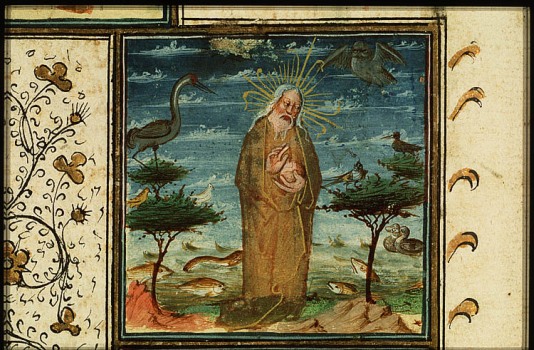
The creation of
fowl and water animals.
1. And God said
"Let the earth bring forth the living creature after his kind, cattle
and creeping things, and beast of the earth after his kind; and it was
so." The command of God advanced step by step and earth thus received
her adornment.
Yesterday it was said, "Let the waters produce moving things," and
to-day "let the earth bring forth the living creature." Is the earth
then alive? And are the mad-minded Manichaeans right in giving it a
soul? At these words "Let the earth bring forth," it did not produce a
germ contained in it, but He who gave the order at the same time gifted
it with the grace and power to bring forth. When the earth had heard
this command "Let the earth bring forth grass and the tree yielding
fruit," it was not grass that it had hidden in it that it caused to
spring forth, it did not bring to the surface a palm tree, an oak, a
cypress, hitherto kept back in its depths. It is the word of God which
forms the nature of things created. "Let the earth bring forth;" that
is to say not that she may bring forth that which she has but that she
may acquire that which she lacks, when God gives her the power. Even so
now, "Let the earth bring forth the living creature," not the living
creature that is contained in herself, but that which the command of
God gives her. Further, the Manichaeans contradict themselves, because
if the earth has brought forth the life, she has left herself despoiled
of life. Their execrable doctrine needs no demonstration.
But why did the waters receive the command to bring forth the moving
creature that hath life and the earth to bring forth the living
creature? We conclude that, by their nature, swimming creatures appear
only to have an imperfect life, because they live in the thick element
of water. They are hard of hearing, and their sight is dull because
they see through the water; they have no memory, no imagination, no
idea of social intercourse. Thus divine language appears to indicate
that, in aquatic animals, the carnal life originates their psychic
movements, whilst in terrestrial animals, gifted with a more perfect
life, the soul enjoys supreme authority. In fact the greater part of
quadrupeds have more power of penetration in their senses; their
apprehension of present objects is keen, and they keep all exact
remembrance of the past. It seems therefore, that God, after the
command given to the waters to bring forth moving creatures that have
life, created simply living bodies for aquatic animals, whilst for
terrestrial animals He commanded the soul to exist and to direct the
body, showing thus that the inhabitants of the earth are gifted with
greater vital force. Without doubt terrestrial animals are devoid of
reason. At the same tithe how many affections of the soul each one of
them expresses by the voice of nature! They express by cries their joy
and sadness, recognition of what is familiar to them, the need of food,
regret at being separated from their companions, and numberless
emotions. Aquatic animals, on the contrary, are not only dumb; it is
impossible to tame them, to teach them, to train them for man's
society. "The ox knoweth his owner, and the ass his master's crib." But
the fish does not know who feeds him. The ass knows a familiar voice,
he knows the road which he has often trodden, and even, if man loses
his way, he sometimes serves him as a guide. His hearing is more acute
than that of any other terrestrial animal. What animal of the sea can
show so much rancour and resentment as the camel? The camel conceals
its resentment for a long time after it has been struck, until it finds
an opportunity, and then repays the wrong. Listen, you whose heart does
not pardon, you who practise vengeance as a virtue; see what you
resemble when you keep your anger for so long against your neighbour
like a spark, hidden in the ashes, and only waiting for fuel to set
your heart ablaze!
2. "Let the earth bring forth a living soul." Why did the earth produce
a living soul? so that you may make a difference between the soul of
cattle and that of man. You will soon learn how the human soul was
formed; hear now about the soul of creatures devoid of reason. Since,
according to Scripture, "the life of every creature is in the blood,"
as the blood when thickened changes into flesh, and flesh when
corrupted decomposes into earth, so the soul of beasts is naturally an
earthy substance. "Let the earth bring forth a living soul." See the
affinity of the soul with blood, of blood with flesh,of flesh with
earth; and remounting in an inverse sense from the earth to the flesh,
from the flesh to the blood, from the blood to the soul, you will find
that the soul of beasts is earth. Do not suppose that it is older than
the essence of their body, nor that it survives the dissolution of the
flesh; avoid the nonsense of those arrogant philosophers who do not
blush to liken their soul to that of a dog; who say that they have been
formerly themselves women, shrubs, fish. Have they ever been fish? I do
not know; but I do not fear to affirm that in their writings they show
less sense than fish. "Let the earth bring forth the living creature."
Perhaps many of you ask why there is such a long silence in the middle
of the rapid rush of my discourse. The more studious among my auditors
will not be ignorant of the reason why words fail me. What! Have I not
seen them look at each other, and make signs to make me look at them,
and to remind me of what I have passed over? I have forgotten a part of
the creation, and that one of the most considerable, and my discourse
was almost finished without touching upon it. "Let the waters bring
forth abundantly the moving creature that hath life and fowl that may
fly above the earth in the open firmament, of heaven." I spoke of fish
as long as eventide allowed: to-day we have passed to the examination
of terrestrial animals; between the two, birds have escaped us. We are
forgetful like travellers who unmindful of some important object, are
obliged, although they be far on their road, to retrace their steps,
punished for their negligence by the weariness of the journey. So we
have to turn back. That which we have omitted is not to be despised. It
is the third part of the animal creation, if indeed there are three
kinds of animals, land, winged and water.
"Let the waters" it is said "bring forth abundantly moving creature
that hath life and fowl that may fly above the earth in the open
firmament of heaven." Why do the waters give birth also to birds?
Because there is, so to say, a family link between the creatures that
fly and those that swim. In the same way that fish cut the waters,
using their fins to carry them forward and their tails to direct their
movements round and round and straightforward, so we see birds float in
the air by the help of their wings. Both endowed with the property of
swimming, their common derivation from the waters has made them of one
family. At the same time no bird is without feet, because finding all
its food upon the earth it cannot do without their service. Rapacious
birds have pointed claws to enable them to close on their prey; to the
rest has been given the indispensable ministry of feet to seek their
food and to provide for the other needs of life. There are a few who
walk badly, whose feet are neither suitable for walking nor for
preying. Among this number are swallows, incapable of walking and
seeking their prey, and the birds called swifts who live on little
insects carried about by the air. As to the swallow, its flight, which
grazes the earth, fulfils the function of feet.
3. There are also innumerable kinds of birds. If we review them all, as
we have partly done the fish, we shall find that under one name, the
creatures which fly differ infinitely in size, form and colour; that in
their life, their actions and their manners, they present a variety
equally beyond the power of description. Thus some have tried to
imagine names for them of which the singularity and the strangeness
might, like brands, mark the distinctive character of each kind known.
Some, as eagles, have been called Schizoptera, others Dermoptera, as
the bats, others Ptilota, as wasps, others Coleoptera, as beetles and
all those insects which brought forth in cases and coverings, break
their prison to fly away in liberty. But we have enough words of common
usage to characterise each species and to mark the distinction which
Scripture sets up between clean and unclean birds. Thus the species of
carnivora is of one sort and of one constitution which suits their
manner of living, sharp talons, curved beak, swift wings, allowing them
to swoop easily upon their prey and to tear it up after having seized
it. The constitution of those who pick up seeds is different, and again
that of those who live on all they come across. What a variety in all
these creatures! Some are gregarious, except the birds of prey who know
no other society than conjugal union; but innumerable kinds, doves,
cranes, starlings, jackdaws, like a common life. Among them some live
without a chief and in a sort of independence; others, as cranes, do
not refuse to submit themselves to a leader. And a fresh difference
between them is that some are stationary and non-migratory; others
undertake long voyages and the greater part of them, migrate at the
approach of winter. Nearly all birds can be tamed and are capable of
training, except the weakest, who through fear and timidity cannot bear
the constant and annoying contact of the hand. Some like the society of
man and inhabit our dwellings; others delight in mountains and in
desert places. There is a great difference too in their peculiar notes.
Some twitter and chatter, others are silent, some have a melodious and
sonorous voice, some are wholly inharmonious and incapable of song;
some imitate the voice of many taught their mimicry either by nature or
training; others always give forth the same monotonous cry. The cock is
proud; the peacock is vain of his beauty; doves and fowls are amorous,
always seeking each other's society. The partridge is deceitful and
jealous, lending perfidious help to the huntsmen to seize their prey.
4. What a variety, I have said, in the actions and lives of flying
creatures. Some of these unreasoning creatures even have a government,
if the feature of government is to make the activity of all the
individuals centre in one common end. This may be observed in bees.
They have a common dwelling place; they fly in the air together, they
work at the same work together; and what is still more extraordinary is
that they give themselves to these labours under the guidance of a king
and superintendent, and that they do not allow themselves to fly to the
meadows without seeing if the king is flying at their head. As to this
king, it is not election that gives him this authority; ignorance on
the part of the people often puts the worst man in power; it is not
fate; the blind decisions of fate often give authority to the most
unworthy. It is not heredity that places him on the throne; it is only
too common to see the children of kings, corrupted by luxury and
flattery, living in ignorance of all virtue. It is nature which makes
the king of the bees, for nature gives him superior size, beauty, and
sweetness of character. He has a sting like the others, but he does not
use it to revenge himself. It is a principle of natural and unwritten
law, that those who are raised to high office, ought to be lenient in
punishing. Even bees who do not follow the example of their king,
repent without delay of their imprudence, since they lose their lives
with their sting. Listen, Christians, you to whom it is forbidden to
"recompense evil for evil" and commanded "to overcome evil with good."
Take the bee for your model, which constructs its cells without
injuring any one and without interfering with the goods of others. It
gathers openly wax from the flowers with its mouth, drawing in the
honey scattered over them like dew, and injects it into the hollow of
its cells. Thus at first honey is liquid; time thickens it and gives it
its sweetness. The book of Proverbs has given the bee the most
honourable and the best praise by calling her wise and industrious. How
much activity she exerts in gathering this precious nourishment, by
which both kings and men of low degree are brought to health! How great
is the art and cunning she displays in the construction of the store
houses which are destined to receive the honey! After having spread the
wax like a thin membrane, she distributes it in contiguous compartments
which, weak though they are, by their number and by their mass, sustain
the whole edifice. Each cell in fact holds to the one next to it, and
is separated by a thin partition; we thus see two or three galleries of
cells built one upon the other. The bee takes care not to make one vast
cavity, for fear it might break trader the weight of the liquid, and
allow it to escape. See how the discoveries of geometry are mere
by-works to the wise bee!
The rows of honey-comb are all hexagonal with equal sides. They do not
bear on each other in straight lines, lest the supports should press on
empty spaces between and give way; but the angles of the lower hexagons
serve as foundations and bases to those which rise above, so as to
furnish a sure support to the lower mass, and so that each cell may
securely keep the liquid honey.
5. How shall we make an exact review of all the peculiarities of the
life of birds? During the night cranes keep watch in turn; some sleep,
others make the rounds and procure a quiet slumber for their
companions. After having finished his duty, the sentry utters a cry,
and goes to sleep, and the one who awakes, in his turn, repays the
security which he has enjoyed. You will see the same order reign in
their flight. One leads the way, and when it has guided the flight of
the flock for a certain time, it passes to the rear, leaving to the one
who comes after the care of directing the march.
The conduct of storks comes very near intelligent reason. In these
regions the same season sees them all migrate. They all start at one
given signal. And it seems to me that our crows, serving them as
escort. go to bring them back, and to help them against the attacks of
hostile birds. The proof is that in this season not a single crow
appears, and that they return with wounds, evident marks of the help
and of the assistance that they have lent. Who has explained to them
the laws of hospitality? Who has threatened them with the penalties of
desertion? For not one is missing from the company. Listen, all
inhospitable hearts, ye who shut your doors, whose house is never open
either in the winter or in the night to travellers. The solicitude of
storks for their old would be sufficient, if our children would reflect
upon it, to make them love their parents; because there is no one so
failing in good sense, as not to deem it a shame to be surpassed in
virtue by birds devoid of reason. The storks surround their father,
when old age makes his feathers drop off, warm him with their wings,
and provide abundantly for his support, and even in their flight they
help him as much as they are able, raising him gently on each side upon
their wings, a conduct so notorious that it has given to gratitude the
name of "antipelargosis." Let no one lament poverty; let not the man
whose house is bare despair of his life, when he considers the industry
of the swallow. To build her nest, she brings bits of straw in her
beak; and, as she cannot raise the mud in her claws, she moistens the
end of her wings in water and then rolls in very fine dust and thus
procures mud. After having united, little by little, the bits of straw
with this mud, as with glue, she feeds her young; and if any one of
them has its eyes injured, she has a natural remedy to heal the sight
of her little ones.
This sight ought to warn you not to take to evil ways on account of
poverty; and, even if you are reduced to the last extremity, not to
lose all hope; not to abandon yourself to inaction and idleness, but to
have recourse to God. If He is so bountiful to the swallow, what will
He not do for those who call upon Him with all their heart?
The halcyon is a sea bird, which lays its eggs along the shore, or
deposits them in the sand. And it lays in the middle of winter, when
the violence of the winds dashes the sea against the land. Yet all
winds are hushed, and the wave of the sea grows calm, during the seven
days that the halcyon sits.
For it only takes seven days to hatch the young. Then, as they are in
need of food so that they may grow, God, in His munificence, grants
another seven days to this tiny animal. All sailors know this, and call
these days halcyon days. If divine Providence has established these
marvellous laws in favour of creatures devoid of reason, it is to
induce you to ask for your salvation from God. Is there a wonder which
He will not perform for you--you have been made in His image, when for
so little a bird, the great, the fearful sea is held in check and is
commanded in the midst of winter to be calm.
6. It is said that the turtle-dove, once separated from her mate, does
not contract a new union, but remains in widowhood, in remembrance of
her first alliance. Listen, O women! What veneration for widowhood,
even in these creatures devoid of reason, how they prefer it to an
unbecoming multiplicity of marriages. The eagle shows the greatest
injustice in the education which she gives to her young. When she has
hatched two little ones, she throws one on the ground, thrusting it out
with blows from her wings, and only acknowledges the remaining one. It
is the difficulty of finding food which has made her repulse the
offspring she has brought forth. But the osprey, it is said, will not
allow it to perish, she carries it away and brings it up with her young
ones. Such are parents who, finder the plea of poverty, expose their
children such are again those who, in the distribution of their
inheritance, make unequal divisions. Since they have given existence
equally to each of their children, it is just that they should equally
and without preference furnish them with the means of livelihood.
Beware of imitating the cruelty of birds with hooked talons. When they
see their young are from henceforth capable of encountering the air in
their flight, they throw them out of the nest, striking them and
pushing them with their wings, and do not take the least care of them.
The love of the crow for its young is laudable! When they begin to fly,
she follows them, gives them food, and for a very long time provides
for their nourishment. Many birds have no need of union with males to
conceive. But their eggs are unfruitful, except those of vultures, who
more often, it is said, bring forth without coupling: and this although
they have a very long life, which often reaches its hundredth year.
Note and retain, I pray you, this point in the history of birds; and if
ever you see any one laugh at our mystery, as if it were impossible and
contrary to nature that a virgin should become a mother without losing
the purity of her virginity, bethink you that He who would save the
faithful by the foolishness of preaching, has given us beforehand in
nature a thousand reasons for believing in the marvellous.
7. "Let the waters bring forth the moving creatures that have life, and
fowl that may fly above the earth in the open firmament of heaven."
They received the command to fly above the earth because earth provides
them with nourishment. "In the firmament of heaven," that is to say, as
we have said before, in that part of the air called ouranos, heaven,
from the word oran, which means to see; called firmament, because the
air which extends over our heads, compared to the aether, has greater
density, and is thickened by the vapours which exhale from the earth.
You have then heaven adorned, earth beautified, the sea peopled with
its own creatures, the air filled with birds which scour it in every
direction. Studious listener, think of all these creations which God
has drawn out of nothing, think of all those which my speech has left
out, to avoid tediousness, and not to exceed my limits; recognise
everywhere the wisdom of God; never cease to wonder, and, through,
every creature, to glorify the Creator.
There are some kinds of birds which live by night in the midst of
darkness; others which fly by day in fall light. Bats, owls,
night-ravens are birds of night: if by chance you cannot sleep, reflect
on these nocturnal birds and their peculiarities and glorify their
Maker. How is it that the nightingale is always awake when sitting on
her eggs, passing the night in a continual melody? How is it that one
animal, the bat, is at the same time quadruped and fowl? That it is the
only one of the birds to have teeth? That it is viviparous like
quadrupeds, and traverses the air, raising itself not upon wings, but
upon a kind of membrane? What natural love bats have for each other!
How they interlace like a chain and hang the one upon the other! A very
rare spectacle among men, who flit the greater part prefer individual
and private life to the union of common life. Have not those who give
themselves up to vain science the eyes of owls? The sight of the owl,
piercing during the night time, is dazzled by the splendour of the sun;
thus the intelligence of these men, so keen to contemplate vanities, is
blind in presence of the true light.
During the day, also, how easy it is for you to admire the Creator
everywhere! See how the domestic cock calls you to work with his shrill
cry, and how, forerunner of the sun, and early as the traveller, he
sends forth labourers to the harvest! What vigilance in geese! With
what sagacity they divine secret dangers! Did they not once upon a time
save the imperial city? When enemies were advancing by subterranean
passages to possess themselves of the capitol of Rome, did not geese
announce the danger? Is there any kind of bird whose nature offers
nothing for our admiration? Who announces to the vultures that there
will be carnage when men march in battle array against one another? You
may see flocks of vultures following armies and calculating the result
of warlike preparations; a calculation very nearly approaching to human
reasoning. How can I describe to you the fearful invasions of locusts,
which rise everywhere at a given signal, and pitch their camps all over
a country? They do not attack crops until they have received the divine
command. Or shall I describe how the remedy for this curse, the thrush,
follows them with its insatiable appetite, and the devouring nature
that the loving God has given it in His kindness for men? How does the
grasshopper modulate its song? Why is it more melodious at midday owing
to the air that it breathes in dilating its chest?
But it appears to me that in wishing to describe the marvels of winged
creatures, I remain further behind than I should if my feet had tried
to match the rapidity of their flight. When you see bees, wasps, in
short all those flying creatures called insects, because they have an
incision all around reflect that they have neither respiration nor
lungs, and that they are supported by air through all parts of their
bodies. Thus they perish. if they are covered with oil, because it
stops up their pores. Wash them with vinegar, the pores reopen and the
animal returns to life. Our God has created nothing unnecessarily and
has omitted nothing that is necessary. If now you cast your eyes upon
aquatic creatures, you will find that their organization is quite
different. Their feet are not split like those of the crow, nor hooked
like those of the carnivora, but large and membraneous; therefore they
can easily swim, pushing the water with the membranes of their feet as
with oars. Notice how the swan plunges his neck into the depths of the
water to draw his food from it, and you will understand the wisdom of
the Creator in giving this creature a neck longer than his feet, so
that he may throw it like a line, and take the food hidden at the
bottom of the water.
8. If we simply read the words of Scripture we find only a few short
syllables. "Let the waters bring forth fowl that may fly above the
earth in the open firmament of heaven," but if we enquire into the
meaning of these words, then the great wonder of the wisdom of the
Creator appears. What a difference He has foreseen among winged
creatures! How He has divided them by kinds! How He has characterized
each one of them by distinct qualities! But the day will not suffice me
to recount the wonders of the air. Earth is calling me to describe wild
beasts, reptiles and cattle, ready to show us in her turn sights
rivalling those of plants, fish, and birds. "Let the earth bring forth
the living soul" of domestic animals, of wild beasts, and of reptiles
after their kind. What have you to say, you who do not believe in the
change that Paul promises you in the resurrection, when you see so many
metamorphoses among creatures of the air? What are we not told of the
horned worm of India! First it changes into a caterpillar, then becomes
a buzzing insect, and not content with this form, it clothes itself,
instead of wings, with loose, broad plates. Thus, O women, when you are
seated busy with your weaving, I mean of the silk which is sent you by
the Chinese to make your delicate dresses, remember the metamorphoses
of this creature, conceive a clear idea of the resurrection, and do not
refuse to believe in the change that Paul announces for all men.
But I am ashamed to see that my discourse oversteps the accustomed
limits; if I consider the abundance of matters on which I have just
discoursed to you, I feel that I am being borne beyond bounds; but when
I reflect upon the inexhaustible wisdom which is displayed in the works
of creation, I seem to be but at the beginning of my story.
Nevertheless, I have not detained you so long without profit. For what
would you have done until the evening? You are not pressed by guests,
nor expected at banquets. Let me then employ this bodily fast to
rejoice your souls. You have often served the flesh for pleasure,
to-day persevere in the ministry of the soul. "Delight thyself also in
the Lord and he shall give thee the desire of thine heart." Do you love
riches? Here are spiritual riches. "The judgments of the Lord are true
and righteous altogether. More to be desired are they than gold and
precious stones." Do you love enjoyment and pleasures? Behold the
oracles of the Lord, which, for a healthy soul, are "sweeter than honey
and the honey-comb." If I let you go, and if I dismiss this assembly,
some will run to the dice, where they will find bad language, sad
quarrels and the pangs of avarice. There stands the devil, inflaming
the fury of the players with the dotted bones, transporting the same
sums of money from one side of the table to the other, now exalting one
with victory and throwing the other into despair, now swelling the
first with boasting and covering his rival with confusion. Of what use
is bodily fasting and filling the soul with innumerable evils? He who
does not play spends his leisure elsewhere. What frivolities come from
his mouth! What follies strike his ears Leisure without the fear of the
Lord is, for those who do not know the value of time a school of vice.
I hope that my words will be profitable; at least by occupying you here
they have prevented you from sinning. Thus the longer I keep you, the
longer you are out of the way of evil.
An equitable judge will deem that I have said enough, not if he
considers the riches of creation, but if he thinks of our weakness and
of the measure one ought to keep in that which tends to pleasure. Earth
has welcomed you with its own plants, water with its fish, air with its
birds; the continent in its turn is ready to offer you as rich
treasures. But let us put an end to this morning banquet, for fear
satiety may blunt your taste for the evening one. May He who has filled
all with the works of His creation and has left everywhere visible
memorials of His wonders, fill your hearts with all spiritual joys in
Jesus Christ, our Lord, to whom belong glory and power, world without
end. Amen.
|
|