|
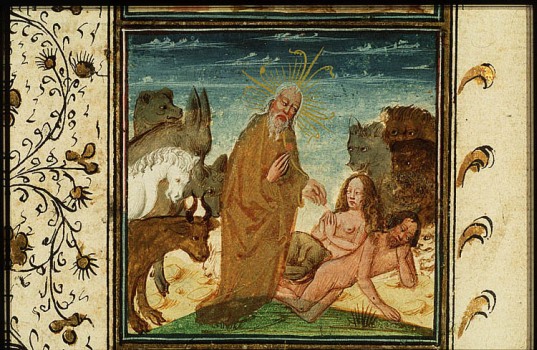
The creation of
terrestrial animals.
1. How did you
like the fare of my morning's discourse? It seemed to me that I had the
good intentions of a poor giver of a feast, who, ambitious of having
the credit of keeping a good table saddens his guests by the poor
supply of the more expensive dishes. In vain he lavishly covers his
table with his mean fare; his ambition only shows his folly. It is for
you to judge if I have shared the same fate. Yet, whatever my discourse
may have been, take care lest you disregard it. No one refused to sit
at the table of Elisha; and yet he only gave his friends wild
vegetables. I know the laws of allegory, though less by myself than
from the works of others. There are those truly, who do not admit the
common sense of the Scriptures, for whom water is not water, but some
other nature, who see in a plant, in a fish, what their fancy wishes,
who change the nature of reptiles and of wild beasts to suit their
allegories, like the interpreters of dreams who explain visions in
sleep to snake them serve their own ends. For me grass is grass; plant,
fish, wild beast, domestic animal, I take all in the literal sense.
"For I am not ashamed of the gospel." Those who have written about the
nature of the universe have discussed at length the shape of the earth.
If it be spherical or cylindrical, if it resemble a disc and is equally
rounded in all parts, or if it has the forth of a winnowing basket and
is hollow in the middle; all these conjectures have been suggested by
cosmographers, each one upsetting that of his predecessor. It will not
lead me to give less importance to the creation of the universe, that
the servant of God, Moses, is silent as to shapes; he has not said that
the earth is a hundred and eighty thousand furlongs in circumference;
he has not measured into what extent of air its shadow projects itself
whilst the sun revolves around it, nor stated how this shadow, casting
itself upon the moon, produces eclipses. He has passed over in silence,
as useless, all that is unimportant for us. Shall I then prefer foolish
wisdom to the oracles of the Holy Spirit? Shall I not rather exalt Him
who, not wishing to fill our minds with these vanities, has regulated
all the economy of Scripture in view of the edification and the making
perfect of our souls? It is this which those seem to me not to have
understood, who, giving themselves up to the distorted meaning of
allegory, have undertaken to give a majesty of their own invention to
Scripture. It is to believe themselves wiser than the Holy Spirit, and
to bring forth their own ideas under a pretext of exegesis. Let us hear
Scripture as it has been written.
2. "Let the earth bring forth thee living creature." Behold the word of
God pervading creation, beginning even then the efficacy which is seen
displayed to-day, and will be displayed to the end of the world! As a
ball, which one pushes, if it meet a declivity, descends, carried by
its form and the nature of the ground and does not stop until it has
reached a level surface; so nature, once put in motion by the Divine
command, traverses creation with an equal step, through birth and
death, and keeps up the succession of kinds through resemblance, to the
last. Nature always makes a horse succeed to a horse, a lion to a lion,
an eagle to an eagle, and preserving each animal by these uninterrupted
successions she transmits it to the end of all things. Animals do not
see their peculiarities destroyed or effaced by any length of time;
their nature, as though it had been just constituted, follows the
course of ages, for ever young. "Let the earth bring forth the living
creature." This command has continued and earth does not cease to obey
the Creator. For, if there are creatures which are successively
produced by their predecessors, there are others that even to-day we
see born from the earth itself. In wet weather she brings forth
grasshoppers and an immense number of insects which fly in the air and
have no names because they are so small; she also produces mice and
frogs. In the environs of Thebes in Egypt, after abundant rain in hot
weather, the country is covered with field mice. We see mud alone
produce eels; they do not proceed from an egg, nor in any other manner;
it is the earth alone which gives them birth. Let the earth produce a
living creature."
Cattle are terrestrial and bent towards the earth. Man, a celestial
growth, rises superior to them as much by the mould of his bodily
conformation as by the dignity of his soul. What is the form of
quadrupeds? Their head is bent towards the earth and looks towards
their belly, and only pursues their belly's good. Thy head, O man! is
turned towards heaven; thy eyes look up. When therefore thou degradest
thyself by the passions of the flesh, slave of thy belly, and thy
lowest parts, thou approachest animals without reason and becomest like
one of them. Thou art called' to more noble cares; "seek those things
which are above where Christ sitteth." Raise thy soul above the earth;
draw from its natural conformation the rule of thy conduct; fix thy
conversation in heaven. Thy true country is the heavenly Jerusalem; thy
fellow-citizens and thy compatriots are "the first-born which are
written in heaven."
3. "Let the earth bring forth the living creature. Thus when the soul
of brutes appeared it was not concealed in the earth, but it was born
by the command of God. Brutes have one and the same soul of which the
common characteristic is absence of reason. But each animal is
distinguished by peculiar qualities. The ox is steady, the ass is lazy,
the horse has strong passions, the wolf cannot be tamed, the fox is
deceitful, the stag timid, the ant industrious, the dog grateful and
faithful in his friendships. As each animal was created the distinctive
character of his nature appeared in him in due measure; in the lion
spirit, taste for solitary life, an unsociable character. True tyrant
of animals, he, in his natural arrogance, admits but few to share his
honours. He disdains his yesterday's food and never returns to the
remains of the prey. Nature has provided his organs of voice with such
great force that often much swifter animals are caught by his roaring
alone. The panther, violent and impetuous in his leaps, has a body
fitted for his activity and lightness, in accord with the movements of
his soul. The bear has a sluggish nature, ways of its own, a sly
character, and is very secret; therefore it has an analogous body,
heavy, thick, without articulations such as are necessary for a cold
dweller in dens.
When we consider the natural and innate care that these creatures
without reason take of their lives we shall be induced to watch over
ourselves and to think of the salvation of our souls; or rather we
shall be the more condemned when we are found falling short even of the
imitation of brutes. The bear, which often gets severely wounded, cares
for himself and cleverly fills the wounds with mullein, a plant whose
nature is very astringent. You will also see the fox heal his wounds
with droppings from the pine tree; the tortoise, gorged with the flesh
of the viper, finds in the virtue of marjoram a specific against this
venomous animal and the serpent heals sore eyes by eating fennel.
And is not reasoning intelligence eclipsed by animals in their
provision for atmospheric changes? Do we not see sheep, when winter is
approaching, devouring grass with avidity as if to make provision for
future scarcity? Do we not also see oxen, long confined in the winter
season, recognise the return of spring by a natural sensation, and look
to the end of their stables towards the doors, all turning their heads
there by common consent? Studious observers have remarked that the
hedgehog makes an opening at the two extremities of his hole. If the
wind from the north is going to blow he shuts up the aperture which
looks towards the north; if the south wind succeeds it the animal
passes to the northern door. What lesson do these animals teach man?
They not only show us in our Creator a care which extends to all
beings, but a certain presentiment of future even in brutes. Then we
ought not to attach ourselves to this present life and ought to give
all heed to that which is to come. Will you not be industrious for
yourself, O man? And will you not lay up in the present age rest in
that which is to come, after having seen the example of the ant? The
ant during summer collects treasures for winter. Far from giving itself
up to idleness, before this season has made it feel its severity, it
hastens to work with an invincible zeal until it has abundantly filled
its storehouses. Here again, how far it is from being negligent! With
what wise foresight it manages so as to keep its provisions as long as
possible! With its pincers it cuts the grains in half, for fear lest
they should germinate and not serve for its food. If they are damp it
dries them; and it does not spread them out in all weathers, but when
it feels that the air will keep of a mild temperature. Be sure that you
will never see rain fall from the clouds so long as the ant has left
the grain out.
What language can attain to the marvels of the Creator? What ear could
understand them? And what time would be sufficient to relate them? Let
us say, then, with the prophet, "O Lord, how manifold are thy works! in
wisdom hast thou made them all." We shall not be able to say in
self-justification, that we have learnt useful knowledge in books,
since the untaught law of nature makes us choose that which is
advantageous to us. Do you know what good you ought to do your
neighbour? The good that you expect from him yourself. Do you know what
is evil? That which you would not wish another to do to you. Neither
botanical researches nor the experience of simples have made animals
discover those which are useful to them; but each knows naturally what
is salutary and marvellously appropriates what suits its nature.
4. Virtues exist in us also by nature, and the soul has affinity with
them not by education, but by nature herself. We do not need lessons to
hate illness, but by ourselves we repel what afflicts us, the soul has
no need of a master to teach us to avoid vice. Now all vice is a
sickness of the sold as virtue is its health. Thus those have defined
health well who have called it a regularity in the discharge of natural
functions; a definition that can be applied without fear to the good
condition of the soul. Thus, without having need of lessons, the soul
can attain by herself to what is fit and conformable to nature. Hence
it comes that temperance everywhere is praised, justice is in honour,
courage admired, and prudence the object of all aims; virtues which
concern the soul more than health concerns the body. Children love your
parents, and you, "parents provoke not your children to wrath." Does
not nature say the same? Paul teaches us nothing new; he only tightens
the links of nature. If the lioness loves her cubs, if the she wolf
fights to defend her little ones, what shall man say who is unfaithful
to the precept and violates nature herself; or the son who insults the
old age of his father; or the father whose second marriage has made him
forget his first children?
With animals invincible affection unites parents with children. It is
the Creator, God Himself, who substitutes the strength of feeling for
reason in them. From whence it comes that a lamb as it bounds from the
fold, in the midst of a thousand sheep recognises the colour and the
voice of its mother, runs to her, and seeks its own sources of milk. If
its mother's udders are dry, it is content, and, without stopping,
passes by more abundant ones. And how does the mother recognise it
among the many lambs? All have the same voice, the same colour, the
same smell, as far at least as regards our sense of smell. Yet there is
in these animals a more subtle sense than our perception which makes
them recognise their own. The little dog has as yet no teeth,
nevertheless he defends himself with his mouth against any one who
teases him. The calf has as yet no horns, nevertheless he already knows
where his weapons will grow. Here we have evident proof that the
instinct of animals is innate, and that in all beings there is nothing
disorderly, nothing unforeseen. All bear the marks of the wisdom of the
Creator, and show that they have come to life with the means of
assuring their preservation.
The dog is not gifted with a share of reason; but with him instinct has
the power of reason. The dog has learnt by nature the secret of
elaborate inferences, which sages of the world, after long years of
study, have hardly been able to disentangle. When the dog is on the
track of game, if he sees it divide in different directions, he
examines these different paths, and speech alone fails him to announce
his reasoning. The creature, he says, is gone here or there or in
another direction. It is neither here nor there; it is therefore in the
third direction. And thus, neglecting the false tracks, he discovers
the true one. What more is done by those who, gravely occupied in
demonstrating theories, trace lines upon the dust and reject two
propositions to show that the third is the true one?
Does not the gratitude of the dog shame all who are ungrateful to their
benefactors? Many are said to have fallen dead by their murdered
masters in lonely places. Others, when a crime has just been committed,
have led those who were searching for the murderers, and have caused
the criminals to be brought to justice. What will those say who, not
content with not loving the Master who has created them and nourished
them, have for their friends men whose mouth attacks the Lord, sitting
at the same table with them, and, whilst partaking of their food,
blaspheme Him who has given it to them?
5. But let us return to the spectacle of creation. The easiest animals
to catch are the most productive. It is on account of this that hares
and wild goats produce many little ones, and that wild sheep have
twins, for fear lest these species should disappear, consumed by
carnivorous animals. Beasts of prey, on the contrary, produce only a
few and a lioness with difficulty gives birth to one lion; because, if
they say truly, the cub issues from its mother by tearing her with its
claws; and vipers are only born by gnawing through the womb, inflicting
a proper punishment on their mother. Thus in nature all has been
foreseen, all is the object of continual care. If you examine the
members even of animals, you will find that the Creator has given them
nothing superfluous, that He has omitted nothing that is necessary. To
carnivorous animals He has given pointed teeth which their nature
requires for their support. Those that are only half furnished with
teeth have received several distinct receptacles for their food. As it
is not broken up enough in the first, they are gifted with the power of
returning it after it has been swallowed, and it does not assimilate
until it has been crushed by rumination. The first, second, third, and
fourth stomachs of ruminating animals do not remain idle; each one of
them fulfils a necessary function. The neck of the camel is long so
that it may lower it to its feet and reach the grass on which it feeds.
Bears, lions, tigers, all animals of this sort, have short necks buried
in their shoulders; it is because they do not live upon grass and have
no need to bend down to the earth; they are carnivorous and eat the
animals upon whom they prey.
Why has the elephant a trunk? This enormous creature, the greatest of
terrestrial animals, created for the terror of those who meet it, is
naturally huge and fleshy. If its neck was large and in proportion to
its feet it would be difficult to direct, and would be of such an
excessive weight that it would make it lean towards the earth. As it
is, its head is attached to the spine of the back by short vertebrae
and it has its trunk to take the place of a neck, and with it it picks
up its food and draws up its drink. Its feet, without joints, like
united columns, support the weight of its body. If it were supported on
lax and flexible legs, its joints would constantly give way, equally
incapable of supporting its weight, should it wish either to kneel or
rise. But it has under the foot a little ankle joint which takes the
place of the leg and knee joints whose mobility would never have
resisted this enormous and swaying mass. Thus it had need of this nose
which nearly touches its feet. Have you seen them in war marching at
the head of the phalanx, like living towers, or breaking the enemies'
battalions like mountains of flesh with their irresistible charge? If
their lower parts were not in accordance with their size they would
never have been able to hold their own. Now we are told that the
elephant lives three hundred years and more, another reason for him to
have solid and unjointed feet. But, as we have said, his trunk, which
has the form and the flexibility of a serpent, takes its food from the
earth and raises it up. Thus we are right in saying that it is
impossible to find anything superfluous or wanting in creation. Well!
God has subdued this monstrous animal to us to such a point that he
understands the lessons and endures the blows we give him; a manifest
proof that the Creator has submitted all to our rule, because we have
been made in His image. It is not in great animals only that we see
unapproachable wisdom; no less wonders are seen in the smallest. The
high tops of the mountains which, near to the clouds and continually
beaten by the winds, keep up a perpetual winter, do not arouse more
admiration in me than the hollow valleys, which escape the storms of
lofty peaks and preserve a constant mild temperature. In the same way
in the constitution of animals I am not more astonished at the size of
the elephant, than at the mouse, who is feared by the elephant, or at
the scorpion's delicate sting, which has been hollowed like a pipe by
the supreme artificer to throw venom into the wounds it makes. And let
nobody accuse the Creator of having produced venomous animals,
destroyers and enemies of our life. Else let them consider it a crime
in the schoolmaster when he disciplines the restlessness of youth by
the use of the rod and whip to maintain order.
6. Beasts bear witness to the faith. Hast thou confidence in the Lord?
"Thou shalt walk upon the asp and the basilisk and thou shalt trample
under feet the lion and the dragon." With faith thou hast the power to
walk upon serpents and scorpions. Do you not see that the viper which
attached itself to the hand of Paul, whilst he gathered sticks, did not
injure him, because it found the saint full of faith? If you have not
faith, do not fear beasts so much as your faithlessness, which renders
you susceptible of all corruption. But I see that for a long time you
have been asking me for an account of the creation of man, and I think
I can hear you all cry in your hearts, We are being taught the nature
of our belongings, but we are ignorant of ourselves. Let me then speak
of it, since it is necessary, and let me put an end to my hesitation.
In truth the most difficult of sciences is to know one's self. Not only
our eye, from which nothing outside us escapes, cannot see itself; but
our mind, so piercing to discover the sins of others, is slow to
recognise its own faults. Thus my speech, after eagerly investigating
what is external to myself, is slow and hesitating in exploring my own
nature. Yet the beholding of heaven and earth does not make us know God
better than the attentive study of our being does; I am, says the
Prophet, fearfully and wonderfully made; that is to say, in observing
myself I have known Thy infinite wisdom. And God said "Let us make
man." Does not the light of theology shine, in these words, as through
windows; and does not the second Person show Himself in a mystical way,
without yet manifesting Himself until the great day? Where is the Jew
who resisted the truth and pretended that God was speaking to Himself?
It is He who spoke, it is said, and it is He who made. "Let there be
light and there was light." But then their words contain a manifest
absurdity. Where is the smith, the carpenter, the shoemaker, who,
without help and alone before the instruments of his trade, would say
to himself; let us make the sword, let us put together the plough, let
us make the boot? Does he not perform the work of his craft in silence?
Strange folly, to say that any one has seated himself to command
himself, to watch over himself, to constrain himself, to hurry himself,
with the tones of a master! But the unhappy creatures are not afraid to
calumniate the Lord Himself. What will they not say with a tongue so
well practised in lying? Here, however, words stop their mouth; "And
God said let us make man." Tell me; is there then only one Person? It
is not written "Let man be made," but, "Let us make man." The preaching
of theology remains enveloped in shadow before the appearance of him
who was to be instructed, but, now, the creation of man is expected,
that faith unveils herself and the dogma of truth appears in all its
light. "Let us make "O enemy of Christ, man.O y of hear God speaking to
His Co-operator, to Him by Whom also He made the worlds, Who upholds
all things by the word of His power. But He does not leave the voice of
true religion without answer. Thus the Jews, race hostile to truth,
when they find themselves pressed, act like beasts enraged against man,
who roar at the bars of their cage and show the cruelty and the
ferocity of their nature, without being able to assuage their fury.
God, they say, addresses Himself to several persons; it is to the
angels before Him that He says, "Let us make man." Jewish fiction! a
fable whose frivolity shows whence it has come. To reject one person,
they admit many. To reject the Son, they raise servants to the dignity
of counsellors; they make of our fellow slaves the agents in our
creation. The perfect man attains the dignity of an angel; but what
creature can be like the Creator? Listen to the continuation. "In our
image." What have you to reply? Is there one image of God and the
angels? Father and Son have by absolute necessity the same form, but
the form is here understood as becomes the divine, not in bodily shape,
but in the proper qualities of Godhead. Hear also, you who belong to
the new concision and who, under the appearance of Christianity,
strengthen the error of the Jews. To Whom does He say, "in our image,"
to whom if it is not to Him who is "the brightness of His glory and the
express image of His person," "the image of the invisible God"? It is
then to His living image, to Him Who has said "I and my Father are
one," "He that hath seen me hath seen the Father," that God says "Let
us make man in our image." Where is the unlikeness in these Beings who
have only one image? "So God created man," It is not "They made." Here
Scripture avoids the plurality of the Persons. After having enlightened
the Jew, it dissipates the error of the Gentiles in putting itself
under the shelter of unity, to make you understand that the Son is with
the Father, and guarding you from the danger of polytheism. He created
him in the image of God. God still shows us His co-operator, because He
does not say, in His image, but in the image of God.
If God permits, we will say later in what way man was created in the
image of God, and how he shares this resemblance. Today we say but only
one word. If there is one image, from whence comes the intolerable
blasphemy of pretending that the Son is unlike the Father? What
ingratitude! You have yourself received this likeness and you refuse it
to your Benefactor! You pretend to keep personally that which is in you
a gift of grace, and you do not wish that the Son should keep His
natural likeness to Him who begat Him.
But evening, which long ago sent the sun to the west, imposes silence
upon me. Here, then, let me be content with what I have said, and put
my discourse to bed. I have told you enough up to this point to excite
your zeal; with the help of the Holy Spirit I will make for you a
deeper investigation into the truths which follow. Retire, then, I beg
you, with joy, O Christ-loving congregation, and, instead of sumptuous
dishes of various delicacies, adorn and sanctify your tables with the
remembrance of my words. May the Anomoean be confounded, the Jew
covered with shame, the faithful exultant in the dogmas of truth, and
the Lord glorified, the Lord to Whom be glory and power, world without
end. Amen.
|
|