|
The world's major religions have their sacred languages --
Judaism with its Hebrew, Islam with Arabic, Hinduism with Sanskrit.
Christianity is no different, and benefits from a sacred language's
ability to unify all in a common liturgy, fulfilling Christ's desire
that we be
as one. Another benefit is that Latin, aside from at Vatican City, is
considered a "dead language" whose words can't change meaning over time
(though actually it's not a "dead language," strictly speaking; new
words are added to keep up with technology and it is the official
language of a country). But that it is not commonly used in a profane
way is an exceedingly important fact in light of the problems of
politicized language and the absolute importance of Truth.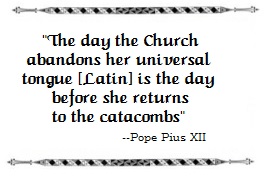
Latin is, contrary to popular belief, still the language of
the Church, and even the documents of Vatican II require it to
be
retained for the Mass (Gregorian Chant, too, is to be not only
retained, but given "pride of place": see Vatican II's document,
"Constitution on the Sacred Liturgy"; "Instruction on the Liturgy,"
Congregation of Rites, 16 October 1964; "Instruction on Music in the
Sacred Liturgy," Sacred Congregation of Rites, 5 March 1967; "Iubilate
Deo," Preface, Pope Paul VI, 14 April 1974; "General Instruction on the
Roman Missal," Roman Missal, 1975, 3rd ed.; and "Fidelity to Doctrinal
Foundations Must Guide All Liturgical Renewal," Address to US Bishops,
9 October 1998).
Sadly, we've lost much since the "reformers" with their
"spirit of Vatican II" have tried to strip away our common language and
cultural heritage. It used to be that a Catholic could go to Mass anywhere
in the world -- China, India, Italy, Mexico, Australia -- and
experience the same Mass in the same way. The American could look at
the Chinese man in the pew next to him and know that both are "on the
same page," hearing the Latin but each understanding in his own
language. They might not be able to speak to each other after Mass, but
both of them, during the liturgy, were participating in the same
supernatural Sacrifice, praying with the angels in the same language
and in a manner thousands of years old. If needed, each could have his
Missal, the former his "Latin-English Missal," the latter his
"Latin-Chinese Missal," and follow along. Now, in the Novus Ordo
liturgy with its predominant abuses of Vatican II documents, the
American and Chinese man would each have to have buy a different Missal
for every parish he visited which had a different language than his
own.
And consider a world where our priests are no longer trained solidly in
the Latin language! Some will become Bishops and Cardinals. Some will
have to meet in huge Councils with Bishops from other countries. Some
will have to meet in Conclaves to elect the next Pope. How will the
Bishops and Cardinals from Pakistan, the Netherlands, Malaysia, and
Lichtenstein be able to even communicate to do the Church's business
without a common language?
No, Pope Pius IX had it right when he said in Officiorum Omnium:
"For the Church,
precisely because it embraces all nations and is destined to endure
until the end of time... of its very nature requires a language which
is universal, immutable, and non-vernacular."
And so was Pope Pius XII, when he wrote in Mediator Dei:
"The use of the
Latin language prevailing in a great part of the Church affords at once
an imposing sign of unity and an effective safeguard against the
corruption of true doctrine."
Since even the documents of Vatican II have been ignored and
Latin stripped from our liturgy, since dissidents have won a few
generations and have denied us the luxury of growing up with our
cultural birthright, we must make a conscious effort to
reclaim our unifying heritage and pass it on to our children. Please,
expose yourself and your children to Ecclesiastical Latin, to chant, to
traditional hymns and Catholic art. Give yourself and your children
what was denied to you and what makes life much more beautiful and
rich. No layman is expected to make a huge study of Latin Grammar or to
be able to carry on conversations in the language, but the ability to
recognize a few basic prayers and phrases, to be able to recognize the
Latin and chants of those parts of the Mass which never change -- these
things are basic to our culture and bring on a flood of mental and
emotional associations. Do your soul a favor and attend only the
Traditional Latin Mass. Support the ancient liturgy at all times! And,
by all means, encourage your children to
study Latin in school.
How to Pronounce It
Ecclesiastical Latin is different from the Latin you might
learn in High School; it's basically Latin with an Italian accent (and
a few other differences), the way Latin's been pronounced since at
least around the 3rd and 4th centuries. It's actually pretty easy to
pronounce as the rules are few and have so much in common with English
and modern Italian. As a general rule, just set your mouth to speak
Italian, with the slightly trilled "R," and pronounce every vowel and
consant you see the same way an Italian would, with few exceptions.
Vowels with acute accent marks are "long vowels."
|
Vowel Sounds
|
|
Short sound
|
Long sound
|
|
A
|
like the A in
"facility"
|
Á
|
AH, like the A
in "father"
|
|
E
|
EH, like the E
in "met"
|
É
|
AY like the AY
in "may"
|
|
I
|
I like the I in
"hit"
|
Í
|
EE, like the I
in "machine"
|
|
O
|
O like the O in
"loss"
|
Ó
|
O, like the O in
"for"
|
|
U
|
U like the U in
"put"
|
Ú
|
OO, like the U
in "Jude"
|
|
Y &
Diphthongs
|
|
Y
|
EE, like Y in
"family"
|
|
Æ
|
EH, like E in
"met"
|
|
EI
|
AY, like EI in
"reign"
|
|
Œ
|
EH, like E in
"met"
|
|
AU
|
AH-oo, almost
like OU in "mouse"
|
The
consonants sound the same as in English for the most part, with the
following exceptions:
|
Before e, i,
ae, oe and y
|
|
These letters
become soft:
|
and sound
like:
|
|
C
|
CH as in "cherry"
|
|
CC
|
TCH as in
"matching"
|
|
SC
|
SH as in "ship"
|
|
G
|
G as in "gentle"
|
|
More tricks
|
|
T followed by
the letter I + another vowel, and not
preceded by
S, T, X
|
TS as in "Betsy"
(ex., "gratia" is pronounced "grah-tsee-ah," but "modestia" is
pronounced "moh-des-tee-ah")
|
|
TH
|
T as in "thyme"
|
|
GN
|
NY as in canyon,
or like the Spanish ñ
|
|
CH
|
K as in "Christ"
|
|
X
|
After an E or followed by a vowel, X sounds like GS, as in
"exam"
Followed by a consonant, or at the end of a word, X sounds like KS, as
in "tax" |
|
R
|
very slightly roll the R, touching the tip of your tongue to
the top and front of your palate, making almost a slight D sound, like
a Scottish R |
|
V
|
V sounds like the English "V", not like "W" as in Classical
Latin |
|
H
|
silent except for two words, where it sounds like a guttural,
German "CH" or K sound as in "ich" or "key": nihil and mihi |
|
J
|
Y, as in "young"
(J is usually replaced with an I, as in "Iesus" for "Jesus")
|
|
Z
|
pronounce like "ds" |
|
Double
consonants are each pronounced, but it comes off sounding like a single
letter that is held just a tad longer, the same way the L's in the word
"tailless" are held longer, but each pronounced so quickly they could almost
be mistaken for one sound
|
What Syllable to Accent
Two syllables:
Accent the first syllable
Three or more syllables:
If the next to the last syllable has a long vowel sound, accent that
syllable
If the next to the last syllable has a short vowel sound, accent the
syllable before it
Roman Numerals
Stringing Roman numerals together means to add them.
Placing
a smaller number in front of a larger one indicates that one should
subtract the smaller from the larger. Only powers of 10 are subtracted
(I, X, C, etc.), and only single digits are subtracted (ex., one writes
8 as VIII, not as IIX). A number can't be subtracted from a number that
is no more than 10 times larger (ex., I can only be subtracted from V
and X; X can only be subtracted from L and C, etc.)
| I |
1 |
II=2
III=3
IV=4 |
| V |
5 |
VI=6
VII=7
VIII=8
IX=9 |
| X |
10 |
XI=11
XII=12
XIII=13
XIV=14
XV=15
XV!=16
XVII=17
XVIII=19
XIX=19
XX=20
XXX=30
XL=40
49=XLIX |
| L |
50 |
LX=60
LXX=70
LXXX=80
XC=90
99=XCIX |
| C |
100 |
CL=150
CC=200
CCC=300
CD=400
CDXXIX=429 |
| D |
500 |
DL=550
DC=600 |
| M |
1,000 |
MM=2000
MMIII=2003 |
A horizontal line drawn over (or under) the numbers means to
multiply by 1,000.
Making Latin
Characters with your Computer Keyboard
To type Latin vowels with acute accents, simply press the ALT
key on your keyboard and hold down while pressing the following
numbers on the Number Pad at the right of your keyboard:
|
Small
|
|
Capital
|
|
á
|
0225 |
|
é
|
0233 |
|
í
|
0237 |
|
ó
|
0243 |
|
ú
|
0250 |
|
ý
|
0253 |
|
æ
|
0230 |
|
œ
|
0156 |
|
|
|
Á
|
0193 |
|
É
|
0201 |
|
Í
|
0205 |
|
Ó
|
0211 |
|
Ú
|
0218 |
|
Ý
|
0221 |
|
Æ
|
0198 |
|
Œ
|
0140 |
|
Tools to Help You
Learn Latin
|