|
Matthew 21:33-46
Hear ye another
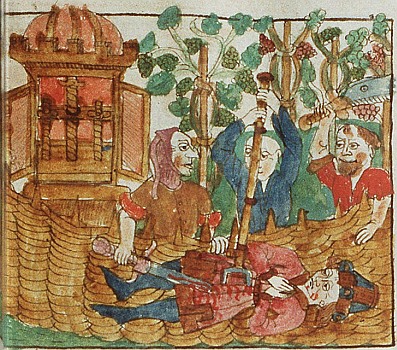
parable. There was a man an householder, who planted a vineyard, and
made a hedge round about it, and dug in it a press, and built a tower,
and let it out to husbandmen; and went into a strange country. And when
the time of the fruits drew nigh, he sent his servants to the
husbandmen that they might receive the fruits thereof. And the
husbandmen laying hands on his servants, beat one, and killed another,
and stoned another.
Again he sent other servants more than the former; and they did to them
in like manner. And last of all he sent to them his son, saying: They
will reverence my son. But the husbandmen seeing the son, said among
themselves: This is the heir: come, let us kill him, and we shall have
his inheritance. And taking him, they cast him forth out of the
vineyard, and killed him. When therefore the lord of the vineyard shall
come, what will he do to those husbandmen?
They say to him: He will bring those evil men to an evil end; and will
let out his vineyard to other husbandmen, that shall render him the
fruit in due season. Jesus saith to them: Have you never read in the
Scriptures: The stone which the builders rejected, the same is become
the head of the corner? By the Lord this has been done; and it is
wonderful in our eyes. Therefore I say to you, that the kingdom of God
shall be taken from you, and shall be given to a nation yielding the
fruits thereof. And whosoever shall fall on this stone, shall be
broken: but on whomsoever it shall fall, it shall grind him to powder.
And when the chief priests and Pharisees had heard his parables, they
knew that he spoke of them.
And seeking to lay hands on him, they feared the multitudes: because
they held him as a prophet.
Mark 12:1-12
And he began to
speak to them in parables: A certain man planted a vineyard and made a
hedge about it, and dug a place for the winefat, and built a tower, and
let it to husbandmen; and went into a far country. And at the season he
sent to the husbandmen a servant to receive of the husbandmen of the
fruit of the vineyard. Who having laid hands on him, beat him, and sent
him away empty. And again he sent to them another servant; and him they
wounded in the head, and used him reproachfully. And again he sent
another, and him they killed: and many others, of whom some they beat,
and others they killed.
Therefore having yet one son, most dear to him; he also sent him unto
them last of all, saying: They will reverence my son. But the
husbandmen said one to another: This is the heir; come let us kill him;
and the inheritance shall be ours. And laying hold on him, they killed
him, and cast him out of the vineyard. What therefore will the lord of
the vineyard do? He will come and destroy those husbandmen; and will
give the vineyard to others. And have you not read this scripture, The
stone which the builders rejected, the same is made the head of the
corner: 1
By the Lord has this been done, and it is wonderful in our eyes. And
they sought to lay hands on him, but they feared the people. For they
knew that he spoke this parable to them. And leaving him, they went
their way.
Luke 20:9-20
And he began to
speak to the people this parable: A certain man planted a vineyard, and
let it out to husbandmen: and he was abroad for a long time. And at the
season he sent a servant to the husbandmen, that they should give him
of the fruit of the vineyard. Who, beating him, sent him away empty.
And again he sent another servant. But they beat him also, and treating
him reproachfully, sent him away empty. And again he sent the third:
and they wounded him also, and cast him out. Then the lord of the
vineyard said: What shall I do? I will send my beloved son: it may be,
when they see him, they will reverence him. Whom when the husbandmen
saw, they thought within themselves, saying: This is the heir, let us
kill him, that the inheritance may be ours. So casting him out of the
vineyard, they killed him. What therefore will the lord of the vineyard
do to them?
He will come, and will destroy these husbandmen, and will give the
vineyard to others. Which they hearing, said to him: God forbid. But he
looking on them, said: What is this then that is written, The stone,
which the builders rejected, the same is become the head of the corner?
Whosoever shall fall upon that stone, shall be bruised: and upon
whomsoever it shall fall, it will grind him to powder. And the chief
priests and the scribes sought to lay hands on him the same hour: but
they feared the people, for they knew that he spoke this parable to
them. And being upon the watch, they sent spies, who should feign
themselves just, that they might take hold of him in his words, that
they might deliver him up to the authority and power of the governor.
Commentary
By St. John Chryostom
Many things
doth He intimate by this parable, God's providence, which had been
exercised towards them from the first; their murderous disposition from
the beginning; that nothing had been omitted of whatever pertained to a
heedful care of them; that even when prophets had been slain, He had
not turned away from them, but had sent His very Son; that the God both
of the New and of the Old Testament was one and the same; that His
death should effect great blessings; that they were to endure extreme
punishment for the crucifixion, and their crime; the calling of the
Gentiles, the casting out of the Jews.
Therefore He putteth it after the former parable, that He may show even
hereby the charge to be greater, and highly unpardonable. How, and in
what way? That although they met with so much care, they were worse
than harlots and publicans, and by so much.
And observe also both His great care, and the excessive idleness of
these men. For what pertained to the husbandmen, He Himself did, the
hedging it round about, the planting the vineyard, and all the rest,
and He left little for them to do; to take care of what was there, and
to preserve what was given to them. For nothing was left undone, but
all accomplished; and not even so did they gain, and this, when they
had enjoyed such great blessings from Him. For when they had come forth
out of Egypt, He gave a law, and set up a city, and built a temple, and
prepared an altar.
"And went into a far country;" that He bore long with them, not always
bringing the punishments close upon their sins; for by His going into a
far country, He means His great long-suffering.
And "He sent His servants," that is, the prophets, "to receive the
fruit;" that is, their obedience, the proof of it by their works. But
they even here showed their wickedness, not only by failing to give the
fruit, after having enjoyed so much care, which was the sign of
idleness, but also by showing anger towards them that came. For they
that had not to give when they owed, should not have been indignant,
nor angry, but should have entreated. But they not only were indignant,
but even filled their hands with blood, and while deserving punishment,
themselves inflicted punishment.
Therefore He sent both a second, and a third company, both that the
wickedness of these might be shown, and the love towards man of Him who
sent them.
And wherefore sent He not His Son immediately? In order that they might
condemn themselves for the things done to the others, and leave off
their wrath, and reverence Him when He came. There are also other
reasons, but for the present let us go on to what is next. But what
means, "It may be they will reverence?" It is not the language of one
ignorant, away with the thought! but of one desiring to show the sin to
be great; and without any excuse. Since Himself knowing that they would
slay Him, He sent Him. But He saith, "They will reverence," declaring
what ought to have been done, that it was their duty to have reverenced
Him. Since elsewhere also He saith, "if perchance they will hear;"not
in this case either being ignorant, but lest any of the obstinate
should say, that His prediction was the thing that necessitated their
disobedience, therefore He frames His expressions in this way, saying,
"Whether they will," and, "It may be." For though they had been
obstinate towards His servants, yet ought they to have reverenced the
dignity of the Son.
What then do these? When they ought to have run unto Him, when they
ought to have asked pardon for their offenses, they even persist more
strongly in their former sins, they proceed to add unto their
pollutions, forever throwing into the shade their former offenses by
their later; as also He Himself declared when He said, "Fill ye up the
measure of your fathers."For from the first the prophets used to charge
them with these things, saying, "Your hands are full of blood;"and,
"They mingle blood with blood;"and, "They build up Sion with blood."
But they did not learn self-restraint, albeit they received this
commandment first, "Thou shalt not kill;" and had been commanded to
abstain from countless other things because of this, and by many and
various means urged to the keeping of this commandment.
Yet, for all that, they put not away that evil custom; but what say
they, when they saw Him? Come, let us kill Him. With what motive, and
for what reason? what of any kind had they to lay to His charge, either
small or great? Is it that He honored you, and being God became man for
your sakes, and wrought His countless miracles? or that He pardoned
your sins? or that He called you unto a kingdom?
But see together with their impiety great was their folly, and the
reason of His murder was full of much madness. "For let us kill Him,"
it is said, "and the inheritance shall be ours."
And where do they take counsel to kill Him? "Out of the vineyard."
2. Seest thou how He prophesies even the place where He was to be
slain. "And they cast Him out, and slew Him." And Luke indeed saith,
that He declared what these men should suffer; and they said, "God
forbid;" and He added the testimony [of Scripture]. For "He beheld
them, and said, What is it then that is written? The stone which the
builders rejected, the same is become the head of the corner; and
every; one that falleth upon it shall be broken."But Matthew, that they
themselves delivered the sentence. But this is not a contradiction. For
indeed both things were done, both themselves passed the sentence
against themselves; and again, when they perceived what they had said,
they added, "God forbid;" and He set up the prophet against them,
persuading them that certainly this would be.
Nevertheless, not even so did He plainly reveal the Gentiles, that He
might afford them no handle, but signified it darkly by saying, "He
will give the vineyard to others." For this purpose then did He speak
by a parable, that themselves might pass the sentence, which was done
in the case of David also, when He passed judgment on the parable of
Nathan. But do thou mark, I pray thee, even hereby how just is the
sentence, when the very persons that are to be punished condemn
themselves.
Then that they might learn that not only the nature of justice requires
these things, but even from the beginning the grace of the Spirit had
foretold them, and God had so decreed, He both added a prophecy, and
reproves them in a way to put them to shame, saying, "Did ye never
read, The stone which the builders rejected, the same is become the
head of the corner? this is the Lord's doing, and it is marvellous in
our eyes;" by all things showing, that they should be cast out for
unbelief, and the Gentiles brought in. This He darkly intimated by the
Canaanitish woman also; this again by the ass, and by the centurion,
and by many other parables; this also now.
Wherefore He added too, "This is the Lord's doing, and it is marvellous
in our eyes," declaring beforehand that the believing Gentiles, and as
many of the Jews as should also themselves believe, shall be one,
although the difference between them had been so great before.
Then, that they might learn that nothing was opposed to God's will of
the things doing, but that the event was even highly acceptable, and
beyond expectation, and amazing every one of the beholders (for indeed
the miracle was far beyond words), He added and said, "It is the Lord's
doing." And by the stone He means Himself, and by builders the teachers
of the Jews; as Ezekiel also saith, "They that build the wall, and daub
it with untempered mortar."But how did they reject Him? By saying,
"This man is not of God;This man deceiveth the people;"and again, "Thou
art a Samaritan, and hast a devil."
Then, that they might know that the penalty is not limited to their
being cast out, He added the punishments also, saying, "Every one that
falleth on this stone, shall be broken; but upon whomsoever it shall
fall, it shall grind him to powder."He speaks here of two ways of
destruction, one from stumbling and being offended; for this is,
"Whosoever falleth on this stone:" but another from their capture, and
calamity, and utter destruction, which also He clearly foretold,
saying, "It will grind him to powder." By these words He darkly
intimated His own resurrection also.
Footnote:
1 Our Lord references
Psalm 117, verse 22 in this parable. It reads: "The stone which the
builders rejected; the same is become the head of the corner." 
|
|