|
In the 24th
chapter of the Gospel of St. Matthew -- the chapter that precedes the
one that contains this parable -- Jesus told His Apostles what to
expect with regard to the destruction of the Temple and the end of that
age, and the end of our age (the contents of this chapter and of Mark
13 are called the "Olivet discourse" because Jesus sat on Mount Olivet,
or the "Mount of Olives," when He spoke of these things). He segues
into the Parable of the Ten Virgins here, in Matthew 25.
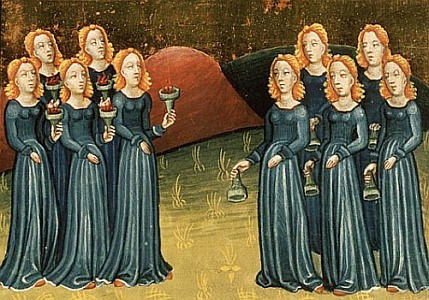
The Ten Virgins: Matthew 25:1-13
Then shall the
kingdom of heaven be like to ten virgins, who taking their lamps went
out to meet the bridegroom and the bride. And five of them were
foolish, and five wise. But the five foolish, having taken their lamps,
did not take oil with them: But the wise took oil in their vessels with
the lamps. And the bridegroom tarrying, they all slumbered and slept.
And at midnight there was a cry made: Behold the bridegroom cometh, go
ye forth to meet him. Then all those virgins arose and trimmed their
lamps. And the foolish said to the wise: Give us of your oil, for our
lamps are gone out. The wise answered, saying: Lest perhaps there be
not enough for us and for you, go ye rather to them that sell, and buy
for yourselves. Now whilst they went to buy, the bridegroom came: and
they that were ready, went in with him to the marriage, and the door
was shut.
But at last come also the other virgins, saying: Lord, Lord, open to
us. But he answering said: Amen I say to you, I know you not. Watch ye
therefore, because you know not the day nor the hour.
Commentary
By St. John Chryostom
These parables
are like the former parable of the faithful servant, and of him that
was ungrateful and devoured his Lord's goods. For there are four in
all, in different ways admonishing us about the same things, I mean
about diligence in almsgiving, and about helping our neighbor by all
means which we are able to use, since it is not possible to be saved in
another way. But there He speaks more generally of all assistance which
should he rendered to one's neighbor; but as to the virgins, he
speaketh particularly of mercifulness in alms, and more strongly than
in the former parable. For there He punishes him that beats, and is
drunken, and scatters and wastes his lord's goods, but here even him
that doth not help, nor spends abundantly his goods upon the needy. For
they had oil indeed, but not in abundance, wherefore also they are
punished.
But wherefore doth He set forth this parable in the person of the
virgins, and doth not merely suppose any person whatever? Great things
had He spoken of virginity, saying, "There are eunuchs, who have made
themselves eunuchs for the kingdom of Heaven's sake;" and, "He that is
able to receive, let him receive it."He knew also that the generality
of men would have a great opinion of it. For indeed the work is by
nature great, and is shown so by this, that neither under the old
dispensation was it fulfilled by these ancient and holy men, nor under
the new was it brought under the compulsion of the law. For He did not
command this, but left it to the choice of his hearers.
Wherefore Paul also said "Now, concerning virgins I have no commandment
of the Lord." "For though I praise him that attains thereto, yet I
constrain not him that is not willing, neither do I make the thing an
injunction." Since then the thing is both great in itself and hath
great honor with the multitude, lest any one attaining to this should
feel as though he had attained to all, and should be careless about the
rest, He putteth forth this parable sufficient to persuade them, that
virginity, though it should have everything else, if destitute of the
good things arising out of almsgiving, is cast out with the harlots,
and He sets the inhuman and merciless with them.
And most reasonably, for the one was overcome by the love of carnal
pleasure, but theseof money. But the Jove of carnal pleasure and of
money are not equal, but that of carnal pleasure is far keener and more
tyrannical. And the weaker the antagonist, the less excusable are
thesethat are overcome thereby. Therefore also He calls them foolish,
for that having undergone the greater labor, they have betrayed all for
want of the less. But by lamps here, He meaneth the gift itself of
virginity, the purity of holiness; and by oil, humanity, almsgiving,
succor to them that are in need.
"Then, while the bridegroom tarried, they all slumbered and slept." He
shows that the time intervening will not be short, leading His
disciples away from the expectation that His kingdom was quite
immediately to appear. For this indeed they hoped, therefore He is
continually holding them back from this hope. And at the same time He
intimates this too, that death is a sleep. For they slept, He saith.
"And about midnight there was a cry made." Either He was continuing the
parable, or again He shows that the resurrection will be at night. But
the cry Paul also indicates, saying, "With a shout, with a voice of an
archangel, with the last trump, He shall come down from Heaven."And
what mean the trumpets, and what saith the cry? "The bridegroom
cometh." When therefore they had trimmed their lamps, the foolish say
unto the wise, "Give us of your oil."
Again He calls them foolish, showing that nothing can be more foolish
than they who are wealthy here, and depart naked thither, where most of
all we have need of humanity, where we want much oil. But not in this
respect only were they foolish, but also because they looked to receive
it there, and sought it out of season; and yet nothing could be more
humane than those virgins, who for this especially were approved.
Neither do they seek for it all, for, "Give us," they say, "of your
oil;" and the urgency of their need is indicated; "for our lamps," they
say, "are going out." But even so they failed, and neither the humanity
of those whom they asked, nor the easiness of their request, nor their
necessity and want, made them obtain.
But what now do we learn from hence? That no man can protect us there,
if we are betrayed by our works, not because he will not, but because
he cannot. For these too take refuge in the impossibility. This the
blessed Abraham also indicated, saying, "Between us and you there is a
great gulf,"so that not even when willing is it permitted them to pass
it.
"But go to them that sell, and buy." And who are they that sell? The
poor. And where are these? Here, and then should they have sought them,
not at that time.
Seest thou what great profit arises to us from the poor? shouldest thou
take them away, thou wouldest take away the great hope of our
salvation. Wherefore here must we get together the oil, that it may be
useful to us there, when the time calls us. For that is not the time of
collecting it, but this. Spend not then your goods for nought in luxury
and vainglory. For thou wilt have need of much oil there.
Having heard these things, those virgins went their way; but they
profiled nothing. And this He saith, either pursuing the parable, and
working it up; or also by these things showing, that though we should
become humane after our departure, we shall gain nothing from thence
towards our escape.
Therefore neither did their forwardness avail these virgins, because
they went to them that sell not here, but there; nor the rich man, when
he became so charitable, as even to be anxious about his relations. For
he that was passing by him that was laid at the gate, is eager to
rescue from perils and from hell them whom he did not so much as see,
and entreats that some be sent to tell them these things. But
nevertheless, he derived no benefit from thence, as neither did these
virgins. For when they having heard these things went their way, the
bridegroom came, and they that were ready went in with Him, but the
others were shut out. After their many labors, after their innumerable
toils, and that intolerable fight, and those trophies which they had
set up over the madness of natural appetite, disgraced, and with their
lamps gone out, they withdrew, bending down their faces to the earth.
For nothing is more sullied than virginity not having mercy; so that
even the multitude are wont to call the unmerciful dark.
Where then was the profit of virginity, when they saw not the
bridegroom? and not even when they had knocked did they obtain, but
they heard that fearful saying, "Depart, I know you not."And when He
hath said this, nothing else but hell is left, and that intolerable
punishment; or rather, this word is more grievous even than hell. This
word He speaks to them also that work iniquity?
"Watch therefore, for ye know not the day nor the hour." Seest thou how
continually He adds this, showing how awful our ignorance concerning
our departure hence? Where now are they, who throughout all their life
are remiss, but when they are blamed by us, are saying, At the time of
my death, I shall leave money to the poor. Let them listen to these
words, and be amended. For indeed at that time many have failed of
this, having been snatched away at once, and not permitted so much as
to give charge to their relations touching what they wished to be done.
This parable was spoken with respect to mercy in alms; but the one that
comes after this, to them that neither in money, nor in word, nor in
protection, nor in any other things whatever, are willing to assist
their neighbors, but withhold all.
And wherefore can it be that this parable brings forward a king, but
that a bridegroom? That thou mightest learn how close Christ is joined
unto the virgins that strip themselves of their possessions; for this
indeed is virginity. Wherefore Paul also makes this as a definition of
the thing. "The unmarried woman careth for the things of the Lord;"such
are his words: and, "For that which is comely, and that ye may attend
upon the Lord without distraction. These things we advise," he saith.
|
|