|
Luke 15:11-32
And he said: A
certain man had two sons: And the younger of them said to his father:
Father, give me the portion of substance that falleth to me. And he
divided unto them his substance.
And not many days after, the younger son, gathering all together, went
abroad into a far country: and there wasted his substance, living
riotously. And after he had spent all, there came a mighty famine in
that country; and he began to be in want.
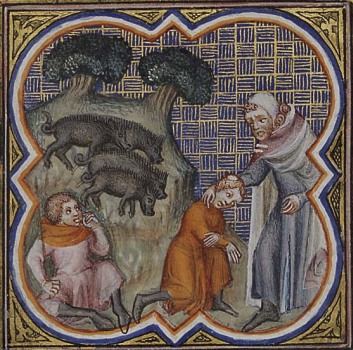
And he went and cleaved to one of the citizens of that country. And he
sent him into his farm to feed swine. And he would fain have filled his
belly with the husks the swine did eat; and no man gave unto him. And
returning to himself, he said: How many hired servants in my father's
house abound with bread, and I here perish with hunger? I will arise,
and will go to my father, and say to him: Father, I have sinned against
heaven, and before thee: I am not worthy to be called thy son: make me
as one of thy hired servants.
And rising up he came to his father. And when he was yet a great way
off, his father saw him, and was moved with compassion, and running to
him fell upon his neck, and kissed him.
And the son said to him: Father, I have sinned against heaven, and
before thee, I am not now worthy to be called thy son.
And the father said to his servants: Bring forth quickly the first
robe, and put it on him, and put a ring on his hand, and shoes on his
feet: And bring hither the fatted calf, and kill it, and let us eat and
make merry: Because this my son was dead, and is come to life again:
was lost, and is found. And they began to be merry.
Now his elder son was in the field, and when he came and drew nigh to
the house, he heard music and dancing: And he called one of the
servants, and asked what these things meant.
And he said to him: Thy brother is come, and thy father hath killed the
fatted calf, because he hath received him safe.
And he was angry, and would not go in. His father therefore coming out
began to entreat him. And he answering, said to his father: Behold, for
so many years do I serve thee, and I have never transgressed thy
commandment, and yet thou hast never given me a kid to make merry with
my friends: But as soon as this thy son is come, who hath devoured his
substance with harlots, thou hast killed for him the fatted calf.
But he said to him: Son, thou art always with me, and all I have is
thine. But it was fit that we should make merry and be glad, for this
thy brother was dead and is come to life again; he was lost, and is
found.
Commentary
By Macarius Chrysocephalus
1. What choral
dance and high festival is held in heaven, if there is one that has
become an exile and a fugitive from the life led under the Father,
knowing not that those who put themselves far from Him shall perish; if
he has squandered the gift, and substance, and inheritance of the
Father; if there is one whose faith has failed, and whose hope is
spent, by rushing along with the Gentiles into the same profligacy of
debauchery; and then, famished and destitute, and not even filled with
what the swine eat, has arisen and come to his Father!
But the kind Father waits not till the son comes to Him. For perchance
he would never be able or venture to approach, did he not find Him
gracious. Wherefore, when he merely wishing, when he straightway made a
beginning, when he took the first step, while he was yet a great way
off, He the Father was moved with compassion, and ran, and fell upon
his neck and kissed him. And then the son, taking courage, confessed
what he had done.
Wherefore the Father bestows on him the glory and honour that was due
and meet, putting on him the best robe, the robe of immortality; and a
ring, a royal signet and divine seal, — impress of consecration,
signature of glory, pledge of testimony (for it is said, "He hath set
to his seal that God is true,") and shoes, not those perishable ones
which he hath set his foot on holy ground is bidden take off, nor such
as he who is sent to preach the kingdom of heaven is forbidden to put
on, but such as wear not, and ate suited for the journey to heaven,
becoming and adorning the heavenly path, such as unwashed feet never
put on, but those which are washed by our Teacher and Lord.
Many, truly, are the shoes of the sinful soul, by which it is bound and
cramped. For each man is cramped by the cords of his own sins.
Accordingly, Abraham swears to the king of Sodom, "I will not take of
all that is thine, from a thread to a shoe-latchet." On account of
these being defiled and polluted on the earth, every kind of wrong and
selfishness engrosses life.
As the Lord reproves Israel by Amos, saying, "For three iniquities of
Israel, yea, for four, I will not turn him back; because they have
given away the righteous for silver, and the needy for a pair of shoes,
which tread upon the dust of the ground."
2. Now the shoes which the Father bids the servant give to the
repentant son who has be-taken himself to Him, do not impede or drag to
the earth (for the earthly tabernacle weighs down the anxious mind);
but they are buoyant, and ascending, and waft to heaven, and serve as
such a ladder and chariot as he requires who has turned his mind
towards the Father. For, beautiful after being first beautifully
adorned with all these things without, he enters into the gladness
within. For "Bring out" was said by Him who had first said, "While he
was yet a great way off, he ran and fell upon his neck." For it is here
that all the preparation for entrance to the marriage to which we are
invited must be accomplished. He, then, who has been made ready to
enter will say, "This my joy is fulfilled." But the unlovely and
unsightly man will hear, "Friend, how camest thou in here, without
having a wedding garment?" And the fat and unctuous food, — the
delicacies abundant and sufficing of the blessed, — the fatted calf is
killed; which is also again spoken of as a lamb (not literally); that
no one may suppose it small; but it is the great and greatest.
For not small is "the Lamb of God who taketh away the sin of the
world," who "was led as a sheep to the slaughter," the sacrifice full
of marrow, all whose fat, according to the sacred law, was the Lord's.
For He was wholly devoted and consecrated to the Lord; so well grown,
and to such excessive size, as to reach and extend over all, and to
fill those who eat Him and feed upon Him. For He is both flesh and
bread, and has given Himself as both to us to be eaten.
To the sons, then, who come to Him, the Father gives the calf, and it
is slain and eaten. But those who do not come to Him He pursues and
disinherits, and is found to be a most powerful bull. Here, by reason
of His size and prowess, it is said of Him, "His glory is as that of an
unicorn." And the prophet Habakkuk sees Him bearing horns, and
celebrates His defensive attitude — "horns in His hands." Wherefore the
sign shows His power and authority, — horns that pierce on both sides,
or rather, on all sides, and through everything. And those who eat are
so strengthened, and retain such strength from the life-giving food in
them, that they themselves are stronger than their enemies, and are all
but armed with the horns of a bull; as it is said, "In thee shall we
butt our enemies."
3. Gladness there is, and music, and dances; although the eider son,
who had ever been with and ever obedient to the Father, takes it ill,
when he who never had himself been dissipated or profligate sees the
guilty one made happy.
Accordingly the Father calls him, saying, "Son, thou art ever with me."
And what greater joy and feast and festivity can be than being
continually with God, standing by His side and serving Him? "And all
that is mine is thine." And blessed is the heir of God, for whom the
Father holds possession, — the faithful, to whom the whole world of
possessions belongs. "It was meet that we should be glad, and rejoice;
for thy brother was dead, and is alive again." Kind Father, who givest
all things life, and raisest the dead. "And was lost, and is found."
And "blessed is the man whom Thou hast chosen and accepted," and whom
having sought, Thou dost find. "Blessed are those whose iniquities are
forgiven, whose sins are covered." It is for man to repent of sins; but
let this be accompanied with a change that will not be checked. For he
who does not act so shall be put to shame, because he has acted not
with his whole heart, but in haste.
And it is ours to flee to God. And let us endeavour after this
ceaselessly and energetically. For He says, "Come unto Me, all ye that
labour and are heavy laden, and I will give you rest." And prayer and
confession with humility are voluntary acts. Wherefore it is enjoined,
"First tell thy sins, that thou mayest be justified." What afterwards
we shall obtain, and what we shall be, it is not for us to judge.
4. Such is the strict meaning of the parable. The repentant son came to
the pitying Father, never hoping for these things, — the best robe, and
the ring, and the shoes, — or to taste the fatted calf, or to share in
gladness, or enjoy music and dances; but he would have been contented
with obtaining what in his own estimation he deemed himself worth.
"Make me," he had made up his mind to say, "as one of thy hired
servants." But when he saw the Father's welcome meeting him, he did not
say this, but said what he had in his mind to say first, "Father, I
have sinned against Heaven, and before thee." And so both his humility
and his accusation became the cause of justification and glory. For the
righteous man condemns himself in his first words. So also the publican
departed justified rather than the Pharisee. The son, then, knew not
either what he was to obtain, or how to take or use or put on himself
the things given him; since he did not take the robe himself, and put;
it on. But it is said, "Put it on him." He did not himself put the ring
on his finger, but those who were bidden "Put a ring on his hand." Nor
did he put the shoes on himself, but it was they who heard, "and shoes
on his feet." And these things were perhaps incredible to him and to
others, and unexpected before they took place; but gladly received and
praised were the gifts with which he was presented.
5. The parable exhibits this thought, that the exercise of the faculty
of reason has been accorded to each man. Wherefore the prodigal is
introduced, demanding from his father his portion, that is, of the
state of mind, endowed by reason. For the possession of reason is
granted to all, in order to the pursuit of what is good, and the
avoidance of what is bad. But many who are furnished by God with this
make a bad use of the knowledge that has been given them, and land in
the profligacy of evil practices, and wickedly waste the substance of
reason, — the eye on disgraceful sights, the tongue on blasphemous
words, the smell on foetid licentious excesses of pleasures, the mouth
on swinish gluttony, the hands on thefts, the feet on running into
plots, the thoughts on impious counsels, the inclinations on indulgence
on the love of ease, the mind on brutish pastime. They preserve nothing
of the substance of reason unsquandered. Such an one, therefore, Christ
represents in the parable, — as a rational creature, with his reason
darkened, and asking from the Divine Being what is suitable to reason;
then as obtaining from God, and making a wicked use of what had been
given, and especially of the benefits of baptism, which had been
vouchsafed to him; whence also He calls him a prodigal; and then, after
the dissipation of what had been given him, and again his restoration
by repentance, He represents the love of God shown to him.
6. For He says, "Bring hither the fatted calf, kill it, and let us eat
and be merry; for this my son" — a name of nearest relationship, and
significative of what is given to the faithful — "was dead and lost," -
an expression of extremest alienation; for what is more alien to the
living than the lost and dead? For neither can be possessed any more.
But having from the nearest relationship fallen to extremest
alienation, again by repentance he returned to near relationship. For
it is said, "Put on him the best robe," which was his the moment he
obtained baptism. I mean the glory of baptism, the remission of sins,
and the communication of the other blessings, which he obtained
immediately he had touched the font. "And put a ring on his hand." Here
is the mystery of the Trinity; which is the seal impressed on those who
believe. "And put shoes on his feet," for "the preparation of the
Gospel of peace," and the whole course that leads to good actions.
7. But whom Christ finds lost, after sin committed since baptism, those
Novatus, enemy of God, resigns to destruction. Do not let us then
reckon any fault if we repent; guarding against falling, let us, if we
have fallen, retrace our steps. And while dreading to offend, let us,
after offending, avoid despair, and be eager to be confirmed; and on
sinking, let us haste to rise up again. Let us obey the Lord, who calls
to us, "Come unto Me, all ye that labour, and I will give you rest."
Let us employ the gift of reason for actions of prudence. Let us learn
now abstinence from what is wicked, that we may not be forced to learn
in the future. Let us employ life as a training school for what is
good; and let us be roused to the hatred of sin. Let us bear about a
deep love for the Creator; let us cleave to Him with our whole heart;
let us not wickedly waste the substance of reason, like the prodigal.
Let us obtain the joy laid up, in which Paul exulting, exclaimed, "Who
shall separate us from the love of Christ?" To Him belongs glory and
honour, with the Father and the Holy Spirit, world without end. Amen.
Footnote:
1 "Prodigal" means
"recklessly extravagant; characterized by wasteful expenditure; lavish;
yielding abundantly." As a noun, it refers to someone who spends or
gives lavishly and foolishly. 
|
|