|
Luke 16:19-34
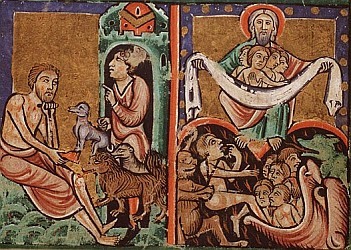
There was a
certain rich man, who was clothed in purple and fine linen; and feasted
sumptuously every day. And there was a certain beggar, named Lazarus,
who lay at his gate, full of sores, Desiring to be filled with the
crumbs that fell from the rich man's table, and no one did give him;
moreover the dogs came, and licked his sores.
And it came to pass, that the beggar died, and was carried by the
angels into Abraham's bosom. And the rich man also died: and he was
buried in hell. And lifting up his eyes when he was in torments, he saw
Abraham afar off, and Lazarus in his bosom:
And he cried, and said: Father Abraham, have mercy on me, and send
Lazarus, that he may dip the tip of his finger in water, to cool my
tongue: for I am tormented in this flame.
And Abraham said to him: Son, remember that thou didst receive good
things in thy lifetime, and likewise Lazareth evil things, but now he
is comforted; and thou art tormented. And besides all this, between us
and you, there is fixed a great chaos: so that they who would pass from
hence to you, cannot, nor from thence come hither.
And he said: Then, father, I beseech thee, that thou wouldst send him
to my father's house, for I have five brethren, That he may testify
unto them, lest they also come into this place of torments.
And Abraham said to him: They have Moses and the prophets; let them
hear them.
But he said: No, father Abraham: but if one went to them from the dead,
they will do penance.
And he said to him: If they hear not Moses and the prophets, neither
will they believe, if one rise again from the dead.
Commentary
from the Catholic Encyclopedia
The rich fool
and Dives and Lazarus raise the question whether we should interpret
them as true histories or as instructive fictions. Both are directed
against the chief enemy of the Gospel, riches loved and sought after.
The rich fool ("Nabal", as in I Kings 25) was uttered on occasion of a
dispute concerning property and Christ answers "Man, who hath appointed
me judge, or divider, over you?" Not injustice, but covetousness, "the
root of all evil", is here reprehended. Read St. Cyprian, "De opere et
eleemosyna", 13.
The story of Lazarus, which completes this lesson by contrast, appears
to have no concealed meaning and would therefore not fulfil the
definition of a parable. Catholics, with Irenaeus, Ambrose, Augustine,
and the church liturgy, regard it as a narrative. The modern school
rejects this view, allows that our Lord may have spoken the first half
of the recital (Luke 16:19-26) but considers the rest to be an allegory
which condemns the Jews for not accepting the witness of Moses and the
Prophets to Jesus as the Messias. In any case our Lord's resurrection
furnishes an implied reference. "Abraham's bosom" for the middle state
after death is adopted by the Fathers generally; it receives
illustration from IV Mach. 13:17. St. Augustine (De Gen. ad Litt.,
viii, 7) doubts whether we can take literally the description of the
other world.
|
|