|
The
fascinating Passion Flower ("Passiflora") became known to the West
around A.D. 1610, when an Augustinian friar named Emmanuel de Villegas
visited Rome from Mexico, bringing drawings to Jacomo Bosio, a monk who
was writing a treatise on Christ's Passion. Bosio looked at the
drawings, but was tentative about including mention or drawings of them
in his narrative as they looked so strange he figured the drawings
given to him must be exaggerated. But more drawings came, and visiting
Mexican Jesuits assured him that the flowers were quite real.
In the flower's three bracts, he saw a symbol of the Trinity; it its
corona filaments, he saw the Crown of Thorns, and in its stigma, the
three nails and the column at which Christ was scourged. He described
the stamens as "five spots or stains of the hue of blood evidently
setting forth five wounds received by our Lord on the Cross." The
leaves of the plant are shaped like St. Longinus's spear, and their
undersides bear round spots signifying the 30 pieces of silver for
which Christ was betrayed by Judas.
The flowers he saw opened for one day, and then closed back up into
their bell-like shapes. This, he postulated, could be so because "in
His infinite wisdom it pleases Him to create it thus, shut up and
protected, as though to indicate that the wonderful mysteries of the
Cross and of His Passion were to remain hidden from the heathen people
of these countries until the time preordained by His highest Majesty."
There are over 600 species of Passiflora (some with edible fruits --
"passion fruit"), so they come in all colors -- white, yellow, pink,
red, purple, blue. They originate in the South American rain forest,
but are now found all over the world. Passiflora is known in Spanish
not only as "flor passionis," but as "flor de las cinco llagas" --
"flower of the five wounds."
An
Interesting Aside
The
painting "Madonna and Child" by Joos Van Cleve was painted some time
between A.D. 1530 and 1535 and has as one of its highlights a
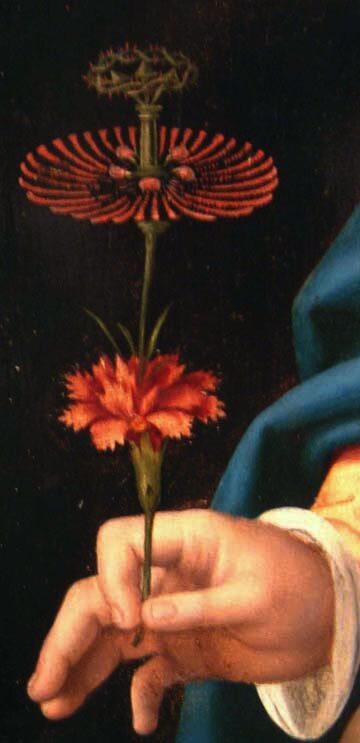
Passion
Flower rising up out of a carnation, both held by Our Lady. The Passion
Flower combined with a carnation, a symbpol of the Incarnation,
reflects the Child's Nature and destiny, while the Christ Child reaches
for
three cherries, a symbol of the Trinity. Remember, though,
that the
Passion Flower wasn't discovered by Europeans until around A.D. 1610 --
but the painting was made some 80 years before. This anachronism threw
the provenance of this painting into chaos before it was
determined that the Passion Flower was added later, by an unknown
artist. The painting:
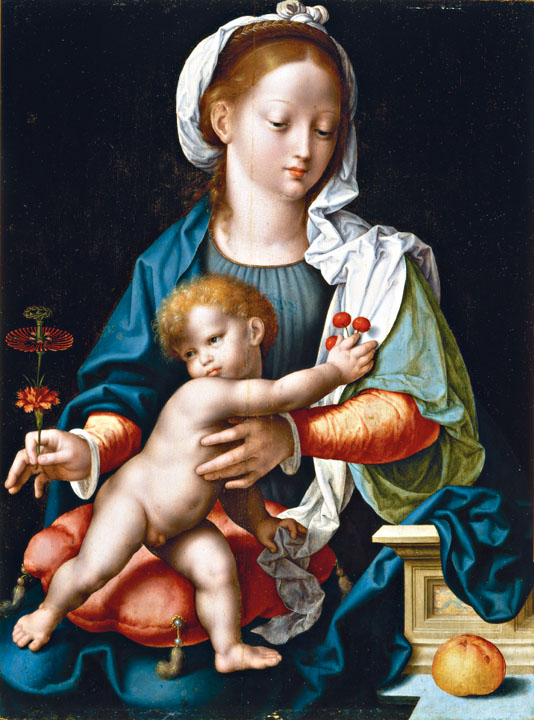
Detail
of the Passion Flower:
|
|



