``Where the
Bishop is, there let the multitude of believers be;
even as where Jesus is, there is the Catholic Church'' Ignatius of
Antioch, 1st c. A.D
Piñatas
It's unknown
where piñatas originated. Some believe they are a Chinese invention,
taken to Italy by Marco Polo. What is known is that in the 14th
century, the Italian "pignatta" became associated with Carnevale
before Lent because it was then that a clay pot shaped like a dove
began to be suspended over the Carnevale crowd and smashed to shower
down treats ("pignatta" means "clay pot"). The pre-Lenten practice
spread to Spain and was taken by Spanish missionaries to the New World.
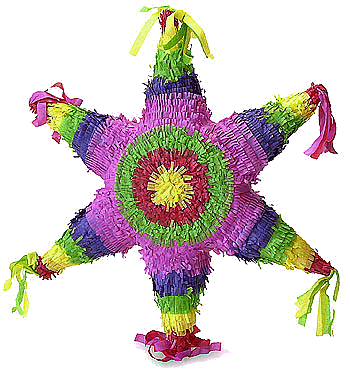
There, the priests fashioned piñatas to represent Satan, and
seven-pointed stars representing the Seven Deadly Sins, so that beating
them would be, in part, a bit of religious instruction and a defiance
of evil. The rewards, as a sign of faith rewarded, would attract the
natives to their sermons.
Nowadays, most piñatas are usually made of papier-mache and are
associated most strongly with Mexico (though they are still used in
Italy and Spain, too). In Mexico, they are seen at most celebrations,
especially around Christmas.
To make a piñata takes about 5 days, and it's messy work, but children
love them, so it's all worthwhile. You will need:
Very large
balloon, smaller balloons of different shapes, cardboard tubes,
cardboard with the thickness of shoebox cardboard, and other things to
form the shape
Old newspapers
torn, crosswise, into 2" wide strips
Plain white
paper torn into strips
Flour and water
mixed to a pancake batter consistency
Brightly colored
tissue paper and a glue stick (liquid glue is too wet) and/or
acrylic or fabric paints
Wrapped candies,
peanuts, trinkets, etc., to fill
Blow up the
large balloon to form the basic shape, such as the body if making an
animal (don't blow it up too full). Arrange with other balloons,
cardboard tubes, cones and other shaped formed from shoebox-thick
cardboard, etc., to refine shape and create legs, arms, horns, points,
etc. -- whatever your shape requires -- and lightly tape them together
to keep the shape.
Dip strips of newspaper into the flour-water mixture and lay a layer
over the form, slightly overlapping as you go, until the form is fully
covered. Let dry. The next day, repeat the process, adding another
layer over the layer already made. Do the same for 4 or 5 days -- using
plain white paper on the last day -- until you have a nice, solid shape
made of many layers of paper. When fully dry, cut a two inch circle in
the top of the main section, popping and removing the main balloon, and
fill up with the candies and trinkets. Replace the two-inch circle you
removed, and tape into place, and then decorate the piñata with acrylic
paints or fabric paints, and/or tiny pieces of tissue paper glued on
with a glue stick.
Suspend the piñata on a rope
-- from a tree or a clothes line, etc. -- and get a stick or bat with
which the children can strike at it, one child at a time, with the goal
of smashing it open and releasing the treats inside. Suspending the
piñata from a rope so that it can be raised and lowered as the children
strike at it makes the game more
challenging!
To make it even more challenging than that, before a child takes his
turn, blindfold him, and spin him around a few times. Be sure the other
children are at least 15 feet away so they don't get swung at.
While a child takes his turn at bat (start with the youngest or
smallests child and work up to the oldest or largest), the crowd shouts
directions ("Up
higher!" Lower!" Go right! You're getting colder!" etc.) and keeps time
to let the child know when his turn is up. In Mexico, a child gets
three swings in his attempt to break the piñata open, or his
turn at hitting the piñata that
lasts as long as it takes to sing the piñata song, which takes about 15
seconds to sing.
Dale, dale, dale
No pierdas el tino
Porque si lo pierdes,
Pierdes el camino.
Ya le diste una,
Ya le diste dos,
Ya le diste tres,
Y tu tiempo se acabó!
Hit, hit, hit,
Don't lose the knack,
Because if you lose it,
You'll lose the way.
You've hit it once,
You've hit it twice,
You've hit it thrice,
Now your time is up.
English-speaking
children could sing the following to the same tune:
Candy, candy,
candy
Inside the pinata
Free up all the candy
You really, really gotta!
If you can't free all the candy
By the end of this song
Then your turn is over
It's time to move along!
When
the piñata breaks open happens, the children will
all scramble to gather up as many of the treats as they can. To ensure
that
no child is left out, set aside some extra candy beforehand so that all
children will have some at the end of the game.