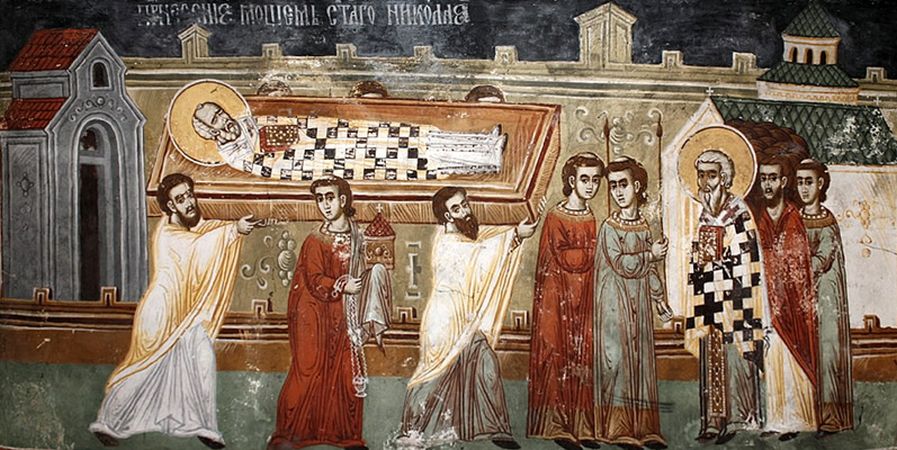
|
Exodus13:19
"And Moses took Joseph's bones with him: because he had adjured the
children of Israel, saying: God shall visit you, carry out my bonesfrom
hence with you."
4 Kings 13:20-21 "And Eliseus died, and they buried him. And the rovers
from Moab came into the land the same year. And some that were burying
a man, saw the rovers, and cast the body into the sepulchre of
Eliseus.And when it had touched the bones of Eliseus, the man came to
life and stood upon his feet."
Matthew 9:20-22 "And behold a woman who was troubled with an issue of
blood twelve years, came behind him, and touched the hem of His
garment. For she said within herself: If I shall touch only His
garment, I shall be healed. But Jesus turning and seeing her, said: Be
of good heart, daughter, thy faith hath made thee whole. And the woman
was made whole from that hour."
Acts 19:11-12 "And God wrought by the hand of Paul more than common
miracles. So that even there were brought from his body to the sick,
handkerchiefs and aprons: and the diseases departed from them: and the
wicked spirits went out of them."
It's funny to me how a culture that is filled with autograph hounds and
those who clamor to be around those glittered with "star dust"
canconsider the Catholic veneration of relics as a joke. A lovely dish
is just a lovely dish, but one owned by your great-grandmother is a
treasure. Some stranger's pocketwatch is just a timepiece, but one
given to you by your grandfather is something you'd literally mourn
losing. We pay $20,000 for a $200 jacket worn by Jacqueline Kennedy,
faint at Beatles concerts, engage in riotous behavior to get our hands
on one of Elvis's scarves, but when a relic of St. Catherine is
mentioned, people snicker.
As you can see, however, from the verses above, veneration of relics is
absolutely scriptural, and the earliest Christians saw things in the
same way as did the ancient Israelites and those in the New Testament
accounts. St. Augustine (A.D. 354 - 430) wrote in City of God:
If a father's
coat or ring, or anything else of that kind, is so much more cherished
by his children, as love for one's parents is greater, in no way are
the bodies themselves to be despised, which are much more intimately
and closely united to us than any garment; for they belong to man's
very nature,
St.Jerome (ca.
A.D. 340 - 420) clarified Catholic belief in his Ad Riparium:
We do not adore,
I will not say the relics of the martyrs, but either the sun or the
moon or even the angels -- that is to say, with the worship of
"latria"...But we honor the martyrs' relics, so that thereby we give
honor to Him Whose [witness] they are: we honor the servants, that the
honor shown to them may reflect on their Master... Consequently, by
honoring the martyrs' relics we do not fall into the error of the
Gentiles, who gave the worship of "latria" to dead men.
When considering
relics, it is to be remembered that the body and soul are forever one,
even when they seem to be separated by death.1 The body of
the saved
will be resurrected and glorified (the bodies of the damned will also
be resurrected, for that matter). Forever is there a connection between
the remains and the soul that has departed from them-- and the great
souls whose remains are left to us have a power described well by St.
John of Damascus (a.k.a. "John Damascene"), ca.A.D. 676 - 754/87, in
his "Exposition of the Orthodox Faith":
These [the
bodies of the Saints] are made treasuries and pure habitations of God:
For I will dwell in them, said God, and walk inthem, and I will be
their God. The divine Scripture likewise saith that the souls of the
just are in God's hand and death cannot lay hold of them. For death is
rather the sleep of the saints than their death. For they travailed in
this life and shall to the end, and Precious in the sight of the Lord
is the death of His saints. What then, is more precious than to be in
the hand of God? For God is Life and Light, and those who are in God's
hand are in life and light.
Further, that God dwelt even in their bodies in spiritual wise, the
Apostle tells us, saying, Know ye not that your bodies are the temples
of the Holy Spirit dwelling in you?, and The Lord is that Spirit, and
if any one destroy the temple of God, him will God destroy.
Surely,then, we must ascribe honour to the living temples of God, the
living tabernacles of God. These while they lived stood with confidence
beforeGod.
The Master Christ made the remains of the saints to be fountains of
salvation to us, pouring forth manifold blessings and abounding in oil
of sweet fragrance: and let no one disbelieve this. For if water burst
in the desert from the steep and solid rock at God's will and from the
jaw-bone of an ass to quench Samson's thirst, is it incredible that
fragrant oil [see below] should burst forth from the martyrs' remains?
By no means, at least to those who know the power of God and the honour
which He accords His saints.
In the law every one who toucheth a dead body was considered impure,
but these are not dead. For from the time when He that is Himself life
and the Author of life was reckoned among the dead, we do not call
those dead who have fallen asleep in the hope of the resurrection and
in faith on Him. For how could a dead body work miracles? How,
therefore, are demons driven off by them, diseases dispelled, sick
persons made well, the blind restored to sight, lepers purified,
temptations and troubles overcome, and how does every good gift from
the Father of lights come down through them to those who pray with sure
faith?
See also this excerpt from the Homilies on the
Epistle to the Romans, by St. John Chrysostom (A.D. 347 - 407).
Classes of Relics
|
1st Class
Relic:
|
a part of the
Saint (bone, hair, etc.) and the instruments of Christ'spassion |
|
2nd Class
Relic:
|
something owned
by the Saint or instruments of torture used against a martyr |
|
3rd Class
Relic:
|
something that
has been touched to a 1st or 2nd Class Relic. You can make your own 3rd
Class relics by touching an object to a 1st or 2nd Class Relic,
including the tomb of a Saint. |
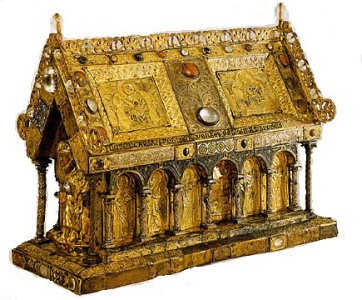
Relics in
churches or chapels are usually kept in one of two places: in a cavity
("sepulchre") inside the Altar or in a "reliquary." Reliquaries have
taken on a variety of shapes -- boxes, Noah's Arks, caskets, the shape
of an arm, leg, head, etc.. -- and some are exquisite specimens of gold
and silversmithing.
The Treatment of relics
CanonLaw 1190
§1 It is absolutely wrong to sell sacred relics.
§2 Distinguished relics, and others which are held in great veneration
by the people, may not validly be in any way alienated nor transferred
on a permanent basis, without the permission of the Apostolic See.
While selling relics ("simony") is wrong, it is permissible to buy
them if they will be marketed anyway and
buying them would save them from desecration. This must be done only if
the good that comes from buying the relic outweighs other uses the
money spent could be used for -- and this should never be done at
auction because bidding would only drive up the price, forcing others
who simply want to rescue relics to pay more. This could also increase
the likelihood of a market developing in the sale of relics.
Relics may be legitimately obtained from Church sources, i.e., the
Vicariate in Rome, the religious Order of the Saint involved, the
shrine of the Saint involved, etc. When this is done, a donation is
usually expected to cover the cost of the metal container (theca)
that contains the relic, but in any case, a profit cannot legitimately
be made from the sale of relics by anyone.
Particular Relics
I thought I'd
list the locations of some of the major first class relics here so that
you'll know where to find them if you're blessed to make a pilgrimage
to these locations. The sites below house the greatest part of the
given relic, but tinier pieces may be found throughout the world,
especially in the Altars of Catholic churches.
Note that some of the Saints are marked as "incorrupt"; this refers
tothe phenomenon whereby some Saints' bodies do not corrupt after
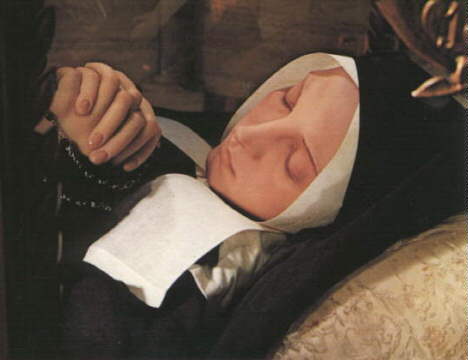
death. An example is St. Bernadette Soubirous, who saw Our Lady at Lourdes and
who now lies in a glass coffin at her convent in Nevers,
France. Though she died in A.D. 1879, she is as lovely as she ever was.
Other examples are those of Blessed Imelda Lambertini, who
died in ecstasy during her First Communion in A.D. 1333 at age 11 (I am
uncertain how accurately the picture at right represents Imelda's state
of preservation; this may be a wax figure); of St. Catherine Labouré,
who had the vision of Our Lady which led to the minting of the Miraculous Medal and who died in A.D.
1876; of St. Maria Mazzarello, the first Salesian Sister, who died in
A.D. 1881; and of St. John Vianney,Curé d'Ars, who died in A.D. 1859
(see pictures at right). There are many more.
This phenomenon of incorruptibility is often accompanied by a sweet
fragrance, known as the "odor of sanctity," which has been described as
being unlike any known perfume. Another related phenomenon is the flow
of a healing liquid, called "oil of saints," which exudes from the
Saint's body or tomb. In the case of some Saints who exude this "oil,"
the flow of liquid is periodic and not constant (the famous flow of
"oil" from the relics of St. Walburga,
who is not incorrupt, is periodic like this).
No one knows why some Saints are preserved from corruption while others
aren't, and incorruptibility is never seen, in itself and by itself, as
a proof of holiness. It is a good indicator of such
when the deceased was known for his life of faith and virtue -- but
it's a phenomenon that can be mimicked by science, by the effects of
natural conditions, and by the demonic.
A final note on the phenomenon of incorruptibility: don't let anyone
try to tell you that Pope John XXIII (d. 1963) is one of
the"incorruptibles." While his body was found to be
well-preserved when he was exhumed in January, 2001, there is no
miracle because he was injected with formalin (a mixture of
formaldehyde and methyl alcohol) and other preservatives by Dr. Gennaro
Goglia -- i.e., he was embalmed.
Then he was sprayed with an anti-bacterial agent and placed in a three
layer air-tight coffin which was itself put inside a marble sarcophagus
-- all in optimal, dry conditions for preservation. Though the Vatican
denies any unnatural preservation in his case, one
still hears some Catholics claim that Pope John XXIII is "incorrupt."
Now, on to the list of relics...
Where you can venerate
some First Class Relics
Austria
Vienna
Relic: St. Longinus' Lance (lance of the Roman soldier whopierced
Christ's side)
Where: Hofburg Treasure House,Vienna,
Austria. The shaft of the lance is at St. Peter's Basilica,Rome.
Relic: St. Elizabeth of Hungary
Where: Convent of St. Elizabeth,Vienna,
Austria. Preserved here is St. Elizabeth's skull, crowned with the
crown she wore in life.
Belgium
Brussels
Relic: St. Boniface of Brussels, Bishop of Lausanne
Where: Notre Dame de la Chapelle, Brussels,
Belgium
Gheel
Relic: St. Dymphna
Where: Church of St. Dymphna,Gheel (province
of Antwerp), Belgium
Canada
Midland
Relic: St. Isaac Jogues, St. Jean de Brébeuf, and Companions
Where: The Martyrs' Shrine, Highway 12,
Midland, Ontario, Canada
Quebec
Relic: St. Kateri Tekakwitha
Where: Saint Francis-Xavier Mission Church,
Kahnawake, Quebec, Canada
Relic: St. Anne
Where: Church of Ste. Anne deBeaupré, Ste.
Anne de Beaupré, Montmorency county, Quebec, Canada (the majority of
St. Anne's relics are in Apt, Bouches-du-Rhone, Provence,France).
Czech Republic
Prague
Relic: St. Wenceslaus, St. Vitus
Where: Cathedral of St. Vitus,Prague, Czech
Republic
Relic: St. Ludmilla
Where: St. George's Basilica, Prague, Czech
Republic
Note:
Though not a shrine in honor of canonized Saints, also of note in
theCzech Republic is "Sedlec Ossuary" ("Kostnice") of the Cistercian
All Saints chapel in Sedlec, a suburb on the outskirts of the town of
KutnaHora, about 45 miles East of Prague. In A.D. 1278, the abbot there
went on a pilgrimage to the Holy Land and brought back some soil, which
he poured over the cemetery ground. Christians, then, wanted to be
buried in that soil when they died, but after a time the graveyard
became too crowded, especially in A.D. 1318, when 30,000 people were
buried after dying from the Plague. An ossuary was built so that the
older bones could be dug up and new bodies buried. A woodcarver was
later hired to decorate the chapel, and he used the bones decoratively.
The ossuary came to be adorned -- literally -- with the bones of around
40,000 Christians. You can see some pictures of this fascinating place
at this website, and see this page
for a Quicktime panoramic view of the place. (links will open in a new
browser window)
Ecuador
Quito
Relic: Mother Mariana de Jesus Torres (incorrupt), and the
miraculous image of Our Lady of Good Success
Where: Mother Mariana lies in a glass coffin
at the cloistered Convent of the Immaculate Conception in Quito,
Ecuador. The miraculous statue can be seen by the public at these
times: during the novena anticipating the Feast of the Purification,
from around January 24 to February 2; during the month of May; during
the month of October.
Egypt
Alexandria
Relic: St. Mark, Evangelist
Where: St. Mark Church in Alexandria, Egypt.
(Cenotaph in Church of San Marco Venice, Italy where his relics had
been taken during the Crusades.)
England
London
Relic: The Venerable Bede
Where: Galilee Chapel, Durham Cathedral,
County Durham, England
Relic: St. Edward the Confessor(incorrupt)
Where: Westminster Abbey, London, England
Relic: St. John Southworth
Where: Westminster Cathedral (Precious Blood
Cathedral), London, England. St John was hanged, drawn,and quartered
during the Protestant "Reformation" for celebrating the Traditional
Mass. The quarters of his body and his head were recovered after the
execution, reassembled and sent to the Catholic Seminary at Douai,
where it was buried during the Napoleonic purges in France. The relic
was re-discovered in the last century during construction work to build
a new road, and is now contained within a silver effigy, dressed in red
Mass Vestments and contained within a glass reliquary in the Chapel of
Saint George and the English Martyrs.
Relic: St. Thomas More and St. John Fisher
Where: Church of St. Peter ad Vincula in the
Tower of London (St. Thomas More's head, after it was removed, was
boiled and displayed, after which it was to be thrown in to the Thames
River. His daughter rescued it by bribing the guard and allegedly
buried it in her husband's family vault).
France
Annecy
Relic: St. Francis de Sales
Where: Church of the firstMonastery of the
Visitation, Annecy, France (his incorrupt heart is preserved at the
Monastery of the Visitation, Treviso, Italy).
Ars
Relic: St. John Vianney (incorrupt)
Where: Basilica at Ars, France
 St.John Vianney,
d. 1859
St.John Vianney,
d. 1859
Bordeaux
Relic: St. Simon Stock
Where: Carmelite monastery,Bordeaux, France
(his skull is preserved at Aylesford, Kent, England)
Champagne
Relic: St.Helena
Where: Abbey of Hautvillers,Champagne, France
(diocese of Reims). Her relics were translated here from Constantinople
in A.D. 849 (Note: it is in this abbey that the pirest, Dom Pierre
Perignon, invented Champagne in the 17th century. He, too, is buried
here).
Lisieux
Relic: St. Thérèse of Lisieux
Where: Chapel of the Convent of Carmel,
Lisieux, France
Nevers
Relic: St. Bernadatte (incorrupt)
Where: Convent of St. Gildard in Nevers,
France
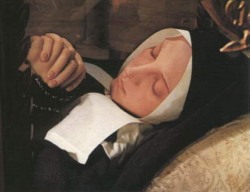 St.Bernadette
Soubirous, d. 1879
St.Bernadette
Soubirous, d. 1879
Click to enlarge
Paray-le-Monial
Relic: St. Margaret Mary Alacoque (unsure as to whether or not she
is incorrupt; I've read that her relics are not incorrupt, but are kept
in a figurine of her which makes her appear incorrupt)
Where: Shrine of St. Margaret Mary Alacoque,
Paray-le-Monial, France
Paris
Relic: St. Genevieve
Where: Church of Saint Etienne-Du-Mont,
Paris, France
Relic: Crown of Thorns and a piece of the
True Cross
Where: Kept, starting with King St. Louis IX,
at Ste. Chapelle, Paris, France (on the Ile de la Cité,near Notre Dame)
-- a chapel the sainted King built just for theserelics. Removed during
the French Revolution and placed in the Bibliotheque Nationale. They
are now at Notre Dame Cathedral in Paris (but visit Ste. Chapelle
anyway! It is stunning...).
Relic: St. Catherine Labouré(incorrupt)
Where: Chapel of the Sisters of Charity
Convent, 140 Rue du Bac, Paris, France
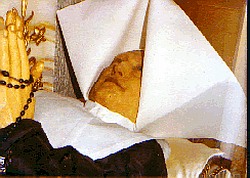 St.Catherine
Labouré, d. 1876
St.Catherine
Labouré, d. 1876
Relic: St. Vincent de Paul(incorrupt)
Where: Church of St. Vincent dePaul, Rue de
Sevres, Paris, France (his heart is at the Chapel of the Miraculous
Medal)
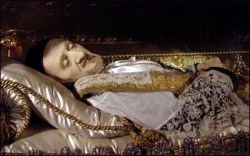 St.Vincent de
Paul, d. 1660
St.Vincent de
Paul, d. 1660
Saint-Maximin-la-Sainte-Baume
Relic: St. Mary Magdalen
Where: Basilique Sainte-Marie-Madeleine in
Saint-Maximin-la-Sainte-Baume in Provence-Alpes-Côte d'Azur, France
Seine et Marne
Relic: St. Fiacre
Where: Cathedrale de Meaux, Seineet Marne,
France
Tarascon
Relic: St.
Martha
Where: The
tomb of St. Martha can be found in l'Église Sainte-Marthe de Tarascon
in Tarascon, Provence, France
Saint
Denis
Relic: St. Denis (Dionysius); St. Louis IX
Where: Basilica of St. Denis, St.Denis,
France (now a northern suburb of Paris). Along with the relics of St.
Denis and King St. Louis IX, you will find here almost all
the remains of French monarchs from Dagobert I on. During the French
Revolution, the contents of the tombs were emptied into a mass grave,
but were later recovered and put into a large ossuary inside the
Basilica.
Toulouse
Relic: St. Thomas Aquinas
Where: Couvent des Jacobins, Toulouse,
France
Vannes
Relic: St. Vincent Ferrer
Where: Cathedral of Vannes,Vannes, France
Germany
Cologne
Relic: The Three Magi
Where: Discovered in Persia, brought to
Constantinople by St. Helena, transferred to Milan in the fifth century
and then to the Cathedral of Cologne, Germany in A.D. 1163, where
they've been ever since.
Relic: St. Ursula
Where: Ursalaplatz (Church of St.Ursula),
Cologne, Germany
Relic: St. Albert the Great
Where: Komdienstraße (Church ofSaint
Andreas), Cologne, Germany
Eibergen
Relic: St. Hildegard von Bingen
Where: Parish church of Eibergen, Eibergen,
Germany (originally buried at the graveyard of the convent of
Disibodenberg. Translated to present location in A.D. 1642).
Eichstatt
Relic: St. Walburga
Where: Church of St. Walburga, Eichstätt,
Bavaria, Germany. Her relics exude a healing "oil of Saints" between 12
October and 25 February, her Feast in the Benedictine Breviary.
Fulda
Relic: St. Boniface
Where: Cathedral of Fulda, Fulda,Germany
Munich
Relic: St. Mundita
Where: Peterskirche (St. Peter's Church),
Rindermarkt 1 (near the Rathaus), Munich, Germany. I have no idea who
this Saint is, but her skeleton is gilded, bejeweled, and kept in a
glass case. Fitted with glass eyes, she seems to stare at you from the
beyond...
Trier
Relic: Christ's Robe
Where: Cathedral of St. Peter,Trier, Germany.
The "tunica Christi" was brought to Trier by St. Helena.
Hungary
Buda
Relic: the right hand King Saint Istvan (Stephen) (this relic is
known as the "Holy Right")
Where: Saint Istvan's Basilica,Buda (the
western part of Budapest)
India
Chennai
Relic: St. Thomas the Apostle
Where: Santhome Cathedral,Chennai, India
Goa
Relic: St. Francis Xavier (incorrupt)
Where: Basilica Bom Jesus, Goa,India
Ireland
(Republic of Ireland and Northern Ireland)
Downpatrick
Relic: SS. Patrick, Brigid, and Columba (a.k.a. "Columcille")
Where: Cathedral of Down, Downpatrick,
Northern Ireland
Dublin
Relic: St. Valentine
Where: The Carmelite Whitefriar Church,
Dublin, Republic of Ireland. At least some of the greater relics of St.
Valentine were retrieved from the Cemetery of St Hippolytus, on the
Tiburtine Way in Rome, and given to Fr. John Spratt by Pope Gregory XVI
in 1836.
Italy
Amalfi
Relic: St. Andrew, Apostle
Where: Cathedral of Amalfi, Italy
Aquila
Relic: St. Bernardine of Siena
Where: Basilica di S.Bernardino, Aquila,
Abruzzo, Italy
Assisi
Relic: St. Francis of Assisi
Where: Lower Church of the Basilica of Saint
Francis of Assisi, Assisi, Umbria, Italy
Relic: St. Clare of Assisi, St. Agnes of
Assisi, and their mother, Blessed Ortolana
Where: Basilica of Santa Chiara, Assisi,
Umbria, Italy
Bari
Relic: St. Nicholas of Myra
Where: Translated from Myra to the Church of
St. Stephen in Bari, Apulia, Italy in A.D. 1087 to save them from
Muslim desecration.
Bologna
Relic: St. Dominic
Where: Church of St. Dominic,Bologna, Italy
Relic: Blessed Imelda Lambertini(incorrupt?)
Where: San Sigismondo Church near the
University of Bologna, Bologna, Italy. Blessed Imelda died in ecstasy
while receiving her First Holy Communion. I am uncertain how accurately
the picture above represents Imelda's state of preservation; this may
be a wax figure. The translation of the Latin inscription above her
tomb reads:
Imelda
Lambertini
A virgin of Bologna in ancient Coenobio
St. Mary Magdalene in the Valley of Peter,
Emulating the innocent angel
When, long ago, she desired most passionately
To approach the sacred altar,
But did not reach it because of her tender youth.
Jesus Himself, overcome by her great love,
Four days before the Ides of May in the year 1333
He descending from heaven, restored her in a new miracle with the
divine bread,
Embracing her as a spouse,
He filled her with so much ecstatic joy
That the bonds of her fragile body were broken
And her most innocent spirit flew away from this earth
To the eternal banquet of Christ.
Oh blessed citizen of Bologna
You whose bones protect this place with their religious power,
Watch over the chaste line of children,
And approach the celestial banquets.
Teach them to trample down the earthly delights, like you
And to always hope for immortality.
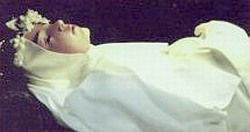 BlessedImelda
Lambertini, d. 1333
BlessedImelda
Lambertini, d. 1333
Caposele
Relic: St. Gerard Majella
Where: Caposele, Italy
Cascia
Relic: St. Rita of Cascia (incorrupt)
Where: Basilica of St Rita in Cascia, Italy
Cassino
Relic: St. Benedict and St. Scholastica
Where: Abbey of Monte Cassino, on a hill
overlooking Cassino, Italy
Castello
Relic: Blessed Margaret of Castello (incorrupt)
Where: Church of St. Domenico,Castello, Italy
Florence
Relic: St.
Mary of Egypt (skull)
Where:
Cattedrale di Santa Maria del Fiore
Lanciano
Relic: Eucharist whose accidents had turned also to Flesh inA.D.
700
Where: Church of Lagontial,Lanciano, Italy. A
Basilian monk who was offering Mass in the church of St. Legonziano in
Lanciano began to doubt the real presence of Christ under the sacred
species after the consecration. At that very moment, the priest saw how
the sacred host was transformed into human flesh and the wine into
blood, which later coagulated. Read about the
Eucharistic Miracle of
Lanciano and what science has discovered.
Milan
Relic: St. Ambrose
Where: Basilica of Sant'Ambrogio,Milan, Italy
(crypt open on his Feast Day)
Relic: St. Charles Borromeo
Where: Cathedral of Milan, Italy
Relic: St.
Peter Martyr (Peter of Verona)
Where:
Portinari Chapel of the Basilica of Sant'Eustorgio
Monoppello
Relic: St. Veronica's Veil (?)
Where: Carthusian Monastery,Monoppello,
Italy. If this is the true Veil of Vernoica, the historygoes like this:
the veil had been kept at St. Peter's Basilica, Rome, Italy (there is a
niche for it near the statue of St. Veronica there), but was removed
from there when St. Peter's was being rebuilt, and taken to this
monastery in A.D. 1608. There is either a copy of the veil at the
Vatican today in the aforementioned niche, or the one at the Vatican is
the original (all other copies of the Veil were prohibited by Pope Paul
V in 1616).
Naples
Relic: St. Januarius (Genarro)
Where: Cathedral of Naples,Naples, Campania,
Italy. A vial of St. Genarro's dried blood liquefies and "boils" when
brought near his head 18 times a year.
Relic: St.
Mary of Egypt
Where: Santa
Maria Egiziaca a Forcella
Montefalco
Relic: St. Clare of Montefalco (incorrupt)
Where: Church of the Holy Cross,Montefalco,
Italy
Nettuno
Relic: St. Maria Goretti
Where: Our Lady of Grace, Nettuno,Italy
Padua
Relic: St. Anthony of Padua
Where: Basilica of St. Anthony,Padua, Italy.
When St. Anthony's coffin was opened 30 years after his disposition,
most of his body was found to have returned to dust but for his tongue,
which remained fresh as a sign of his gift of preaching. It is this
that is kept at the Basilica.
Relic: St. Luke
Where: Basilica of St. Justina in Padua, Italy
Pavia
Relic: St. Augustine, Boethius (martyr whose cultus is approved in
Pavia)
Where: San Pietro in Ciel D'Oro, in Pavia,
Lombardy, Italy
Rieti
Relic: St. Barbara
Where: Cathedral of Rieti, Italy
Rome
Relic: Titulus Crucis, a Crucifixion nail, relic of the True
Cross, two thorns from the Crown of Thorns, the greater part of the
sponge used to give Christ vinegar, a piece of the cross of the good
thief (St. Dismas), finger of St. Thomas the Apostle
Where: Santa Croce in Gerusalemme (Holy Cross
in Jerusalem) 12 Piazza di Santa Croce in Gerusalemme,Rome, Italy. The
church, whose floor was packed with soil from the HolyLand, was
consecrated about A.D. 325, in an older building that was rebuilt to
house the Passion Relics brought to Rome by St. Helena, Constantine's
mother. The "Titulus Crucis" is the sign that hung over Christ's Head,
naming Him as "King of the Jews."
Relic: St. Agnes
Where: Sant' Agnese fuori le mura(St Agnes
Outside the Walls), 364 Via Nomentana, Rome, Italy. The church is built
over St. Agnes's tomb. Her head is preserved at the Sancta Sanctorum in
the area.
Relic: Many Popes, including: St.Peter; St.
Leo the Great; St. Gregory the Great; St. Pius X(incorrupt). Many
Saints, including St. Gregory Nazianzen.
Where: San Pietro in Vaticano (St. Peter's
Basilica, Vatican City, Italy)
Relic: St. Jerome and St. Pius V(incorrupt),
part of the manger, the icon Salus Populi Romani
Where: Santa Maria Maggiora (St.Mary Major)
42 Piazza di Santa Maria Maggiore, Rome, Italy
Relic: St. Bartholomew, Apostle
Where: St.Bartholomew-in-the-Island, Rome,
Italy
Relic: St. Lawrence and St.Stephen
Where: San Lorenzo fuori le Mura(St Lawrence
outside the Walls, a.k.a. San Lorenzo in Campo Verano) 3Piazzale del
Verano, Rome, Italy. The church is built over the tomb of St. Lawrence.
St. Stephen was brought from Constantinople by PopePelagius II. Another
church, San Lorenzo in Panisperna, was built over the place of St.
Lawrence's martyrdom, and there one can see the gridiron upon which he
was put to death.
Relic: St. Paul
Where: Some of St. Paul's relics are kept at
the Basilica of St. Paul's Outside the Walls (San PaoloFuori Le Mura).
At the Church of the Decapitation (Church of San PaoloAlle Tre
Fontane), built over the site he was beheaded, you can see the marble
column to which St. Paul was bound, the table on which he died,and
three springs that sprang up at the spot where he was killed (the
springs are now operated mechanically).
Relic: SS. Cosmas and Damian
Where: Church of Saints Cosmas and Damian,
Rome, Italy
Relic: Hearts of Popes Sixtus V,Urban VII,
Gregory XIV, Innocent IX, Clement VIII, Leo XI, Paul V,Gregory XV,
Urban VIII, Innocent X, Alexander VII, Clement IX, ClementX, Bl.
Innocent XI, Alexander VIII, Innocent XII, Clement XI, InnocentXIII,
Benedict XIII, Clement XII, Benedict XIV, Clement XIII, ClementXIV,
Pius VII, Leo XII, Pius VIII, Gregory XVI, Bl. Pius IX (all the Popes
from Sixtus V, who died in 1590, to Pius IX, with the exception of Pius
VI)
Where: Santi Vincenzo e Anastasio(Church of
SS. Vincent and Anastasius), in the Piazza di Trevi, Rome
Relic: Steps of Pilate's house that Christ
ascended for His sentencing (moved from Jerusalem to Romeby St. Helena)
Where: Basilica of St. JohnLateran, Rome,
Italy. Also in this basilica is a monument to Pope Sylvester II that is
said to "cry" before a Pope dies (its marblebecomes moist).
Relic: St. Cecilia
Where: Santa Cecilia in Trastevere, Rome,
Italy.
St. Cecilia was originally buried in the Catacombs of St.Callixtus
(Catacombe di San Callisto), but in A.D. 821, Pope Paschal collected
the remains of the Saints to preserve them from raiders. Her relics
were moved to the church built in her honor, at the site of her home
when she lived.
Relic: St. Sebastian
Where: Church of St. Sebastian, Rome, Italy.
(St. Sebastian's head is at Church of the Four Crowned Martyrs --
"Santi Quattro Incoronati)
Relic: St. Monica
Where: Church of St. Augustine in Campo
Marzio, Rome, Italy
Relic: St. Ignatius of Loyola and St. Robert
Bellarmine
Where: Church of the Gesu, Rome,Italy
Relic:
St. Valentine
Where: Chiesa di Santa Maria in Cosmedin, on
Rome’s Piazza Bocca della Verità, where the "Bocca della Verità" (the
"Mouth of Truth" seen in "Roman Holiday") is located. This relic is St.
Valentine's skull; most the rest of his relics are in Dublin, Ireland.
Relic:
St.
Catherine of Siena and Fra Angelico
Where: Altar at the Basilica of Santa Maria
Sopra Minerva, Rome, Italy (St. Catherine's head is in the Church of
San Domenico, Siena, Italy)
Note:
Also of interest in Rome are two sites rather like Kostnice in the
Czech Republic (see above). The first is the Cimitero dei Capuccini,the
Capuchin catacombs near Piazza Barberini. This subterranean crypt
underneath the Church of Santa Maria della Concezione contains the
bones of monks and others arranged in artistic designs. The second is
S.Maria dell'Orazione e Morte, located at via Giulia 262. This place
contains the bones of unknown people who died and had no one to bury
them, and who were buried by a Confraternity that had charge of such
things and offered Masses for their souls.
Relic:
St. Peter and the Holy Machabees
Where: Church of San Pietro in Vincoli, Rome,
Italy.
(The chains used to bind St. Peter during his imprisonment in
Jerusalem, the chains used to bind him during his imprisonment by Nero
in Rome, and the relics of the Seven Holy Machabees).
San Giovanni Rotondo
Relic: St. Pio of Pietrelcina (Padre Pio)
Where: Padre Pio Shrine, SanGiovanni Rotondo,
Italy
Turin
Relic: St. John Bosco (incorrupt), St. Dominic Savio, St.Maria
Mazzarello (incorrupt)
Where: Basilica di MariaAusiliatrice (Mary
Help of Christians), Turin, Piedmont, Italy. In Valsalice, Piedomont,
you can see the room where St. John Bosco died,kept exactly as it was
when he went to his Heavenly reward.
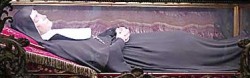 St.Maria
Mazzarello, d. 1881
St.Maria
Mazzarello, d. 1881
Relic: The Holy Shroud
Where: Royal Chapel of the Holy Shroud,
Cathedral of San Giovanni, Turin, Piedmont, Italy (since A.D.1578).
Please learn more about the most fascinating Holy Shroud of Turin and the Sudarium of
Oviedo.
Venice
Relic: St. Lucy
Where: Church of San GeremiaVenice, Italy.
Her remains, moved from Syr acuse to Constantinople, were translated
from Constantinople to Venice in A.D. 1204. Her head,however, may be
venerated at the Cathedral of Bourges France (it wassent to Louis XII).
Relic: St. Roch
Where: Church of San Rocco,Venice, Italy.
Malta
Relic: The pillar upon which St. Paul was martyred, Wrist bone of
St. Paul
Where: Church of St Paul's Shipwreck, Saint
Paul Street, Valletta. The church contains ornate baroque carvings
covering almost the entire surface of the church and ornate statues
that are paraded through the streets on the appropriate day.
Relic: Saint George Preca, various relics including a vial of blood
Where: Where: Blata l-Bajda, close by the
mother house of the M.U.S.E.U.M. (Magister Utinam Sequator Evangelium
Universus Mundus) Society, a group founded by the saint to promulgate
the faith in Malta and abroad.
Mexico
Relic: The miraculous image of Our Lady of Guadalupe
Where: the Basilica of Our Lady of Guadalupe
in Mexico City. Read about Our Lady of Guadalupe
and the miraculous tilma of St. Juan Diego here.
Peru
Lima
Relic: St. Martin de Porres
Where: Convent of the Holy Rosary, Lima, Peru
Poland
Krakow
Relic: SS. Hedwig (Jadwiga) and Stanislaus
Where: Cathedral Basilica of St.Stanislaus
and St. Wenceslaus. ("Wawel Cathedral"), Krakow, Poland
Spain
Agreda
Relic: Venerable Mary of Agreda (incorrupt)
Where: Convent of the Conception, Agreda, Spain
Avila
Relic: St. Teresa of Avila (incorrupt)
Where: Convent of St. Teresa, Avila, Spain
(St. Teresa's heart is in the Carmelite Convent in Alba de Tormes,
Spain)
Compostela
Relic: St. James the Greater
Where: Cathedral of Santiago de Compostela,
Compostela, Spain
Granada
Relic: St. John of God
Where: Iglesia de San Juan deDios, Granada,
Spain. At the Museo de S. Juan de Dios. Calle Convalescencía, you can
see the room in which he died, along with some of his belongings.
Oviedo
Relic: Sudarium of Oviedo (the second linen used to cover Jesus'
Face at His entombment)
Where: Cathedral of Oviedo,Oviedo, Spain.
Please learn more about the most fascinating Holy Shroud of Turin and the Sudarium of
Oviedo.
Segovia
Relic: St. John of the Cross
Where: Segovia, Spain
Sweden
Vadstena
Relic: St. Birgitta
Where: Vadstena Cloister,Vadstena,
Ostergotlands Lan, Sweden
United States
Chicago, Illinois
Relic: Over 2000 relics, including some of all 12 Apostlesand 24
of the 33 Doctors of the Church
Where: St. John Cantius Parish,825 North
Carpenter Street Chicago, Illinois 60622-5405, Phone:312-243-7373
St. Marys, Kansas
Relic: Practically every Saint who's ever lived
Where: At St. Mary's Academy,there's a Relic
Chapel that contains an incredible amount of first class relics (though
no major tombs or shrines). The address is: St.Mary's Academy &
College, 200 E. Mission Street, St. Marys, KS66536
Louisville, Kentucky
Relic: St. Bonosa and St. Magnus
Where: At St. Martin of Toursparish church,
639 South Shelby Street, Louisville, Kentucky, 40202
Emmitsburg, Maryland
Relic: St. Elizabeth Ann Seton
Where: Seton Shrine Chapel,Emmitsburg,
Frederick County, Maryland
Relic: St. Frances Cabrini
Where: St. Frances CabriniShrine, 701 Fort
Washington Avenue, New York City, New York
Maria Stein, Ohio
Relic: Practically every Saint who's ever lived
Where: Another Relic Chapel likethat of St.
Mary's Academy in Kansas (no major tombs or shrines) is the Maria Stein
Center. The address is: 2291 St. Johns Road, Maria Stein,Ohio 45860,
(419) 925-4532
Philadelphia, Pennsylvania
Relic: St. John Neumann
Where: National Shrine of SaintJohn Neumann,
1019 North Fifth Street, Philadelphia, Pennsylvania 19123
Pittsburgh, Pennsylvania
Relic: Practically every Saint who's ever lived
Where: Another Relic Chapel --the largest in
the United States -- is St. Anthony's Chapel in the MostHoly Name of
Jesus parish. The address is: 1700 Harpster St.,Pittsburgh,
Pennsylvania (Troy Hill).
Footnotes:
1 So entwined are body and soul that
there exists a rather creepy phenomenon by which recipients of organ
transplants sometimes take on aspects of their donors' personalities:
Many different
types of personality changes have been described following organ
transplantation. These include changes in preferences for food, music,
art, sex, recreation, and career [8], the experience of new memories
[9], feelings of euphoria, enhanced social and sexual adaptation [10],
improved cognitive abilities [11], and spiritual or religious episodes
[12]. These changes were generally described as neutral or positive.
However, troubling changes have also been reported. As many as 30–50%
percent of heart transplant recipients experience emotional or
affective issues [7,13], while others experience delirium [10],
depression, anxiety [14,15,16], psychosis [17], and sexual dysfunction
[18].
A report in the lay literature describes the case of Claire Sylvia who
reported changes in her personality, preferences, and behaviors
following a heart and lung transplant at Yale-New Haven hospital in
1988. Following surgery, Sylvia developed a new taste for green peppers
and chicken nuggets, foods she previously disliked. As soon as she was
released from the hospital, she promptly headed to a Kentucky Fried
Chicken to order chicken nuggets. She later met her donor’s family and
inquired about his affinity for green peppers. Their response was, “Are
you kidding? He loved them… But what he really loved was chicken
nuggets” (p. 184, [9]). Sylvia later discovered that at the time of her
donor’s death in a motorcycle accident, a container of chicken nuggets
was found under his jacket [9].
In addition to changes in preferences, some recipients describe new
aversions after receiving a donor heart. For example, a 5-year-old boy
received the heart of a 3-year-old boy but was not informed about his
donor’s age or cause of death. Despite this lack of information, he
provided a vivid description of his donor after the surgery: “He’s just
a little kid. He’s a little brother like about half my age. He got hurt
bad when he fell down. He likes Power Rangers a lot I think, just like
I used to. I don’t like them anymore though” (p. 70, [8]). Subsequently
it was reported that his donor had died after falling from an apartment
window while trying to reach a Power Ranger toy that had fallen onto
the window ledge. After receiving his new heart, the recipient refused
to touch or play with Power Rangers [8].
Some recipients have reported “memories” that seem unrelated to their
own lived experiences and involved sensory experiences that were,
unbeknownst to them, related to their donor. For example, a 56-year-old
college professor received the heart of a 34-year-old police officer
who tragically lost his life after he was fatally shot in the face.
Following the transplant, the recipient reported a peculiar experience,
stating, “A few weeks after I got my heart, I began to have dreams. I
would see a flash of light right in my face and my face gets real, real
hot. It actually burns” (p. 71, [8]).
Source: Carter, Brian, Laveen Khoshnaw, Megan Simmons, Lisa
Hines, Brandon Wolfe, and Mitchell Liester. 2024. "Personality Changes
Associated with Organ Transplants" Transplantology 5, no. 1: 12-26.
https://doi.org/10.3390/transplantology5010002
|