|
In the 13th
century, a Portuguese woman who'd been demonically oppressed resolved
to
do the unthinkable by taking her own life by drowning herself in the
Tagus River. On her way to the river, she passed a shrine erected in
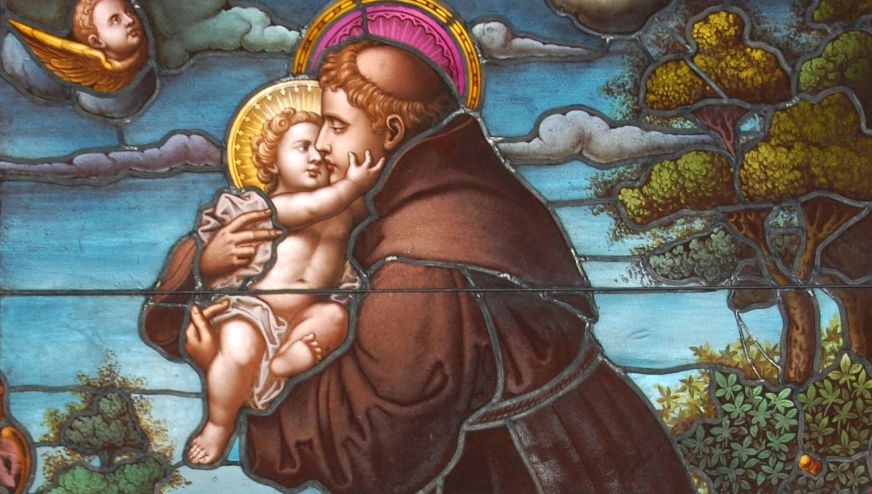
honor of the great orator and miracle-worker, St. Anthony of Padua. She
stopped to pray, one last time. As she prayed, she saw St. Anthony
standing before her, saying, "'Arise woman, and take this paper, which
will free you from the molestations of the Evil One." Then he gave her
a parchment inscribed with what is now known as the "Brief (i.e.,
"Letter") of St. Anthony," 1 and
she was now free from demonic oppression and the desire to do away with
herself.
News of this miracle spread, even to the King who asked the woman for
the Brief. He placed it with the Crown Jewels of Portugal, which was
fine for the King, but bad for the woman. After the Brief was no longer
with her, she began to weaken and lapse, so the King made a copy for
her that restored her to her healed state. Other copies of the Brief
were spread to help the faithful fight the Evil One and remind them
that Christ has conquered.
The Brief consists of a depiction of a Cross, and words which, forming
a rhyme in the Latin, hearken back to Apocalypse 5:5, "And one of the
ancients said to me: Weep not: behold the lion of the tribe of Juda,
the root of David, hath prevailed to open the book and to loose the
seven seals thereof." The words of St. Anthony's Brief are:
Ecce Crucem
Domini,
Fugite, partes adversae,
Vicit Leo de Tribu Juda,
Radix David, alleluia.
English version:
Behold the Cross of the Lord!
Flee ye adversaries!
The Lion of the Tribe of Juda,
The Root of David has conquered, alleluia!
The exorcizing
proclamation is carried on the person or placed in homes. It is also
used in more specific situations, such as that encountered by the
French seamen who found their ship tossed by an angry sea during a
storm off Brittany's coast in 1708. One of the men wrote the words of
St. Anthony's Brief, and threw it into the sea with a prayer to the
Saint. Immediately, the seas calmed and the sailors were saved.
The words of this Brief are good ones to use when feeling tempted by
evil, oppressed by demons, and in general spiritual warfare.
As an aside, part of these words from the Apocalypse are also inscribed
at the top of the obelisk that sits in St. Peter's Square. The obelisk
had been in Rome since A.D. 37, set up in what is believed by many to
have been the site of the divisional wall (spina) of Caligula's Circus,
where Nero's massacre of Christians took place in A.D. 67. Pope Sixtus
V moved the obelisk to its present position in a move that
...celebrated
the triumph of the Faith of Christ, St Peter and the apostles over
pagan superstition. The proximity of the obelisk to the old basilica
had always been resented as something of a provocation, almost as a
slight to the Christian religion. It had stood there like a false idol,
as it were vaingloriously, on what was believed to be the center of the
accursed circus where the early Christians and St Peter had been put to
death. Its sides, then as now, were graven with dedications to Augustus
and Tiberius. On its summit was a bronze sphere believed to contain the
ashes of Julius Caesar. When taken down, the sphere proved to be solid.
Nevertheless, Sixtus had a bronze cross put in its place (in 1740,
after repairs, a piece of the True Cross was inserted in one of the
arms). Solemnly the pope had the heathen spirit of the obelisk
exorcised. 'Impio cultu dicatum' he carved upon the base as a reminder
of what the needle once represented, and 'Ecce Crux Domini fugite
partes adverase' in proud defiance of Luther and the reformed Churches.
2
Footnote:
1 Other accounts say that
she fell asleep, dreamed of St. Anthony, and awakened to find the
Brief. I don't know which is accurate.
2 "Saint Peter's", by James
Lees-Milne, 1967
|
|