 |
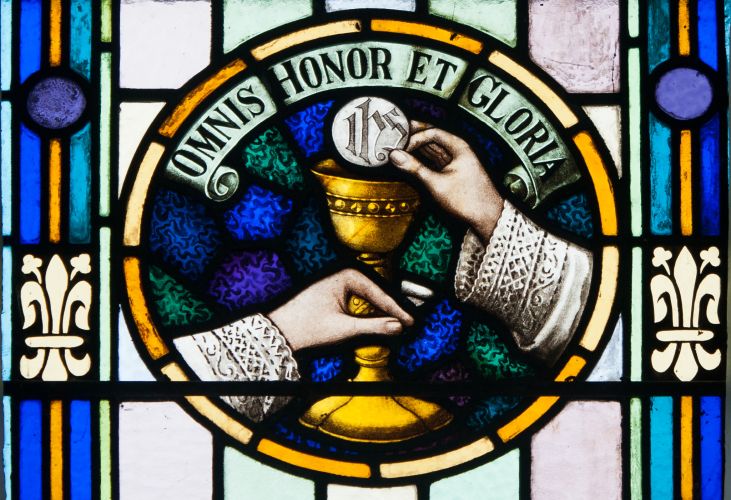
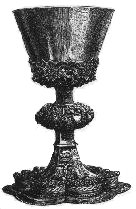
Chalice
The consecrated gold or gilded silver cup used to hold the Precious
Blood. Only priests or deacons are allowed to touch the Chalice (though
sacristans may in the course of their duties). Pewter Chalices are
"okay" for use during times of persecution but, even then, the inside
of the bowl must be gilded.
When Mass begins, the Chalice is covered by the folded purificator and
the pall (see below).
|
|
|
|
|
|
|
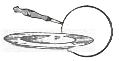
Paten
The consecrated gold or gilded silver plate on which the Sacred Host is
laid. Only priests or deacons are allowed to touch the Paten (though
sacristans may in the course of their duties). A Communion Paten has a
handle and is held under the chin of one receiving the Eucharist so
that in case the Host is dropped, it won't fall to the floor. |
|
|
|
|
|
|
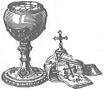
Ciborium
A chalice-shaped vessel with a lid used to hold consecrated Hosts for
distribution during the Communion of the faithful. It can be made
of any material as long as the inside is gilded. It is kept in the
Tabernacle between Masses, covered with a white veil (which can be
decorated with precious metals). |
|
|
|
|
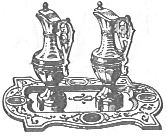 |
Cruets
These vessels hold the water and wine before Consecration |
|
|
|
|
|

|
Monstrance (or "Ostensorium" or "Ostensory")
A gold or silver vessel, often in a sunburst shape, with a clear glass
area, called a "luna," for viewing the Sacrament. The Host is kept in
place inside the crystal or glass frame by a crescent shaped gold or
silver gilded clip called a "lunette." The monstrance is used during
Benedictions and processions, etc., for adoration by the faithful. It
doesn't require a blessing, but it should be blessed.
|
|
|
|
|
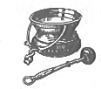 |
Aspersory and Aspergillum (or "Aspergill")
The Aspersory is a container for holding Holy
Water. The Aspergillum is a stick-shaped implement with holes in it
to dip into the Aspersory and catch the Holy Water for sprinkling the
people and things. Because of Leviticus 14:49-52, Numbers 19:18, Psalm
50:9, etc., the aspergillum used to contain crushed Biblical hyssop
(Origanum syriacum) to catch the water, but nowadays a small sponge is
more often used. |
|
|
|
|
|
|
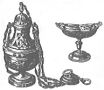
Thurible (or "Censer") and Boat
A thurible is the incense burner used at
Mass. It hangs from chains so it can be swung to incense people and
things. The boat is where the incense is stored until it is placed in
the thurbible. |
|
|
|
|
|

|
Pyx
A small container, also called a custodia, used to carry the Sacred
Host when taking it to the sick and homebound. It is made of the same
material as the Ciborium -- gilt on the inside.
|
|
|
|
|
|
Altar
Linens
|
|
|
Chalice veil
Small silk cloth, of the same color as the priest's vestments, used to
cover the Chalice |
|
|
|
|
|
Purificator (or "Mundatory" or "Purificatory")
Rectangular piece of linen or hemp used to wipe the Chalice before the
Offertory and after Communion, the priest's lips and fingers. It
requres no special blessing. |
|
|
|
|
|
Pall
A blessed, stiff square piece of linen, sometimes decorated with a
Cross or other embroidery, used to cover the Chalice to prevent
impurities from falling into it. If it is embroidered or made of silk,
the side touching the Chalice must still be made of linen.
Another type of pall is the cloth used to cover coffins at Requiem
Masses. |
|
|
|
|
|
Finger Towels
These may be made of any material (preferably linen) and are used at
the lavabo and after Communion |
|
|
|
|
|
Corporal
A blessed square linen cloth which is spread out by the priest in the
middle of the Altar. From the Catholic Encylopedia, "after it [the
corporal] is washed, bleached, and ironed, it is folded into three
equal parts, both in its length and in its width, i.e. the anterior
part is folded over the middle; then the posterior part is turned down
over the anterior part; after this the part at the priest's right is
folded over the middle, and finally the part at the priest's left is
folded over these. The corporal is placed in the burse in such a manner
that the edge of the last fold is towards the opening of the burse." |
|
|
|
|
|
Burse
A 10-inch square container to hold the Corporal. The burse covers the
chalice before the Mass, with the opening of the burse facing toward
the priest. (The leather pouch used to hold the pyx is also called a
burse)
|
|
 |
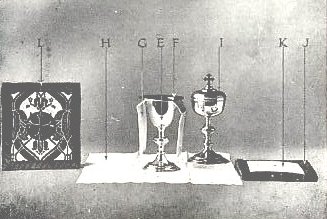 |
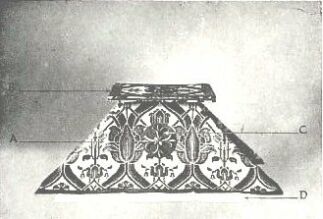
A: Chalice Veil
which covers the Chalice underneath
B: Burse
C: Cross on front of veil
D: Corporal on which the veiled Chalice sits |
|
E: Chalice
F: Paten
G: Purificator
H: Corporal |
|
I: Ciborium
J: Folded Chalice Veil
K: Pall
L: Burse |
|
|