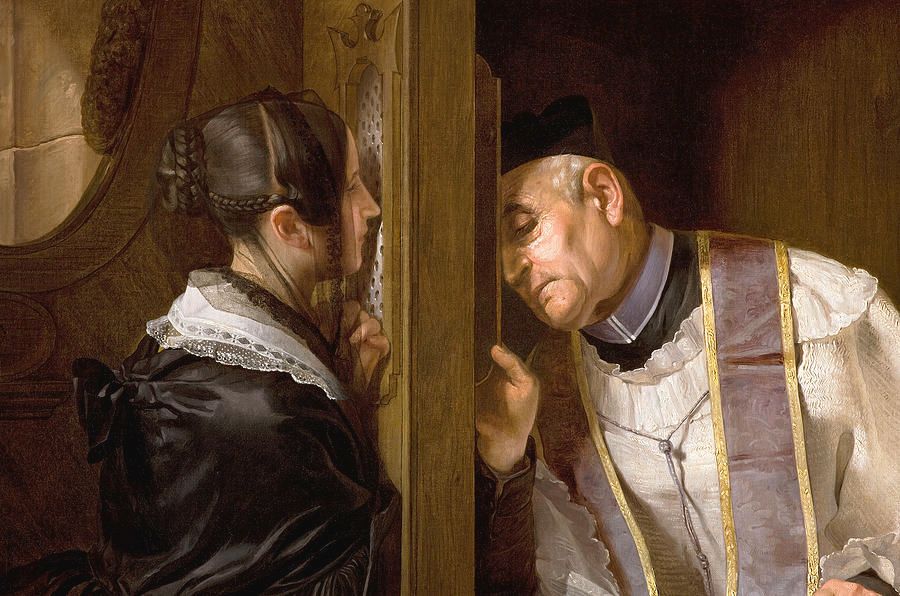
"Confession isn't in the Bible!"
First, Protestants really have to get over the idea that if something
isn't in the Bible, it isn't true or important (see Sola Scriptura). Christ didn't set up a
reading group; He set up a Church
and gave spiritual authority to His apostles and those they ordained.
Second, the sacrament of confession was foreshadowed in the Old
Testament --
Leviticus 5:5-6
And
it shall be, when he shall be guilty in one of these things, that he shall confess that he hath sinned
in that thing: And he shall bring his trespass offering unto the
Lord for his sin which he hath sinned, a female from the flock, a lamb
or a kid of the goats, for a sin offering; and the priest shall make an atonement
for him concerning his sin.
--and is explicitly described in John 20: it is the day of the
Resurrection. Mary
Magdalene told the disciples that she had seen the risen Lord. Then
this happens:
John 20:19-23
Then
the same day at evening, being the first day of the week, when the
doors were shut where the disciples were assembled for fear of the
Jews, came Jesus and stood in the midst, and saith unto them, Peace be
unto you.
And
when He had so said, He shewed unto them His hands and His side. Then
were the disciples glad, when they saw the Lord.
Then
said Jesus to them again, Peace be unto you: as My Father hath sent Me, even so send I
you.
And
when He had said this, He breathed on them, and saith unto them,
Receive ye the Holy Ghost:
Whose soever sins ye remit, they are
remitted unto them; and whose soever sins ye retain, they are retained.
Now, did Jesus send certain men even as the Father sent Him? This is a
yes or no question.
Did He give to those men the power to remit and retain others' sins?
This, too, is a yes or no question.
The earliest Christians took this bit of Scripture quite
literally. Acts 19:18 describes how the locals in Ephesus behaved
toward Paul:
And many that
believed came, and confessed, and
shewed their deeds.
From the 4th chapter of the Didache, a catechism -- the first catechism
-- which was written in the 1st century:
In the church
you shall acknowledge your transgressions, and you shall not come near
for your prayer with an evil conscience. This is the way of life.
And its 14th chapter says:
But every Lord's
day [Sunday] gather yourselves together, and break bread, and give
thanksgiving after having confessed your transgressions,
that your sacrifice may be pure.
Consider the words of Hippolytus (165 – c. 235 AD), who wrote in his
"Apostolic Tradition":
He who is
ordained as a bishop, being chosen by all the people, must be
irreproachable. When his name is announced and approved, the people
will gather on the Lord's day with the council of elders and the
bishops who are present. With the assent of all, the bishops will place
their hands upon him, with the council of elders standing by,
quietly. Everyone will keep silent, praying in their hearts for
the descent of the Spirit. After this, one of the bishops present, at
the request of all, shall lay his hand upon him who is being ordained
bishop, and pray, saying,
God
and Father of our Lord Jesus Christ,
Father
of mercies and God of all consolation,
you
who live in the highest, but regard the lowest,a
you
who know all things before they are,
you
who gave the rules of the Church through the word of your grace,
who
predestined from the beginning the race of the righteous through
Abraham,
who
instituted princes and priests,
and
did not leave your sanctuary without a minister;
who
from the beginning of the world has been pleased
to
be glorified by those whom you have chosen,
pour
out upon him the power which is from you, the princely Spirit,
which
you gave to your beloved Son Jesus Christ,
which
he gave to your holy apostles,
who
founded the Church in every place as your sanctuary,
for
the glory and endless praise of your name.
Grant,
Father who knows the heart,
to
your servant whom you chose for the episcopate, that he will feed your
holy flock,
that
he will wear your high priesthood without reproach,
serving
night and day, incessantly making your face favorable,
and
offering the gifts of your holy church;
in
the spirit of high priesthood having the power to forgive sins
according to your command;
to
assign lots according to your command;
to loose any
bond according to the authority which you gave to the apostles;
to
please you in mildness and a pure heart, offering to you a sweet scent,
through
your son Jesus Christ,
through
whom to you be glory, power, and honor,
Father
and Son, with
the Holy Spirit,
in
the Holy Church,
now
and throughout the ages of the ages. Amen.
Or those of St. Cyprian of Carthage (d. A.D. 258), who wrote in his"The
Lapsed":
28. Moreover,
how much are they both greater in faith and better in their fear, who,
although bound by no crime of sacrifice to idols or of certificate,
yet, since they have even thought of such things, with grief and
simplicity confess this very thing
to God's priests, and make the conscientious avowal, put off
from them the load of their minds, and seek out the salutary medicine
even for slight and moderate wounds, knowing that it is written, God is
not mocked. God cannot be mocked, nor deceived, nor deluded by any
deceptive cunning. Yea, he sins the
more, who, thinking that God is like man, believes that he evades the
penalty of his crime if he has not openly admitted his crime.
Christ says in His precepts, Whosoever shall be ashamed of me, of him
shall the Son of man be ashamed. And does he think that he is a
Christian, who is either ashamed or afraid to be a Christian? How can
he be one with Christ, who either blushes or fears to belong to Christ?
He will certainly have sinned less, by not seeing the idols, and not
profaning the sanctity of the faith under the eyes of a people standing
round and insulting, and not polluting his hands by the deadly
sacrifices, nor defiling his lips with the wicked food. This is
advantageous to this extent, that the fault is less, not that the
conscience is guiltless. He can more easily attain to pardon of his
crime, yet he is not free from crime; and let him not cease to carry
out his repentance, and to entreat the Lord's mercy, lest what seems to
be less in the quality of his fault, should be increased by his neglect
of atonement.
29.
I entreat you, beloved brethren, that
each one should confess his own sin, while he who has sinned is
still in this world, while his confession may be received, while the
satisfaction and remission made by
the priests are pleasing to the Lord. Let us turn to the Lord
with our whole heart, and, expressing our repentance for our sin with
true grief, let us entreat God's mercy. Let our soul lie low before
Him. Let our mourning atone to Him. Let all our hope lean upon Him. He
Himself tells us in what manner we ought to ask. Turn to me, He says,
with all your heart, and at the same time with fasting, and with
weeping, and with mourning; and rend your hearts, and not your
garments. Let us return to the Lord with our whole heart. Let us
appease His wrath and indignation with fastings, with weeping, with
mourning, as He Himself admonishes us.
Or those of St. Ambrose (A.D. 340 - 397), who wrote in his "Concerning
Repentance," Book I, Chapter 2, 8
Consider, too,
the point that he who has received the Holy Ghost has also received the
power of forgiving and of retaining sin. For thus it is written:
Receive the Holy Spirit: whosesoever sins you forgive, they are
forgiven unto them, and whosesoever sins you retain, they are retained.
So, then, he who has not received power to forgive sins has not
received the Holy Spirit. The office
of the priest is a gift of the Holy Spirit, and His right it is
specially to forgive and to retain sins. How, then, can they
claim His gift who distrust His power and His right?
St. John Chrysostom (A.D. 347 - 407) writes this in Book II of his "On
the Priesthood":
For if any one
will consider how great a thing it is for one, being a man, and
compassed with flesh and blood, to be enabled to draw near to that
blessed and pure nature, he will then clearly see what great honor the
grace of the Spirit has vouchsafed to
priests; since by their agency these rites are celebrated, and
others nowise inferior to these both in respect of our dignity and our
salvation. For they who inhabit the earth and make their abode there are entrusted with the administration of
things which are in Heaven, and have received an authority which God
has not given to angels or archangels. For it has not been said
to them, Whatsoever you shall bind on earth shall be bound in Heaven,
and whatsoever you shall loose on earth shall be loosed in Heaven. They
who rule on earth have indeed authority to bind, but only the body:
whereas this binding lays hold of
the soul and penetrates the heavens; and what priests do here below God
ratifies above, and the Master confirms the sentence of his
servants. For indeed what is it but all manner of heavenly authority
which He has given them when He says, Whose sins ye remit they are
remitted, and whose sins ye retain they are retained? What authority
could be greater than this? The Father has committed all judgment to
the Son? But I see it all put into the hands of these men by the Son.
There are many more such writings from the earliest of Christians. Do
you know better than they?
"I don't need any priest to
confess my sins to! I go straight to God!"
By saying such a thing, you are ignoring that Christ gave the power of
binding and loosing to priests, and He did so for a reason. It's a
given that you can go straight to God and confess your sins (Catholic
do this all the time). If you're alone on a desert island, there's no
reason to fear that your sins can't be forgiven because no priest is
around (perfect contrition absolves in itself, see below). But it's also the case
that He wants you, whenever possible, to confess your sins to His
priests.
Priests are not merely fellow Christians; they are ministers who've
been empowered by God to do things that other Christians can't (absolve
sins, offer Mass, bless things with the power of the Church behind
them, etc.). Have you ever wondered why Jude -- in the New Testament -- described
certain errant Christians as people who are emulating Core (Korah)?
Jude 1:11
Woe
unto them! for they have gone in the way of Cain, and ran greedily
after the error of Balaam for reward, and perished in the gainsaying of
Core.
Go read Numbers 16 to find out how some of the ancient Israelites, led
by Core/Korah, got
angry at Moses, Aaron and their priests for behaving as priests, saying
to them, "Ye take too much upon you, seeing all the congregation are
holy, every one of them, and the Lord is among them: wherefore then
lift ye up yourselves above the congregation of the Lord?" In other
words, they said, in essence, "We're all
holy! We're all priests! We don't need the likes of you holding
yourselves over us as if you have some special power and special
office!"
Do you know what happened to those who thought it beneath them to have
a priesthood over them? This is what happened (Numbers 16:
32-35):
And the earth
opened her mouth, and swallowed them up, and their houses, and all the
men that appertained unto Korah, and all their goods. They, and all
that appertained to them, went down alive into the pit, and the earth
closed upon them: and they perished from among the congregation. And
all Israel that were round about them fled at the cry of them: for they
said, Lest the earth swallow us up also. And there came out a fire from
the Lord, and consumed the two hundred and fifty men that offered
incense.
Since Jude, in the New
Testament, warned Christians
about the rebellion of Core, you might want to re-think your attitudes
toward the priesthood and the very idea of spiritual authority.
Confession is Good
Anthropology
That "confession is good for the soul" is something everyone knows, and studies support the notion.1 God
made us as He made us, with a nature such that we have a psychological
need to express, to externalize, what shames us so we can be rid of it.
The sacrament of Confession works, of course, on a supernatural level, with priests --
by the power of Christ, through the power of Christ's Sacrifice --
absolving us, and our receiving sanctifying grace through the process.
But also on a purely natural
leve, confession just makes sense.
From the Protestant Carl Jung's 1932 lecture "Psychotherapists or the
Clergy," my emphasis:
I should like to
call attention to the following facts. During the past thirty years,
people from all the civilized countries of the earth have consulted me.
Many hundreds of patients have passed through my hands, the greater number being Protestants, a
lesser number Jews, and not more than five or six believing Catholics.
Among all my patients in the second half of life -- that is to say,
over thirty-five -- there has not been one whose problem in the last
resort was not that of finding a religious outlook on life. It is safe
to say that every one of them fell ill because he had lost what the
living religions of every age have given to their followers, and none
of them has been really healed who did not regain his religious
outlook. This of course has nothing whatever to do with a particular
creed or membership of a church.
Here,
then, the clergyman stands before a vast horizon. But it would seem as
if no one had noticed it. It also looks as though the Protestant clergyman of today were
insufficiently equipped to cope with the urgent psychic needs of our age.
It is indeed high time for the clergyman and the psychotherapist to
join forces to meet this great spiritual task.
Here
is a concrete example which goes to show how closely this problem
touches us all. A little more than a year ago the leaders of the
Christian Students’ Conference at Aarau [Switzerland] laid before me
the question whether people in spiritual distress prefer nowadays to
consult the doctor rather than the clergyman, and what are the causes
of their choice. This was a very direct and very practical question. At
the time I knew nothing more than the fact that my own patients
obviously had consulted the doctor rather than the clergyman. It seemed
to me to be open to doubt whether this was generally the case or not.
At any rate, I was unable to give a definite reply. I therefore set on
foot an inquiry, through acquaintances of mine, among people whom I did
not know personally; I sent out a questionnaire which was answered by
Swiss, German, and French Protestants, as well as by a few Catholics.
The results are very interesting, as the following general summary
shows. Those who decided for the doctor represented 57 per cent of the
Protestants and only 25 per cent of the Catholics, while those who
decided for the clergyman formed only 8 per cent of the Protestants as
against 58 per cent of the Catholics These were the unequivocal
decisions. The remaining 35 per cent of the Protestants could not make
up their minds, while only 17 per cent of the Catholics were undecided.
And he had this to say in a talk called “The Symbolic Life,” given
April 5, 1939 to the Guild of Pastoral Psychology in London:
You have heard
that I said Roman Catholics are less threatened by neurosis than
members of other religious confessions. Of course there are Catholic
neurotics just as well as others, but it is a fact that in my forty
years of experience I have had no more than six practising Catholics
among my patients. Naturally I do not count all those who have been
Catholics, or who say that they are Catholics but who do not practise;
but of practising Catholics I have had not more than about six. That is
also the experience of my colleagues. In Zurich we are surrounded by
Catholic cantons; not quite two-thirds of Switzerland is Protestant and
the rest is Catholic. And then we have on the frontier Southern Germany
which is Catholic. So we should have a fair number of Catholic
patients…
You
find the least or the smallest number of complex manifestations in
practising Catholics, far more in Protestants, and the most in Jews.
So
there must be something in the Catholic Church which accounts for this
peculiar fact. Of course, we think in
the first place of confession.
The
fact is that there are relatively few neurotic Catholics, and yet they
are living under the same conditions as we do. They are presumably
suffering from the same social conditions and so on, and so one would
expect a similar amount of neurosis. There must be something in the
cult,
in the actual religious practice, which explains that peculiar fact
that there are fewer complexes, or that these complexes manifest
themselves much less in Catholics than in other people. That something,
besides confession, is really the cult itself.
In addition to what happens to the soul on a supernatural level, confession simply feels great! It's like a long, soapy shower for one's spirit.
"Catholics think they can sin all week and
just confess and get away with it!"
That is not at all how the sacrament works. In order to receive the
graces of the sacrament, confession must be made with contrition
or, at least, attrition. Contrition is a true sorrow for
having offended God (perfect contrition absolves the guilt of sin in itself,
even
before confession is made -- assuming one has the will to go to
confession as soon as possible); attrition is fear of the loss of
Heaven and of the pains of Hell. Both contrition and attrition mean the
penitent in question wills not to sin again. And, of course, God will not
be mocked (Galatians 6:7).
Now, it's likely that one who's confessed will, in fact, sin again,
which is why periodic, regular confessions are advised. In the same way
we take regular showers to keep our bodies clean, we go to confession
regularly to keep our souls clean. Practice good spiritual hygiene: go Catholic, and go to confession!
Footnotes:
1 Two such studies:
Radcliffe AM, Lumley MA, Kendall J, Stevenson JK, Beltran J. Written
Emotional Disclosure: Testing Whether Social Disclosure Matters. J Soc
Clin Psychol. 2010 May 1;26(3):362-384. doi:
10.1521/jscp.2007.26.3.362. PMID: 20824150; PMCID: PMC2932452.
Pennebaker, J. W. (1997). Writing about emotional experiences as a
therapeutic process. Psychological Science, 8(3), 162–166.
https://doi.org/10.1111/j.1467-9280.1997.tb00403.x
|