``Where
the Bishop is, there let the multitude of believers be;
even as where Jesus is, there is the Catholic Church'' Ignatius of
Antioch, 1st c. A.D
Feast of
Pope St. Gregory the Great
Gregory was born
around 540 to a saintly mother and to a wealthy patrician senator father who was the
grandson of Pope Felix III. Not only his mother was canonized, but so also
were two of his father's sisters,1 ensuring he was raised in the
Faith and had good examples set for him from the beginning. He grew up
in a very nice villa on Rome's Caelian Hill, and his father also owned
land in Sicily.
But the times in which he was raised were pretty tumultuous: the Gothic
War was raging, and Rome was periodically under the power of barbarians
until they were finally ousted in 554. If that weren't bad enough,
it was also a time in which the Plague of Justinian -- a form of the
bubonic plague that would later more than decimate Christendom during
the Black Death -- was tearing through Europe and the Near East.
Nonetheless, he thrived, receiving a good education and eventually
becoming a prefect. But around the age of 34, he decided to leave all
that behind and become a monk. His father having died, Gregory
converted the villa in which he grew up into a monastery named after St. Andrew (it
has been occupied by various religious orders throughout the centuries,
and today is a Benedictine Camaldolese monastery. After Gregory's
death, the monastery was renamed in his honor and is now known as San Gregorio Magno al Celio.2)
His time there didn't last long, however; Pope Pelagius II had him
ordained as a deacon and sent him to Constantinople to get some
military help. You see, after the Goths were finaly defeated, the
Lombards made their advances against Rome. Gregory was unsuccessful in
his efforts, in spite of spending six years there. His time
wasn't wasted, though! It was there that he wrote his "Morals on the
Book of Job." He also got into a theological scuffle with the Patriarch
of Constantinople, who insisted that our resurrected bodies would be
impalpable -- i.e., not made of anything touchable.
Gregory showed he was wrong
by pointing to the risen Christ, into Whose side St. Thomas slid his
fingers. The Emperor settled the matter by agreeing with Gregory and
having the Patriach's books burned.
Gregory returned to his monastery in Rome, becoming its abbot.
A number of stories come down to us his about these years. One of
them forms the origin story of the Catholic practice of offering 30
Masses after someone's death -- the "Gregorian Masses" or the
"Gregorian Thirty": a fellow monk named Justus broke his vow of poverty
by caching away three coins. And he was about to die. In order to get
him to repent, Gregory gave this hardcore order: "See that none of our
monks do so much as visit Justus in this his extremity, neither let any
give him any comfort at all: and when his last hour draweth nigh, and
he doth desire the presence of his spiritual brethren, let his carnal
brother tell him that they do all detest him, for the three crowns
which he had hidden: that, at least before his death, sorrow may wound
his heart, and purge it from the sin committed and when he is dead, let
not his body be buried amongst the rest of the monks, but make a grave
for him in some one dunghill or other, and there cast it in, together
with the three crowns which he left behind him, crying out all with
joint voice: 'Thy money be with thee unto perdition'; and so put earth
upon him." 3
But after Justus died, Gregory arranged for Masses to be offered for
his soul. On the thirtieth day, Justus appeared to his brother and told
him that he has "received the communion." To this day, many Catholics
arrange to have thirty Masses offered for their dead loved ones.
Another story is attested to by an inscription on the door of the
Church of San Saba in Rome, near the Caelian Hill on which Gregory's
monastery stood. It reads, Ex qua
domo cotidie pia mater mittebat ad clivum Scauri scutellam leguminum
-- “From this house every day the pious mother brought a bowl of
legumes to Clivus Scaurus.” The "pious mother" was Gregory's
mother, Saint Silvia, who lived at the site after her husband died. When
Gregory was an abbot, she kept him fed, bringing vegetables and pottage
from her place to his monastery on Clivus Scaurus Street.
John the Deacon's biography of Gregory tells the story -- one also
recounted in The Golden Legend -- about the silver dish Gregory's
mother used to bring those foods to him. One day, a mariner went to
Gregory, telling him how he'd just escaped a great storm at sea and
needed help. He begged money from him, and Gregory gave it to him. He
came back the same day and begged some more. Gregory gave him all the
coins he had. He came a third time, and Gregory, out of coins, gave him
the silver dish his mother used to bring him pottage. A while later,
the mariner came back -- and revealed himself to have been an angel all
along.
And speaking of angels, another famous story from this time concerns
his encounter with some Angles -- that is, people from England. He was in the
marketplace when he saw -- well, here, accounts are divided: he either saw
young Angle boys being sold as slaves, or he saw Angle men visiting of
their own free will. In any case, he was struck by their physical
beauty marked by milky white skin and fair hair. When told they were
"Angles," he replied "non Angli sed angeli" -- "not Angles, but
angels." He resolved to evangelize their homeland, got the Pope's
permission to do so, and set off to accomplish the task.
So beloved was he, though, that the people of Rome were very upset
about his departure and went to complain to the Pope about it. The Pope
responded by sending emmisaries off to bring him back. Meanwhile,
Gregory and his travelling companions had stopped in a meadow to rest.
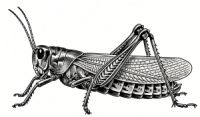
Gregory sat reading a book when a grasshopper -- locusta in Latin4 --
leaped onto the page he was looking at. He pondered the name -- locusta
-- and realized it sounded very similar to "loco sta" -- "stay in place."
He took it as a sign from God and was preparing to return to Rome when
the papal emissaries caught up to him. They accompanied him back to the Eternal City.
Not long after,
in 590 -- it was only five years since his return from Constantinople
-- Pope Pelagius II died, and Gregory, much to his regret as a man who
was a monk at heart, was elected as his successor by popular
acclamation.
He came to the throne at a bad time: the year before, Rome's Tiber
River had flooded, its waters destroying buildings and, even worse,
granaries. Starvation
-- and then pestilence -- followed (in fact, it was the plague that
felled Pelagius). Gregory had grain shipped in from Sicily, and held a
great procession -- the Litania
Septiformis, or Sevenfold Litany -- to beg God's mercy. Seven classes
of people -- clergy, monks, virgins, laity, widows, matrons, and the
poor -- made a great procession, each group from a different church,
first to St. Mary Major, then to
St. Peter's with the Marian icon Salus
Populi Romani, chanting the Litany
of the Saints on the way. During this great outpouring of faith, St. Michael the Archangel
appeared on top of what was once Hadrian's Tomb, but which is now
called Castel Sant'Angelo. (tradition also relates that Pope
St. Gregory started the Christian tradition of saying "God bless you"
to someone caught sneezing).
Gregory then accomplished his mission of evangelizing England, but did so by
proxy, sending Augustine of Canterbury -- once a monk at his monastery
-- to do the job.
He also established a vast and effective system of help for the poor, and
ate his nightly dinners with twelve of them. Gregory the Deacon's biography of Gregory, and the
later Golden Legend relate that at one of these dinners, a thirteenth
man showed up -- but no one but Gregory could see him. And the man's
face kept changing, first appearing old, then young, and back again.
Gregory took him aside and asked who he was. It was the "mariner" --
the angel -- who'd begged coins from him earlier. To this day, in the
Oratory of St. Barbara in the the church associated with Gregory's
monastery you can find a marble table with the following inscription: Bis senos hic Gregorius pascebat egentes /
angelus et decimus tertius accubuit (“Here Gregory fed twelve
needy people, and an angel reclined as the thirteenth”).
He set up a strict accounting system for the Vatican.
He standardized the style of chant that now bears the name "Gregorian."
He standardized, as well, the list of the "Seven Deadly Sins" and wrote extensively about them.
He tweaked the liturgy, for ex., establishing the nine kyries still
used to day in the traditional Mass.
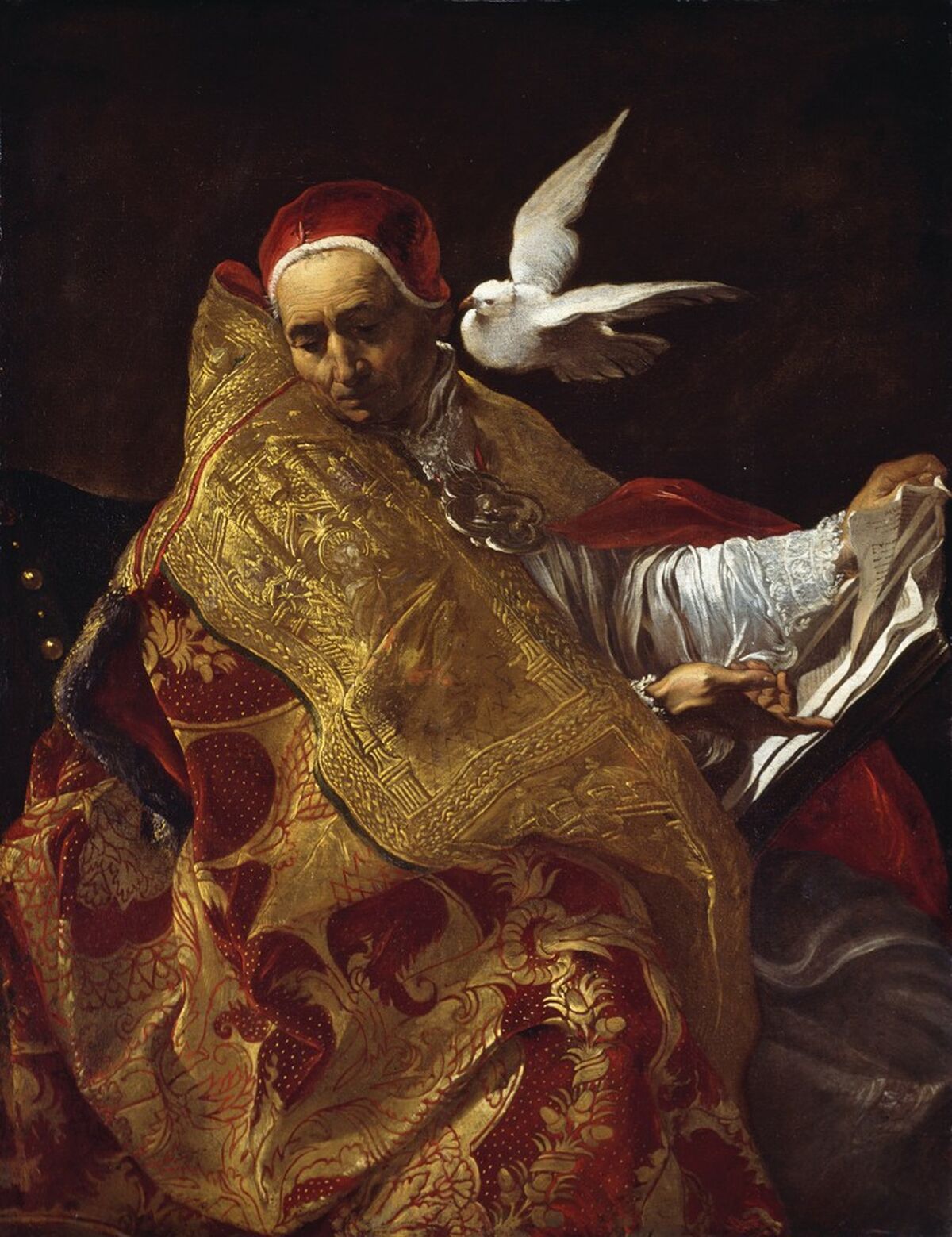
And he wrote, authoring the book "Dialogues," a book on pastoral care,
the aforementioned "Morals on the Book of Job," a plethora of letters,
and many, many sermons. What took place while he was writing his
sermons on Ezechiel is the source of the imagery of Gregory with a
dove. Paul the Deacon tells the story:
[W]e have
learned that it was told by a reliable and virtuous man, one deservedly
very intimate with our revered father on account of his piety and
talents, that when this same vessel of election and dwelling place of
the Holy Spirit was interpreting the last vision of Ezechiel a veil was
hanging between him and his secretary. Because the saint was very
silent for a long interval the scribe pierced the veil with his stylus
and, looking through the opening, saw a dove whiter than snow perched
for a long time upon Gregory’s head with its beak in his mouth. When
the dove removed its beak from his mouth, the holy pontiff began to
speak and the scribe applied his stylus to the wax tablet. When again
the medium of the Holy Spirit was silent, the scribe again put his eye
to the opening and saw Gregory in prayer with his hands and eyes both
uplifted towards heaven and the beak of the dove again in his mouth.
Then, by a revelation of the Holy Spirit, he discovered the scribe and,
by right of his apostolic authority, seriously charged him not to tell
anyone about the wonderful miracle that he had witnessed. Meanwhile the
secret was guarded, but after the death of the saintly priest,
motivated by the envy of certain persons who disparaged the holy man
and said that he had been presumptuous and had himself spoken about
these heavenly mysteries, the scribe faithfully related all the things
he had seen.
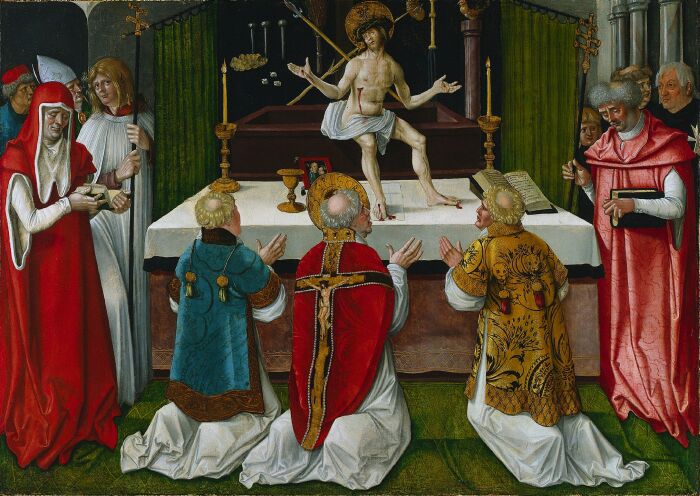
Another story you must know from Gregory's life is that of "Gregory's'
Mass" -- a Eucharistic miracle that has frequently been portrayed in
art. The tale as Paul the Deacon tells it:
There was in
this Roman city a certain noble matron who was won through zeal and
devotion to make offerings and on the Lord's day to come to church and
present to the pontiff the materials for the holy sacrifice.
On a certain day when, according to her custom, she
approached in her turn to receive Communion from the pope, he held out
the morsel of the Lord’s body and said: “May the body of our Lord Jesus
Christ avail you for the remission of all your sins and for life
eternal,” and she smiled.
When the man of God saw her smile, he withdrew the holy
Communion and placed it separately on the altar and told the deacon to
watch it until all the faithful had communicated.Then, when the sacred
mysteries were completed, blessed Gregory questioned her, saying, “Tell
me, what were you thinking of that you should smile when you were about
to receive Communion?”
And she said, “I recognized that portion as a part of the
offering I made with my own hands and gave to you. And when I heard you
call it the body of the Lord, I smiled.”
Forthwith the holy pontiff preached a sermon to the people
and exhorted them humbly to implore the Lord that, to strengthen the
faith of many, He would show to the eyes of flesh what this unfaithful
woman should see with spiritual insight. After they had prayed, he
himself together with the people and this same woman arose, and all
looked towards the altar, composing themselves to behold the heavenly
spectacle.
Gregory lifted up the particle of the Lord’s body and, in the
sight of all the people and the woman herself, discovered that the tip
of his finger was stained with blood, and he said to the woman: “Learn,
I say, now whether to believe the truth or at least a witness: ‘The
bread which I give is My flesh, and the drink indeed is My blood.’ But
the Creator, foreknowing our weakness, by that power which enabled Him
to make all things from nothing and also to fashion a body for Himself
from the flesh of a virgin through the cooperation of the Holy Spirit,
changed bread and wine mingled with water, though these retained their
own appearances, into His body and blood for the Catholic sacrifice of
expiation and through the sanctifying power of His Spirit.”
Then he ordered all to beseech God to change the most holy
mystery into its pristine form; thus it would be possible for the woman
to pick it up, and this also was done. Therefore the much talked-of
woman, gaining greatly in holy religion and faith, was sanctified by
participation in the sacrament of the Lord. And all who had seen this
miracle grew more fervent in divine love and orthodox faith.
Though
he accomplished so much as to be known as "the Great," he was
Pope for only thirteen and a half years. And for many of those years,
he was in very bad health, suffering so horribly from the excruciating
pain of gout that he was bedridden. On March 12, 1604, he died. He was
buried in the old St. Peter's church, and the Venerable Bede records
his epitaph as having read:
Suscipe, terra, tuo corpus de corpore sumptum,
Reddere quod valeas vivificante Deo.
Spiritus astra petit; leti nil iura nocebunt,
Cui vitae alterius mors magis ipsa via est.
Pontificis summi hoc clauduntur membra sepulcro,
Qui innumeris semper vivit ubique bonis.
Esuriem dapibus superavit, frigora veste,
Atque animas monitis texit ab hoste sacris.
Implebatque actu quicquid sermone docebat,
Esset ut exemplum, mystica verba loquens.
Ad Christum Anglos convertit pietate magistra,
Adquirens fidei agmina gente nova.
Hic labor, hoc studium, haec tibi cura, hoc pastor agebas,
Ut Domino offerres plurima lucra gregis.
Hisque Dei consul factus laetare triumphis:
Nam mercedem operum iam sine fine tenes.
Receive, O earth, this body taken from your body,
that you may give it back when God gives life.
His spirit seeks the stars; the laws of death will not harm him
for whom death itself is rather the road to another life.
In this tomb are enclosed the limbs of the supreme pontiff,
who lives always and everywhere by countless good works.
He overcame hunger with banquets, cold with clothing,
and by holy teaching shielded souls from the enemy.
He fulfilled in deed whatever he taught in word,
that he might be an example while speaking mystic words.
With piety as his teacher he converted the English to Christ,
winning troops of the faith from a new nation.
This was your labor, this your zeal, this your care, this you did as shepherd:
to offer the Lord a great profit from the flock.
Made consul of God by these triumphs, rejoice:
for you already hold the reward of your works without end.
When
the new St. Peter's church was built, his tomb was destroyed, so that
epitaph is gone. But his relics were moved into the new building, and
can now be venerated at the Altar of St. Gregory there. His papal
throne can be seen at the Roman church named in his
honor -- San Gregorio Magno al Celio. (the church associated with his monastery and which contains the marble table at which the angel sat).
His feast is traditionally kept on March 12, the date of his death. In
the Novus Ordo, it is on September 3, the date of his election to the
papacy. Early art sometimes
depicts him in his monastic habit, but usually, and in later art, he is
shown in
his papal robes, often accompanied by a dove. He is a Doctor of the Church -- one of the
Four Great Latin Doctors along with St.
Ambrose, St. Augustine, and
St. Jerome (the Four Great Greek Fathers are St. John Chrysostom, St.
Basil the Great, St. Gregory Nazianzus, and St. Athanasius).
St. Gregory the Great is the patron Saint of singers, scholars,
students, teachers, and builders, and he is invoked against gout and the plague.
Customs
Today's collect prayer:
O God, Who has
conferred the rewards of everlasting happiness upon the soul of Thy
servant Gregory, mercifully grant that we, who are oppressed by the
burden of our sins, may be relieved by his prayers to Thee. Through our
Lord Jesus Christ, Thy Son, Who lives and reigns with Thee in the unity
of the Holy Spirit, God, forever and ever. Amen.
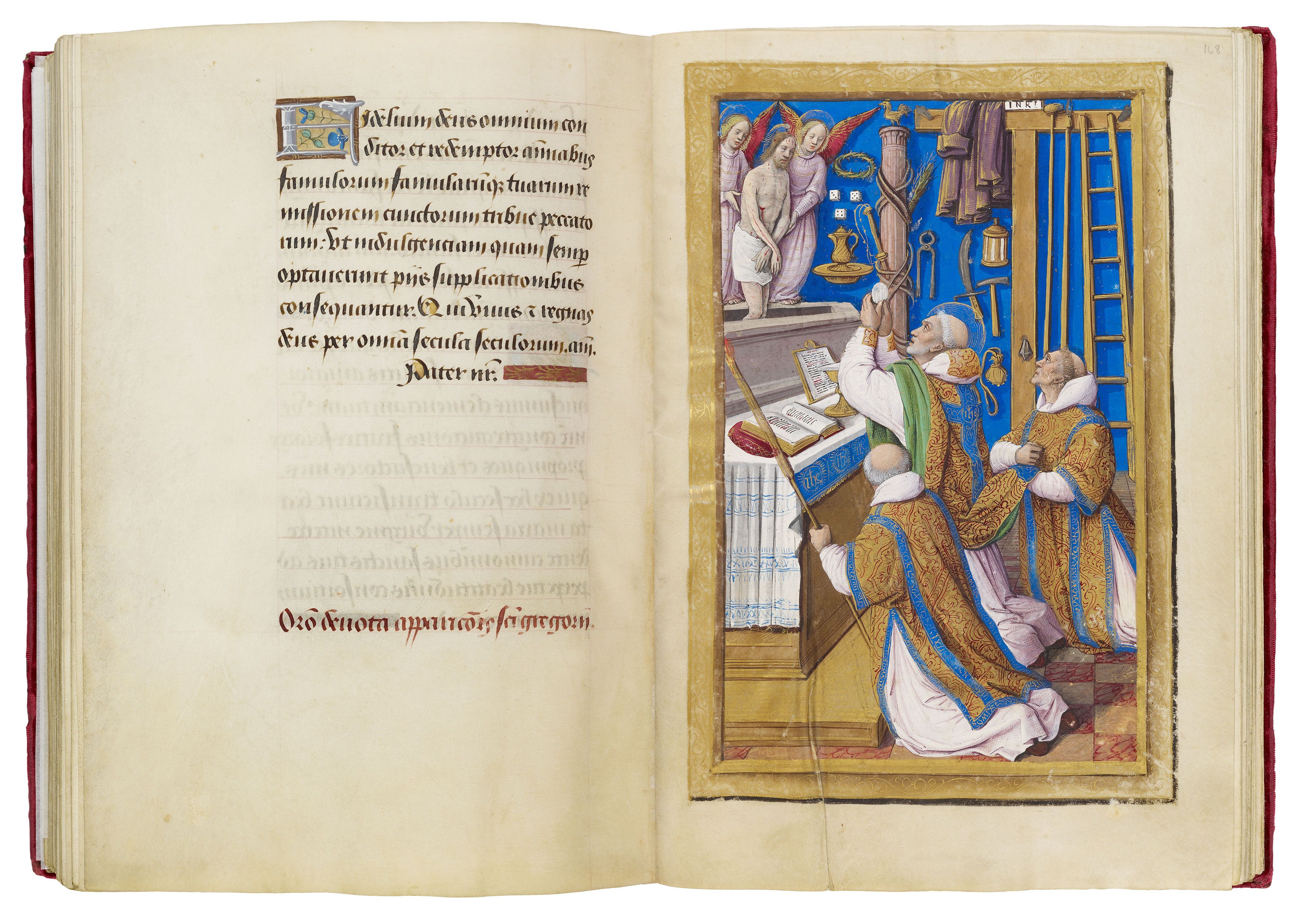
You may benefit, too, from another prayer related to St. Gregory the Great -- actually a set of
prayers, the Seven Prayers of St. Gregory. They stem from the
"Gregory's Mass" incident related above, and are found in late medieval
prayer books, such as this Book of Hours of Henry VIII (click to enlarge):
The Seven Prayers of St. Gregory
(I) O Lord Jesus, I adore Thee hanging on the Cross, bearing
the thorny crown on Thy head. I beg Thee, that Thy Cross may free me
from the persecuting angel. Amen. (Pray one
Pater and one Ave)
(II) O Lord Jesus, I adore Thee wounded on the Cross, having
drunk vinegar and gall. I beg Thee, that Thy wounds may be the remedy
of my soul. Amen. (Pray one Pater and one Ave)
(III) O Lord Jesus, I ask by that bitterness of Thy Passion,
which Thou didst endure in the hour of Thy death, especially at that
time when Thy most holy soul departed from Thy blessed body, to have
mercy on my soul in its departure from my body, and lead it into
eternal life. Amen. (Pray one Pater and one Ave)
(IV) O Lord Jesus, I adore Thee placed in the tomb, embalmed
with myrrh and spices. I beg Thee, that Thy death may be my life. Amen.
(Pray one Pater and one Ave)
(V) O Lord Jesus, I adore Thee descending into hell and
freeing your captives from that place. I beg Thee, that Thou mayest
never allow me to enter there. Amen. (Pray one Pater and one Ave)
(VI) O Lord Jesus, I adore Thee rising from the dead, and
ascending into heaven, and sitting at the right hand of the Father. I
beg Thee, that I may merit to follow Thee there and to be presented to
Thee. Amen. (Pray one Pater and one
Ave)
(VII) O Lord Jesus, good Shepherd, preserve the just, pardon
sinners, have mercy on all the faithful, and be well-disposed to me, a
wretched and unworthy sinner. Amen. (Pray one Pater and one Ave)
I beseech Thee, Lord Jesus Christ, that Thy Passion may be a
strength for me, by which I may be fortified, protected, and defended.
May Thy wounds be food and drink for me, by which I may be fed,
inebriated, and delighted. May the sprinkling of Thy Blood be an
ablution of all my sins. May Thy death be eternal glory for me. In
these may refreshment, health, zeal, joy, delight, and desire of my
body and soul be mine, now and forever. Amen.
Lord Jesus Christ, Son of the living God, place Thy Passion,
Cross, and Death between Thy judgment and my soul, now and in the hour
of my death.
Deign to grant grace and mercy to me, pardon to the living,
rest to the dead, peace to Thy Church, and life and eternal glory to
all sinners. Thou who livest and reignest forever and ever. Amen.
As to music for the day, there is, of course, Gregorian chant --
including Anglorum iam Apostolus, written by St. Peter Damian in honor
of Pope St. Gregory the Great:
Anglórum jam
Apóstolus,
Nunc Angelórum sócius,
Ut tunc, Gregóri, géntibus
Succúrre jam credéntibus.
Tu largas opum copías,
Omnémque mundi glóriam
Spernis, ut inops ínopem
Jesum sequáris príncipem.
Vidétur egens náufragus,
Dum stipem petit Angelus;
Tu munus jam post géminum,
Praebes et vas argénteum.
Ex hoc te Christus témpore,
Suæ præfert Ecclésiæ
Sic Petri gradum pércipis,
Cujus et normam séqueris.
O Póntifex egregie,
Lux et decus Ecclésiæ,
Non sinas in perículis,
Quos tot mandátis ínstruis.
Mella. cor obdulcántia.
Tua distíllant lábia:
Fragrántum vim arómatum
Tuum vincit elóquium.
Scriptúræ sacræ mýstica
Mire solvis ænígmata:
Theórica mystéria
Te docet ipsa Véritas.
Tu nactus apostólicam
Vicem simul et glóriam:
Nos solve culpæ néxibus,
Redde polórum sedibus.
Sit Patri laue ingénito,
Sit decus unigénito?
Sit utriúsque párili
Majéstas summa Flámini. Amen.
Apostle to the
English lands
Now with the angel hosts he stands.
Make haste, St. Gregory, relieve
And help the people who believe.
From riches and from wealth you turned.
The glory of the world you spurned,
That you might follow, being poor,
Prince Jesus, who was poor before.
An angel asks for alms,
who seems a poor, shipwrecked man;
after giving him a double gift,
you present also a silver vessel.
This Christ, High Pontifex, decreed
That you would take His Church’s lead,
And learn St. Peter’s steps to tread:
The rule of all called in his stead.
O Pontifex, our leader bright,
The Church’s honor and its light,
Through dangers let them all be brought,
The ones you carefully have taught.
Thy lips drip honey
that sweeteneth hearts,
thy speech surpasseth the
power of fragrant spices.
You wondrously solved riddles deep:
The mystic secrets Scriptures keep,
For Truth Himself has taught you these:
The lofty sacred mysteries.
Having obtained the apostolic office
and glory, release us
from the bonds of sin,
and bring us back to heaven.
The unborn Father let us praise,
And to His Son like glory raise,
And to their Equal, majesty.
All glory to the Trinity. Amen.
And the Italian composer Ottorino Respighi wrote Vetrate di chiesa (Church Windows),
P. 150: IV. San Gregorio Magno
in tribute to our Saint, which you can listen to below (as a side note,
the final 40 seconds of this piece were used by the rock group Emerson
Lake & Palmer as their theme song at the end of their live
concerts):
As to foods for the day, a legume "pottage" in remembrance of the dinners
St.Silvia brought to her son is in order:
Zuppa di legumi (Legume Stew)
1 pound dried chickpeas, soaked overnight (12 hours)
1/2 c finely chopped pork fat (can replace with 1/4 c. olive
oil)
2 cloves garlic, crushed
1 onion, diced
2 carrots, diced
2 celery stalks, diced
2 russet potatoes, in 1/2" cubes
vegetable broth (approx 6 c.)
salt and pepper
1/2 tsp thyme
1/2 tsp sage
a couple bay leaves
a pinch of cayenne pepper
Put the pork fat in a pot and heat up. When melty, add the
garlic, saute until golden, then remove. Add the onions, carrots, and
celery and cook until tender. Add the chickpeas and potato. Cover
with vegetable broth by a few inches. Bring to a boil, then lower heat
and simmer uncovered for an hour or so. Add the seasonings/herbs and
simmer uncovered a tad more. Remove bay leaves and serve with parmesan cheese on
top and a good bread on the side.
Or, to take a totally different tack, there's this mint chocolate chip ice
cream-flavored adult beverage in honor of the "locusta" that helped
change history:
Grasshopper Cocktail
1 oz green crème de menthe
1 oz white crème de cacao
1 oz heavy cream
Fill a cocktail shaker with ice. Add the liqueurs and cream
and shake vigorously for 10 to 15 seconds until chilled. Strain into a
chilled coupe or martini glass. Garnish with chocolate shavings or a
tiny bit of cocoa sprinkled on top. (Adding a shot of vodka makes it a
"Flying Grasshopper.")
Learn more about and read the works of Pope St. Gregory the Great
in this site's Catholic Library.
Readings
From "The Liturgical Year" by Dom Prosper Gueranger
Among all the Pastors whom our Lord Jesus Christ has placed as his
Vice-regents over the universal Church, there is not one whose merits
and renown have surpassed those of the holy Pope whose feast we keep
today. His name is Gregory, which signifies watchfulness; his surname
is the Great, and he was in possession of that title when God sent the
Seventh Gregory, the glorious Hildebrand, to govern his Church.
In recounting the glorious of this illustrious Pontiff, it is but
natural we should begin with his zeal for the Services of the Church.
The Roman Liturgy, which owes to him some of its finest Hymns, may be
considered as his work, at least in this sense, that it was he who
collected together and classified the prayers and rites drawn up by his
predecessors, and reduced to the form in which we now have them. He
collected also the ancient chants of the Church and arranged them in
accordance with the rules and requirements of the Divine Service. Hence
it is that our sacred music is called the Gregorian Chant, which gives
such solemnity to the Liturgy and inspires the soul with respect and
devotion during the celebration of the great Mysteries of our Faith.
He is, then, the Apostle of the Liturgy, and this alone would have
immortalized his name; but we must look for far greater things from
such a Pontiff as Gregory. His name was added to the three who had
hitherto been honored as the great Doctors of the Latin Church. These
three were Ambrose, Augustine, and Jerome; who else could be the fourth
but Gregory? The Church found in his Writings such evidence of his
having been guided by the Holy Ghost-such a knowledge of the Sacred
Scriptures, such a clear appreciation of the Mysteries of Faith, and
such unction and authority in his teachings that she gladly welcomed
him as a new guide for her children.
Such was the respect wherewith everything he wrote was treated, that
his very Letters were preserved as so many precious treasures. This
immense Correspondence shows us that there was not a country, scarcely
even a city, of the Christian world on which the Pontiff had not his
watchful eye steadily fixed; that there was not a question, however
local or personal, which, if it interested religion, did not excite his
zeal and arbitration, as the Bishop of the universal Church. If certain
writers of modern times had but taken the pains to glance at these
Letters, written by a Pope of the 6th century, they would never have
asserted, as they have done, that the prerogatives of the Roman Pontiff
are based on documents, fabricated, as they say, two hundred years
after the death of Gregory.
Throned on the Apostolic See, our Saint proved himself to be a rightful
heir of the Apostles, not only as the representative and depository of
their authority, but as a fellow sharer in their mission of calling
nations to the true faith. To whom does England owe her having been for
so many ages the Island of Saints? To Gregory, who, touched with
compassion for these Angli,-of whom, as he playfully said, he would
fain make Angeli,-sent to their island the Monk Augustine, with forty
companions, all of them, as was Gregory himself, children of St.
Benedict. The faith had been sown in this land as early as the second
century, but it had been trodden down by the invasion of an infidel
race. This time the seed fructified, and so rapidly that Gregory lived
to see a plentiful harvest. It is beautiful to hear the aged Pontiff
speaking with enthusiasm about the results of his English mission. He
thus speaks in the twenty-seventh Book of his Morals: “Lo! the language
of Britain, which could once mutter naught save barbarous sounds, has
long since begun to sing, in the divine praises, the Hebrew Alleluia!
Lo! that swelling sea is now calm, and Saints walk on its waves. The
tide of barbarians, which the sword of earthly princes could not keep
back, is now hemmed in at the simple bidding of God’s Priests.”
During the fourteen years that this holy Pope held the place of Peter,
he was the object of the admiration of the Christian world, both in the
East and West. His profound learning, his talent for administration,
his position-all tended to make him beloved and respected. But who
could describe the virtues of his great soul?-that contempt for the
world and its riches, which led him to seek obscurity in the cloister;
that humility which made him flee the honors of the Papacy and hide
himself in a cave, where, at length, he was miraculously discovered,
and God himself put into his hands the Keys of Heaven, which he was
evidently worthy to hold, because he feared the responsibility; that
zeal for the whole flock, of which he considered himself not the master
but the servant, so much so indeed that he assumed the title, which the
Popes have ever since retained, of Servant of the Servants of God; that
charity which took care of the poor throughout the whole world; that
ceaseless solicitude which provided for every calamity, whether public
or private; that unruffled sweetness of manner which he showed to all
around him, in spite of the bodily sufferings which never left him
during the whole period of his laborious pontificate; that firmness in
defending the deposit of the Faith, and crushing error wheresoever it
showed itself; in a word, that vigilance with regard to discipline,
which made itself felt for long ages after in the whole Church? All
these services, and glorious examples of virtue have endeared our Saint
to the whole world, and will make his name be blessed by all future
generations, even to the end of time.
Footnotes:
1 Gregory relates the interesting story of his
aunts' deaths in Homily 38 of his "Homilies on the Gospels":
My father had
three sisters, who were all three consecrated virgins. Of these, one
was called Tarsilla, another Gordiana, and the third Emiliana. All were
converted by the same love, and all three were consecrated at one and
the same time; living under the same austere rule, and leading a common
life in their own house. And having continued a long time in the same
manner of life, Tarsilla and Emiliana began through daily increase in
virtue to grow in love for their Creator, and, while present solely in
the body, to turn daily more towards eternal things. On the other hand,
the spirit of Gordiana began day by day to fail in the warmth of its
love, and began little by little to return to the love of this world.
Often Tarsilla would say sorrowfully to her sister Emiliana: ‘I see
that our sister Gordiana is not of our mind. I think she is drifting
away from us; and that she has not her heart in her vocation.’ And so
they would chide her gently; seeking with mild correction to bring her
back from her new lightness of manner to her former way of life. And in
the middle of their words of correction, she would of a sudden resume
her former serious manner. But within an hour, this seriousness would
leave her, and soon she would again resume her new levity of speech and
manner. She took much pleasure in the company of lay girls, and soon it
became difficult for her to put up with anyone who was not given over
to this world.
On a certain night, Felix, my ancestor, admirable for age and
glory (a Mac. xv. 13), and a former bishop of this Roman Church,
appeared, in a vision as she afterwards related, to Tarsilla, my aunt,
who among her sisters had advanced furthest in seriousness of life, and
in repute and height of sanctity by virtue of her continuous prayer and
her extraordinary abstinence, He showed her the perpetual glory of the
home of the blessed, saying to her: ‘Come, for I shall receive thee in
this mansion of light.’ Soon after she was taken ill of a fever, and in
a little while came to her last day. And as many people come to noble
men and women when they are dying, to comfort their neighbours, so at
the very hour of her death many men and women stood about her, among
whom also was my mother, when suddenly looking upwards the dying woman
saw Jesus coming, and began to cry out with great anxiety to those
standing around her: ‘Stand back, stand back, Jesus is coming.’ And as
she stretched towards Him Whom she beheld, that holy soul was separated
from her body. And then of a sudden an odour of such wondrous sweetness
spread about, as though this sweetness also would show them that the
Author of all sweetness had come there.
And when, as is the custom with the dead, her body was
unclothed to be washed, it was found that the skin on her knees and
elbows had from prolonged and continuous prayer become hard like that
of a camel; so that her body bore witness to what her loving spirit had
urged it without ceasing. And this took place on the day before the
Lord’s Birth.
And very soon after this she appeared to her sister,
Emiliana, in a vision of the night, and said to her: ‘Come, for as I
passed the Lord’s Day of Birth without thee, I shall pass the holy day
of His Manifestation (Epiphany) with thee.’ Emiliana, ever anxious for
the salvation of her sister Gordiana, at once answered: ‘And if I come
alone, to whom shall I entrust our sister Gordiana?’ To which with a
sorrowful countenance she replied, as was afterwards related: ‘Come,
for Gordiana our sister is now numbered among those who belong to the
world.’ This vision to Emiliana was soon followed by an affliction of
body, and, just as had been foretold, her sickness growing rapidly
worse, she died on the day before the Lord’s Manifestation. Gordiana,
as soon as she found herself alone, increased her worldliness of life,
and later did in deed what she had before desired in thought. For
forgetful of her fear of the Lord, forgetful of shame and of reverence,
forgetful of her dedication to God, she later married the steward of
her lands.
See how in the beginning all three were converted by the same
eager love, but they did not persevere with one and the same
earnestness of heart; for, as our Lord here tells us: Many are called,
but few are chosen.
2 The address of the monastery and church
that sit on the site of Gregory's childhood home is Piazza di San
Gregorio al Celio, 1, 00184 Rome.
3 St. Gregory himself tells this story in
his Book IV, Chapter 55 of his "Dialogues"
4 Locusts are grasshoppers.
There are around 10,000 species of grasshoppers (cavallette -- "little
horses" -- in Italian), and most are always solitary creatures. But
around 20 species of grasshoppers do something strange when their
population becomes dense: their bodies release serotonin, their flight
muscles become stronger, they undergo a color change, and they start to
swarm, becoming what we call "locusts." All locusts are grasshoppers,
but most grasshoppers never become locusts. Also, the "seventeen-year
locusts" are not locusts at all, but cicadas.