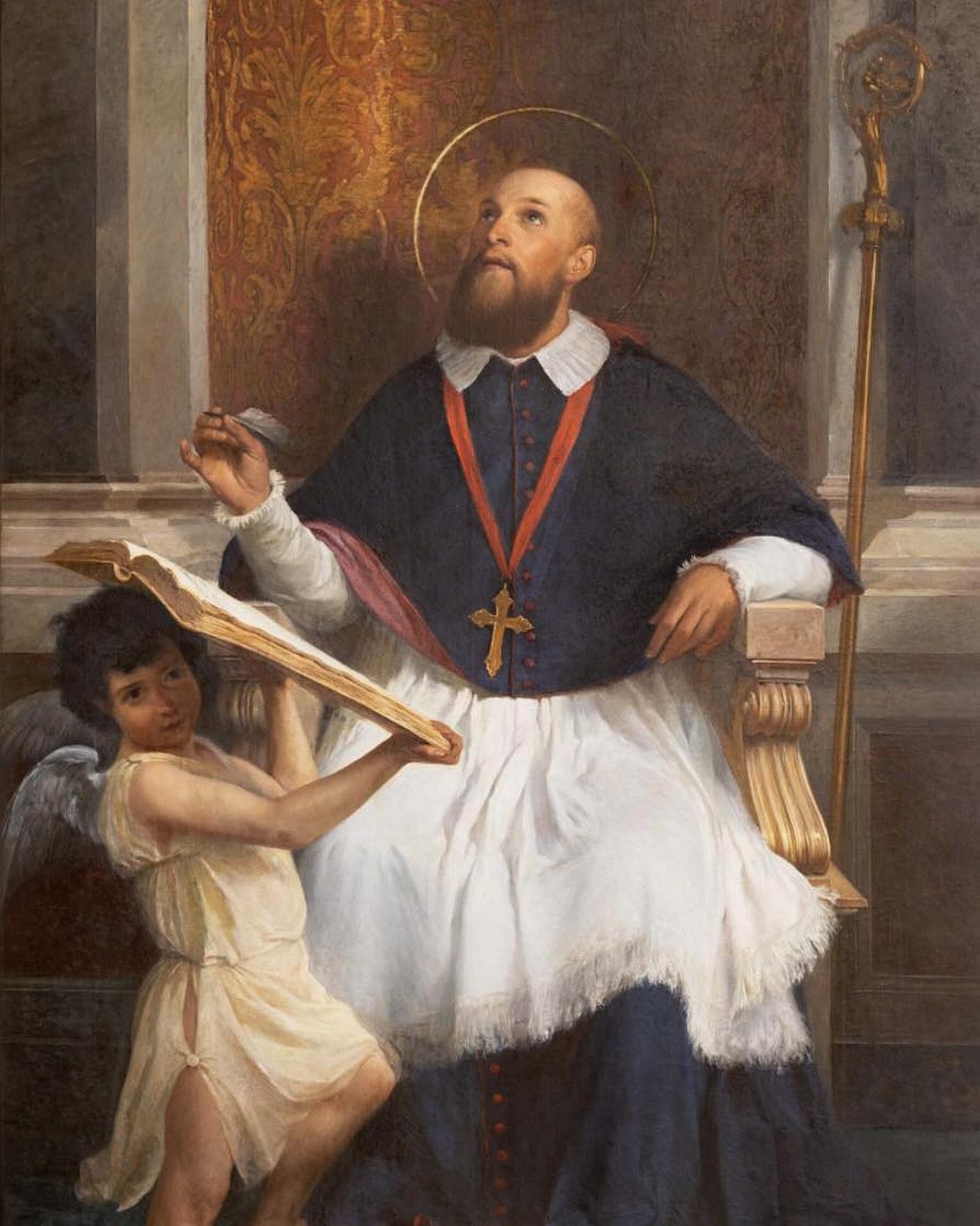
St. Francis de
Sales was born the oldest of six brothers on August 21, 1567. His
family was an aristocratic one that lived in the Duchy of Savoy -- an
area of the Holy Roman Empire that now consists of the lands where
southeastern France, western Switzerland, and northwestern Italy meet.
His father wanted him to be a magistrate -- i.e., a civil servant who
administers the law -- so had him educated at some of the better
schools in the area.
At the age of 11, he went to Paris to study, and when he was around 19,
he took a course in theology that exposed him to the arguments of
theologians of the time who were trying to sort out thoughts about
predestination. Listening to them, he fell into a state of existential
despair, sure he was destined for Hell. He became not just depressed,
but despairing to the point of becoming periodically bedridden.
Then, one day, he went to the Church of Saint-Étienne-des-Grès in
Paris's Latin Quarter, knelt down before a 14th century statue of Notre Dame de Bonne Délivrance --
Our Lady of Good Deliverance -- known as "The Black Madonna of Paris," 1
and prayed the Memorare --
Remember, O most
gracious Virgin Mary, that never was it known that anyone who fled to
thy protection, implored thy help, or sought thy intercession was left
unaided. Inspired with this confidence, I fly to thee, O Virgin of
virgins, my Mother; to thee do I come; before thee I stand, sinful and
sorrowful. O Mother of the Word Incarnate, despise not my petitions,
but in thy mercy hear and answer me. Amen.
Suddenly, in one of those miraculous moments of explosive grace, he was
healed of his despair. Then and there, he took a vow of chastity and
consecrated himself to the Blessed Virgin.
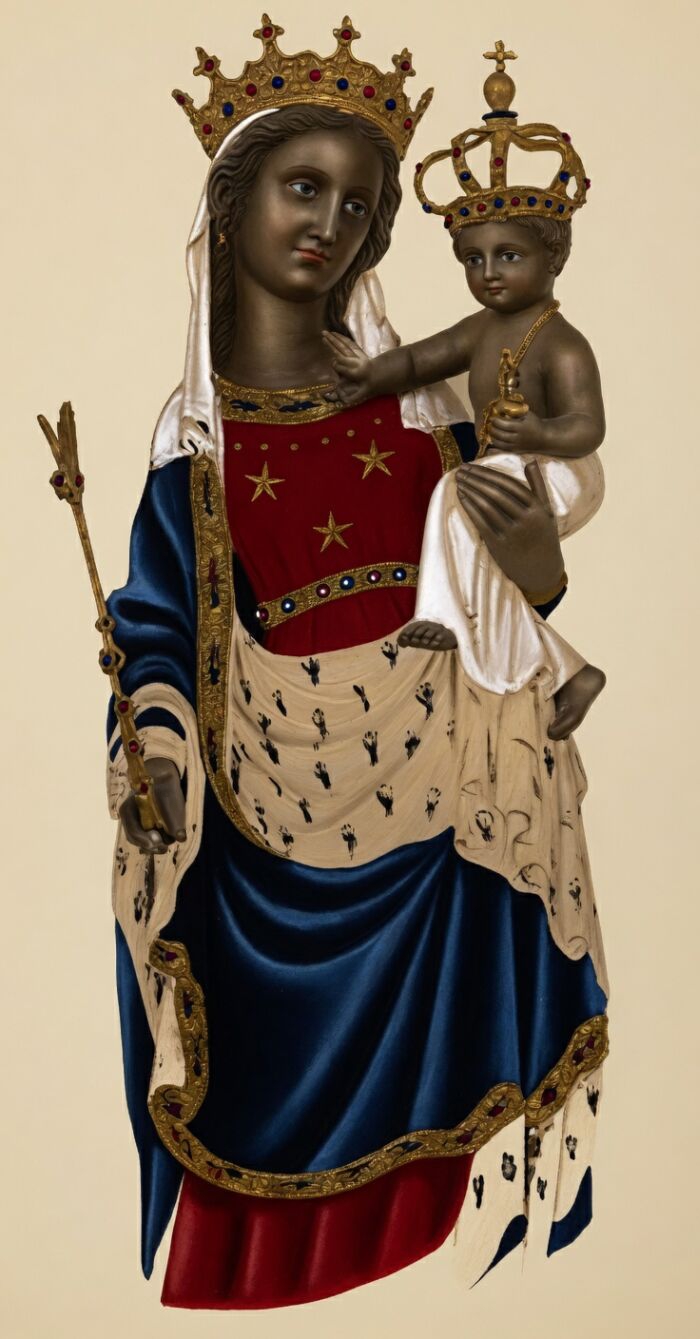
Notre Dame de Bonne Délivrance
He went to Italy to continue with his studies, became an attorney, and
was about to become a member of the senate in Chambéry when he decided
he wanted to become a priest instead. His father wasn't happy about
that at all, but gave in when the Bishop was able to promise for his
son the high-ranking position of provost of the cathedral chapter of
Geneva. So, Francis was ordained in 1593.
The intelligent, handsome, tall, very gentlemanly Francis, with his
rich speaking voice, became widely popular as a preacher, even
impressing King Henry IV with his sermons. He especially devoted
himself to defeating the heresies of Calvinism, bringing back to the
Faith the region of Chablais -- a part of the Duchy of Savoie -- that
had fallen to Calvin's nonsense. He did this by printing out tracts,
sliding them under doors and tacking them to walls, and through debate
with Calvinist leaders. One conversation with Theodore de
Bèze, successor of Calvin, went like this:2
“Sir,” Francis
then said, “can one achieve his salvation in the Roman Church?”
This question took Bèze by surprise. He remained silent for
some time, his eyes fixed on a corner of the room. “Permit me to think
about this a bit more profoundly.” And, giving Francis a little book
“to peruse”, he passed into the next room, where Francis heard him
pacing. The interval lasted a quarter of an hour.
“You have asked me,” Bèze said, “if one can achieve his
salvation in the Roman Church. Certainly, I answer you affirmatively;
it is possible without any doubt, and no one can deny the truth that
she is the Mother Church.”
Francis went on: “Since that is so, why have you planted this
Reform with so many sackings, ruins, conflagrations, rapes, murders,
destructions of churches, and other innumerable evils?”
“I do not deny,” Bèze replied, “that you are achieving your
salvation in your religion. But there is this misfortune that you
embroil souls in too many ceremonies and difficulties, because you say
that good works are necessary for salvation, which, however, are merely
decency.”
“Indeed,” Francis replied, “can you ignore the reason why our
Lord, when instructing his apostles as to what he wished them to expect
at the Last Judgment, makes no mention of sins committed but speaks
only of how he will condemn them because they will not have performed
good works: "Go, you accursed, to eternal fire: because I was hungry
and you did not give me anything to eat.‟ And the rest. If these were
merely decency, as you say, would we be punished so rigorously for
having neglected to do them?”
At this Bèze lost his self-control, and “let himself utter a
few words unworthy of a philosopher.”
Yes, the Calvinists saw him as an enemy. But his admirers were even
more numerous. And for good reason: as the Catholic Encylcopedia tells
us, he instituted "catechetical instructions for the faithful, both
young and old. He made prudent regulations for the guidance of his
clergy. He carefully visited the parishes scattered through the rugged
mountains of his diocese. He reformed the religious communities. His
goodness, patience and mildness became proverbial. He had an intense
love for the poor, especially those who were of respectable family. His
food was plain, his dress and his household simple. He completely
dispensed with superfluities and lived with the greatest economy, in
order to be able to provide more abundantly for the wants of the needy.
He heard confessions, gave advice, and preached incessantly. He wrote
innumerable letters (mainly letters of direction) and found time to
publish the numerous works..."
In 1602, he was made Bishop of Geneva -- but because the area was
controlled by Calvinists and dangerous for him, he lived in nearby
Annecy, now a city in the Haute-Savoie department of France.
Now, a year before Francis was made Bishop, a woman we now know as St.
Jeanne ("Jane") de Chantal was widowed by her Baron husband. She was 28
years old
with mostly grown children and, feeling in need of guidance, asked God
to send her a spiritual director. In response to her plea, God granted
her a vision of the man He intended to help her. Then, in 1604, she saw
Francis de Sales preaching in Dijon and realized that he was the man
God had shown her. They became great friends, exchanging many letters,
many of which come down to us today. In
1610, they together founded the Order of the
Visitation of Holy Mary (also known as the Visitandines, Visitiation
Sisters, or Salesian Sisters), named in honor of the Visitation, when Elizabeth (the mother
of St. John the Baptist)
and Mary met when both were pregnant, and the unborn John leaped with
joy in his mother's womb at recognizing the One Mary was carrying. The
Order, with an emphasis is on gentleness and humility, has the motto
"Live Jesus," and is intended for older women and those whose
constitutions disallow their following intense disciplines. It gave to
the world St. Margaret Mary Alacoque, who brought to us Catholics many
devotions to the Sacred Heart, such as Holy Hour, First Fridays,
and even the Feast of the
Sacred Heart.
He also established an Oratory for priests, based on the work of St. Philip Neri, but, alas, the community
didn't survive after he died.
Around 1618, he met with St. Vincent de
Paul in Paris. Francis's
writings, especially his "An Introduction to the Devout Life" and
"Treatise on the Love of God," affected Vincent deeply. The latter work
was also especially embraced by St. Paul of the Cross (founder of the
Passionist Order), and St. John Eudes was greatly inspired by Francis's
writings on Our Lady.
In 1622, when Francis was 56 years old, he was visiting Lyons, France
where he had a stroke. He died the next day, on December 28, the Feast of the Holy Innocents. His
body was taken to Annecy,3 but his heart was kept in Lyons
until the
French Revolution, when it was taken by Visitation nuns to Venice for
safe-keeping. Under Pope Pius X, his heart was then moved to the Monastero della Visitazione in
Treviso, Italy -- about 40 miles north of Venice -- where it can be
venerated today.
The Feast of St.
Francis de Sales -- "the Gentleman Saint" -- is January 29 (January 24
on the Novus Ordo calendar).
Because of his exceedingly helpful spiritual writing, he is a Doctor of
the Church -- the "Doctor of Charity" -- and the patron Saint of
writers, journalists, the deaf, the Paulist Fathers, the Institute of
Christ the King Sovereign Priest (ICK), and the Salesians
of St. John Bosco ("Don Bosco"), whom we
celebrate in two days, on
January 31.
Hmm. His life doesn't sound very exciting, does it? There's no great
suffering; no persecution to the point of injury or death; no dramatic
battles; no travels to foreign lands to do mission work; no great
conversions of Muslims, Jews, or pagans; no martyrdom. There's not a
lot about his life to stir the romantic imagination, is there? But he is, along with St. Therese of Lisieux and
St. Philip Neri, the Saint
for laymen -- average,
ordinary, everyday Christians -- who want practical advice in acquiring
virtue and living lives of holiness. Writer Esther Berry makes the
point in passing in an article she wrote about the importance of
community -- even in spite of the hassles and annoyances of community.4
She wrote,
Do my parents
and grandparents and in-laws and brothers and sisters say and do things
that I don’t like? All the time. But my desires for comfort, control,
and to never under any circumstances suffer the indignation of my
“boundaries” being overstepped are desires directly at odds with my primary goal: that is, raising my
own children in the context of a community. And further, I recognize
that the huffy, indignant feeling I get when a friend asks for help
with a laborious task or a family member suggests something I don’t
like is not a sign of my own
moral purity and their unfeeling wickedness. It is a feeling that in
most cases, for the sake of my own survival and flourishing, I am
better off ignoring.
It should be mentioned that not only does this sort of
intentional moral habituation provide the resilience required to live
peaceably in an IRL community—the kind of community that is invaluable
if you need to do something hard in your life, like give birth to a
child or go through a nasty breakup—but it also makes you a better and
happier person all around. My husband is a great example of this: he
has the unique trait of being thoroughly easygoing and gentle-hearted,
but without any hint of passivity or cowardice. This is so disarming
that patrons at the bar where he works sometimes directly ask him “how
he got this way”. He just tells them the truth: he binge-read Francis
de Sales’s Introduction to the
Devout Life in college and modelled his whole personality after
it.
Learn more about
and, especially, from St. Francis de Sales with these books from
this site's Catholic Library, all in pdf format. If you read just one,
make it "Introduction to the Devout Life" (also known as "Philothea"); if you read only two, add
"Treatise on the Love of God."
Customs
Some Catholics may pray a Novena to St.
Francis de Sales in anticipation of his feast, starting on January
20 and ending on January 28, the feast's eve. For the feast itself,
there are the Litany of St.
Francis de Sales, and the following prayer for those who want Saint
Francis de Sales as their special friend and protector:
O Great St.
Francis, glorious apostle of Jesus Christ, seraph of the earth, who
didst breathe but for the glory of God; perfect imitator of thy meek
and humble Saviour, and devoted child of the holy Mother of God, deign
to receive me among the number of thy special clients; be henceforth my
advocate, my counselor, my friend, and my father. Thy prayers, even on
earth, were the instruments of innumerable miracles of grace.
Vouchsafe to offer one for me, now that their efficacy is so greatly
increased in heaven. May my entire conversion now add another to the
already countless triumphs of thy charity. Teach me, like thee, to see
God in my fellow-creatures; and for His sake to make myself all to all,
weeping with them that weep, rejoicing with them that rejoice. May the
example of thy wondrous meekness sink into my soul and excite my
earnest, persevering efforts to imitate it. Strengthen me, by thy
prayers, to pursue the difficult practice of interior mortification,
without which I can not hope to possess my soul in peace and patience.
Enkindle in my heart one spark of the heavenly fire of charity which
glowed in thine! Teach me, like thee, to seek and find my happiness in
God, and to feel that it is good to live, to labor, and rejoice in Him
alone. Shield me against the many perils which beset my path: watch
over my immortal interests, and obtain that my soul may die the death
of the just, and my last end be like unto thine. Amen.
There are no special musical works or food customs that I know of that
are related to this feast, but there is a very old cake -- what we'd
likely think of as a gâteau but which
is called a biscuit -- that
comes from the kitchen of Amédée VI, Count of Savoie, in the 14th
century, and which is prevalent in the Savoy area where Saint Francis
de Sales lived. It's very likely that our Saint ate this light
sponge-type cake himself:
Biscuit de Savoie
6 eggs, room temperature, separated
Pinch salt + 2 or 3 drops lemon juice for the whites
3/4 c. + 2 TBSP sugar, divided
1/2 tsp vanilla
Zest of 1 lemon
1/2 c. + 1 heaping tsp flour
1/2 c. potato starch (not potato flour!) + extra for dusting
pan
1 or 2 TBP butter, softened, for coating pan
Preheat oven to 325F. Use the softened butter to coat the
inside of a 10" bundt pan or fluted tube pan, and sprinkle inside with
potato starch, dumping out what doesn't stick.
Add the pinch of salt and the 2 or 3 drops of lemon juice to
the egg whites, and then set aside.
Beat the yolks on low speed and slowly add the 3/4 c. sugar.
Once it's all added, turn up the mixer and beat until pale and smooth
(about 4 minutes). Add the zest and vanilla, beat for a minute more,
and set aside.
With very clean beaters, beat the egg whites until foamy, and
then start adding the remaining 2 TBSP sugar and beat to stiff peaks.
Now very gently fold the beaten whites into the yolk mixture in four
additions (do not overfold!).
Mix together the flour and potato starch, and then gently
fold that into the egg mixture in four additions. Pour into prepared
pan and bake for 40 - 45 min. Let cool 10 minutes or so, and remove
from pan. Dust with powdered sugar to make it look pretty. Serve with
Chantilly cream (i.e., sweetened whipped cream -- but "Chantilly cream"
sounds nicer) and macerated blackberries, strawberries, and/or
blueberries.
As you eat your cake topped with berries, think of this image from St.
Francis de Sales -- from Part III, Chapter X of his "Introduction to
the Devout Life":
Imitate a little
child, whom one sees holding tight with one hand to its father, while
with the other it gathers strawberries or blackberries from the wayside
hedge. Even so, while you gather and use this world’s goods with one
hand, always let the other be fast in your Heavenly Father’s Hand, and
look round from time to time to make sure that He is satisfied with
what you are doing, at home or abroad.
For your children: St. Francis de Sales Coloring Page (pdf).
A final note: Those who live in the United States might like to make a
trip to St. Louis to visit the very beautiful St. Francis de Sales
Oratory, now under the care of the Institute of Christ the King as I
write. And if that trip is made, don't miss the Cathedral Basilica of
St. Louis as well; it is stunning!
Reading
From "The Liturgical Year"
by Dom
Prosper Gueranger
The angelical Bishop Francis of Sales has a right to a distinguished
position near the Crib of Jesus, on account of the sweetness of his
virtues, the childlike simplicity of his heart, and the humility and
tenderness of his love. He comes with the lustre of his glorious
conquests upon him--seventy-two thousand heretics converted to the
Church by the ardour of his charity; an Order of holy servants of God,
which he founded; and countless thousands of souls trained to piety by
his prudent and persuasive words and writings.
God gave him to His Church at the very time that heresy was holding her
out to the world as a wornout system, that had no influence over men's
minds. He raised up this true minister of the Gospel in the very
country where the harsh doctrines of Calvin were most in vogue, that
the ardent charity of Francis might counteract the sad influence of
that heresy. If you want heretics to be convinced of their errors, said
the learned Cardinal Du Perron, you may send them to me; but if you
want them to be converted, send them to the Bishop of Geneva.
Francis of Sales was sent, then, as a living image of Jesus, opening
his arms and calling sinners to repentance, the victims of heresy to
truth, the just to perfection, and all men to confidence and love. The
Holy Spirit had rested on him with all his divine power and sweetness.
A few days back, we were meditating on the Baptism of Jesus, and how
the Holy Ghost descended upon him in the shape of a dove. There is an
incident in the life of Francis, which reminds us of this great
Mystery. He was singing Mass on Whit Sunday, at Annecy. A dove, which
had been let into the Cathedral, after flying for a long time round the
building, at length came into the sanctuary, and rested on the Saint's
head. The people could not but be impressed with this circumstance,
which they looked on as an appropriate symbol of Francis' loving
spirit; just as the globe of fire, which appeared above the head of St.
Martin, when he was offering up the Holy Sacrifice, was interpreted as
a sign of his apostolic zeal.
The same thing happened to our Saint, on another occasion. It was the
Feast of our Lady's Nativity, and Francis was officiating at Vespers,
in the Collegiate Church, at Annecy. He was seated on a Throne, the
carving of which represented the Tree of Jesse, which the Prophet
Isaias tells us produced the virginal Branch, whence sprang the divine
Flower, on which there rested the Spirit of love. They were singing the
Psalms of the Feast, when a Dove flew into the Church, through an
aperture in one of the windows of the Choir, on the epistle side of the
Altar. It flew about for some moments, and then lighted first on the
Bishop's shoulder, then on his knee, where it was caught by one of the
assistants. When the Vespers were over, the Saint mounted the pulpit,
and ingeniously turned the incident that had occurred into an
illustration which he hoped would distract the people from himself--he
spoke to them of Mary, who, being full of the grace of the Holy Spirit,
is called the Dove that is all fair, in whom there is no blemish (1
Cant. vi. 8; iv. 7.).
If we were asked, which of the Disciples of our Lord was the model on
which this admirable Prelate formed his character, we should mention,
without any hesitation, the Beloved Disciple, John. Francis of Sales
is, like him, the Apostle of charity; and the simplicity of the great
Evangelist caressing an innocent bird, is reflected with perfection in
the heart of the Bishop of Geneva. A mere look from John, a single word
of his, used to draw men to the love of Jesus; and the contemporaries
of Francis were wont to say: If the Bishop of Geneva is so amiable,
what, O Lord, must not thou be!
A circumstance in our Saint's last illness again suggests to us the
relation between himself and the Beloved Disciple. It was on the 27th
of December, the Feast of St. John, that Francis, after celebrating
Mass, and giving Communion to his dear Daughters of the Visitation,
felt the first approach of the sickness which was to cause his death.
As soon as it was known, the consternation was general--but the Saint
has already his whole conversation in heaven, and on the following day,
the Feast of the Holy Innocents, his soul took its flight to its
Creator, and the candour and simplicity of his spirit made him a worthy
companion of those dear little ones of Bethlehem.
But on neither of these two days could the Church place his Feast, as
they were already devoted to the memory of St. John and the Holy
Innocents; but she has ordered it to be kept during the forty days
consecrated to the Birth of our Lord, and this 29th of January is the
day fixed for it.
St. Francis, then, the ardent lover of our new-born King, is to aid us,
like all these other Christmas Saints, to know the charms of the Divine
Babe. In his admirable Letters, we find him expressing, with all the
freedom of friendly correspondence, the sweetness which used to fill
his heart during this holy Season. Let us read a few passages from
these confidential papers--they will teach us how to love our Jesus.
Towards the end of the Advent of 1619, he wrote to a Religious of the
Visitation, instructing her how to prepare for Christmas. "My very dear
Daughter, our sweet Infant Jesus is soon to be born in our remembrance,
at the coming Feasts; and since He is born on purpose that He may visit
us in the name of His Eternal Father, and is to be visited in His Crib
by the Shepherds and the Kings, I look on Him as both the Father and
the Child of our Lady of the Visitation.
"Come, then, load Him with your caresses; join all our Sisters in
giving Him a warm welcome of hospitality; sing to Him the sweetest
carols you can find; and above all, adore Him very earnestly and very
sweetly, and, with Him, adore His poverty, His humility, His obedience,
and His meekness, as did His most holy Mother and St. Joseph. Take one
of His divine tears, which is the dew of heaven, and put it on your
heart, that so you may never admit any other sadness there, than the
sadness which will gladden this sweet Infant. And when you recommend
your own soul to Him, recommend mine also, for you know its devotedness
to yours.
"I beg of you to remember me affectionately to the dear Sisters, whom I
look upon as simple shepherdesses keeping watch over their flocks, that
is, their affections, and who, being warned by the Angel, are going to
pay their homage to the Divine Babe, and offer him, as an earnest of
their eternal loyalty, the fairest of their lambs, which is their love,
unreserved and undivided."
On Christmas Eve, filled by anticipation with the joy of the sacred
Night which is to give the world its Redeemer, Francis writes to St.
Jane Frances de Chantal, and thus invites her to profit by the visit of
the Divine Infant.
"May the sweet Infant of Bethlehem ever be your happiness and your
love, my very dear Mother. Oh! the loveliness of this Little Child! I
imagine I see Solomon on his ivory throne, all beautifully gilded and
carved, which, as the Scripture tells us, had no equal in all the
kingdoms of the earth, neither was there any king that could be
compared, for glory and magnificence, with the king that sat upon it.
And yet, I would a hundred times rather see the dear Jesus in his Crib,
than all the kings of the world on their thrones.
"But, when I see him on the lap or in the arms of His Blessed Mother,
He seems to me to be more magnificent on this Throne, not only than
Solomon ever was on his of ivory, but than He himself on any throne
that the heavens could provide him with; for though the heavens surpass
Mary in outward grandeur, yet she surpasses them in invisible
perfections. Oh! may the great St. Joseph give us some of the
consolation that filled his soul; may the Blessed Mother lend us
something of her own love, and the Infant Jesus mercifully pour into
our hearts of the infinite abundance of His merits!
"I beseech you to keep close to this Divine Babe, and rest near Him as
lovingly as you can--He will love you in return, even should your heart
feel no tenderness or devotion. What sense had the poor ox and the
ass?--and yet He refuses not to let them breathe warmly upon Him. And
think you He will refuse the aspirations of our poor hearts, which,
though just at present they feel no devotion, yet are sincerely and
loyally His, and are ever offering themselves to be the faithful
servants of His own divine self, and of His Holy Mother, and of His
dear protector Joseph!"
The sacred night is over, and has brought Peace to men of good
will:--Francis again writes to the same Saint, and thus betrays to her
the joy he has received from the contemplation of the great Mystery.
"Oh! the sweetness of this Night! The Church has been singing these
words--honey has dropped from the heavens. I thought to myself, that
the Angels, not only come down on our earth to sing their admirable
Gloria in excelsis, but to gaze also on this sweet Babe, this Honey of
heaven resting on two beautiful Lilies, for sometimes He is in Mary's
arms, and sometimes it is Joseph that caresses him.
"What will you say of my having the ambition to think that our two
Angel Guardians were of the grand choir of blessed Spirits that sang
the sweet hymn on this Night? I said to myself--oh! happy we, if they
would deign to sing once more their heavenly hymn, and our hearts could
hear it! I besought it of them, that so there might be glory in the
highest heavens, and peace to hearts of good will.
"Returning home from celebrating these sacred mysteries, I rest awhile
in thus sending you my Happy Christmas! for I dare say that the poor
Shepherds took some little rest, after they had adored the Babe
announced to them by the Angels. And as I thought of their sleep on
that night, I said to myself: How sweetly must they not have slept,
dreaming of the sacred melody wherewith the Angels told them the glad
tidings, and of the dear Child and the Mother they had been to see!"
We will close our quotations by the following passage of another of his
Letters, to St. Jane Frances de Chantal, in which he speaks of the Most
Holy Name of "Jesus" which the Divine Child of Mary received at His
Circumcision.
"O my Jesus! fill our hearts with the sacred balm of Thy Holy Name,
that so the sweetness of its fragrance may penetrate our senses, and
perfume our every action. But, that our hearts may be capable of
receiving this sweetness, they must be circumcised:--take, therefore,
from them whatever could displease thy divine sight. O glorious Name!
named by the heavenly Father from all eternity, be thou for ever
written on our souls; that, as Thou, Jesus, art our Saviour, so may our
souls be eternally saved. And thou, O Holy Virgin! that wast the first
among mortals to pronounce this saving Name, teach us to pronounce it
as it behoveth us, that so we may merit the Salvation which thou didst
bring into this world!
"My dear Daughter! it was but right that my first letter of this year
should be to Jesus and Mary: my second is to you, to wish you a Happy
New Year, and exhort you to give your whole heart to God. May we so
spend this year, as that it may secure to us the years of eternity! My
first word on waking this morning was: Jesus! and I felt as though I
would gladly pour out on the face of the whole earth the oil of this
sweet Name.
"As long as balm is shut up in a well-sealed vase, no one knows its
sweetness, save him who put it there: but, as soon as the vase is
opened, and a few drops are sprinkled around, all who are present say:
What sweet Balm! Thus it was, my dear Daughter, with our Jesus. He
contained within Himself the balm of salvation; but no one knew it
until his divine Flesh was laid open by the fortunate wound of that
cruel knife--and then people knew him to be the Balm of the world's
Salvation, and first Joseph and Mary, then the whole neighbourhood,
began to cry out: Jesus! which means Saviour."
Let us now turn
to the Office of the Church for this Feast,
and read the life of our Saint.
Francis was born of pious and noble parents, in the town of Sales, from
which the family took their name. From his earliest years, he gave
pledge of his future sanctity by the innocence and gravity of his
conduct. Having been instructed in the liberal sciences during his
youth, he was sent early to Paris, that he might study Philosophy and
Theology; and in order that his education might be complete, he was
sent to Padua, where he took, with much honour, the degree of doctor in
both civil and canon law. He visited the sanctuary of Loreto, where he
renewed the vow, he had already taken in Paris, of perpetual virginity,
in which holy resolution he continued till death, in spite of all the
temptations of the devil, and all the allurements of the flesh.
He refused to accept an honourable position in the Senate of Savoy, and
entered into the ecclesiastical state. He was ordained Priest, and was
made Provost of the Diocese of Geneva, which charge he so laudably
fulfilled that Granier, his Bishop, selected him for the arduous
undertaking of labouring, by the preaching of God's word, for the
conversion of the Calvinists of Chablais and the neighbouring country
round about Geneva. This mission he undertook with much joy. He had to
suffer the harshest treatment on the part of the heretics, who
frequently sought to take away his life, caluminated him, and laid all
kinds of plots against him.
But, he showed heroic courage in the midst of all these dangers and
persecutions, and by the divine assistance, converted, as it is stated,
seventy-two thousand heretics to the catholic faith, among whom were
many distinguished by the high position they held in the world and by
their learning.
After the death of Granier, who had already made him his Coadjutor, he
was made Bishop of Geneva. Then it was that his sanctity showed itself
in every direction, by his zeal for ecclesiastical discipline, his love
of peace, his charity to the poor, and every virtue. From a desire to
give more honour to God, he founded a new Order of Nuns, which he
called the Visitation, taking for their Rule that of St. Augustine, to
which he added Constitutions of admirable wisdom, and sweetness. He
relightened the children of the Church by the works he wrote, which are
full of a heavenly wisdom, and point out a path, which is at once safe
and easy to christian perfection. In his fifty-fifth year, whilst
turning from France to Annecy, he was taken with his last sickness,
immediately after having celebrated Mass, on the Feast of St. John the
Evangelist. On the following day, his soul departed this life for
heaven, in the year of our Lord 1622. His body was taken to Annecy, and
was buried, with great demonstration of honour, in the Church of the
Nuns of the above mentioned Order. Immediately after his death,
miracles began to be wrought through his intercession, which being
officially authenticated, he was canonised by Pope Alexander the
Seventh, and his Feast was appointed to be kept on the twenty-ninth day
of January.
The Collect
Let us Pray. O God, who, for the salvation of Souls, wast
pleased that Blessed Francis, thy Confessor and Bishop, should become
all to all: mercifully grant, that being plentifully enriched with the
sweetness of thy charity, by following his directions, and by the help
of his merits, we may obtain life everlasting. Through Christ our Lord.
Amen.
Peaceful conqueror of souls! Pontiff beloved of God and man! we
venerate thee as the perfect imitator of the sweetness and gentleness
of our Jesus. Having learned of him to be meek and humble of heart,
thou didst, according to his promise, possess the land. Nothing could
resist thee. Heretics, however obstinate; sinners, however hardened;
tepid souls, however sluggish-all yielded to the powerful charm of thy
word and example. We love to see thee standing near the Crib of our
loving Jesus, and sharing in the glory of John and the Innocents, for
thou wast an Apostle like John, and simple like the children of Rachel.
Oh! that our hearts might be filled with the spirit of Bethlehem, and
learn how sweet is the yoke, and how light the burden of our Emmanuel.
Pray for us to our Lord, that our charity may be ardent like thine;
that the desire of perfection may be ever active within us; that we may
gain that introduction to a devout Life which thou hast so admirably
taught; that we may have that love of our neighbor, without which we
cannot hope to love God; that we may be zealous for the salvation of
souls; that we may be patient and forgive injuries, in order that we
may love one another, not only in word an din tongue, but, as thy great
model says, in deed and in truth. Bless the Church Militant, whose love
for thee is as fresh as though thou hadst but just now left her; thou
art venerated and loved throughout the whole world.
Hasten the conversion of the followers of Calvin. Thy prayers have
already miraculously forwarded the great work, and the Holy Sacrifice
has, long since, been publicly offered up in the very City of Geneva.
Redouble those prayers, and then, even we may live to see the grand
triumph of the Church. Root out too, the last remnants of that
Jansenistic heresy, which was beginning to exercise its baneful
influence at the close of thy earthly pilgrimage. Remove from us the
dangerous maxims and prejudices which have come down to us from those
unhappy times when this odious sect was at the height of its power.
Bless with all the affection of thy paternal heart the holy Order thou
didst found, and which thou didst offer to Mary under the title of her
Visitation. Maintain it in its present edifying fervor; give it
increase in number and merit; and do thou thyself direct it, that so
thy family may be ever animated by the spirit of its father. Pray,
also, for the venerable Episcopate, of which thou art the ornament and
model: ask our Lord to bless his Church with Pastors endowed with thy
spirit, inflamed with thy zeal, and imitators of thy sanctity.
Footnotes:
1 The statue of Our Lady of Good
Deliverance -- Paris's Black Madonna -- can now be found at the chapel
of the Congregation of the Sisters of St. Thomas, in what remains of
the Château de Neuilly in Neuilly-sur-Seine, a western suburb of Paris.
It was acquired by a wealthy woman when the Church of
Saint-Étienne-des-Grès was destroyed during the French Revolution. This
woman was arrested by revolutionaries along with the Sister of St.
Thomas, and when they all were freed in 1806, she gave the statue to
them.
2 A. Ravier, Francis de Sales: Sage and Saint,
tr. Joseph Bowler [San Francisco: Ignatius Press, 1988]
3 The bodies of of both St. Francis de
Sales and St. Jane de Chantal can be venerated at the Basilique de la
Visitation in Annecy, France.
4 Source:
https://theliteratewoman.substack.com/p/the-virtue-ethics-of-not-being-rich
|