``Where the
Bishop is, there let the multitude of believers be;
even as where Jesus is, there is the Catholic Church'' Ignatius of
Antioch, 1st c. A.D
Nativity Scenes
The beginning of Advent is the time to set up your Nativity
scene ("presepio" in Italian, "crèche" in French). All of the figures
are set out but
for
Baby Jesus; the manger itself should be left empty until Christmas Eve, when Baby Jesus
arrives at midnight. This sets up a mood of anticipation; everything is
in place -- but He has not yet come. Some families have a tradition of
"preparing the manger" by allowing the children each evening to place a
single piece of straw for each good deed they've done during the day.
By the
time Christmas Eve comes, Jesus will have a soft bed to lie in.
The presepio, then, becomes a scene of drama, and just as the crib is
empty until Christmas Eve when Baby Jesus is added, the Three Kings
should be kept away from the manger and moved closer and closer
until they finally reach it, not on Christmas, but on the Eve of the Feast of the Epiphany
(Twelfthnight) which begins the celebration of Our Lord's showing His
divinity to the wise men. Some families might start with the Magi in a
totally different room and move them closer and closer each night. When
they finally arrive on Twelfthnight, Baby Jesus can be crowned and
adorned in purple, the color of royalty. The St. Barbara's Day custom of forcing
branches of cherry trees to blossom (or germinating wheat, as per the
French practice) comes into play with regard to the creche, too: the
blossoms are used to adorn the crib throughout the Christmas season.
The first presepio was created by St. Francis of Assisi when he
recreated the scene of Christ's Nativity in Greccio, Italy, on
Christmas Eve of A.D. 1223. This, according to the Catholic
Encyclopedia, is the first instance of a Mystery
Play in Italy. The Saint's first biographer, Bl. Thomas of
Celano (d. ca. A.D. 1255), describes the scene:
There was in
that place a certain man named John, of good reputation and even better
life, whom the blessed Francis particularly loved. Noble and honorable
in his own land, he had trodden on nobility of the flesh and pursued
that of the mind. Around fifteen days before the birthday of Christ
Francis sent for this man, as he often did, and said to him, "If you
wish to celebrate the approaching feast of the Lord at Greccio, hurry
and do what I tell you. I want to do something that will recall the
memory of that child who was born in Bethlehem, to see with bodily eyes
the inconveniences of his infancy, how he lay in the manger, and how
the ox and ass stood by." Upon hearing this, the good and faithful man
hurried to prepare all that the holy man had requested.
The day of joy drew near, the time of exultation approached. The
brothers were called from their various places. With glad hearts, the
men and women of that place prepared, according to their means, candles
and torches to light up that night which has illuminated all the days
and years with its glittering star. Finally the holy man of God arrived
and, finding everything prepared, saw it and rejoiced.
The manger is ready, hay is brought, the ox and ass are led in.
Simplicity is honored there, poverty is exalted, humility is commended
and a new Bethlehem, as it were, is made from Greccio. Night is
illuminated like the day, delighting men and beasts. The people come
and joyfully celebrate the new mystery. The forest resounds with voices
and the rocks respond to their rejoicing. The brothers sing,
discharging their debt of praise to the Lord, and the whole night
echoes with jubilation. The holy man of God stands before the manger
full of sighs, consumed by devotion and filled with a marvelous joy.
The solemnities of the mass are performed over the manger and the
priest experiences a new consolation.
The holy man of God wears a deacon's vestments, for he was indeed a
deacon, and he sings the holy gospel with a sonorous voice. And his
voice, a sweet voice, a vehement voice, a clear voice, a sonorous
voice, invites all to the highest rewards. Then he preaches
mellifluously to the people standing about, telling them about the
birth of the poor king and the little city of Bethlehem. Often, too,
when he wished to mention Jesus Christ, burning with love he called him
"the child of Bethlehem," and speaking the word "Bethlehem" or "Jesus,"
he licked his lips with his tongue, seeming to taste the sweetness of
these words.
The gifts of the Almighty are multiplied here and a marvelous vision is
seen by a certain virtuous man. For he saw a little child lying
lifeless in the manger, and he saw the holy man of God approach and
arouse the child as if from a deep sleep. Nor was this an unfitting
vision, for in the hearts of many the child Jesus really had been
forgotten, but now, by his grace and through his servant Francis, he
had been brought back to life and impressed here by loving
recollection. Finally the celebration ended and each returned joyfully
home.
The hay placed in the manger was kept so that the Lord, multiplying his
holy mercy, might bring health to the beasts of burden and other
animals. And indeed it happened that many animals throughout the
surrounding area were cured of their illnesses by eating this hay.
Moreover, women undergoing a long and difficult labor gave birth safely
when some of this hay was placed upon them. And a large number of
people, male and female alike, with various illnesses, all received the
health they desired there. At last a temple of the Lord was consecrated
where the manger stood, and over the manger an altar was constructed
and a church dedicated in honor of the blessed father Francis, so that,
where animals once had eaten hay, henceforth men could gain health in
soul and body by eating the flesh of the Lamb without spot or blemish,
Jesus Christ our Lord, who through great and indescribable love gave
himself to us, living and reigning with the Father and Holy Spirit, God
eternally glorious forever and ever, Amen. Alleluia! Alleluia!
St. Bonaventure,
who wrote another biography of St. Francis,1 described the
institution
of the crib like this:
Now three years
before his death it befell that he was minded, at the town of Greccio,
to celebrate the memory of the Nativity of the Child Jesus, with all
the added solemnity that he might, for the kindling of devotion. That
this might not seem an innovation, he sought and obtained license from
the Supreme Pontiff, and then made ready a manger, and bade that hay,
together with an ox and ass, be brought unto the spot. The friars were
called together, the folk assembled, the wood echoed with their voices,
and that august night was made radiant and solemn with many bright
lights, and with tuneful and sonorous praises. The man of God, filled
with tender love, stood before the manger, bathed in tears, and
overflowing with joy.
Solemn Masses were celebrated over the manger, Francis, the levite of
Christ, chanting the Holy Gospel. Then he preached unto the folk
standing around at the Birth of the King of poverty, calling Him, when
he wished to name Him, the Child of Bethlehem, by reason of his tender
love for Him. A certain knight, valorous and true, Messer Giovanni di
Greccio, who for the love of Christ had left the secular army and was
bound by closest friendship unto the man of God, declared that he
beheld a little Child right fair to see, sleeping in that manger, who
seemed to be awakened from sleep when the blessed Father Francis
embraced Him in both arms. This vision of the devout knight is rendered
worthy of belief, not alone through the holiness of him that beheld it,
but is also confirmed by the truth that it set forth, and withal proven
by the miracles that followed it. For the example of Francis, if
meditated upon by the world, must needs stir up sluggish hearts unto
the faith of Christ; for even the hay that was taken from the manger by
the folk proved a marvellous remedy for sick beasts, and a preventative
against divers other plagues, God magnifying by all means His servant,
and making manifest by clear and miraculous portents the efficacy of
his holy prayers.
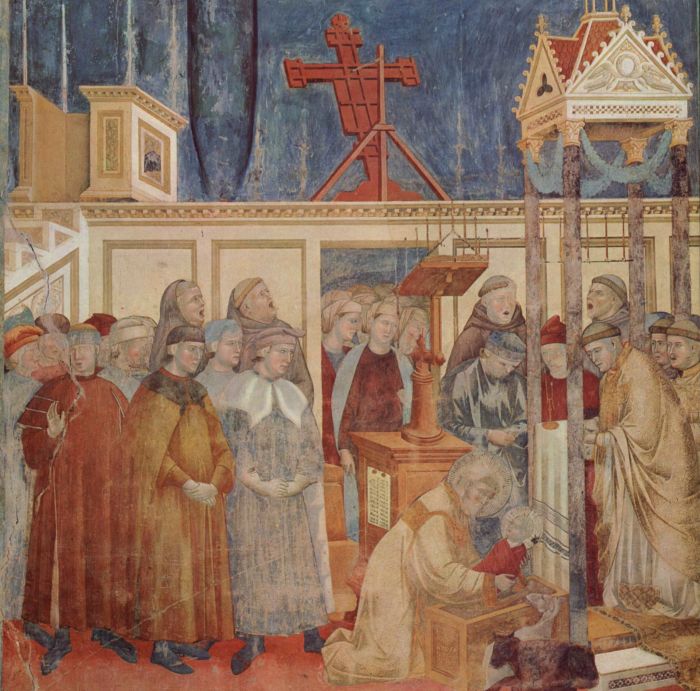
St. Francis's
"Institution of the Crib" was captured in the painting by Giotto below
(A.D. 1297-1300).
The scene of the Nativity is usually depicted as a cave or a
simple wooden structure, but some manger scenes are set in churches or
homes instead. Some show just the place of His birth, while others
depict the entire village (these large depictions of Bethlehem are
known as "belén" in Spain). Some shred time, depicting stories from the
Old Testament alongside the story of the Nativity, and some shred space
in the same manner, with the village looking very much like the town of
the person setting up the scene. They can be incredibly complex or
simple, made of fine ceramics or of wood or paper. But in all cases,
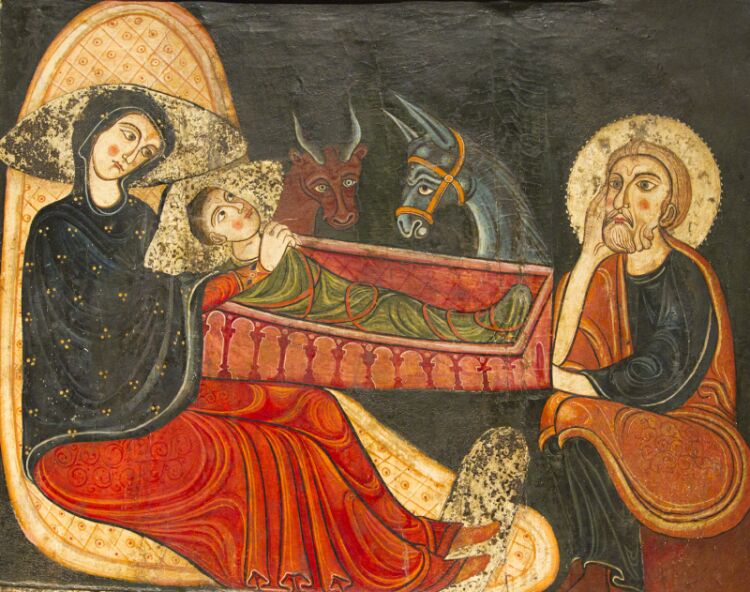
the basics of the Nativity Scene are Mary (on Christ's
right, or our left as we face the manger), St. Joseph (to Christ's
left, or our right as we face the manger), at least one angel, the
three Magi, at least one shepherd, a lamb as the shepherds' offering
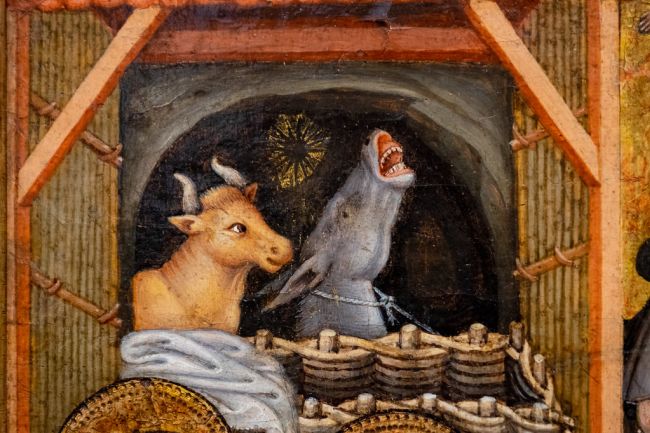
and symbolizing the Sacrifice of Christ, and the ox and the ass. That
Jesus lay between an ox and an ass is ascertained from Isaias 1:3:
The ox knoweth
his owner, and the ass his master's crib: but Israel hath not known me,
and my people hath not understood.
The presence of
the ass also foreshadows Palm Sunday.
In
fact, it is said that as a reward for the donkey's using its breath to
warm Baby Jesus, a Cross was marked on its and its progeny's backs so
that Jesus would recognize it for use at His entry into Jerusalem.
Other animals you might find in the manger
scenes are the Magis' camels (added with the Magi on Twelfth Night),
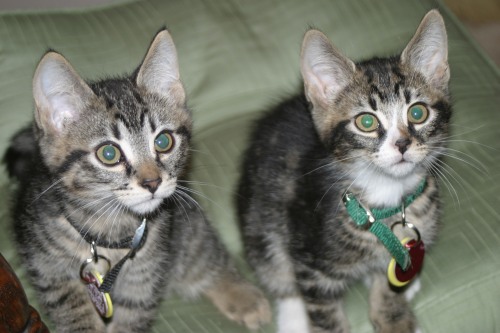
the peacock symbolizing immortality, and a cat -- usually a cat with
kittens. The cat -- la Gatta della Madonna -- is based on an old
Christmas legend that a tabby cat gave birth to kittens in the stable
as Mary gave birth to Jesus. Said kitty purred Baby Jesus to sleep, and
as a reward, the letter M, for Mary, was put on its forehead, and, so,
all tabby cats today still proudly display M's on their heads.2
Other figures can be added, and often are, especially in Italy, Mexico,
and Southern France, where exquisite and elaborate presepi are the
rule. You might see a kneeling St. Francis, Mary's midwife, one of the Sibyls, La
Befana (the old woman who visits children on Epiphany Eve) -- even popular contemporary
figures. Townspeople are often added, especially in Italy, and in
France, where the figures, called "santons," represent tradesmen and
the old guilds.
In Naples, presepi are extremely
elaborate. You'll find figures to represent each month: a butcher for
January; a cheesemaker for February; a poultry-seller for March; an
egg-seller for April; a cherry-seller for May; a baker for June; a
tomato vendor for July; a watermelon seller for August; a farmer for
September; a wine-seller for October; a chestnut-seller for November;
and a fishmonger for December.
You'll also invariably find a shepherd-bagpiper,
or "zampognaro." The zampognari figures are based on the Italian
tradition of the shepherds' (especially of Abruzzi and Lazio)
coming down from the mountains at Christmastime, going door-to-door to
play bagpipes to announce the birth of Christ. This tradition continues
today, and is so beloved that the zampognaro appears in Italian
presepi, sometimes accompanied by the pifferai (flute players) that
often accompany the pipers in real life. Click below to hear the
traditional Sicilian carol of the bagpipers, "Canzoni di Zampognari,"
whose lyrics in a strange Italian are below.
Quanno nascette
Ninno a Betelem me,
E rannotee pa rea miezo giorno
Maje le stelle, lusteree belle,
Seve dettero accusi!
La chiu lucen to
Jet tea chiamma li
Magi, in Oriente
When Christ our
Lord was born in Bethlehem afar,
Although 'twas night,
There shone as bright as noon, a star.
Never so brightly, never so whitely,
Shone the stars,
As on that night!
The Brightest star went
Away to call the Wise Men from the Orient.
And here is the
most popular of all Italian Christmas songs, one strongly associated
with the music of the zampognari and similar to the song above: "Te
Scendi Dalle Stelle" ("From Starry Skies Descending"), written by St.
Alphonsus de Liguori (A.D. 1696-1787) and amended by Pope Pius IX (A.D.
1792-1878).
Tu scendi dalle
stelle
O Re del Cielo
E vieni in una grotta
Al freddo al gelo
O Bambino mio Divino
Io ti vedo qui a tremar,
O Dio Beato
Ah, quanti ti costo
L'avermi amato
A te che sei del mondo,
Il creatore
Mancano panni e fuoco,
O mio Signore
Caro eletto, Pargoletto,
Quanto questa povertà,
Piu m'innamora
Giacche ti fece
Amor povero ancora
From starry
skies descending,
Thou comest, glorious King,
A manger low Thy bed,
In winter's icy sting;
O my dearest Child most holy,
Shudd'ring, trembling in the cold!
Great God, Thou lovest me!
What suff'ring Thou didst bear,
That I near Thee might be!
Thou art the world's Creator,
God's own and true Word,
Yet here no robe, no fire
For Thee, Divine Lord.
Dearest, fairest, sweetest Infant,
Dire this state of poverty.
The more I care for Thee,
Since Thou, O Love Divine,
Will'st now so poor to be.
I can't leave the topic of nativity scenes in Italy without
mentioning a "new tradition" that takes place in Laveno-Mombello, in
the Province of Varese in Lombardy. Underwater divers there swam to the
bottom of Lake Maggiore a week before Christmas in 1979 and set
up a creche -- only three pieces at first, the figures of the Holy
family which had, of course, been blessed by a priest. Since then,
figures have been added such that it's grown rather elaborate,
consisting of 42 lifesize statues as I write. Each year they set up the
presepio and leave it until the Epiphany -- but it's only complete
when, on Christmas Eve, the town's oldest and most recently married
couples carry the figure of the Baby Jesus from the Church of SS.
Filippo and Giacomo to the lake, in procession with the local faithful.
Then divers do their work, swimming down to tuck Jesus into His manger,
and finishing by lighting up the scene with underwater lights such that
it's visible at night from the lake's edge.
In Cesenatico, on the Eastern coast of the Emilia-Romagna region of
Italy, life-sized, wood-carved creche figures are set up on boats in
the harbor on the first Sunday of December, and are left until the
Epiphany.
Elsewhere in Italy, in towns as disparate as Custonaci, Dogliani,
Greccio, Matera, Morcone, Pietrelcina, and Resuttano, living nativities
are displayed. The one in Greccio, where St. Francis invented the
creche tradition, is the most elaborate: from Christmas Eve to the
Epiphany, six scenes from the life of St. Francis -- based on the
aforementioned texts by St. Bomaventure and Thomas of Celano -- and the
birth of Christ are dramatized in splendid detail.
Blessing of the Christmas Crib and Tree
This blessing come from "Christmas Missal" by Reverend Aloisius J.
Muench, 1951. It can be downloaded in pdf
format (I've included the lyrics to the Christmas hymns mentioned
in the pdf):
The prayers may
be said by the Father or Mother.
In the little
procession formed by the children, the youngest
is allowed to place the figure of the Christ Child in the manger. The
tree lights should not burn until the
blessing of the tree begins.
All sing: HOLY NIGHT.
Father: Our help is in the name of the Lord.
All: Who made heaven and earth.
Father: Let us pray. Almighty, everlasting God, pour down
your blessings on this Crib, which we have set up in memory of the
Birth of your Divine Son, Jesus Christ (he sprinkles the crib with holy
water). Help us to remember, we beg you, each time we look at it, that
Jesus came down to us at Bethlehem because He loved us. Let it remind
us, too, O Heavenly Father, that the presents we give and those we
receive, are given and received in memory of His love. Give peace to
our home, O Lord, and peace to the world, so that we may live with our
own family and with all men in hap- piness; through the same Jesus
Christ your Son, who lives and rules with you in union with the Holy
Spirit, forever and ever. Amen.
All sing: AWAY IN A MANGER, or some other hymn, while moving
to the tree.
Father: O Lord Jesus Christ, we humbly beg you to bless this
tree (he sprinkles it with holy water) which we have decorated with
ornaments and lights in honor of your birth in Bethlehem. Grant that
our souls may also wear the ornaments of good deeds; and make the light
of virtue shine in us, so that we may draw all men to you. Amen.
All sing: O COME, ALL YE FAITHFUL, or some other well-known
hymn.
Prayer Before the Crib
I adore Thee, O Word Incarnate, true Son of God from all
eternity, and true Son of Mary ever Virgin in the fullness of time.
When I adore Thy divine Person, and the Humanity united to Thy
Divinity, I venerate the poor manger which welcomed Thee when an
Infant, and which was truly the throne of Thy love. I prostrate myself
before it with the simplicity of the shepherds, with the faith of
Joseph, with the love of Mary. I bow down in veneration of this
precious memorial of our salvation with the same spirit of
mortification, poverty and humility with which Thou, though the Lord of
heaven and earth, didst choose for Thyself a manger wherein to lay Thy
tender infant limbs. And Thou, O Lord, Who in Thine Infancy didst deign
to lay Thyself in this manger, vouchsafe also to pour into my heart a
drop of that joy to which the sight of Thy lovely Childhood, and the
miracles which accompanied Thy Birth, gave rise. By that holy Birth, I
now implore Thee to grant to all the world peace and goodwill, and in
the name of the whole human race I render thanks and honour to God the
Father, and to God the Holy Spirit, Who with Thee live and reign one
God world without end. Amen.
Footnotes:
1 Both Thomas of Celano's and St.
Bonaventure's biographies of St. Francis can be found in this site's Catholic Library.
2 Two tabby tom-kittens,
Rocco ("Rocky") and Mario ("Boots"), with perfect letter M's for Mary
on their foreheads: