|
Long before the
Savior was born of the Virgin, and up to around the time of His first
Advent, there are said to have lived wise women who inhabited shrines,
temples, and caves, and who, being blessed "by the gods" with the gift
of prophecy, read the signs of nature
in order to foretell the future.
We call these seers "Sibyls," after the Greek word for prophetess
("sibulla").
Our knowledge of the origins of these women is obscured by the mists of
myth and time, the first written record of them coming from Heraclitus,
who wrote of one -- perhaps the only one at the time -- in a fragment
dating to the 6th century before Christ. It reads:
The Sibyl, with
frenzied mouth uttering things not to be laughed at, unadorned and
unperfumed, yet reaches to a thousand years with her voice by aid of
the god.
The number of
these Sibyls is reckoned differently throughout the ages, with
Heraclitus and Plato mentioning one, the Greeks mentioning nine, the
Romans and early Christians mentioning ten, and medieval Christians
enumerating up to twelve. Whatever their number, the Sibyls most often
came to be referred to by the places they inhabited. The Christian
apologist Lactantius (b. ca. A.D. 250), listing ten Sibyls, describes
them thus in Book I, Chapter VI of his "Divine Institutes" (link to
full text below):
- the Persian
Sibyl: "of her Nicanor made mention, who wrote the exploits of
Alexander of Macedon"
- the Libyan
Sibyl: "of her Euripides makes mention in the prologue of the
Lamia"
- the Delphic
Sibyl: "concerning whom Chrysippus speaks in that book which he
composed concerning divination"
- the Cimmerian
Sibyl: "whom Naevius mentions in his books of the Punic war, and
Piso in his annals"
- the Samian
Sibyl: "respecting whom Eratosthenes writes that he had found a
written notice in the ancient annals of the Samians"
- the
Hellespontine Sibyl: "born in the Trojan territory, in the village
of Marpessus, about the town of Gergithus; and Heraclides of Pontus
writes that she lived in the times of Solon and Cyrus"
- the Phrygian
Sibyl: "who gave oracles at Ancyra"
- the Tiburtine
Sybil: "by name Albunea, who is worshipped at Tibur [modern
Tivoli] as a goddess, near the banks of the river Anio, in the depths
of which her statue is said to have been found, holding in her hand a
book. The senate transferred her oracles into the Capitol."
- the
Erythraean Sybil: "whom Apollodorus of Erythraea affirms to have
been his own country-woman, and that she foretold to the Greeks when
they were setting but for Ilium, both that Troy was doomed to
destruction, and that Homer would write falsehoods"
- the Cumaean
Sibyl: "by name Amalthaea, who is termed by some Herophile, or
Demophile and they say that she brought nine books to the king
Tarquinius Priscus, and asked for them three hundred philippics, and
that the king refused so great a price, and derided the madness of the
woman; that she, in the sight of the king, burnt three of the books,
and demanded the same price for those which were left; that Tarquinias
much more considered the woman to be mad; and that when she again,
having burnt three other books, persisted in asking the same price, the
king was moved, and bought the remaining books for the three hundred
pieces of gold: and the number of these books was afterwards increased,
after the rebuilding of the Capitol; because they were collected from
all cities of Italy and Greece, and especially from those of Erythraea,
and were brought to Rome, under the name of whatever Sibyl they were."
The prophecies of these pagan Sibyls -- most especially the Tiburtine,
Erythraean, and Cumaean Sibyls, who are often confused with one another
or referred to as one -- play interesting roles in Christian History.
One sees depictions of the Sibyls in Catholic art -- from altar pieces
to illuminated manuscripts, from sculpture to even the ceiling of the
Sistine Chapel, the periphery of which is dominated by five Sybils (the
Delphic, Cumaean, Libyan, Persian, and Erythraean) interspersed with
seven Old Testament Prophets (Zacharias, Isaias, Daniel, Jonas,
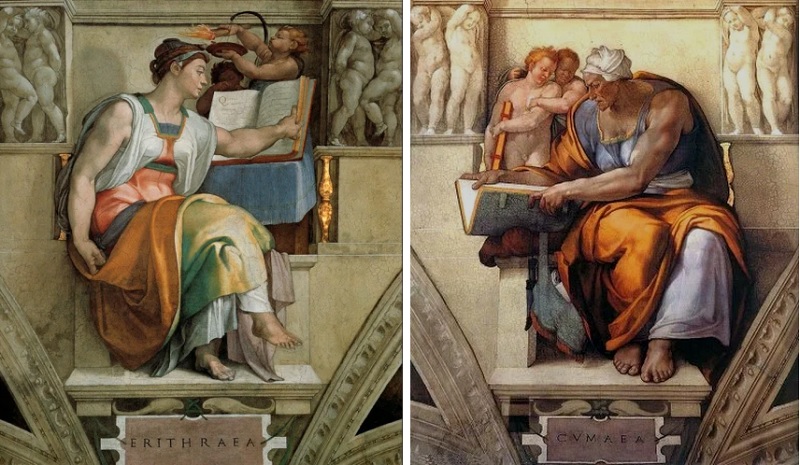
Jeremias, Ezechiel, and Joel). Michelangelo's Erythraean and Cumean
Sibyls are shown at the top of this page in listed order, and Van
Eyck's Ghent altarpiece depictions of those same women, in the same
order, are shown below.
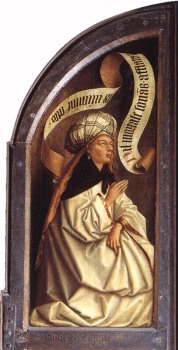 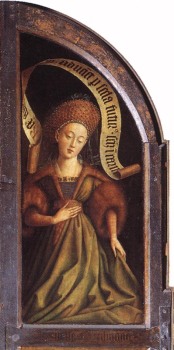
These women are often depicted in medieval dramas,
Jesse Trees and Nativity scenes, and one hears of the
Sibyls
in chant and hymms, too: on Christmas
Eve, after Matins and before Mass, the Song of the Sibyl was sung
all over Europe until the Council of Trent (now this custom, restored
in some places in the 17th c., remains mostly in Spain). 1 They are most famously mentioned in
the "Dies Irae," sung at Masses for the dead.
Its opening lines:
Dies irae, dies
illa,
solvet saeculum in favilla,
teste David cum Sibylla. |
|
That day of
wrath, that dreadful day,
shall heaven and earth in ashes lay,
as David and the Sybil say. |
Who were
these women whom Christians group with King David and the great Old
Covenant Prophets? Why did Tertullian (b. ca. A.D. 160) describe one
Sibyl as "the true prophetess of Truth"? 2
Why would St. Clement of Alexandria (d. ca. A.D. 215) describe a Sibyl
thus in Chapter VIII of his "Exhortation to the Heathens":
Let the Sibyl
prophetess, then, be the first to sing to us the song of salvation --
"So He is all
sure and unerring: Come, follow no longer darkness and gloom; See, the
sun's sweet-glancing light shines gloriously. Know, and lay up wisdom
in your hearts: There is one God, who sends rains, and winds, and
earthquakes, Thunderbolts, famines, plagues, and dismal sorrows, And
snows and ice. But why detail particulars? He reigns over heaven, He
rules earth, He truly is."
-- where, in
remarkable accordance with inspiration she compares delusion to
darkness, and the knowledge of God to the sun and light, and subjecting
both to comparison, shows the choice we ought to make. For falsehood is
not dissipated by the bare presentation of the truth, but by the
practical improvement of the truth it is ejected and put to flight.
Let's look, one
at a time, at the three Sibyls who are most important to Christianity.
The Tiburtine Sibyl:
The Sibyl of Christmas
The Tiburtine
Sibyl -- also known as Albunea -- lived in Tibur, the town now known as
Tivoli and located about fifteen miles Northeast of Rome. Her temple,
which still stands today, was surrounded by a "sacred" grove and by
mineral springs which, poetically enough given the topic of this page,
flowed into the Tiber. The reason for this Sibyl's importance to
Christians is her meeting with Augustus. 3
The story as recounted in Archbishop Jacobus de Voragine's 13th c.
"Golden Legend," in its section on the Feast of the Nativity:
...here is what
Pope Innocent III tells us: in order to reward Octavian for having
established peace in the world, the Senate wished to pay him the
honours of a god. But the wise Emperor, knowing that he was mortal, was
unwilling to assume the title of immortal before he had asked the Sibyl
whether the world would some day see the birth of a greater man than
he.
Now on the day of the Nativity the Sibyl was alone with the emperor,
when at high noon, she saw a golden ring appear around the sun. In the
middle of the circle stood a Virgin, of wondrous beauty, holding a
Child upon her bosom. The Sibyl showed this wonder to Caesar; and a
voice was heard which said: "This woman is the Altar of Heaven (Ara
Coeli)!"
And the Sibyl said to him: "This Child will be greater than thou."
Thus the room where this miracle took place was consecrated to the holy
Virgin; and upon the site the church of Santa Maria in Ara Coeli stands
today. However, other historians recount the same event in a slightly
different way. According to them, Augustus mounted the Capitol, and
asked the gods to make known to him who would reign after him; and he
heard a voice saying: "A heavenly Child, the Son of the living God,
born of a spotless Virgin!" Whereupon Augustus erected the altar
beneath which he placed the inscription: This is the altar of the Son
of the living God.
The Tiburtine
Sibyl is also famous for another prophecy attributed to her -- one pertaining to the end of time.
Click here to see a typical medieval
depiction of
the meeting of the Tiburtine Sibyl and Augustus (you can read more
about this encounter and the church that sprang from it in the Il Santo Bambino section of
the page on Devotion to the Child Jesus).
The Erythraean Sibyl:
The Sibyl of the Acrostic
The Erythraean
Sibyl is said to have been the daughter of a shepherd and a nymph. She
lived in Erythrae, Ionia (Asia Minor), on the Aegean Sea, and is
often confused with the Cumaean Sibyl (St. Augustine, in his "City of
God," speaks of this).
What makes this woman important to Christians is her prediction of
Christ, given in the form of an acrostic poem which formed the words,
'Ihsous Xristos Qeou uios spthr, which means, "Jesus Christ the Son of
God, the Saviour." See excerpts from St. Augustine's "The City of God"
below.
The Cumaean Sibyl:
The Sibyl of the Underworld
The most
fascinating of all Sibyls lived in Cumae (now called Cuma), the first
Greek colony founded in Italy, located about twenty miles northwest of
Naples in "the volcanic region near Vesuvius, where the whole country
is cleft with chasms from which sulphurous flames arise, while the
ground is shaken with pent-up vapors, and mysterious sounds issue from
the bowels of the earth." 4 The
Sibyl who was also known as Amalthaea made her home in a grotto near
Lago d'Averno (Lake Avernus) in this
tempestuous land -- a grotto that can be visited even today -- and
there she would write her prognostications on leaves and spread them at
one of the hundred mouths to her cave, allowing them to be picked up
and read -- or scattered by the winds to be seen no more, whichever
came first, as Virgil tells us in his Aeneid:
Arriv'd at
Cumae, when you view the flood
Of black Avernus, and the sounding wood,
The mad prophetic Sibyl you shall find,
Dark in a cave, and on a rock reclin'd.
She sings the fates, and, in her frantic fits,
The notes and names, inscrib'd, to leafs commits.
 What she commits to leafs, in order laid, What she commits to leafs, in order laid,
Before the cavern's entrance are display'd:
Unmov'd they lie; but, if a blast of wind
Without, or vapors issue from behind,
The leafs are borne aloft in liquid air,
And she resumes no more her museful care,
Nor gathers from the rocks her scatter'd verse,
Nor sets in order what the winds disperse.
Thus, many not succeeding, most upbraid
The madness of the visionary maid,
And with loud curses leave the mystic shade.
In the Aeneid,
too, she gives Aeneas a tour of the infernal regions which
are entered into in the land she inhabited (this story is the
reason for Dante's having chosen Virgil as his guide in "The Divine
Comedy"). After this tour of the underworld, they ascend again, and the
Sibyl tells the story of how she came to be hundreds of years old. From
chapter 25 of Bullfinch's book:
As Aeneas and
the Sibyl pursued their way back to earth, he said to her, "Whether
thou be a goddess or a mortal beloved by the gods, by me thou shalt
always be held in reverence. When I reach the upper air, I will cause a
temple to be built to thy honor, and will myself bring offerings."
"I am no goddess," said the Sibyl; "I have no claim to sacrifice or
offering. I am mortal; yet if I could have accepted the love of Apollo,
I might have been immortal. He promised me the fulfilment of my wish,
if I would consent to be his. I took a handful of sand, and holding it
forth, said, 'Grant me to see as many birthdays as there are
sand-grains in my hand.'
"Unluckily I forgot to ask for enduring youth. This also he would have
granted, could I have accepted his love, but offended at my refusal, he
allowed me to grow old. My youth and youthful strength fled long ago. I
have lived seven hundred years, and to equal the number of the
sand-grains, I have still to see three hundred springs and three
hundred harvests. My body shrinks up as years increase, and in time, I
shall be lost to sight, but my voice will remain, and future ages will
respect my sayings."
An ancient woman
doomed to live a thousand years, but without youth, shrinking with age
each year until nothing is left of her but her voice -- a voice which
some say is kept in a jar in the cave, and that others say one can
still hear there in her Cumaean grotto.
Another great tale told of her, and mentioned by Lactantius above, is
how she went to sell nine books to the King of the Tarquins, a story
told well by Amy Friedman:
For many years,
beneath the temple of Jupiter in Rome, the sibylline books were
protected in a closely guarded vault. These were books that the priests
consulted, especially during times of natural disaster, when
earthquakes and floods and hurricanes swept down on their world, when
disease struck and when hardship came. These books contained great
wisdom and predictions of what the future held for their land and
people. The sibylline books, the priests said, were precious beyond any
treasure.
She was known as the Cumaean Sibyl, a woman who could change her
features at will. She was wild-eyed, wild-haired and wild-tongued. One
day, she came to see the king, Tarquin the Elder. She brought with her
an offer.
"I have nine books to sell to you," she told the king.
"What books would those be?" the king asked. She was an odd-looking
woman, and the king did not believe she was the prophetess she claimed
to be.
"In these nine books," she said, "is contained the destiny of Rome."
Tarquin the Elder laughed at the old woman. He had heard of her, of
course, but he did not believe she could predict the future, and he did
not, for one moment, believe that these books she carried contained the
destiny of the world. Her voice, after all, was more like a croak, and
when she spoke, foam gathered on her lips.
Tarquin had heard that she wrote her predictions on oak leaves and that
she laid these leaves at the edge of her cave. When the wind came and
blew the leaves, they drifted this way and that, hither and yon, so
that those who received the woman's messages often were confused by the
words.
Tarquin did not believe she was as wise as she claimed, but he was
curious about her offer. "How much money do you want for your books?"
he asked.
"Nine bags of gold," she answered.
The king and his advisers roared with laughter. "Nine bags of gold? How
could you ask such a fortune?"
"The future of your world lies within them," she repeated, but seeing
that he did not wish to buy her books, she started a fire, and into
this fire she hurled three of her books.
Within moments they were burned to ash, and the sibyl of Cumae set off
for home, leaving behind the king and his advisers.
It was another year before the sibyl returned. This time, she arrived
with six books.
"What do you want now?" Tarquin asked her.
"I offer six books for sale," she answered. "Six books that contain the
rest of the destiny of Rome."
"How much?" the king asked her.
"Nine bags of gold," she said.
"What?" asked the king. "Nine bags for fewer books? Are you mad? You
asked nine bags for nine books, but now you offer only six for the same
price?"
"Think what they contain before you refuse," the sibyl said. "The rest
of the future of Rome."
"Too much," Tarquin answered, and so, once again, the woman built a
fire and tossed into it three more books. Then she turned and walked
away, crossing the wide farmlands that separated Rome from Cumae.
The roads between the two cities were long and treacherous in those
days. The woman's journey was difficult. Still, the next year, she
returned to see the king once again. This time she brought with her the
three remaining books.
"Three books remain," she said, "and I will sell these to you for nine
bags of gold."
Now the king's advisers gathered around, and they consulted among
themselves. They were worried that the old sibyl would burn the very
last of the predictions. What if what she said were true? What if they
might know their future? What if they were throwing away their
opportunity to read their destinies?
"You must buy these books," the advisers told their king, and so he
did, paying the old sibyl nine bags of gold.
When the king and his advisers had read the three books that remained,
they understood that this odd old woman was truly a great sibyl,
prophetess of the future. The king sent at once for her and had her
returned to his court. "Please," Tarquin begged her, "will you rewrite
the other six books?"
"No," she said, refusing to discuss the matter. "You have chosen your
destiny, and I cannot change that."
Rome did rise to be a great kingdom, and for years and years it
flourished as a powerful republic, conquering Gaul under the famed
Julius Caesar. But when the Roman Empire collapsed, people wondered
what wisdom they might have learned in those six books burned by the
sibyl of Cumae.
What Can Be Learned
from the Church's Honoring of the Sibyls
These women,
albeit shrouded in mystery and wonderful, fantastical tales, remind us
that the Church teaches that actual grace and the natural virtues exist
outside of Her, and that Christians are to honor Truth no matter whence
it comes in the temporal realm. That the majority of Church Fathers
adopted a form of Platonism, considering the philosopher an ally
against naturalism and materiaism, that St. Thomas Aquinas and the
Scholastics who followed used the Truths spoken by Aristotle for the
same, that medieval Catholic civilization revered the "Nine Worthies" 5 -- three of whom were pagan, three of
whom were Old Testament Jewish -- as the embodiment of chivalry --
these things remind us that arrogance and spiritual pride have no place
in a Catholic's life. While there is an "us" and a "them" with regard
to sanctifying grace, there is no "us" and "them" with regard to actual
grace and the natural virtues. Further, we can't presume to
know who's been blessed by sanctifying grace -- i.e., we can't know who
the "them" is in that regard; we can only know who is formally outside
of the Church and, therefore, whom we need to evangelize -- in all
charity and prudence -- and pray for.
Treat all men with charity, honor Truth wherever it is, and live a
deeply Catholic life. "Spread the Gospel and let God sort 'em out."
This is all we can do.
The Sibyls in Virgil's
and early Christians' Writings
- The Eclogues, by Virgil (b. 70 B.C.) See also
his "Aeneid."
- Hortatory Address to the Greeks, by St. Justin
Martyr (b. ca. 100)
- To Aucolytus, by Theophilus, Bishop of Antioch
(ca. 169)
- Exhortation to the Heathen, by St. Clement of
Alexandria (d. ca. 215)
- Divine Institutes, by Lactantius (b. ca. 250)
- On the Anger of God, by Lactantius
- Oration of Constantine, by Eusebius (b. ca.
260)
- City of God, by St. Augustine (b. 354)
- Prophecy of the Tiburtine Sybil, Author
Unknown (written ca. 380)
Footnotes:
1
The Song of the Sibyl:
Judicii signum
tellus sudore madescet.
E caelo rex adveniet per saecla futurus
scilicet ut carnem praesens ut judicet orbem.
Judicii signum tellus sudore madescet.
Unde deum cernent incredulus atque fidelis
celsum cum sanctis aevi jam termino in ipso.
Judicii signum tellus sudore madescet.
Sic animae cum carne aderunt quas judicat ipse
cum jacet incultus densis in vepribus orbis.
Judicii signum tellus sudore madescet.
Reicient simulacra viri cunctam quoque gazam
exuret terras ignis pontumque polumque.
Judicii signum tellus sudore madescet.
Inquirens taetri portas effringet averni
sanctorum sed enim cunctae lux libera carni.
Judicii signum tellus sudore madescet.
Tradetur sontes aeterna flamma cremabit
occultos actus retegens tunc quisque loquetur.
Judicii signum tellus sudore madescet.
Secreta atque deus reserabit pectora luci
tunc erit et luctus stridebunt dentibus omnes.
Judicii signum tellus sudore madescet.
Eripitur solis jubar et chorus interit astris
voluetur caelum lunaris splendor obibit.
Judicii signum tellus sudore madescet.
Deiciet colles valles extollet ab imo
non erit in rebus hominum sublime vel altum.
Judicii signum tellus sudore madescet.
Jam aequantur campis montes et caerula ponti
omnia cessabunt tellus confracta peribit.
Judicii signum tellus sudore madescet.
Sic pariter fontes torrentur fluminaque igni
sed tuba tum sonitum tristem demittet ab alto.
Judicii signum tellus sudore madescet.
Orbe gemens facinus miserum variosque labores tartareumque chaos
monstrabit terra dehiscens.
Judicii signum tellus sudore madescet.
Et coram hic domino reges sistentur ad unum
reccidet e caelo ignisque et sulphuris amnis.
Judicii signum tellus sudore madescet.
2
"Ad Nationes" 
3 Augustus (d. A.D. 14) was born
"Gaius Octavius," became known as "Julius Caesar Octavianus" when he
became heir to Julius Caesar (his great-uncle), and is most often
called "Octavian," "Augustus," or "Caesar Augustus" in literature and
references.
4
"Bullfinch's Mythology, the Age of Fable" by Thomas Bullfinch
5
Jean de Longuyon first enumerated the "Nine Worthies" in the 14th c.,
in his work, Voeux du Paon ("Vows of the Peacock"). The Nine
Worthies are: Hector, Alexander the Great, Julius Caesar, Joshua,
David, Judas Maccabaeus, King Arthur, Charlemagne, and Godfrey of
Bouillon.
|