|
Matthew
2:11: "And entering into the house, they found the child with Mary his
mother, and falling down they adored him; and opening their treasures,
they offered him gifts; gold, frankincense, and myrrh."
"Majesty made itself small so that those who held it could endure it."
-- St. Ephraem the Syrian, Doctor
Devotion to the
Infant Jesus is another aspect of honoring Christ's Incarnation. It is
to marvel at His having humbled Himself by taking on a human nature,
subjecting Himself to all that flesh is heir to (minus the effects of
original sin, of course), even subjecting Himself to the earthly
authority of Mary and Joseph. Recognized even in the Virgin's womb by
St. John the Baptist and his mother, after His Nativity, the Child
Jesus was adored first by the shepherds and then by the Magi, and has
been revered by Saints ever since. Many of the heroes and heroines of
our Faith had a special devotion to the Child Jesus, some even having
been blessed by visions of Him as a boy. St. Christopher, St. Anthony of Padua, St.
Teresa of Avila, St. Rose of Lima, St. Thérèse of Lisieux (whose
religious name is "St. Thérèse of the Child Jesus and the Holy Face"),
St. Francis of Assisi with his creche, and, of course, Our Lady and St. Joseph, are particularly associated
with the Divine Child and many are pictured with Jesus as a child in
art.
St. John
Chrysostom (ca. A.D. 347-407), in the 6th and 7th homilies of his
"Homilies on the Gospel of Matthew," describes devotion to the Divine
Child as he writes of the Magi honoring the newborn King:
And why did they
at all worship one who was in swaddling clothes? For if He had been a
grown man, one might say, that in expectation of the succor they should
receive from Him, they cast themselves into a danger which they
foresaw; a thing however to the utmost degree unreasonable, that the
Persian, the barbarian, and one that had nothing in common with the
nation of the Jews, should be willing to depart from his home, to give
up country, and kindred, and friends, and that they should subject
themselves to another kingdom.
But if this be foolish, what follows is much more foolish. Of what
nature then is this? That after they had entered on so long a journey,
and worshipped, and thrown all into confusion, they went away
immediately. And what sign at all of royalty did they behold, when they
saw a shed, and a manger, and a child in swaddling clothes, and a poor
mother? And to whom moreover did they offer their gifts, and for what
intent? Was it then usual and customary, thus to pay court to the kings
that were born in every place? and did they always keep going about the
whole world, worshipping them who they knew should become kings out of
a low and mean estate, before they ascended the royal throne? Nay, this
no one can say.
And for what purpose did they worship Him at all? If for the sake of
things present, then what did they expect to receive from an infant,
and a mother of mean condition?...
...Shame upon Marcion, shame upon Paul of Samosata, for refusing to see
what those wise men saw, the forefathers of the Church; for I am not
ashamed so to call them. Let Marcion be ashamed, beholding God
worshipped in the flesh. Let Paul be ashamed, beholding Him worshipped
as not being merely a man. As to His being in the flesh, that first is
signified by the swaddling clothes and the manger; as to their not
worshipping Him as a mere man, they declare it, by offering Him, at
that unripe age, such gifts as were meet to be offered to God. And
together with them let the Jews also be ashamed, seeing themselves
anticipated by barbarians and magi, whilst they submit not so much as
to come after them. For indeed what happened then was a type of the
things to come, and from the very beginning it was shown that the
Gentiles would anticipate their nation...
...Let us then also follow the magi, let us separate ourselves from our
barbarian customs, and make our distance therefrom great, that we may
see Christ, since they too, had they not been far from their own
country, would have missed seeing Him. Let us depart from the things of
earth. For so the wise men, while they were in Persia, saw but the
star, but after they had departed from Persia, they beheld the Sun of
Righteousness. Or rather, they would not have seen so much as the star,
unless they had readily risen up from thence. Let us then also rise up;
though all men be troubled, let us run to the house of the young Child;
though kings, though nations, though tyrants interrupt this our path,
let not our desire pass away. For so shall we thoroughly repel all the
dangers that beset us. Since these too, except they had seen the young
Child, would not have escaped their danger from the king. Before seeing
the young Child, fears and dangers and troubles pressed upon them from
every side; but after the adoration, it is calm and security; and no
longer a star but an angel receives them, having become priests from
the act of adoration; for we see that they offered gifts also. Do thou
therefore likewise leave the Jewish people, the troubled city, the
blood-thirsty tyrant, the pomp of the world, and hasten to Bethlehem,
where is the house of the spiritual Bread. For though thou be a
shepherd, and come hither, thou wilt behold the young Child in an inn:
though thou be a king, and approach not here, thy purple robe will
profit thee nothing; though thou be one of the wise men, this will be
no hindrance to thee; only let thy coming be to honor and adore, not to
spurn the Son of God; only do this with trembling and joy...
For forty days,
starting on the Feast
of Christmas,
the Church officially recalls the Divine Childhood. After Christmas
itself, there
are the Feast of the Circumcision
on 1 January, the Feast of His Holy
Name, the Feast of the Epiphany on
6 January ("Three Kings Day," when we recall the Magi's adoration), the
Feast of
the Holy Family, and the Presentation (Candlemas) on 2 February.
Indeed, the entire month of January is dedicated to His Holy Name and His Holy Childhood.
More generally, devotion to the Child Jesus focuses on twelve
mysteries:
- The wait for the
Messias, the anticipation of His arrival for century after century
(Luke 1:5-25
- 57-80);
His genealogy (Matthew 1:1-17)
- the annunciation
of His arrival to the Virgin Mary (Luke 1:26-38)
- the Visitation,
when St. John the Baptist recognizes Him while both are in their
mothers' wombs (Luke 1:39-56)
- the angelic
announcement to St. Joseph, in a dream, revealing Who Jesus is (Luke
1:18-25)
- the birth of
Jesus (Luke 2:1-20)
- the circumcision
of Jesus (Luke 2:21)
- the "redeeming"
of Jesus at the Temple, and the prophecies of Simeon and Anna (Luke
2:22-38)
- the adoration of
the Magi (Matthew 2:1-12)
- the flight into
Egypt and the massacre of the Holy Innocents (Matthew 2:13-23)
- the hidden
family life of Christ as a Child in Nazareth (Luke 2:39-40,51-52)
- the finding of
Jesus in the Temple, arguing with the elders (Luke 2:41-50)
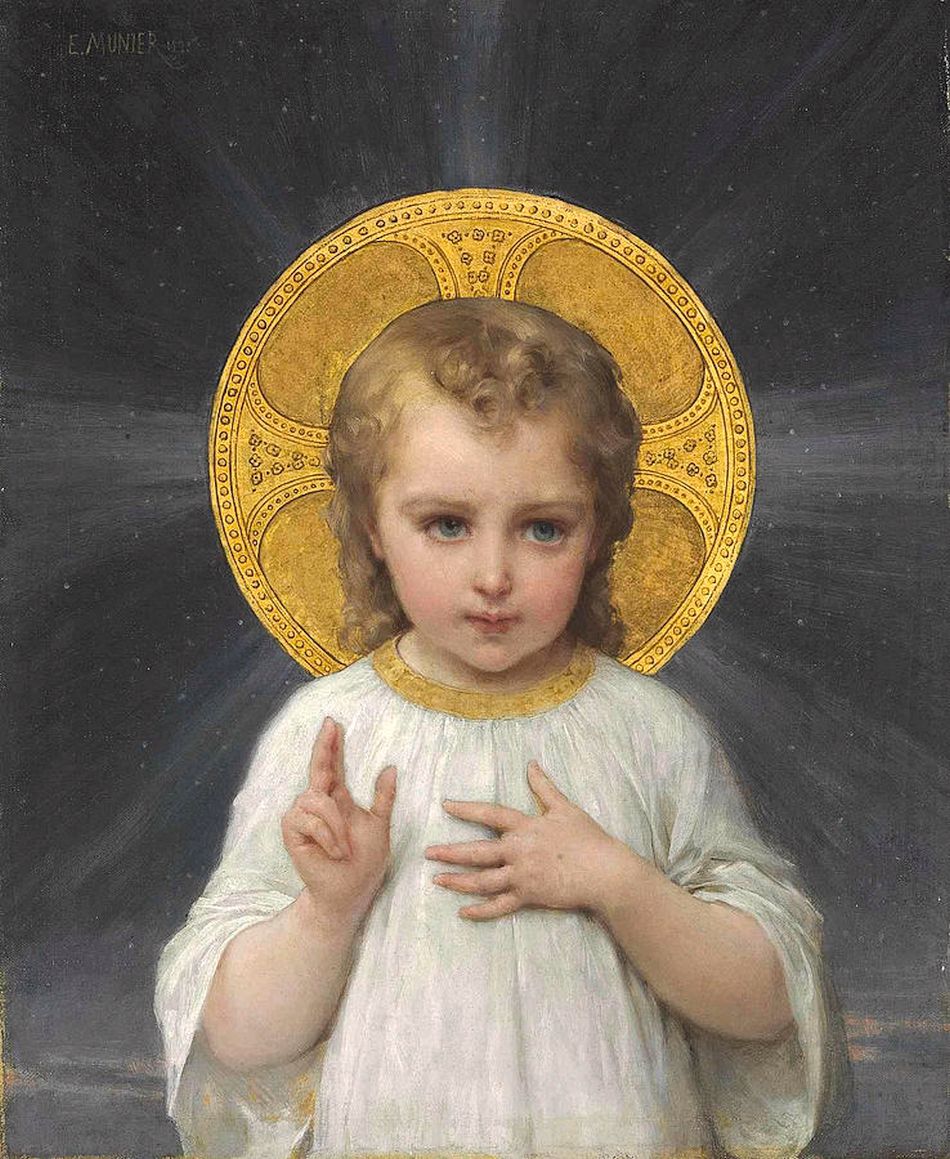
Depictions of
the Child Jesus outside of Nativity
scenes or His being held by Our Lady usually show Him
holding up His right Hand in blessing. In His left Hand, He often holds
a globe (symbolizing the world, and sometimes topped by a Cross), a
book, a bird, or grapes (symbolizing the Eucharist). The Divine Child
is worshipped in different countries in different ways: to
Italian-speaking people, He is "Il Santo Bambino"; to the
Spanish-speaking, He is "El Santo Niño"; to the Germans, He is
"Christkindl." And there are particular devotions to the Christ Child
due to an apparition or a miraculous image, such as is the case with
the Infant of Prague, El Santo Niño de Atocha, and the Santo Bambino di
Ara Coeli in Rome.

The Infant of Prague
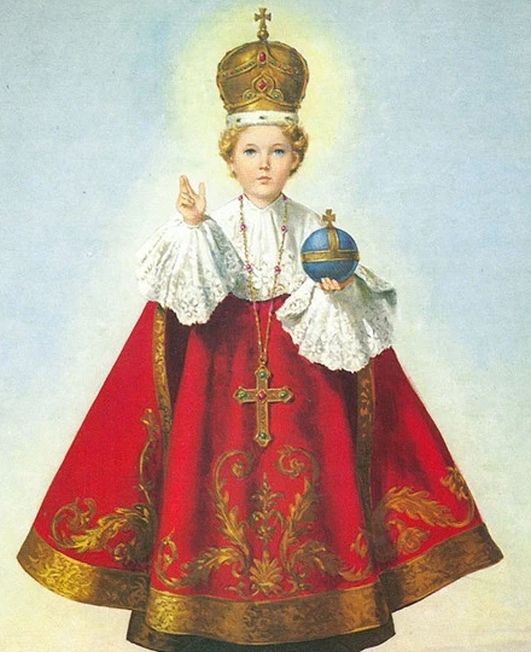
In Prague, Czech Republic, there is a statue of the Christ
Child known as the "Infant of Prague." The statue is Spanish in origin,
having ended up in its present country when it was taken there as a
wedding gift given to a Spanish woman upon her marriage to a Czech
nobleman. It passed down through that family, and was eventually given
to the Disalced Carmelites there.
In 1628, the Carmelites had to escape the area when the Saxons, and
then the Swedes, attacked. Father Cyril a Matre Dei returned to Prague
in 1638 and found the statue lying in what was left of the church, its
arms broken. He placed it back in the oratory for veneration and, while
praying near it one day, heard the voice of the Infant Jesus say to
Him, "Have pity on Me and I will have pity on you. Give Me My hands and
I will give you peace. The more you honor Me, the more I will bless
you". In that war-torn era, the priest didn't have the money to carry
out that wish, so prayed for guidance. He heard the Child Jesus again,
"Place Me near the entrance of the sacristy and you will receive aid."
And so it happened. Within a few days, a rich man came by and offered
to repair the statue.
The statue became known for its association with the miraculous,
including healings and, especially, for the protection of the church
through so many wars that followed. Many benefits are said to come to
those who worship Christ under His title of the "Infant of Prague,"
and there are prayers and novenas to Him
under this name.
The statue is around 18½ inches tall and made of wax, possibly with a
wooden inner core. The Christ Child holds a globe surmounted by a Cross
-- symbolizing His Kingship. His right hand is raised in a blessing,
his first two fingers extended to signify His two natures. The statue
was not originally dressed, but was first crowned by Bernard Ignatius
in 1651, and
was solemnly coronated by the Bishop of Prague in 1655. Now it is
always seen not only crowned, but dressed in regal,
priestly robes (the statue has over 85 different robes, including one
sent by Empress Mary Theresa). Since 1788, sometimes two rings adorn
the statue's fingers, gifts from a noble family in gratitude for the
cure of their daughter.
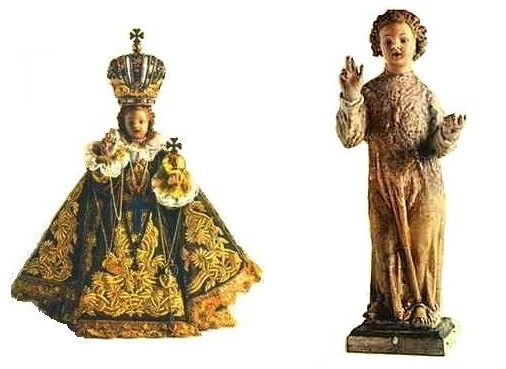
The statue can
be seen in the Church of St. Mary the Victorious and St.
Anthony of Padua,
Karmelitska 9, 118 00 Praha 1, Czech Republic, in the care of
the Discalced Carmelites. Replicas can
be bought
at many different Catholic gift shops, and the image of the Infant of
Prague is often represented two-dimensionally in paintings and on Holy
Cards.
A famous copy of this icon can
be seen on the Island of Cebu in the Philippines, and the story of its
presence there is very interesting. The great Portugese explorer
Ferdinand Magellan gave a copy of the statue of the Infant of Prague to
Cebu's king Rajah Humabon's wife, after she converted and took the name
Queen Juana upon her baptism in 1521. Magellan's chaplain, Padre Pedro
de Valderrama, converted many of the island's natives -- a move which
led to a skirmish between the old and new Christians, and natives from
the island of Mactan. The Christian Cebu side lost, Magellan was
killed, and his crew later returned to Spain.
In 1565, the Spanish Captain, Miguel Lopez de Legazpi, went to Cebu
accompanied by Augustinian Missionaries. They were attacked and, of
course, defended themselves. Among the ruins of the battle's aftermath,
they found the statue of the Holy Infant (El Santo Niño) that Magellan
had given to Queen Juana years earlier. A shrine was built to house the
statue, and it later became the Basilica Minore del Santo Niño. The
Holy Infant is especially dear to the Filippino people to this day, and
in the first month of the year, there are in His honor great parades,
celebrations, a Feast on the third Sunday of January, and even a
special dance (sinulog). Devotion to the Holy Child, though, is
year-round in the Philippines, and no Filippino home is without an
image of El Santo Niño.
"Prayer in
Affliction" to the Infant of Prague
O Dearest Jesus tenderly loving us, Thy greatest joy is to dwell among
men, and to bestow Thy blessing upon us! Though I am not worthy that
Thou shouldst behold me with love, I feel myself drawn to Thee, O dear
Infant Jesus, because Thou dost gladly pardon me and exercise Thy
almighty power over me. So many, who turned with confidence to Thee,
have recieved graces and had their petitions granted. Behold me, in
spirit I kneel before Thy miraculous image on Thy altar in Prague, and
lay open my heart to Thee, with its prayers, petitions and hopes. My
greatest need in particular -- (mention your intentions here)
-- I enclose it in Thy loving Heart.
Govern me, and do with me and mine, according to Thy holy will, for I
know that in Thy Divine wisdom and love Thou wilt ordain everything for
the best. Almighty, gracious Infant Jesus, do not withdraw Thy hand
from us, but protect and bless us forever. I pray Thee, sweetest
Infant, in the name of Thy Blessed Mother Mary who cared for Thee with
such tenderness, and by the great reverence with which Saint Joseph
carried Thee in his arms, comfort me and make me happy that I may bless
and thank Thee forever from all my heart Amen.
Act of Thanksgiving to the Infant Jesus
O most gracious Infant Jesus, prostate before Thee, I offer Thee most
fervent thanks for the blessings Thou hast bestowed upon me. I shall
incessantly praise Thine ineffable mercy and confess that Thou alone
art my God, my helper, and my protector. Henceforth, my entire
confidence shall be placed in Thee, everywhere will I proclaim Thy
mercy and generosity, so that Thy great love and great deeds which Thou
preformest may be acknowledged by all. May devotion to Thy holy infancy
extend more and more in the hearts of all Christians, and may all who
experience Thy assistance persevere in returning unceasing gratitude to
Thy most holy Infancy to which be praise and glory for all eternity
Amen.
See also the Novena to the
Infant of Prague.
El Santo Niño de Atocha
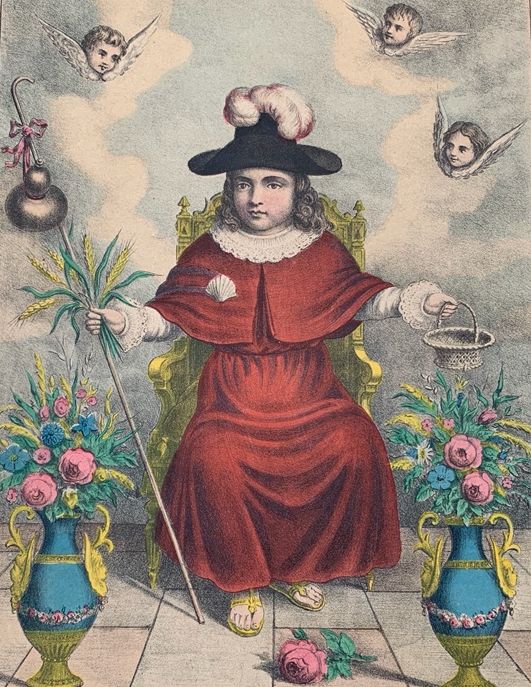
In Mexico, the Holy Child is known under various titles, the
most famous of which is El Santo Niño de Atocha. In the Mexican State
of Zacatecas are two towns with two shrines: the more famous Fresnillo,
home of the "Blue Santo Niño," and Plateros, where the "Pink Santo
Niño" is found. The statues of the Infant are dressed in the attire
of a pilgrim: brimmed hat, cape,
and a scallop shell -- the pilgrim's badge indicating pilgrimage to
Compostela where the relics of St. James the Greater can be found. He
carries a basket of food, and a pilgrim's staff to which are fasted a
gourd (to hold water) and wheat.
The devotion originated in Atocha, Spain when the Moors invaded and
took many Christians as prisoners. The Christians were disallowed
visitors and began to fear for their very lives as they lacked food and
anyone to bring them some. After praying intensely for relief, the
Christ Child appeared dressed in the attire described above and bearing
a basket of food and a containter of water, neither of which were
depleted until they were no longer needed.
El Santo Niño de Atocha is most often invoked for healing, especially
of children. Pilgrims to his shrines leave children's shoes, a custom
born in the folk tale that the Child wears out His own as He goes about
at night secretly visiting sick children in order to heal them.
Prayer to El
Niño de Atocha
All-knowing Child of Atocha, protector of all men, protection of
invalids, divine doctor of any illness. Most Powerful Child, I greet
Thee, I praise Thee on this day and I offer Thee these three Our
Fathers, and Hail Marys, with a Glory be to the Father in memory of the
journey that Thou hast made incarnate in the most pure womb of Thy most
beloved Mother from the holy city of Jerusalem to Bethlehem.
For the petitions that I make today, I ask Thee to grant my request,
for which I submit these deeds in unison with the choir of Cherabim and
Seraphim, adorned with the most perfect wisdom, because, precious Child
of Atocha, happy in sending my supplication, I know that I will not be
disapointed by Thee and I will obtain a good death in order to
accompany Thee in the glory of Bethlehem. Amen.
Santo Bambino di Ara Coeli
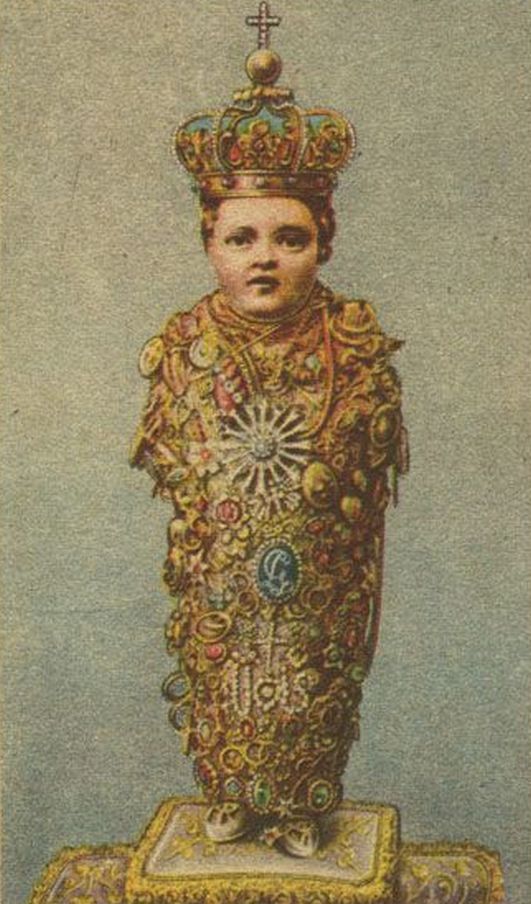
The Church of Santa Maria di Ara Coeli on the Capitoline Hill
in Rome is built on the ruins of ruins of a temple to Juno Moneta, on
the steps of which the Roman Senate used to meet (and where, by the
way, Roman coins used to be minted, hence our word "money"). According
to legend, the earliest extant text of which derives from the late 4th
century, Emperor Augustus, consulted the Tiburtine Sibyl -- the sibyl who prophecied from the town
of Tibur (the modern town of Tivoli) -- after he learned he was to be
honored as a god. The Sibyl prophesied that "the King of the Ages"
would soon come, and as she did, the Emperor had a vision of the Virgin
standing on an altar, surrounded by a bright halo and holding the
Infant. A voice said: "This is the altar of the Son of God." An altar
to this future King was raised on the pagan site and became known as
the "Altar of Heaven" (Ara Coeli). And of course, Our Lord was born
during Augustus's reign.
In the 6th century, a church was built over the site. Over the ages, it
was enlarged, first housing Byzantine monks, then the Benedictines, and
then the Franciscans, who still tend the place today.
Inside this church is housed a statue of the Baby Jesus carved in the
15th century by a Franciscan friar in Jerusalem, from an olive wood
tree that is said to have grown in the Garden of Gethsemani. It is said
that the friar ran out of paint when he was making it, and so angels
came and finished it while he slept. It is also said that when it was
being transported from the Holy Land to Rome, it fell overboard when
the ship that was carrying it was caught in a storm -- only to wash up
on the shores of Livorno, at the feet of the Franciscan who was
awaiting its arrival.
Down through the centuries, the statue became associated with many
miraculous cures, and it was often carried to the bedsides of those who
were sick or dying (this used to be effected by transporting the image
in a golden carriage dedicated by the people of Rome just for this
purpose; now a less ornate carriage is used). Letters and prayer
requests are sent from all over the world to the church of Santa Maria
di Ara Coeli to be placed near the statue as a sign of prayer.
The statue is kept in the sacristy (a copy sits in a private chapel on
the premises), but on Christmas Eve, it is brought out and unveiled at
the sound of the Gloria, processed to a nativity scene, placed in
Mary's lap, and kept there until the Feast of the Epiphany (6 January).
On that day, the statue is taken to the top of the staircase outside
the church so that Romans might blow it kisses as the zampognari and
pifferai (bagpipers and flautists) play, and then returned to its
private chapel. Nowadays, all of these purposes are served by use of a
second copy, as the original was stolen in February of 1994.
Prayer to the
Santo Bambino
Divine Bambino,
In my difficulties: help me
From the enemies of my soul: save me
In my errors: enlighten me
In my doubts and pains: comfort me
In my solitudes: be with me
In my infirmities: invigorate me
When others despise me: encourage me
In temptations: defend me
In difficult hours: strengthen me
With your Sacred Heart: love me
With your immense power: protect me
And, into your arms,
when I die: receive me.
Amen
A Corollary Devotion:
Maria Bambina
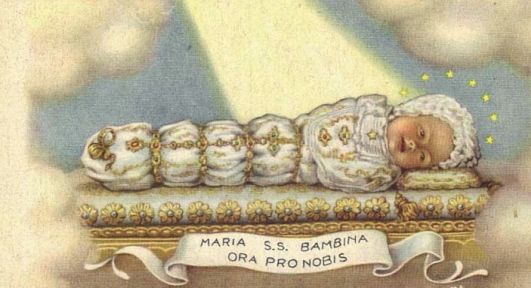
As Jesus is adored in His Divine Childhood, Mary is venerated
in her childhood. The contemplation of the infancy of the woman chosen
by God at the beginning of time (Genesis 3:15) to bring forth the
Savior is an ancient practice; the Church even celebrates her nativity
on 8 September -- one of only three birthdays so honored, the other two
being those of Jesus and His Precursor (St. John the Baptist). All of
these were born without the stain of original sin -- with St. John
having been filled with the Holy Ghost while in his mother's womb (Luke
1:13-17, 44) -- though only Jesus and Mary were conceived filled
with grace.
Most of what we know of Our Lady's childhood is known through
apocryphal sources: the Gospel of the
Nativity of Mary, translated from the Hebrew by St. Jerome (A.D.
340-420) from a manuscript whose date and origin is unknown to us, and
the Protoevangelium of St. James,
written around A.D. 125. From these works, we learn of her parents, SS.
Anne (Feast: 26 July) and Joachim (Feast: 16 August), and it is with
them, especially with her mother, that the young Mary is usually
depicted. We learn, too, of Mary's miraculous conception, her having
been dedicated to the Temple, etc., and the ancients knowing these
stories, too, built churches in honor of Mary and her parents very
early on in Jerusalem.
In A.D. 1007, in the city of Milan, the chuch "Santa Maria Fulcorina"
was dedicated
to the "Mystery of the Nativity of Mary" and eventually became the
cathedral church of Milan. The present-day cathedral was built, and was
later consecrated by St. Charles Borromeo in A.D.
1572 and dedicated to "Mariae Nascenti" -- "The Nativity of Mary." This
city, then, became one of the centers of devotion to the Child Mary.
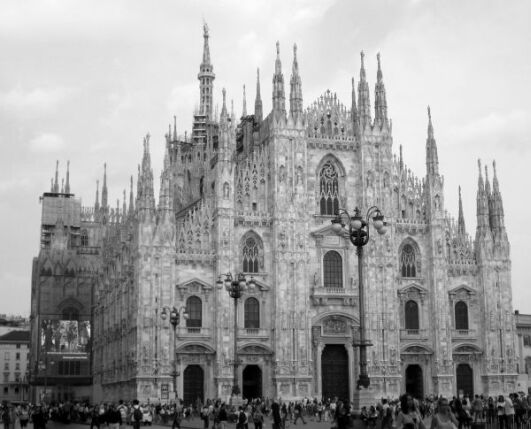
Cattedrale di Santa Maria Nascente, Milano, Italy
One hundred and sixty-three years later, a wax image of Mary as a baby
("Maria Bambina") was made by Sister Isabella Chiara Fornari, superior
of the Poor Clares in Todi, Italy. It was taken to Milan, ended up in
the hands of the Capuchin Sisters there, and was passed down through
their Order until it was given to a priest who then gave it, in A.D.
1876, to the Milanese Motherhouse of the Sisters of Charity, in whose
hands it remains today. As time passed, the image of Maria Bambina
image became rather decrepit and discolored. It's "skin" took on a
grayed yellow cast, so it was kept out of sight only to be brought out
on the Feast of Mary's Nativity. Then, on that Feast in 1884, Sister
Josephine Woinovich, suffering horrible pain and bedridden due to
paralysis in her feet and arms, asked that the image be brought to her
bedside so she could better pray to Mary for her intercession. Her wish
was granted, and her request inspired the Mother General to take Maria
Bambina around to the other sick sisters. One of these sisters was
miraculously cured, and two more sisters were cured in the next few
months.
In January of the next year, the image itself was "healed" in a sense;
without human help, the yellow-gray cast of the "skin" was replaced by
the natural hues of flesh that remain today. Devotion to Mary spread
through these miracles, and on 31 May, 1904 the image was solemnly
coronated by Cardinal Ferrari. Couples began to venerate the image when
they were trying to conceive a child, and it became a custom to give
newlyweds a small wax image of Maria Bambina on their wedding day. You
can see Maria Bambina at the Motherhouse of the Sisters of Charity, Via
Santa Sofia 13, Milan, Italy.
Prayer to
Maria Bambina
Hail, Infant Mary, full of grace, the Lord is with thee, blessed art
thou forever, and blessed are thy holy parents Joachim and Anne, of
whom thou wast miraculously born. Mother of God, intercede for us.
We fly to thy patronage, holy and amiable Child Mary, despise not our
prayers in our necessities, but deliver us from all dangers, glorious
and blessed Virgin.
V. Pray for us, holy Child Mary.
R. That we may be made worthy of the promises of Christ.
Let us Pray: O almighty and merciful God, Who through the cooperation
of the Holy Ghost, didst prepare the body and soul of the Immaculate
Infant Mary that she might be the worthy Mother of Thy Son, and didst
preserve her from all stain, grant that we who venerate with all our
hearts her most holy childhood, may be freed, through her merits and
intercession, from all uncleanness of mind and body, and be able to
imitate her perfect humility, obedience and charity. Through Christ Our
Lord. Amen.
|