|
Numbers 6:24-26
"The Lord bless thee, and keep thee. The Lord shew His Face to thee,
and have mercy on thee. The Lord turn His Countenance to thee, and give
thee peace."
Psalm 26:8 "My heart hath said to thee: My face hath sought Thee: Thy
Face, O Lord, will I still seek."
I Corinthians 13:12 "We see now through a glass in a dark manner; but
then face to Face. Now I know I part; but then I shall know even as I
am known."
Devotion to the Holy Face is like the Devotions to Christ's Childhood and Five
Wounds: it is another aspect of focusing on the Incarnation that
Latin Catholics love to contemplate, but an aspect that is especially
compelling because of the nature of the human face. When we think of
someone we love, we think of that person's face because it is primarily
the face that identifies and expresses who that person is. Indeed, the
very word "person" is rooted in the Latin word for "mask." We can look
at a friend and know instantly how he is feeling by his subtle
expression -- by the "lights" of his eyes and that ineffable way the
eyes act as a "window to the soul."
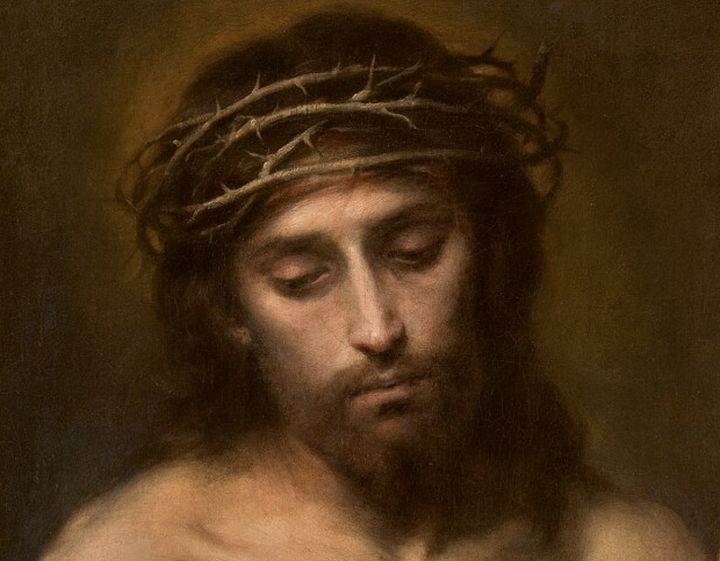
Now consider! Because of the Incarnation, there is God with a
human Face! The Divine Being with human eyes -- eyes into which human
beings could gaze, eyes that beheld things as beautiful as His mother,
and as ugly as soldiers' spittle. God with eyes that cried
(John 11:35). Meditating on the Holy Face is not simply to recall the
visage of some spiritual teacher who lived on earth 2,000 years ago; it
is to realize something so movingly true about the One Who created the
very Sun and Moon and stars: that He is a deeply personal Being, so
personal that He took on our nature and walked among us, looking at us
through human eyes, and letting Himself be seen.
John 14:5-9
Thomas saith to him: Lord, we know not whither Thou goest; and how can
we know the way? Jesus saith to him: I am the way, and the truth, and
the life. No man cometh to the Father, but by Me. If you had known Me,
you would without doubt have known My Father also: and from henceforth
you shall know Him, and you have seen Him. Philip saith to Him: Lord,
shew us the Father, and it is enough for us. Jesus saith to him: Have I
been so long a time with you; and have you not known me? Philip, he
that seeth Me seeth the Father also.
So this
is what the Father is like! Alleluia! God isn't some far-away, coldly
intellectual "source"; He is Father, and we see Him through the human
Face of His Son Who wept at the ugliness of St. Lazarus's death, Who
healed the sick, Who allowed Himself to be beaten for our iniquities.
We aren't evolved monkey-flesh that suffers needlessly and without
meaning; we are creatures deeply loved by a personal God, called to
partake of the Divine Nature! The very fact that God took on a human
Face is a rich Mystery, and behind that adorable Countenace is the
eternal Mystery of God Himself.
Devotion to the Holy Face isn't only a matter of marvelling at these
Truths, however; in another sense, it is to "become St. Veronica "--
the woman we recall at the sixth Station of
the Cross, the one who took pity on Him and wiped the sweat from
His Face with her veil which bears the impession of His Holy Face to
this day. It is to do as she did and comfort Jesus for the wounds the
world still inflicts on Him with its irreverence, sacrilege, and
blasphemy -- especially by doing that which pleases Him most: bringing
souls to Him.
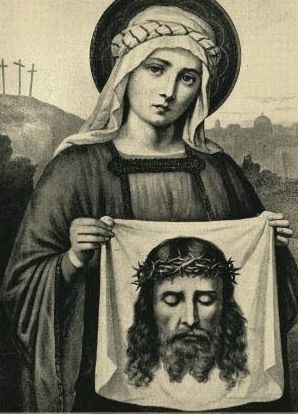
St.
Veronica holding her veil
There has been devotion to the Holy Face ever since Our Lord walked the
earth. His mother looking down into the manger and seeing the Face of a
beautiful Boy, the eyes of St. Mary Magdalen as she looked up at Him
with love after anointing His Feet with perfume, the already mentioned
St. Veronica whose veil, along with the Holy
Shroud, is the basis for our depictions of Christ in the icons upon
which we've gazed for two millennia -- all who saw Him and knew Who He
was carried the image of His Holy Face with them in their hearts. But
throughout Catholic History, there have been those who've done more
than others to popularize the devotion in an explicit way.

Mid-19th Century:
Sister Mary of Saint Peter
and the Venerable Leo Dupont
In the mid-19th
century, in Tours, France, a Carmelite nun named Sister Marie de Saint
Pierre (1816-1848) received a private revelation from Our Lord that
"Those who will contemplate the wounds on My Face here on earth, shall
contemplate it radiant in heaven." In her vision, she was transported
to the road to Calvary and saw St. Veronica wiping away the spit and
mud from His Holy Face with her veil. Sister realized that the taking
of the Name of God in vain and all the other sacrilegious and
blasphemous acts that men do fall on the Lord's Face like that spit and
mud that St. Veronica so lovingly wiped away. Jesus revealed to Sister
that He desired devotion to His Holy Face in reparation for sacrilege,
the profanation of Sundays, and blasphemy, which He described to her as
being like a "poisoned arrow." To her He dictated the prayer which has
become known as "The Golden Arrow" and which honors His Holy Name:
The Golden
Arrow
May the most Holy, most Sacred, most Adorable, Most Incomprehensible
and Ineffable Name of God Be always Praised, Blessed, Loved, Adored and
Glorified, In Heaven, on Earth and under the Earth, By all the
Creatures of God, And by the Sacred Heart of Our Lord Jesus Christ, In
the most Holy Sacrament of the Altar. Amen.
Another practice
which comes down to us from Sr. Mary of Saint Peter is the wearing of
the "Little Sachet," also called the "Gospel of the Holy Name of
Jesus." The Little Sachet is a flat, scapular-sized, scapular-shaped
cloth pouch inside of which is a folded piece of paper on which are
inscribed:
- the words of the
"Gospel of the Circumcision" -- i.e., the words of Luke 2:21: "And
after eight days were accomplished, that the child should be
circumcised, His name was called JESUS, which was called by the angel,
before He was conceived in the womb." The Latin version: "Et postquam
consummati sunt dies octo, ut circumcideretur puer, vocatum est nomen
ejus Jesus, quod vocatum est ab angelo priusquam in utero conciperetur."
- Christ's
monogram: "IHS"
- a picture of the
Infant Christ
- the words: "When
Jesus was named, Satan was disarmed." The Latin version: "Nomine Iesus
dato vincitur diabolus et armis spoliatur".
The purpose of
this devotion is to remind us of the honor due to the Name of Jesus.
It's encouraged that Catholics pray "Blessed be the Most Holy Name of
Jesus without end" while wearing it. A graphic you can use to make the
piece of paper to place inside your own Little Sachet (click to
enlarge). Print as small as possible while ensuring it's still legible,
fold in half, then in half again, and then into thirds, and place
inside a small cloth pouch (one which lies flat) which you can decorate
as you wish:

You can read
about the life of and revelations given to Sr. Mary of St. Peter by
reading "The Message of Sr. Mary of St. Peter" in this site's Catholic Library.
Now, at around the
time Sister was receiving her visions, into Tours from Martinique moved
the saintly Monsieur Leo Dupont (1797-1876), a man whose young wife had
died and whose daughter God also took in this interesting way: she'd
begun moving about in "fashionable circles" and taking on a worldly air
that caused M. Dupont to worry about her eternal welfare, so much so
that he prayed, "My God, if You foresee that my daughter will part from
You, I ask you to take her with You so that she will not be separated
from You." His daughter soon died of typhoid. Though tormented by his
temporal loss, he kept his faith in God and nurtured it.
He soon heard of Sr. Mary of St. Peter's efforts to spread devotion to
the Holy Face and, inspired by the Holy Ghost through her example,
decided to dedicate his life to this work. He kept an oil lamp burning
continuously before an image of the Holy Face, and his home became a
center of pilgrimage when people began to gather to pray before the
image, with many receiving miraculous cures through the application of
his lamp's oil to their skin. He went on to establish the
Archconfraternity of the Holy Face, and was later recognized by the
Church as a "Venerable." He is now known familiarly as "The Holy Man of
Tours."
Late 19th Century:
St. Therese of the
Child Jesus and of the Holy Face
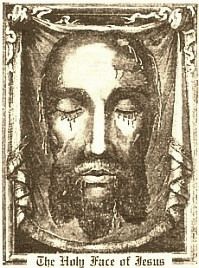 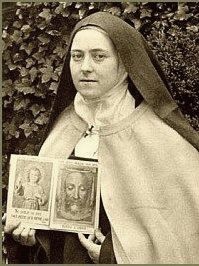
About the picture she venerated -- a picture based on the image of
St. Veronica's Veil -- St. Therese said, "How well Our Lord did to
lower His eyes when He gave us His portrait! Since the eyes are the
mirror of the soul, if we had seen His soul, we would have died from
joy."
In yet another sense, devotion to the Holy Face inspires us
to know how to imitate Him best, teaches us how to "put on Christ."
What did people see when they saw Our Blessed Lord? The Prophet Isaias
tells us:
Isaias 52:14,
53:2-3
As many have been astonished at thee, so shall His Visage be inglorious
among men, and His form among the sons of men... And He shall grow up
as a tender plant before Him, and as a root out of a thirsty ground:
there is no beauty in Him, nor comeliness: and we have seen Him, and
there was no sightliness, that we should be desirous of him: Despised,
and the most abject of men, a man of sorrows, and acquainted with
infirmity: and His look was as it were hidden and despised, whereupon
we esteemed Him not.
It is this sense
of the Holy Face devotion -- meditating on the despised, suffering
Countenance that hid His Divinity from those who had no eyes to see --
that inspired the spirituality of St. Therese of Lisieux, "The
Little
Flower" whose religious name was "St. Therese of the Child Jesus and of the Holy Face."
Contemplating His "hiddenness" and the Mystery of His having humbled
Himself as He did by becoming a Child and by suffering for us is the
source of St. Therese's "Little Way" -- her method of spiritual
discipline that teaches us we don't need to be great in the world's
terms in order to become a Saint. No matter where we are, no matter our
talents or intellect, we can love. Hidden away herself, in her Norman
convent, she wrote of the Prophet's words
These words of
Isaias: "He was without splendor, without beauty, His Face was hidden,
as it were, and His person was not acknowledged”; one finds in them the
whole foundation of my devotion to the Holy Face, or to say it better,
the foundation of all my piety. I also desire myself to be without
splendor, without beauty, to tread alone the wine in the press, unknown
by every creature.
And later:
Jesus set the
book of nature before me and I saw that all the flowers He has created
are lovely. The splendor of the rose and the whiteness of the lily do
not rob the little violet of its scent nor the daisy of its simple
charm. I realized that if every tiny flower wanted to be a rose, spring
would lose its loveliness and there would be no wildflowers to make the
meadows gay.
It is just the same in the world of souls -- which is the garden of
Jesus. He has created the great saints who are like the lilies and the
roses, but He has also created much lesser saints and they must be
content to be the daisies or the violets which rejoice his eyes
whenever He glances down. Perfection consists in doing His will, in
being that which He wants us to be.
St. Therese did
no one particular thing that one would point at and say, "See? Clearly
she is a great Saint!" Her greatness was not in what she did so
much as how she did it: with humility, with acceptance of
suffering, and all for the love of Christ. She died of tuberculosis at
the age of 24, telling a Sister a few months before her death that she
would spend her Heaven doing good upon the earth, and that it will be
like "a shower of roses." She left behind her autobiography ("Story of
a Soul") -- which you can read
in this site's Catholic Library -- and poetry and prayers,
among which are her Canticle and
Prayer to the Holy Face:
Canticle to
the Holy Face
12 August 1895
Jesus, Your ineffable image
Is the star which guides my steps.
Ah, You know, Your sweet Face
Is for me Heaven on earth.
My love discovers the charms
Of Your Face adorned with tears.
I smile through my own tears
When I contemplate Your sorrows.
Oh! To console You I want
To live unknown on earth!
Your beauty, which You know how to veil,
Discloses for me all its mystery.
I would like to fly away to You!
Your Face is my only homeland.
It's my Kingdom of love.
It's my cheerful meadow.
Each day, my sweet sun.
It's the Lily of the Valley
Whose mysterious perfume
Consoles my exiled soul,
Making it taste the peace of Heaven.
It's my Rest, my Sweetness
And my melodious Lyre
Your Face, O my Sweet Savior,
Is the Divine Bouquet of Myrrh
I want to keep on my heart!
Your Face is my only wealth.
I ask for nothing more.
Hiding myself in it unceasingly,
I will resemble You, Jesus
Leave in me, the Divine Impress
Of Your features filled with sweetness,
And soon I'll become holy.
I shall draw hearts to You.
So that I may gather
A beautiful golden harvest,
Deign to set me aflame with Your Fire.
With Your adorned mouth,
Give me soon the Eternal Kiss!
St. Therese's Prayer to the Holy face
O Jesus, Who in Thy bitter Passion didst become "the most abject of
men, a man of sorrows," I venerate Thy Sacred Face whereon there once
did shine the beauty and sweetness of the Godhead ... but now it has
become for me as if it were the Face of a leper! Nevertheless, under
those disfigured features, I recognize Thy Infinite Love and I am
consumed with the desire to love Thee and make Thee loved by all men.
The tears which well up abundantly in Thy Sacred Eyes appear to me as
so many precious pearls that I love to gather up, in order to purchase
the souls of poor sinners by means of their infinite value. O Jesus,
Whose adorable Face ravished my heart, I implore Thee to fix deep
within me Thy Divine Image and to set me on fire with Thy Love, that I
may be found worthy to come to the contemplation of Thy glorious Face
in Heaven. Amen.
Early 20th Century:
Sister Maria Pierina De Micheli
Sister Maria
Pierina was inspired through visions of Our Lord and Lady to take up
the work of spreading devotion to the Holy Face. Lord Christ told her,
"I will that My Face, which reflects the intimate pains of my Spirit,
the suffering and the love of My Heart, be more honoured. He who
meditates upon Me, consoles Me."
An image of a scapular bearing the
likeness of the Face on the Holy Shroud was revealed to her by Our
Lady, who told her, "This Scapular is an armour of defense, a shield of
strength, a token of the love and mercy which Jesus wishes to give the
world in these times of lust and hatred against God and His Church.
Diabolical nets are thrown to wrench the Faith from hearts, evils
abound, true apostles are few, and the remedy is the Holy Face of
Jesus." Our Lady said that all those who piously wear the image, make a
visit to the Blessed Sacrament every Tuesday, if possible, to make
reparation for the assaults against the Holy Face, and receive the Holy
Eucharist every day will have a happy death under the loving gaze of
her Son.
Sister Pierina set about to cast the image in the form of a medal, and
after some struggle in gaining permission, found she had no money to
have the medals cast. This last problem was remedied apparently
miraculously: she found an envelope with the exact sum of
money needed on her desk, seemingly from nowhere. After the medals were
cast, the Evil One made known his displeasure. How could he not despise
an image of the image left behind when Jesus walked away from His
burial shroud? Enraged, Evil Spirit flung the medals around the room,
and physically assaulted Sister Pierina. But he was defeated, and the
practice of wearing the medals spread all over the world.
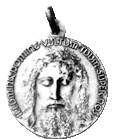
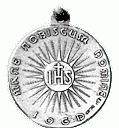
The obverse side of the medal bears the image of the Holy Face, as
revealed by the Shroud of Turin. Surrounding it are the words of Psalm
66:2, "Illumina Domine Vultum Tuum super nos" ("Shew the light of Thy
countenance, O Lord, upon us."). On the back of the medal is a Sacred
Host inscribed with the monogram of the Holy
Name ("IHS"), surrounded by rays and the words, "Mane nobiscum
Domine" ("Stay with us, O Lord").
Sister Pierina
died in 1945, a few years after having written in her diary, "I feel a
deep longing to live always united to Jesus, to love Him intensely
because my death can only be a transport of love with my Spouse,
Jesus."
The Human Face of Lord Christ
For your
adoration, I provide you with a series of
pictures of the Shroud of Turin:
the Shroud as it appears to the naked eye, the Shroud as it appears in
photgraphic negative, and an exquisite painting of Christ based closely
on the Shroud's image and painted by the Armenian artist, Ariel
Agemian. I position these pictures so you can see them side by side,
and then present the painting, englarged, so you can "look into the
eyes of Christ."
Beneath these pictures are the Shroud image and the Agemian painting on
either side of an image of what the 12-year old Christ may have looked
like as determined by the Italian police whose artists, in A.D. 2004,
took the image of the Shroud and subtracted 20 years with methods used
in police investigations.
And I must present for you a very interesting image -- an engraving
called "The Sudarium of Saint Veronica" -- based on Veronica's Veil. It
was made by Claude Mellan in 1649 and was engraved using a single line
starting at the center of the picture. Click the image below to
greatly enlarge:

In all of these images, you will see that, despite the Prophet's words
that "there is no beauty in Him, nor comeliness," there is great beauty
and comeliness indeed in the sweet and Holy Face of our Savior!
See also the Novena to the Holy Face.
|