``Where the
Bishop is, there let the multitude of believers be;
even as where Jesus is, there is the Catholic Church'' Ignatius of
Antioch, 1st c. A.D
The
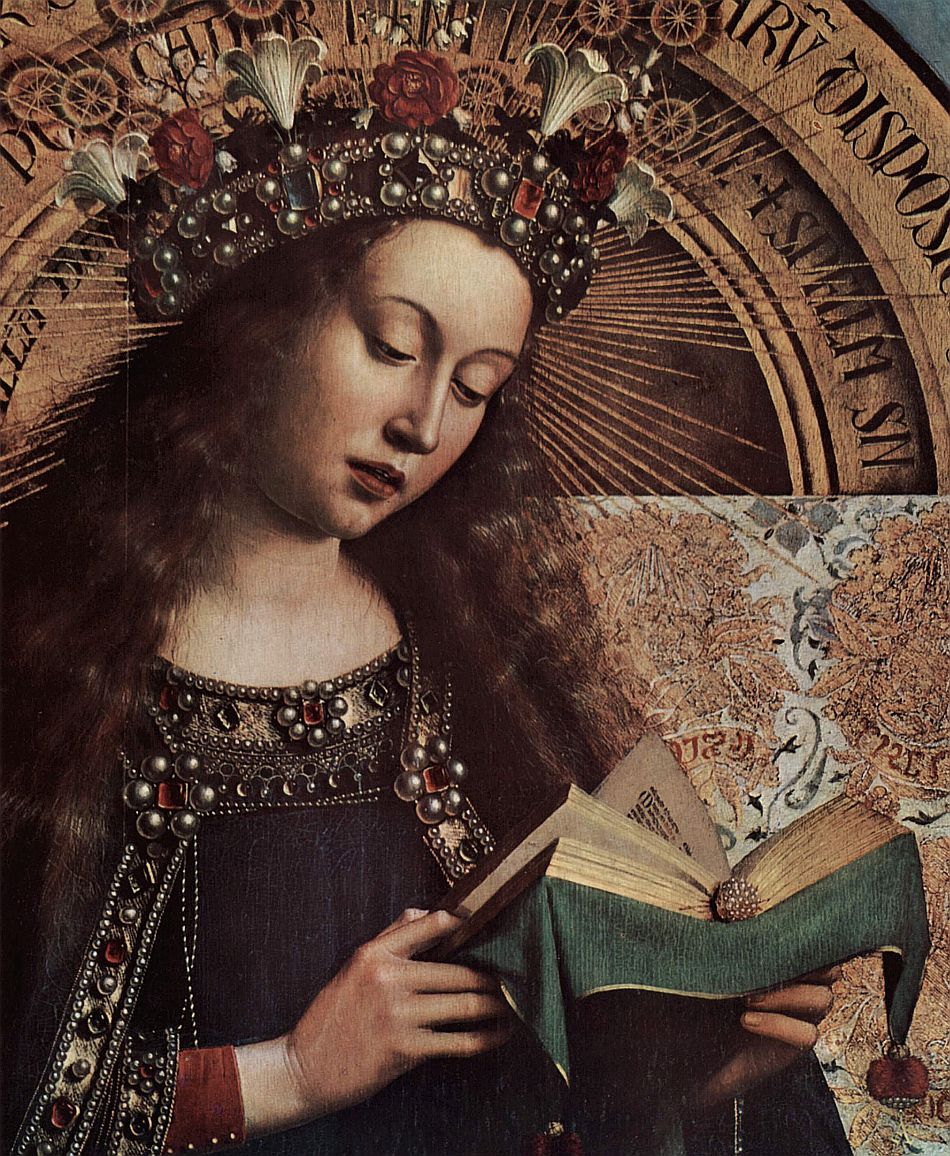
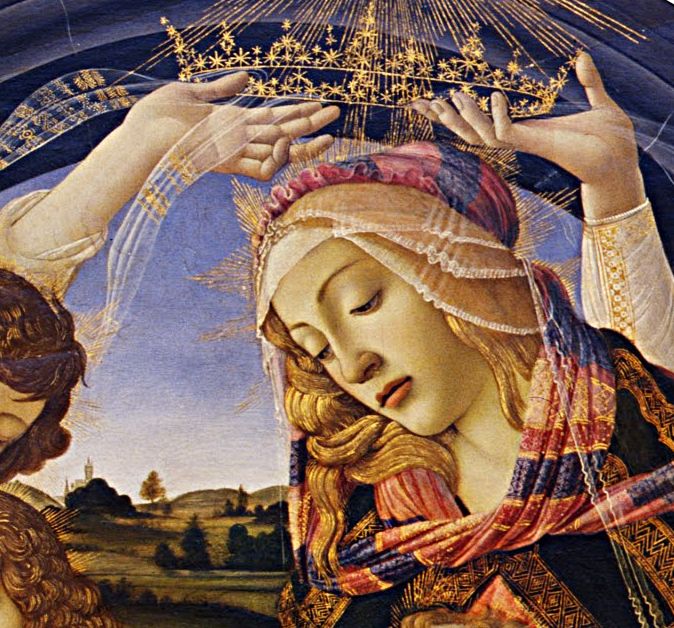
Queenship of Mary
The Feast of the Queenship of Mary 1 ends the month of May -- a month devoted to Our
Lady and which began with the crowning
of her images. This Feast honors the fact that God has restored the
Davidic Kingdom, with Jesus as the Christ (Anointed One) -- and Jesus's
Mother -- Our Mother -- as its Queen Mother. The King of Kings requires
a Queen, and in Israel, it is the King's Mother who sits on the
throne and exerts power as "The Great Lady" ("gebirah" or "gevirah," as
this position is known in Hebrew). Just as Bethsabee (Bathsheba), the
mother of King Solomon, acted as intercessor for the people of Israel,
Our Lady acts as intercessor for us with the King of Kings:
III Kings
2:19-20
Then Bethsabee came to king Solomon, to speak to him for Adonias: and
the king arose to meet her, and bowed to her, and sat down upon his
throne: and a throne was set for the king's mother, and she sat on his
right hand. And she said to him: I desire one small petition of thee,
do not put me to confusion. And the king said to her: My mother, ask:
for I must not turn away thy face.
Psalm 44, which
prophesied Our Lord, speaks of the Queen at His right hand, one whose
name will be remembered "throughout all generations":
Unto the end,
for them that shall be changed, for the sons of Core, for
understanding. A canticle for the Beloved. My heart hath uttered a good
word I speak my works to the king; My tongue is the pen of a scrivener
that writeth swiftly. Thou art beautiful above the sons of men: grace
is poured abroad in thy lips; therefore hath God blessed thee for ever.
Gird thy sword upon thy thigh, O thou most mighty. With thy comeliness
and thy beauty set out, proceed prosperously, and reign. Because of
truth and meekness and justice: and thy right hand shall conduct thee
wonderfully. Thy arrows are sharp: under thee shall people fall, into
the hearts of the king's enemies. Thy throne, O God, is for ever and
ever: the sceptre of thy kingdom is a sceptre of uprightness. Thou hast
loved justice, and hated iniquity: therefore God, thy God, hath
anointed thee with the oil of gladness above thy fellows. Myrrh and
stacte and cassia perfume thy garments, from the ivory houses: out of
which the daughters of kings have delighted thee in thy glory.
The queen stood on thy right hand, in gilded clothing; surrounded with
variety. Hearken, O daughter, and see, and incline thy ear: and forget
thy people and thy father's house. And the king shall greatly desire
thy beauty; for he is the Lord thy God, and him they shall adore. And
the daughters of Tyre with gifts, yea, all the rich among the people,
shall entreat thy countenance. All the glory of the king's daughter is
within in golden borders, Clothed round about with varieties. After her
shall virgins be brought to the king: her neighbours shall be brought
to thee. They shall be brought with gladness and rejoicing: they shall
be brought into the temple of the king. Instead of thy fathers, sons
are born to thee: thou shalt make them princes over all the earth. They
shall remember thy name throughout all generations. Therefore shall
people praise thee for ever; yea, for ever and ever.
Luke 1:46-48
And Mary said: My soul doth magnify the Lord. And my spirit hath
rejoiced in God my Saviour. Because he hath regarded the humility of
his handmaid; for behold from henceforth all generations shall call
me blessed.
St. John's
Apocalypse reveals that he saw Our Lady crowned with stars, one for
each of the twelve tribes and the twelve Apostles. St. John saw her as
Queen in Heaven, the mother of the one who was to "rule all nations":
Apocalypse 12:1-5
And a great sign appeared in heaven: A woman clothed with the sun, and
the moon under her feet, and on her head a crown of twelve stars: And
being with child, she cried travailing in birth, and was in pain to be
delivered. And there was seen another sign in heaven: and behold a
great red dragon, having seven heads, and ten horns: and on his head
seven diadems: And his tail drew the third part of the stars of heaven,
and cast them to the earth: and the dragon stood before the woman who
was ready to be delivered; that, when she should be delivered, he might
devour her son. And she brought forth a man child, who was to rule all
nations with an iron rod: and her son was taken up to God, and to his
throne.
Customs
Call on Our
Queen to intercede for you with her Divine Son! If you want
to pray something different, this 8th century Irish Litany of the Virgin might be
good to pray today. But the Salve Regina (Hail
Holy Queen) prayer is the classic prayer for this feast, which I
present below as chanted by Rebecca Gorzynska, whom you can follow on
Youtube:
Hail holy Queen,
mother of mercy, our life, our sweetness, and our hope. To thee do we
cry, poor banished children of Eve. To thee do we send up our sighs,
mourning and weeping in this valley of tears. Turn then, most gracious
Advocate, thine eyes of mercy toward us. And after this our exile show
unto us the blessed Fruit of thy womb, Jesus. O clement, O loving, O
sweet Virgin Mary. Amen.
Latin Version:
Salve, Regina, mater misericordiae: vita, dulcedo, et spes nostra,
salve. Ad te clamamus exsules filii Hevae. Ad te suspiramus, gementes
et flentes in hac lacrimarum valle. Eia, ergo, advocata nostra, illos
tuos misericordes oculos ad nos converte. Et Iesum, benedictum fructum
ventris tui, nobis post hoc exsilium ostende. O clemens, O pia, O
dulcis Virgo Maria. Amen.
Many composers
have treated the Salve Regina musically, among them Vivaldi. Enjoy one
of his works devoted to our Holy Queen:
Or perhaps Handel's version in GMinor (HWV 241) is more to
your taste:
Or maybe you'd prefer Nicola Porpora's Salve Regina:
Sermon I on
the Dormition
By St. John Damascene (b. A.D. 676)
The memory of
the just takes place with rejoicing, said Solomon, the wisest of men;
for precious in God's sight is the death of His saints, according to
the royal David. If, then, the memory of all the just is a subject of
rejoicing, who will not offer praise to justice in its source, and
holiness in its treasure-house? It is not mere praise; it is praising
with the intention of gaining eternal glory. God's dwelling-place does
not need our praise, that city of God, concerning which great things
were spoken, as holy. David addresses it in these words: "Glorious
things are said of thee, thou city of God." What sort of city shall we
choose for the invisible and uncircumscribed God, who holds all things
in His hand, if not that city which alone is above nature, giving
shelter without circumscription to the supersubstantial Word of God?
Glorious things have been spoken of that city by God himself. For what
is more exalted than being made the recipient of God's counsel, which
is from all eternity?
Neither human tongue nor angelic mind is able worthily to praise her
through whom it is given to us to look clearly upon the Lord's glory.
What then? Shall we be silent through fear of our insufficiency?
Certainly not. Shall we be trespassers beyond our own boundaries, and
freely handle ineffable mysteries, putting off all restraint? By no
means. Mingling, rather, fear with desire, and weaving them into one
crown, with reverent hand and longing soul, let us show forth the poor
first-fruits of our intelligence in gratitude to our Queen and Mother,
the benefactress of all creation as a repayment of our debt. A story is
told of some rustics who were ploughing up the soil when a king chanced
to pass, in the splendour of his royal robes and crown, and surrounded
by countless gift bearers, standing in a circle. As there was no gift
to offer at that moment, one of them was collecting water in his hands,
as there happened to be a copious stream near by. Of this he prepared a
gift for the king, who addressed him in these words: "What is this, my
boy?" And he answered boldly: "I made the best of what I had, thinking
it was better to show my willingness, than to offer nothing. You do not
need our gifts, nor do you wish for anything from us save our good
will. The need is on our side, and the reward is in the doing. I know
that glory often comes to the grateful."
The king in wonder praised the boy's cleverness, graciously
acknowledged his willingness, and made him many rich gifts in return.
Now, if that proud monarch so generously rewarded good intentions, will
not Our Lady, the Mother of God, accept our good will, not judging us
by what we accomplish? Our Lady is the Mother of God, who alone is good
and infinite in His condescension, who preferred the two mites to many
splendid gifts. She will indeed receive us, who are paying off our
debt, and make us a return out of all proportion to what we offer.
Since prayer is absolutely necessary for our needs, let us direct our
attention to it.
What shall we say, O Queen? What words shall we use? What praise shall
we pour upon thy sacred and glorified head, thou giver of good gifts
and of riches, the pride of the human race, the glory of all creation,
through whom it is truly blessed. He whom nature did not contain in the
beginning, was born of thee. The Invisible One is contemplated face to
face. O Word of God, do Thou open my slow lips, and give their
utterances Thy richest blessing; inflame us with the grace of Thy
Spirit, through whom fishermen became orators, and ignorant men spoke
supernatural wisdom, so that our feeble voices may contribute to thy
loved Mother's praises, even though greatness should be extolled by
misery. She, the chosen one of an ancient race, by a predetermined
counsel and the good pleasure of God the Father, who had begotten Thee
in eternity immaterially, brought Thee forth in the latter times, Thou
who art propitiation and salvation, justice and redemption, life of
life, light of light, and true God of true God.
The birth of her, whose Child was marvellous, was above nature and
understanding, and it was salvation to the world; her death was
glorious, and truly a sacred feast. The Father predestined her, the
prophets foretold her through the Holy Ghost. His sanctifying power
overshadowed her, cleansed and made her holy, and, as it were,
predestined her. Then Thou, Word of the Father, not dwelling in place,
didst invite the lowliness of our nature to be united to the
immeasurable greatness of Thy inscrutable Godhead. Thou, who didst take
flesh of the Blessed Virgin, vivified by a reasoning soul, having first
abided in her undefiled and immaculate womb, creating Thyself, and
causing her to exist in Thee, didst become perfect man, not ceasing to
be perfect God, equal to Thy Father, but taking upon Thyself our
weakness through ineffable goodness. Through it Thou art one Christ,
one Lord, one Son of God, and man at the same time, perfect God and
perfect man, wholly God and wholly man, one Substance from two perfect
natures, the Godhead and the manhood. And in two perfect natures, the
divine and the human, God is not pure God, nor the man only man, but
the Son of God and the Incarnate God are one and the same God and man
without confusion or division, uniting in Himself substantially the
attributes of both natures. Thus, He is at once uncreated and created,
mortal and immortal, visible and invisible, in place and not in place.
He has a divine will and a human will, a divine action and a human
also, two powers of choosing divine and human. He shows forth divine
wonders and human affections -- natural, I mean, and pure. Thou hast
taken upon Thyself, Lord, of Thy great mercy, the state of Adam as he
was before the fall, body, soul, and mind, and all that they involve
physically, so as to give me a perfect salvation. It is true indeed
that what was not assumed was not healed. Having thus become the
mediator between God and man, Thou didst destroy enmity, and lead back
to Thy Father those who had deserted Him, wanderers to their home, and
those in darkness to the light. Thou didst bring pardon to the
contrite, and didst change mortality into immortality. Thou didst
deliver the world from the aberration of many gods, and didst make men
the children of God, partakers of Thy divine glory. Thou didst raise
the human race, which was condemned to bell, above all power and
majesty, and in Thy person it is seated on the King's eternal throne.
Who was the instrument of these infinite benefits exceeding all mind
and comprehension, if not the Mother ever Virgin who bore Thee?
Realise, Beloved in the Lord, the grace of to-day, and its wondrous
solemnity. Its mysteries are not terrible, nor do they inspire awe.
Blessed are they who have eyes to see. Blessed are they who see with
spiritual eyes. This night shines as the day. What countless angels
acclaim the death of the life-giving Mother! How the eloquence of
apostles blesses the departure of this body which was the receptacle of
God. How the Word of God, who deigned in His mercy to become her Son,
ministering with His divine hands to this immaculate and divine being,
as His mother, receives her holy soul. O wondrous Law-giver, fulfilling
the law which He bad Himself laid down, not being bound by it, for it
was He who enjoined children to show reverence to their parents.
"Honour thy father and thy mother," He says. The truth of this is
apparent to every one, calling to mind even dimly the words of holy
Scripture. If according to it the souls of the just are in the hands of
God, how much more is her soul in the hands of her Son and her God.
This is indisputable. Let us consider who she is and whence she came,
how she, the greatest and dearest of all God's gifts, was given to this
world. Let us examine what her life was, and the mysteries in which she
took part. Heathens in the use of funeral orations most carefully
brought forward anything which could be turned to praise of the
deceased, and at the same time encourage the living to virtue, drawing
generally upon fable and fiction, not having fact to go upon. How then,
shall we not deserve scorn if we bury in silence that which is most
true and sacred, and in very deed the source of praise and salvation to
all ? Shall we not receive the same punishment as the man who hid his
master's talent ? Let us adapt our subject to the needs of those who
listen, as food is suited to the body.
Joachim and Anne were the parents of Mary. Joachim kept as strict a
watch over his thoughts as a shepherd over his flock, having them
entirely under his control. For the Lord God led him as a sheep, and he
wanted for none of the best things. When I say best, let no one think I
mean what is commonly acceptable to the multitude, that upon which
greedy minds are fixed, the pleasures of life that can neither endure
nor make their possessors better, nor confer real strength. They follow
the downward course of human life and cease all in a moment, even if
they abounded before. Far be it from us to cherish these things, nor is
this the portion of those who fear God. But the good things which are a
matter of desire to those who possess true knowledge, delighting God,
and fruitful to their possessors, namely, virtues, bearing fruit in due
season, that is, in eternity, will reward with eternal life those who
have laboured worthily and have persevered in their acquisition as far
as possible. The labour goes before, eternal happiness follows. Joachim
ever shepherded his thoughts. In the place of pastures, dwelling by
contemplation on the words of sacred Scripture, made glad on the
restful waters of divine grace, withdrawn from foolishness, he walked
in the path of justice. And Anne, whose name means grace, was no less a
companion in her life than a wife, blessed with all good gifts, though
afflicted for a mystical reason with sterility. Grace in very truth
remained sterile, not being able to produce fruit in the souls of men.
Therefore, men declined from good and degenerated; there was not one of
understanding nor one who sought after God. Then His divine goodness,
taking pity on the work of His hands, and wishing to save it, put an
end to that mystical barrenness, that of holy Anne, I mean, and she
gave birth to a child, whose equal had never been created and never can
be. The end of barrenness proved clearly that the world's sterility
would cease and that the withered trunk would be crowned with vigorous
and mystical life.
Hence the Mother of our Lord is announced. An angel foretells her
birth. It was fitting that in this, too, she, who was to be the human
Mother of the one true and living God, should be marked out above every
one else. Then she was offered in God's holy temple, and remained
there, showing to all a great example of zeal and holiness, withdrawn
from frivolous society. When, however, she reached full age and the law
required that she should leave the temple, she was entrusted by the
priests to Joseph, her bridegroom, as the guardian of her virginity, a
steadfast observer of the law from his youth. Mary, the holy and
undefiled, went to Joseph, contenting herself with her household
matters, and knowing nothing beyond her four walls.
In the fulness of time, as the divine apostle says, the angel Gabriel
was sent to this true child of God, and saluted her in the words,
"Hail, full of grace, the Lord is with thee." Beautiful is the angel's
salutation to her who is greater than an angel. He is the bearer of joy
to the whole world. She was troubled at his words, not being used to
speak with men, for she had resolved to keep her virginity unsullied.
She pondered in herself what this greeting might be. Then the angel
said to her: "Fear not, Mary. Thou hast found grace before God." In
very deed, she who was worthy of grace had found it. She found grace
who had done the deeds of race, and had reaped its fulness. She found
grace who brought forth the source of grace, and was a rich harvest of
grace. She found an abyss of grace who kept undefiled her double
virginity, her virginal soul no less spotless than her body; hence her
perfect virginity. "Thou shalt bring forth a Son," he said, "and shalt
call His name Jesus" (Jesus is interpreted Saviour). "He shall save His
people from their sins." What did she, who is true wisdom, reply? She
does not imitate our first mother Eve, but rather improves upon her
incautiousness, and calling in nature to support her, thus answers the
angel: "How is this to be, since I know not man? What you say is
impossible, for it goes beyond the natural laws laid down by the
Creator. I will not be called a second Eve and disobey the will of my
God. If you are not speaking godless things, explain the mystery by
saying how it is to be accomplished." Then the messenger of truth
answered her: "The Holy Spirit shall come to thee, and the power of the
Most High shall overshadow thee. Therefore He who is born to thee shall
be called the Son of God." That which is foretold is not subservient to
the laws of nature. For God, the Creator of nature, can alter its laws.
And she, listening in holy reverence to that sacred name, which she had
ever desired, signified her obedience in words full of humility and
joy: "Behold the handmaid of the Lord. Be it done unto me according to
thy word."
"O the depth of the riches, of the wisdom, and of the knowledge of
God," I will exclaim in the apostle's words. "How incomprehensible are
His judgments, and how unsearchable His ways." O inexhaustible goodness
of God! O boundless goodness! He who called what was not into being,
and filled heaven and earth, whose throne is heaven, and whose
footstool is the earth, a spacious dwelling-place, made the womb of His
own servant, and in it the mystery of mysteries is accomplished. Being
God He becomes man, and is marvellously brought forth without detriment
to the virginity of His Mother. And He is lifted up as a baby in
earthly arms, who is the brightness of eternal glory, the form of the
Father's substance, by the word of whose mouth all created things
exist. O truly divine wonder! O mystery transcending all nature and
understanding! O marvellous virginity! What, O holy Mother and Virgin,
is this great mystery accomplished in thee? Blessed art thou amongst
women, and blessed is the fruit of thy womb. Thou art blessed from
generation to generation, thou who alone art worthy of being blessed.
Behold all generations shall call thee blessed as thou hast said. The
daughters of Jerusalem, I mean, of the Church, saw thee. Queens have
blessed thee, that is, the spirits of the just, and they shall praise
thee for ever. Thou art the royal throne which angels surround, seeing
upon it their very King and Lord. Thou art a spiritual Eden, holier and
diviner than Eden of old. That Eden was the abode of the mortal Adam,
whilst the Lord came from heaven to dwell in thee. The ark foreshadowed
thee who hast kept the seed of the new world. Thou didst bring forth
Christ, the salvation of the world, who destroyed sin and its angry
waves. The burning bush was a figure of thee, and the tablets of the
law, and the ark of the testament. The golden urn and candelabra, the
table and the flowering rod of Aaron were significant types of thee.
From thee arose the splendour of the Godhead, the eternal Word of the
Father, the most sweet and heavenly Manna, the sacred Name above every
name, the Light which was from the beginning. The heavenly Bread of
Life, the Fruit without seed, took flesh of thee. Did not that flame
foreshadow thee with its burning fire an image of the divine fire
within thee? And Abraham's tent most clearly pointed to thee. By the
Word of God dwelling in thee human nature produced the bread made of
ashes, its first fruits, from thy most pure womb, the first fruits
kneaded into bread and cooked by divine fire, becoming His divine
person, and His true substance of a living body quickened by a
reasoning and intelligent soul. I had nearly forgotten Jacob's ladder.
Is it not evident to every one that it prefigured thee, and is not the
type easily recognised? just as Jacob saw the ladder bringing together
heaven and earth, and on it angels coming down and going up, and the
truly strong and invulnerable God wrestling mystically with himself, so
art thou placed between us, and art become the ladder of God's
intercourse with us, of Him who took upon Himself our weakness, uniting
us to Himself, and enabling man to see God. Thou hast brought together
what was parted. Hence angels descended to Him, ministering to Him as
their God and Lord, and men, adopting the life of angels, are carried
up to heaven.
How shall I understand the prediction of prophets? Shall I not refer
them to thee, as we can prove them to be true? What is the fleece of
David which receives the Son of the Almighty God, co-eternal and
co-equal with His Father, as rain falls upon the soil? Does it not
signify thee in thy bright shining? Who is the virgin foretold by
Isaias who should conceive and bear a Son, God ever present with us,
that is, who being born a man should remain God? What is Daniel's
mountain from which arose Christ, the Corner-Stone, not made by the
hand of man ? Is it not thee, conceiving without man and still
remaining a virgin? Let the inspired Ezechiel come forth and show us
the closed gate, sealed by the Lord, and not yielding, according to his
prophecy -- let him point to its fulfilment in thee. The Lord of all
came to thee, and taking flesh did not open the door of thy virginity.
The seal remains intact. The prophets, then, foretell thee. Angels and
apostles minister to thee, O Mother of God, ever Virgin, and John the
virgin apostle. Angels and the spirits of the just, patriarchs and
prophets surround thee to-day in thy departure to thy Son. Apostles
watched over the countless host of the just who were gathered together
from every corner of the earth by the divine commands, as a cloud
around the divine and living Jerusalem, singing hymns of praise to
thee, the author of our Lord's life-giving body.
O how does the source of life pass through death to life? O how can she
obey the law of nature, who, in conceiving, surpasses the boundaries of
nature? How is her spotless body made subject to death? In order to be
clothed with immortality she must first put off mortality, since the
Lord of nature did not reject the penalty of death. She dies according
to the flesh, destroys death by death, and through corruption gains
incorruption, and makes her death the source of resurrection. O how
does Almighty God receive with His own hands the holy disembodied soul
of our Lord's Mother! He honours her truly, whom being His servant by
nature, He made His Mother, in His inscrutable abyss of mercy, when He
became incarnate in very truth. We may well believe that the angelic
choirs waited to receive thy departing soul. O what a blessed departure
this going to God of thine. If God vouchsafes it to all His servants --
and we know that He does -- what an immense difference there is between
His servants and His Mother. What, then, shall we call this mystery of
thine? Death? Thy blessed soul is naturally parted from thy blissful
and undefiled body, and the body is delivered to the grave, yet it does
not endure in death, nor is it the prey of corruption. The body of her,
whose virginity remained unspotted in child-birth, was preserved in its
incorruption, and was taken to a better, diviner place, where death is
not, but eternal life. Just as the glorious sun may be hidden
momentarily by the opaque moon, it shows still though covered, and its
rays illumine the darkness since light belongs to its essence. It has
in itself a perpetual source of light, or rather it is the source of
light as God created it. So art thou the perennial source of true
light, the treasury of life itself, the richness of grace, the cause
and medium of all our goods. And if for a time thou art hidden by the
death of the body, without speaking, thou art our light, life-giving
ambrosia, true happiness, a sea of grace, a fountain of healing and of
perpetual blessing. Thou art as a fruitful tree in the forest, and thy
fruit is sweet in the mouth of the faithful. Therefore I will not call
thy sacred transformation death, but rest or going home, and it is more
truly a going home. Putting off corporeal things, thou dwellest in a
happier state.
Angels with archangels bear thee up. Impure spirits trembled at thy
departure. The air raises a hymn of praise at thy passage, and the
atmosphere is purified. Heaven receives thy soul with joy. The heavenly
powers greet thee with sacred canticles and with joyous praise, saying
: "Who is this most pure creature ascending, shining as the dawn,
beautiful as the moon, conspicuous as the sun? How sweet and lovely
thou art, the lily of the field, the rose among thorns; therefore the
young maidens loved thee. We are drawn after the odour of thy
ointments. The King introduced thee into His chamber. There Powers
protect thee, Principalities praise thee, Thrones proclaim thee,
Cherubim are hushed in joy, and Seraphim magnify the true Mother by
nature and by grace of their very Lord. Thou wert not taken into heaven
as Elias was, nor didst thou penetrate to the third heaven with Paul,
but thou didst reach the royal throne itself of thy Son, seeing it with
thy own eyes, standing by it in joy and unspeakable familiarity. O
gladness of angels and of all heavenly powers, sweetness of patriarchs
and of the just, perpetual exultation of prophets, rejoicing the world
and sanctifying all things, refreshment of the weary, comfort of the
sorrowful, remission of sins, health of the sick, harbour of the
storm-tossed, lasting strength of mourners, and perpetual succour of
all who invoke thee."
O wonder surpassing nature and creating wonder! Death, which of old was
feared and hated, is a matter of praise and blessing. Of old it was the
harbinger of grief, dejection, tears, and sadness, and now it is shown
forth as the cause of joy and rejoicing. In the case of all God's
servants, whose death is extolled, His good pleasure is surmised from
their holy end, and therefore their death is blessed. It shows them to
be perfect, blessed and immoveable in goodness, as the proverb says:
"Praise no man before his death." This, however, we do not apply to
thee. Thy blessedness was not death, nor was dying thy perfection, nor,
again, did thy departure hence help thee to security. Thou art the
beginning, middle, and end of all goods transcending mind, for thy Son
in His conception and divine dwelling in thee is made our sure and true
security. Thus thy words were true: from the moment of His conception,
not from thy death, thou didst say all generations should call thee
blessed. It was thou who didst break the force of death, paying its
penalty, and making it gracious. Hence, when thy holy and sinless body
was taken to the tomb, the choirs of angels bore it, and were all
around, leaving nothing undone for the honour of our Lord's Mother,
whilst apostles and all the assembly of the Church burst into prophetic
song, saying: "We shall be filled with the good things of Thy house,
holy is Thy temple, wonderful in justice." And again: "The Most High
has sanctified His tabernacle. The mountain of God is a fertile
mountain, the mountain in which it pleased God to dwell." The apostolic
band lifting the true ark of the Lord God on their shoulders, as the
priests of old the typical ark, and placing thy body in the tomb, made
it, as if another Jordan, the way to the true land of the gospel, the
heavenly Jerusalem, the mother of all the faithful, God being its Lord
and architect. Thy soul did not descend to Limbo, neither did thy flesh
see corruption. Thy pure and spotless body was not left in the earth,
but the abode of the Queen, of God's true Mother, was fixed in the
heavenly kingdom alone.
O how did heaven receive her who is greater than heaven? How did she,
who had received God, descend into the grave? This truly happened, and
she was held by the tomb. It was not after bodily wise that she
surpassed heaven. For how can a body measuring three cubits, and
continually losing flesh, be compared with the dimensions of heaven ?
It was rather by grace that she surpassed all height and depth, for
that which is divine is incomparable. O sacred and wonderful, holy and
worshipful body, ministered to now by angels, standing by in lowly
reverence. Demons tremble: men
approach with faith, honouring and worshipping her, greeting her with
eyes and lips, and drawing down upon themselves abundant blessings.
Just as a rich scent sprinkled upon clothes or places, leaves its
fragrance even after it has been withdrawn, so now that holy,
undefiled, and divine body, filled with heavenly fragrance, the rich
source of grace, is laid in the tomb that it may be translated to a
higher and better place. Nor did she leave the grave empty; her body
imparted to it a divine fragrance, a source of healing, and of all good
for those who approach it with faith.
We, too, approach thee to-day, O Queen; and again, I say, O Queen, O
Virgin Mother of God, staying our souls with our trust in thee, as with
a strong anchor. Lifting up mind, soul and body, and all ourselves to
thee, rejoicing in psalms and hymns and spiritual canticles, we reach
through thee One who is beyond our reach on account of His Majesty. If,
as the divine Word made flesh taught us, honour shown to servants, is
honour shown to our common Lord, how can honour shown to thee, His
Mother, be slighted? How is it not most desirable? Art thou not
honoured as the very breath of life? Thus shall we best show our
service to our Lord Himself. What do I say to our Lord? It is
sufficient that those who think of Thee should recall the memory of Thy
most precious gift as the cause of our lasting joy. How it fills us
with gladness! How the mind that dwells on this holy treasury of Thy
grace enriches itself.
This is our thank-offering to thee, the first fruits of our discourses,
the best homage of my poor mind, whilst I am moved by desire of thee,
and full of my own misery. But do thou graciously receive my desire,
knowing that it exceeds my power. Watch over us, O Queen, the
dwelling-place of our Lord. Lead and govern all our ways as thou wilt.
Save us from our sins. Lead us into the calm harbour of the divine
will. Make us worthy of future happiness through the sweet and
face-to-face vision of the Word made flesh through thee. With Him,
glory, praise, power, and majesty be to the Father and to the holy and
life-giving Spirit, now and for ever. Amen.
Footnote: 1 This Feast is 31 May on the
traditional calendar, capping the month of May which is dedicated to
Our Lady and begins with the crowning
of her icons. On the Novus Ordo calendar, the Feast falls on 22
August, after the Feast of
the Assumption on 15 August.