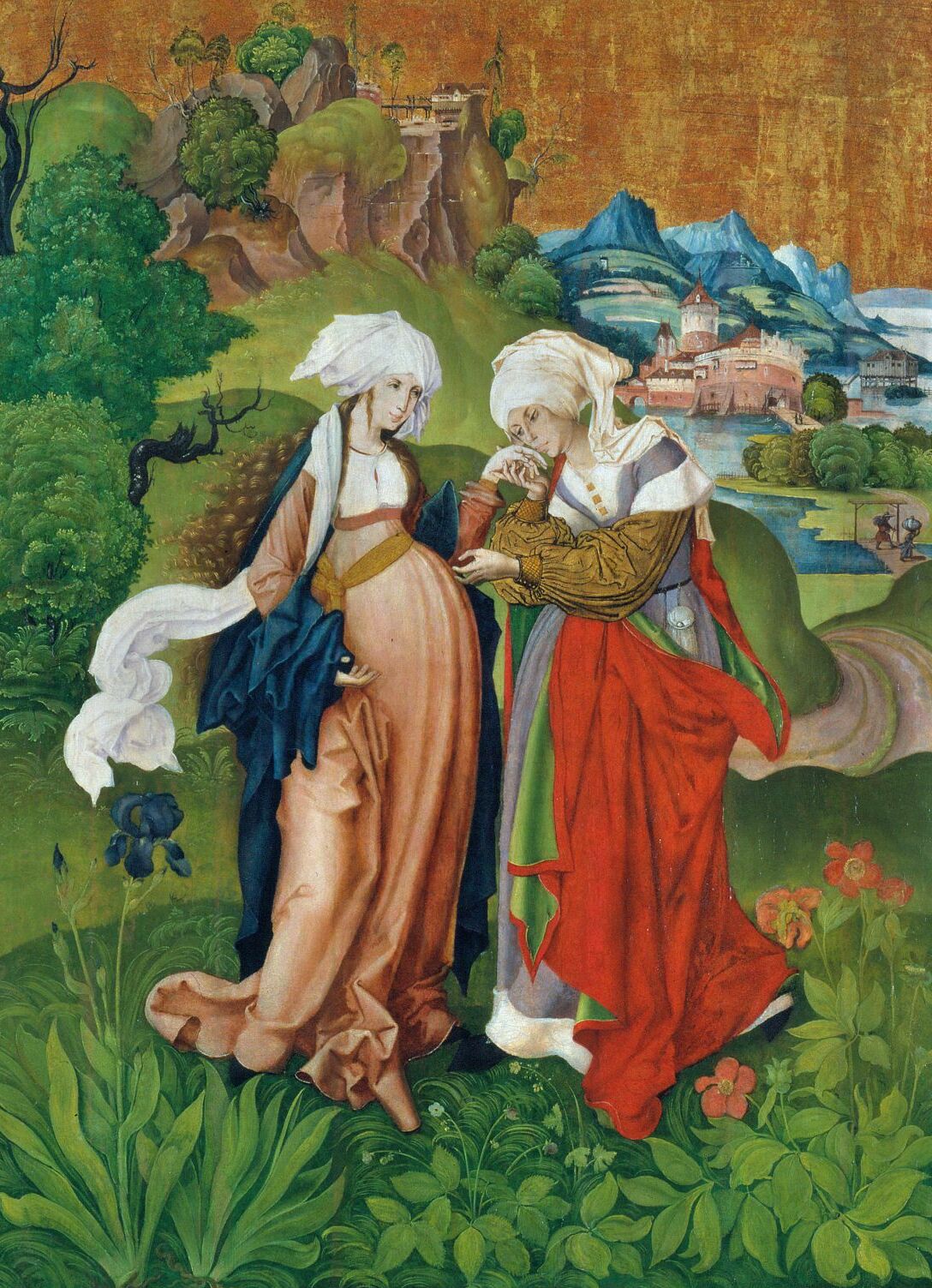
``Where the
Bishop is, there let the multitude of believers be;
even as where Jesus is, there is the Catholic Church'' Ignatius of
Antioch, 1st c. A.D
Feast of
the Visitation
What a beautiful Feast the Visitation is! Begun
by St. Bonaventure among the Franciscans in A.D. 1263, it became a
universal Feast in 1389, during the papacy of Urban VI. On the
traditional calendar, it is celebrated on July 2 (on the Novus Ordo
calendar, it is kept on May 31).
This Feast commemorates what is the second Joyful Mystery of the Rosary: Our Lady's visit to her cousin,
Elizabeth, who was six months pregnant with St. John the Baptist at the
time. At the end of the Archangel Gabriel's Annunciation
to Our Lady that she will conceive, he tells her that her cousin,
Elizabeth, an older woman thought barren, will also conceive. The story
as told in the first chapter of Luke (verses 37-47 of this chapter form
the Gospel reading for today), the words in italics being the prayer
known as "The Magnificat":
And behold thy
cousin Elizabeth, she also hath conceived a son in her old age; and
this is the sixth month with her that is called barren: Because no word
shall be impossible with God.
And Mary said: Behold the handmaid of the Lord; be it done to me
according to thy word. And the angel departed from her.
And Mary rising up in those days, went into the hill country with haste
into a city of Juda. And she entered into the house of Zachary, and
saluted Elizabeth. And it came to pass, that when Elizabeth heard the
salutation of Mary, the infant leaped in her womb.
And Elizabeth was filled with the Holy Ghost: And she cried out with a
loud voice, and said: Blessed art thou among women, and blessed is the
fruit of thy womb. And whence is this to me, that the mother of my Lord
should come to me? For behold as soon as the voice of thy salutation
sounded in my ears, the infant in my womb leaped for joy. And blessed
art thou that hast believed, because those things shall be accomplished
that were spoken to thee by the Lord.
And Mary said: My soul doth magnify the Lord. And my spirit hath
rejoiced in God my Saviour. Because he hath regarded the humility of
his handmaid; for behold from henceforth all generations shall call me
blessed. Because he that is mighty, hath done great things to me; and
holy is his name. And his mercy is from generation unto generations, to
them that fear him. He hath shewed might in his arm: he hath scattered
the proud in the conceit of their heart. He hath put down the mighty
from their seat, and hath exalted the humble. He hath filled the hungry
with good things; and the rich he hath sent empty away. He hath
received Israel his servant, being mindful of his mercy: As he spoke to
our fathers, to Abraham and to his seed for ever.
And Mary abode with her about three months; and she returned to her own
house. Now Elizabeth's full time of being delivered was come, and she
brought forth a son.
It's interesting
that this Feast should come after1
the Feast of St. John the
Baptist
which we just celebrated eight days ago, but this date marks the end of
the three month visit, which would have begun some time soon after the
Annunciation (in the Eastern Churches, the Visitation is recalled on
March 30). This July 2 date is also the day after the
octave of the Baptist's birthday and helps explain why his birth was so
important. The Catena Aurea attributes to a "Greek Expositor" the
following words about St. John, as an infant in Elizabeth's womb,
recognizing the Savior:
For the Prophet
sees and hears more acutely than his mother, and salutes the chief of
Prophets; but as he could not do this in words, he leaps in the womb,
which was the greatest token of his joy. Who ever heard of leaping at a
time previous to birth? Grace introduced things to which nature was a
stranger. Shut up in the womb, the soldier acknowledged his Lord and
King soon to be born, the womb’s covering being no obstacle to the
mystical sight.
It was at the Visitation that John, along with his
mother, were filled with the Holy Ghost, the cause of his being born
without the stain of original sin. It is today that our Redeemer, Our
Lady, and the one about whom Christ said "there hath not risen among
them that are born of women a greater than John the Baptist" all came
together -- the three pure ones all born without sin after the
Fall (of course, Christ and His mother were also conceived
without sin).
But what this Feast reveals about Mary and who she is is even more
wondrous.
Compare how St. Luke describes Mary's visit with how David's visit to
the Ark of the Covenant is described in II Kings (2 Samuel in some
Bibles):
II Kings 6:2
And David arose and went, with all the people that were with him of the
men of Juda to fetch the ark of God, upon which the name of the Lord of
hosts is invoked, who sitteth over it upon the cherubims.
Luke 1:39 And
Mary rising up in those days, went into the hill country with haste
into a city of Juda
II Kings l
6:9 And David was afraid of the Lord that day, saying: How shall
the ark of the Lord come to me?
Luke 1:43
And whence is this to me, that the mother of my Lord should come to me?
II Kings 6:11
And the ark of the Lord abode in the house of Obededom the Gethite
three months...
Luke 1:56 And
Mary abode with her about three months; and she returned to her own
house...
II Kings 6:16
And when the ark of the Lord was come into the city of David, Michol
the daughter of Saul, looking out through a window, saw king David
leaping and dancing before the Lord [His Presence over the Ark]
Luke 1:41
And it came to pass, that when Elizabeth heard the salutation of Mary,
the infant leaped in her womb.
St. Luke clearly wants us to see Our Lady as the Ark of the New
Covenant, the bearer the Word just as the Ark of the Old Covenant
carried the tablets containing the ten words of God; the one who bore
the Root of Jesse Who came back to life in three days, just as the Ark
of the Old Covenant carried Aaron's rod which sprouted; the one who
bore the Bread of Life just as the Ark of the Old Covenant carried some
of the manna that sustained the children of Israel in the desert. St.
John the Evangelist wrote of this same Truth when he described his
Heavenly vision in Apocalypse 11:19-12:1-5:
And the temple
of God was opened in heaven: and the ark of his testament was seen in
his temple, and there were lightnings, and voices, and an earthquake,
and great hail. And a great sign appeared in heaven: A woman clothed
with the sun, and the moon under her feet, and on her head a crown of
twelve stars: And being with child, she cried travailing in birth, and
was in pain to be delivered. And there was seen another sign in heaven:
and behold a great red dragon, having seven heads, and ten horns: and
on his head seven diadems: And his tail drew the third part of the
stars of heaven, and cast them to the earth: and the dragon stood
before the woman who was ready to be delivered; that, when she should
be delivered, he might devour her son. And she brought forth a man
child, who was to rule all nations with an iron rod: and her son was
taken up to God, and to his throne.
These verses and
the words of St. Gregory Thaumaturgus (a.k.a. Gregory of
Neocaesarea, A.D. 213 - ca. 270) remind us who Mary is:
And thus she
received the word, and in the due time of the fulfilment according to
the body's course she brought forth the priceless pearl. Come, then, ye
too, dearly beloved, and let us chant the melody which has been taught
us by the inspired harp of David, and say, "Arise, O Lord, into Thy
rest; Thou, and the ark of Thy sanctuary." For the holy Virgin is in
truth an ark, wrought with gold both within and without, that has
received the whole treasury of the sanctuary.
Pray the words
of St. Athanasius and realize the depths of Mary's beauty! Turn to her
to intercede for us with her Son:
O noble Virgin,
truly you are greater than any other greatness. For who is your equal
in greatness, O dwelling place of God the Word? To whom among all
creatures shall I compare you, O Virgin? You are greater than them all,
O Ark of the Covenant, clothed with purity instead of gold! You are the
Ark in which is found the golden vessel containing the true manna, that
is, the flesh in which Divinity resides.
Customs
First, a prayer for the day, this one by St. Alphonsus
Liguori:
Immaculate and
Blessed Virgin, since thou art the universal dispenser of all divine
graces, thou art the hope of all, and my hope. I will ever thank my
Lord for having granted me the grace to know thee, and for having shown
me the means by which I may obtain graces and be saved. Thou art this
means, O great Mother of God; for I now understand that it is
principally through the merits of Jesus Christ, and then through thy
intercession, that my soul must be saved. Ah! my Queen, thou didst
hasten so greatly to visit, and by that means didst sanctify the
dwelling of Saint Elizabeth; deign, then, to visit, and visit quickly,
the poor house of my soul. Ah! hasten, then; for thou well knowest, and
far better than I do, how poor it is, and with how many maladies it is
afflicted; with disordered affections, evil habits, and sins committed,
all of which are pestiferous diseases, which would lead it to eternal
death. Thou canst enrich it, O Treasurer of God; and thou canst heal
all its infirmities. Visit me, then, in life, and visit me especially
at the moment of death, for then I shall more than ever require thy
aid. I do not indeed expect, neither am I worthy, that thou shouldst
visit me on this earth with thy visible presence, as thou hast visited
so many of thy servants; but they were not unworthy and ungrateful as I
am. I am satisfied to see thee in thy kingdom of heaven, there to be
able to love thee more, and thank thee for all that thou hast done for
me. At present I am satisfied that thou shouldst visit me with thy
mercy; thy prayers are all that I desire.
Pray, then, O Mary, for me, and commend me to thy Son. Thou, far better
than I do, knowest my miseries and my wants. What more can I say? Pity
me; I am so miserable and ignorant, that I neither know nor can I seek
for, the graces that I stand the most in need of. My most sweet Queen
and Mother, do thou seek and obtain for me from thy Son those graces
which thou knowest to be the most expedient and necessary for my soul.
I abandon myself entirely into thy hands, and only beg the Divine
Majesty, that by the merits of my Saviour Jesus He will grant me the
graces which thou askest Him for me. Ask, ask, then, O most Holy
Virgin, that which thou seest best for me; thy prayers are never
rejected; they are the prayers of a Mother addressed to a Son, Who
loves thee, His Mother; so much, and rejoices in doing all that thou
desirest, that He may honour thee more, and at the same time show thee
the great love He bears thee. Let us make an agreement, O Lady, that
while I live confiding in thee, thou on thy part wilt charge thyself
with my salvation. Amen
As to music for the day, be inspired by Bach's Herz
und Mund und Tat und Leben,
BWV 147, written in honor of the Visitation. Note that the gorgeous
"Jesu, Joy of Man's Desiring" (Jesus
bleibet meine Freude) ends this cantata:
The lyrics of the "Jesu, Joy of Man's Desiring" section:
Jesus bleibet
meine Freude,
Meines Herzens Trost und Saft,
Jesus wehret allem Leide,
Er ist meines Lebens Kraft,
Meiner Augen Lust und Sonne,
Meiner Seele Schatz und Wonne;
Darum lass' ich Jesum nicht,
Aus dem Herzen und Gesicht.
Jesus shall
remain my joy,
my heart's comfort and sap,
Jesus shall fend off all sorrow,
He is the strength of my life,
the delight and sun of my eyes,
the treasure and wonder of my soul;
therefore I will not let Jesus go
out of my heart and sight.
In Polish folklore, during the Blessed Virgin's journey to
visit
Elizabeth, she ate berries she found along the way. In remembrance of
this, it's customary that Polish pregnant women not eat berries until
this date so that "Our Lady of Berries" would have enough and would
petition God for them to grant them healthy children. Given this
tradition, today is a day to enjoy berries. A recipe to help you do
just that:
Berry Shortcakes
2 pints berries, any kind you like
1/3 cup sugar
zest and juice of 1 orange
3 cups all-purpose flour
3 tablespoons sugar
2 tablespoons baking powder
1/2 teaspoon kosher salt
1 1/2 sticks (12 tablespoons) cold butter, cut into pieces
1 1/4 cups buttermilk*
1 tablespoon vanilla extract
Mix the berries, 1/3 c. sugar, and orange zest and juice and
store in fridge to macerate. Preheat the oven to 450 degrees F.
Mix the flour, remaining sugar, baking powder and salt in a
bowl (or food processor). Add the butter pieces and mix until the
butter is completely cut into the flour mixture. In a measuring cup,
mix the buttermilk and vanilla and drizzle in to the dry mixture,
mixing as you go, until the dough just comes together and is no longer
crumbly.
Drop the mixture in 8 clumps between 2 parchment-lined baking
sheets, and bake until golden brown, 10 to 12 minutes. Set aside and
allow to cool completely.
Serve the cakes topped with berries and either whipped cream,
ice cream, plain heavy cream, etc.
* If you don't have buttermilk, do this: measure out 1 1/4 c.
milk and add to it 1 1/4 tablespoons of white vinegar or lemon juice.
Stir and let it sit for about 5 minutes.
The patron of Enna, Sicily is Our Lady of the Visitation (Madonna della Visitazione), and the
festivities begin three days before the feast, on June 29, the Feast of Saints Peter and Paul.
On the 29th, a procession is made from the Church of St. Peter (San
Pietro) to the cathedral, where there's a statue of Our Lady that is
kept hidden in a niche all year except for Easter, from Christmas to
January 11 (in remembrance earthquake of 1693 in which the city was
spared), and from September 8 to September 12, days on which we
celebrate the Feast of the
Nativity of Mary, and the Most
Holy Name of Mary. The niche is opened to reveal the statue,
covered in jewels, and crowned with white gold. On the feast itself,
there is Holy Mass followed by a great procession of the statue from
the cathedral to the Church of Montesalvo, and along the way, guns
salute Our Lady.
I don't know of any other special customs or traditions of
the day, but can imagine a craft that would be fun: get two sets of
unfinished Russian nesting dolls (do a search for "blank nesting
dolls," "unfinished nesting dolls," etc.), and take the largest and the
smallest from each set. Paint (or
paint and decoupage) one of the larger ones as Our Lady, and the other
large one as St. Elizabeth; paint one of the smaller ones as the Divine
Infant, and the second small one as baby St. John the Baptist. What a
great and meaningful centerpiece for your table during this Feast!
"And Mary, rising up in those days, set out hastily for the mountain,
for the city of Judah, and entered into the house of Zacharias, and
saluted Elizabeth. "
It is normal for anyone who wants to be believed to provide reasons to
believe. So the angel who announced the mysteries, to make him believe
by a precedent, he announced to Mary, a virgin, the maternity of an old
and sterile woman, thus showing that God can all that he please. As
soon as she had learned of it, Mary, not because of a lack of faith in
the prophecy, not out of uncertainty of this announcement, not out of
doubt about the precedent provided, but in the joy of her desire, to
fulfill a pious duty, in the eagerness of joy, went to the mountains.
From now on filled with God, could she not rise hastily to the heights?
Slow calculations are foreign to the grace of the Holy Spirit. Learn
also, pious women, how eager you are to testify to your relatives near
being mothers. Marie, until then, lived alone in the strictest retreat;
it has not been retained either to appear in public by virginal
modesty, nor of its design by the escarpments of the mountains, nor of
the service to be rendered by the length of the road. Towards the
heights the Virgin hastens, the Virgin who thinks to serve and forgets
her pain, whose charity is strength and not sex; she leaves her house
and goes. Learn, virgins, not to run the houses of others, not to hang
out in the squares, not to engage in conversations on public roads.
Marie lingers at home, rushes on the road. She remained at her cousin's
for three months; for, having come to render service, she had this
service at heart; she remained for three months, not for the pleasure
of being in a foreign home, but because he disliked her from showing
herself often outside.
You have learned, virgins, the delicacy of Mary; learn his
humility. She comes as a relative to her relative, as a younger sister
to her elder sister; and not only does she come, but she is the first
to salute; it is fitting that the more chaste is a virgin, the more
humble she is; that she knows how to honor her elders, that she be
mistress of humility, the one who makes profession of chastity.
Here again there is a motive of piety, there is even a doctrinal
teaching: it must indeed be remarked that the superior comes to the
inferior to help the inferior: Mary to Elizabeth, Christ to John; as
well, later, to consecrate the baptism of John, the Lord came to this
baptism (Matt., III, 13).
And immediately the blessings of the arrival of Mary and the presence
of the Lord manifest themselves: for "when Elizabeth heard the
salvation of Mary, the child shuddered in her womb, and she was filled
with the Holy Spirit. ". Notice the choice and precision of each word.
Elizabeth first heard the voice, but John was the first to feel grace:
the latter, according to the order of nature, heard, the latter
shuddered under the effect of mystery; she perceived the arrival of
Mary, that of the Lord: the woman that of the woman, the child that of
the child. They speak grace; they realize it inside and approach the
mystery of mercy for the benefit of their mothers; and, by a double
miracle, the mothers prophesy under the inspiration of their children.
The child shuddered, the mother was filled; the mother was not
fulfilled before her son, but the son, once filled with the Holy
Spirit, also filled his mother.
Jean shuddered, the spirit of Mary also shuddered. At the thrill of
John, Elizabeth is satisfied; for Mary, we do not learn that she was
(then) filled with the Spirit, but that her spirit shudders: for He who
can not be understood acted in his Mother in a way that was not
understandable.
Finally this one is filled after having conceived, this one before
conceiving.
"Blessed are you among women, and blessed the fruit of your womb! And
how is it that the Mother of my Lord comes to me? "
The Holy Spirit knows his word; He never forgets it, and the prophecy
is realized not only in the miraculous facts, but in all rigor and
property of terms. What is this fruit of the womb, except He from whom
it was said, "Behold, the Lord giveth the inheritance of children, the
reward of the fruit of the womb" (Ps. 126,3)? In other words, the
Lord's inheritance is children, the price of this fruit that comes from
Mary's womb. He is the fruit of the breast, the flower of the stem, of
which Isaiah prophesied well: "A stem," said he, "will rise from the
stock of Jesse, and a flower spring from this stalk" (Is., XI, 1): the
stock is the race of the Jews, the stem Mary, the flower of Mary the
Christ, who, like the fruit of a good tree, according to our progress
in virtue, now flourishes, now fruiting in us, now reborn by the
resurrection that brings life to his body.
"And how is it that the Mother of my Lord come to me? It is not
ignorance that makes her speak - she knows well that there is grace and
operation of the Holy Spirit that the mother of the prophet be saluted
by the Mother of the Lord for the benefit of her child - but she
recognizes that it is the result not of a human merit but of divine
grace; so she says: "How is it given to me", that is to say, what
happiness comes to me, that the Mother of my Lord comes to me! I admit
to being there for nothing. How is it given to me? by what justice,
what actions, for what merits? These are not the customary steps
between women "that the Mother of my Lord come to me". I sense the
miracle, I recognize the mystery: the Mother of the Lord is fruitful of
the Word, full of God.
"For, behold, when your salvation was heard in my ears, the child
trembled with joy in my bosom. And blessed are you to have believed! "
You see that Mary did not doubt, but believed, and thereby obtained the
fruit of faith. "Blessed," said she, "who have believed? But you too
blessed, who have heard and believed! for every soul that believes,
conceives and engenders the word of God and recognizes his works. May
all of you have the soul of Mary to glorify the Lord; that in all lies
the spirit of Mary to exult in God. If there is corporeally only a
Mother of Christ, by faith Christ is the fruit of all: for every soul
receives the Word of God, provided that without spot, preserved from
vices, it keeps chastity in purity without attack. Every soul,
therefore, who achieves this state magnifies the Lord, as the soul of
Mary magnified the Lord, and as his spirit shuddered in the Savior God.
The Lord is indeed magnified, as you have read elsewhere: "Magnify the
Lord with me" (Ps. 33, 4): not that the human word can add anything to
the Lord, but because it grows in us; because "Christ is the image of
God" (II Cor., IV, 4; Coloss., I, 15) and, therefore, the soul that
does right and religious work magnifies this image of God, at the whose
likeness she was created; hence, in magnifying her, she participates in
her grandeur to a certain extent and finds herself elevated in it: she
seems to reproduce in her this image by the brilliant colors of her
good works, and as copy her by virtue.
Now the soul of Mary magnifies the Lord and his spirit trembles in God
because, dedicated soul and spirit to the Father and the Son, she
venerates with a pious love the one God, where all things come from,
and the one Lord by whom are all things (see I. Cor., VIII, 6).
Follows the prophecy of Mary, whose fullness responds to the excellence
of her person. And it is not without interest, it seems, that Elizabeth
prophesies before the birth of John, Mary before that of the Lord. The
salvation of men is already being sketched and outlined; for sin having
begun with women, good, too, begins with women, so that women, in their
turn, abandon effeminate manners, renounce their weakness, and the
soul, which has no sex. Mary, ignorant of error, religiously applies
herself to imitate her chastity.
"Marie stayed at home for three months and came back to her house. It
is well that we are shown Mary rendering service and faithful to a
mystical number: for kinship is not the only cause of this long stay,
but also the profit of so great a prophet. Indeed, if the first entry
has procured such a result that the salvation of Mary the child has
shuddered in the breast, that the Holy Spirit has filled the mother of
the child, what increments can we believe that such a space of time,
the presence of St. Mary has earned him! "Marie stayed at home for
three months. Thus the prophet received the anointing and, like a good
athlete, was exercised from the maternal womb: for it was in
preparation for a great struggle that his strength was being prepared.
At last Mary remained until the time of birth was fulfilled for
Elizabeth. Now, if you take good care of it, you will find that it has
never been noted except for the birth of the righteous; for "the days
were fulfilled for the birth of Mary", "time was fulfilled" for the
birth of Elizabeth, the time of life was fulfilled when the saints left
the career of this life. Plenitude is for the life of the just,
emptiness for the days of the wicked.
Footnote: 1 This Feast was moved to
May 31 on the Novus Ordo calendar, which is the date of Feast of the
Queenship of the Blessed Virgin Mary on the traditional calendar.