|
Self-described "Torah-true Jews" to this day wear tefillin
("phylacteries") on their foreheads and arms as a sign of their
identity and devotion. This practice stems from Deuteronomy 6:4-8:
Hear, O Israel,
the Lord our God is one Lord. Thou shalt love the Lord thy God with thy
whole heart, and with thy whole soul, and with thy whole strength. And
these words which I command thee this day, shall be in thy heart: And
thou shalt tell them to thy children, and thou shalt meditate upon them
sitting in thy house, and walking on thy journey, sleeping and rising.
And thou shalt bind them as a sign on thy hand, and they shall be and
shall move between thy eyes.
Compare those
words with the words of St. Cyril, Bishop of Jerusalem (d. A.D. 386)
Let us,
therefore, not be ashamed of the Cross of Christ; but though another
hide it, do thou openly seal it upon thy forehead, that the devils may
behold the royal sign and flee trembling far away. Make then this sign
at eating and drinking, at sitting, at lying down, at rising up, at
speaking, at walking: in a word, at every act.
God speaking,
through Ezechiel, to the remnant of Israel (and don't forget that the
Church is "Israel"!), tells the faithful:
And the Lord
said to him: Go through the midst of the city, through the midst of
Jerusalem: and mark Thau upon the foreheads of the men that sigh, and
mourn for all the abominations that are committed in the midst thereof.
(Ezechiel 9:4)
The Catholic
Sign of the Cross is absolutely ancient, rooted not only in the Old
Testament but the New (Apocalypse speaks of those who have the sign of
God in their foreheads -- and those who have the sign of the Beast in
their foreheads). When Catholics undergo the Sacrament of Confirmation, the Bishop
(sometimes a priest) seals the sign on our foreheads with holy chrism.
St. John of Damascus wrote
This was given
to us as a sign on our forehead, just as the circumcision was given to
Israel: for by it we believers are separated and distinguished from
unbelievers.
Crossing one's
self recalls this seal, and the invocation that is said while making
this holy sign calls on our God -- the Father, His Son, and the Holy
Ghost -- and is a sign of our of belief; it is both a "mini-creed" that
asserts our belief in the Triune God, and a prayer that invokes Him.
The use of holy water when making this sign,
such as we do when we enter a church, also recalls our Baptism and should bring to mind that we are
born again of water and Spirit, thanks be to God.
Because of what the Sign indicates -- the very Cross of our salvation
-- Satan hates it, and our using it makes demons flee. Make the Sign in
times of temptation and confusion for great spiritual benefit!
The Sign of the Cross is made thus: First choose your style:
- Option A. With
your right hand, touch the thumb and ring finger together, and hold
your index finger and middle finger together to signify the two natures
of Christ. This is the most typical Western Catholic practice.
- Option B. Hold
your thumb and index finger of your right hand together to signify the
two natures of Christ
- Option C. Hold
your thumb, index finger, middle finger of your right hand together
(signifying the Trinity) while tucking the ring finger and pinky finger
(signifying the two natures of Christ) toward your palm. This is the
typically Eastern Catholic practice.
- Option D: Hold
your right hand open with all 5 fingers -- representing the 5 Wounds of Christ -- together and very
slightly curved, and thumb slightly tucked into palm
Then:
- touch the
forehead as you say (or pray mentally) "In nomine Patris" ("In the name
of the Father")
- touch the
breastbone or top of the belly as you say "et Filii" ("and of the
Son")
-
touch the left
shoulder, then right shoulder, as you say "et Spiritus Sancti" ("and of
the Holy Ghost"). Note that some people -- especially Italians and
Hispanics -- end the Sign by crossing the
thumb over the index finger to make a cross, and then kissing the thumb
as a way of "kissing the Cross."

An optional
prayer to pray after signing yourself in the Name of the Father, Son,
and Holy Ghost is this one, said to be favored by St. Benedict:
By the Sign of
the Cross, deliver me from my enemies, O Lord.
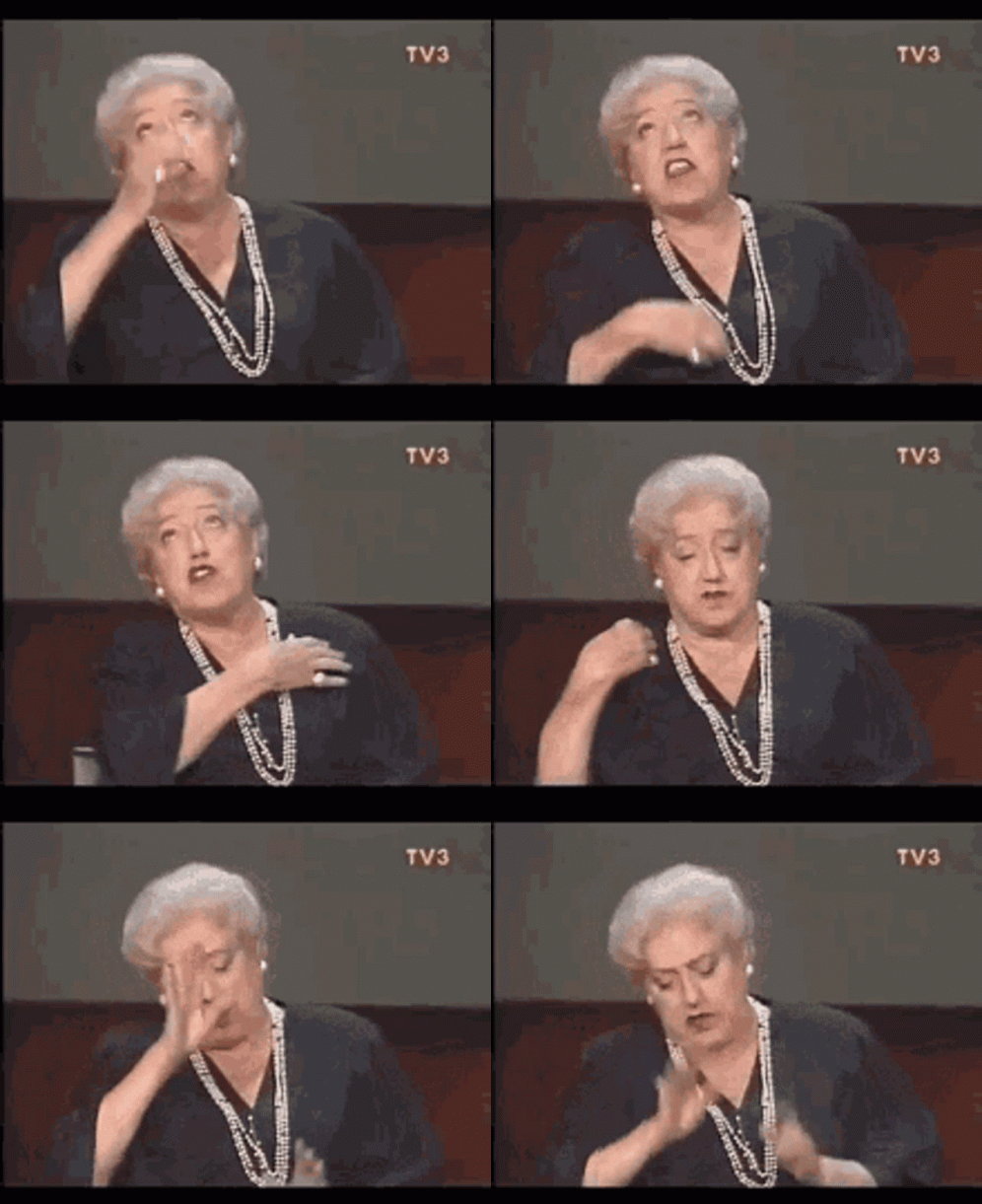
The lady in this
gif demonstrates the Sign of the Cross beautifully, all followed by a
note of exasperation:
Note that
Eastern Catholics (and Orthodox) go from right shoulder to left and end
sometimes by touching their right side, above the hip, to symbolize
Christ's being pierced by the sword. The Bridgettine nuns in their Myroure
of our Ladye write of the mystical reasons for the Latin practice,
and how it summarizes the Incarnation, the Passion, and the Ascension:
And then ye
bless you with the sygne of the holy crosse, to chase away the fiend
with all his deceytes. For, as Chrysostome sayth, wherever the fiends
see the signe of the crosse, they flye away, dreading it as a staffe
that they are beaten withall. And in thys blessinge ye beginne with
youre hande at the hedde downwarde, and then to the lefte side and
byleve that our Lord Jesu Christe came down from the head, that is from
the Father into erthe by his holy Incarnation, and from the erthe into
the left syde, that is hell, by his bitter Passion, and from thence
into his Father's righte syde by his glorious Ascension. (Catholic
Encyclopedia)
With the Sign,
we send a visible sign to the world and follow the advice of St. Ephrem
of Syria (died A.D. 373):
Mark all your
actions with the sign of the lifegiving Cross. Do not go out from the
door of your house till you have signed yourself with the Cross. Do not
neglect that sign whether in eating or drinking or going to sleep, or
in the home or going on a journey. There is no habit to be compared
with it. Let it be a protecting wall round all your conduct, and teach
it to your children that they may earnestly learn the custom.
When the Sign is Made
Catholics should
begin and end their prayers with the Sign of the Cross and should cross
themselves when passing a church to honor Jesus in the Tabernacle, upon
entering a church, and after receving Communion. The sign is made, too,
in times of trouble or fear (e.g., when receiving bad news, in times of
temptation, when hearing an ambulance or fire truck go by), when
passing a cemetery or otherwise recalling the dead, when seeing a
Crucifix -- any time one wishes to honor and invoke God, or
ward away evil, fear, and temptation.
The sign is made as well when during prayer when a Cross symbol -- + -- appears in the prayer's
text.
Just for information's sake, the "Distaff Gospels," a collection of old
wives tales collected ca. 1470, relate the following in its fifteenth
chapter.
If in the
morning, when getting up, a person crosses themselves and washes their
hands before leaving the house, the devil will not have the power of
harming him or her. Otherwise, whatever the work is done on that day
will not be profitable.
...About that, Geffrine Tost Preste said that the devil sits on the
table of whoever does not say grace before eating, then eats and drinks
there.
Other Signs of the Cross
There are other
signs of the Cross that Catholics make, too. One is made by tracing a
small Cross with the thumb of the right hand on people and things. This
sign is especially used by parents when blessing children by tracing
the sign on the children's foreheads..1
Sometimes the sign is traced by the thumb on a book of Sacred Scripture
and then kissed before reading. The sign is also carved onto loaves of
bread before cutting, etc. 
Another sign is the large sign made in the air by bishops and priests
when blessing persons or material objects.
Yet another is the series of three small Crosses traced by the thumb of
the right hand -- one small Cross on the forehead, one small Cross on
the lips, and one small Cross on the breast -- just before the Gospel
reading at Mass. The sign on the forehead is to show that we believe
the Gospel, the sign on the lips is to show that we respect the Gospel
and desire to spread the Good News, and the sign on our breast is to
show that we love the Gospel and want it kept in our hearts. 2
Make the Sign of the Cross and make it often! Teach it to your children
-- even the tiniest of children. If they're infants, take their hands
and make the movements for them! Making the Sign should feel as natural
as breathing.. Mind the words of St. Cyril of Jerusalem (A.D. 315-386):
Let us not
then be ashamed to confess the Crucified. Be the Cross our seal made
with boldness by our fingers on our brow and in everything; over the
bread we eat, and the cups we drink; in our comings in, and goings out;
before our sleep, when we lie down and when we awake; when we are in
the way and when we are still. Great is that preservative; it is
without price, for the poor's sake; without toil, for the sick, since
also its grace is from God. It is the Sign of the faithful, and the
dread of evils; for He has triumphed over them in it, having made a
shew of them openly; for when they see the Cross, they are reminded of
the Crucified; they are afraid of Him, Who hath bruised the heads of
the dragon. Despise not the Seal, because of the freeness of the Gift;
but for this rather honor thy Benefactor.
Tidbits
To "cross
oneself," "sign oneself," "bless oneself," or "make the sign of the
cross" all mean the same thing
A partial indulgence is gained,
under the usual conditions, when piously making the Sign of the Cross.
Footnotes:
1 The use of
"bless" here refers to a parental blessing -- i.e., a prayer for God's
grace for a child. Priests alone have the power to bless in the
name of the Church and with the power of the Church, to
bless liturgically, to bless objects rendering them sacramentals, etc.
2 When passing by
or upon entering a church, many Mexicans make this form of the sign
(with the thumb laid over the index finger to form a cross) -- on the
forehead, lips, and mouth -- while praying the words, "Por la senal de
la Santa Cruz, de nuestros enemigos libranos Seņor Dios Nuestro" -- "By
the sign of the Holy Cross deliver us, Lord, from our enemies." This is
followed by the regular sign of the Cross outlined above (whose words
in Spanish are, "En el nombre del Padre, y del Hijo, y del Espiritu
Santo, amen") and the kissing of the Cross made by the thumb laid over
the index finger. They refer to the first sign as "signing oneself"
("signarse") and the second action as "blessing oneself"
("santiguarse").
|
|