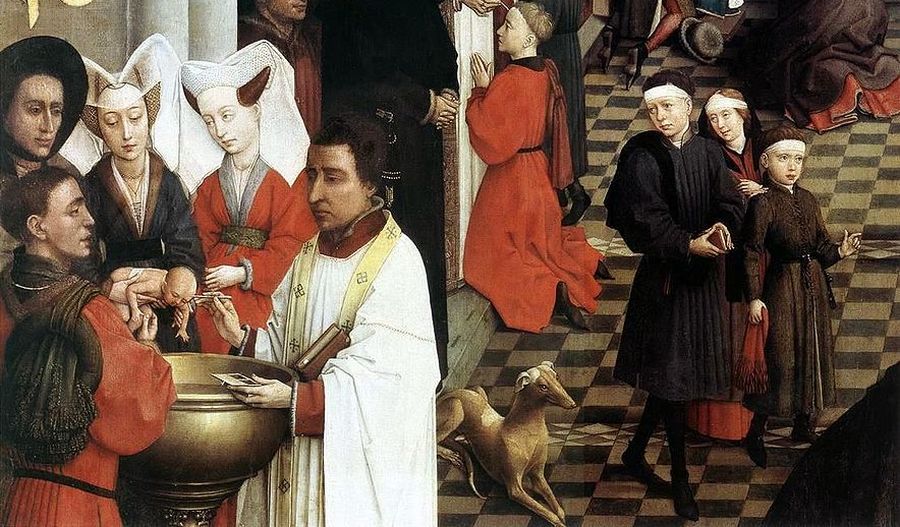
|
First, what are the effects of Baptism? What does Baptism do?
Baptism:
- remits all sins
(both original sin and personal sin) and their temporal punishments. If
one were to die immediately after Baptism, he would go straight to
Heaven (assuming one presents no obstacles).
- imprints an
indelible mark on the soul of the baptized which marks him as God's,
initiates him into the life of the Church, and allows him to receive
the other Sacraments. It is through Baptism that we are born again --
regenerated -- of water and Spirit and receive new life.
- infuses
sanctifying grace, supernatural gifts, and virtues (according to the
disposition of the soul receiving the Sacrament and providing he puts
up no obstacles), making us true adopted children of God.
There is only
one Baptism, therefore the Sacrament may be received only once (if one
is unsure whether he was validly baptized, he is baptized
conditionally. See below). For those who have reached the age of
reason, the Sacrament must also be received in faith. If one does not
have faith in Baptism but receives it anyway, he is still validly
baptized, but the fruits of his Baptism will be delayed until he does
have faith. In the case of infants, it is the faith of the parents that
operates until the child himself reaches the age of reason.
There are a two ways to enter the Church through Baptism:
- Private
Baptism:
An emergency, bare-essentials baptism which can be performed anywhere,
by anyone -- Catholic, pagan, Jew, Protestant -- who uses the proper
matter and form and intends to do what the Church does when She
baptizes. Because of that last condition, Baptism by heretics or
apostates should always be followed by a conditional Baptism (see
below). Note that Baptism must only be administered to those who
request it; Baptism must never, ever be against the will of the person
to be baptized, or his parents' will if he is a child. Also, rest
assured that those who, with contrite hearts, have expressed a true
desire for Baptism and have vowed to receive the Sacrament, but die
before receiving it are baptized "by desire." In any case, a person
baptized in a private Baptism should participate in the Solemn Rite of
Baptism if and when he is able.
- Solemn
Baptism:
Baptism by a priest, who is the usual minister of Baptism, during the
Rite of Baptism which includes ceremonies such as a formal renunciation
of Satan and all his works, exorcism, the use of water blessed at the
Easter Vigil or Pentecost, the imposition of blessed salt, an
annointing with Chrism, etc. One may be solemnly baptized as an infant;
or by preparing oneself through catechesis and being baptized by a
priest outside the Easter Vigil; or, as is most common, by being
baptized at the Easter Vigil by a priest and after a period of official
catechesis.
Private Baptism
The bare
necessity for Baptism -- and the procedure used to baptize someone in
an emergency -- is to say the following words while pouring clean
water (hot or cold, fresh or salt -- though cold and fresh is
preferred) over the forehead of the one to be baptized. The water must touch
and flow over the skin of the head:
I baptize thee
in the Name of the Father and of the Son and of the Holy Ghost.
Latin:
Ego te baptizo in nomine Patris, et Filii, et Spiritus Sancti.
Small variations
may occur in this formula -- e.g., the use of "christen" for "baptize,"
"you" instead of "thee," "Holy Spirit" instead of "Holy Ghost," etc. --
but "baptize" or "christen" must be used in the English language, the
Most Holy Trinity must be invoked using their Biblical titles, water
must be used, it must be at least poured over the forehead such that it
touches the skin (immersion, of course, is fine, too), and the words of
Baptism must be said as the water is being poured or as the
person is being immersed. However, the form written above is the
precise method that should be encouraged and that every Catholic should
know and teach their children in case they ever find themselves in the
position of having to administer the Sacrament to someone in emergency
need. Ideally, there should be a triple pouring or immersion --
once during each invocation of a Divine Person (e.g., "I baptize thee
in the Name of the Father [pour] and of the Son [pour] and of the Holy
[pour] Ghost").
If there is any doubt that Baptism validly took place, that is,
according to the method above, a "conditional Baptism" is later
administered. A conditional Baptism is also the style of private
Baptism used when baptizing someone who is not sure he is baptized. The
words of a conditional Baptism are:
If thou art not
baptized, I baptize thee in the Name of the Father, and of the Son, and
of the Holy Ghost.
Latin:
Si non es baptizatus (-a), ego te baptizo in nomine Patris, et Filii,
et Spiritus Sancti.
Again, private
Baptism should always be followed, if possible, by the formal Solemn
Rite of Baptism.
Solemn Baptism
First things
first: Catholic parents should arrange for the Baptism of their newborn
as soon as possible. Do not delay! It should be the first thing on the
new parents' minds (well, maybe just after they count fingers and
toes...).
The name you choose for your child should,
ideally, be that of a Saint; at the least, he should not be given a
name that conflicts with the Faith or recalls anything unsavory. The
name you, as a Christian parent, give your child is known as his
"Christian name" for a reason (note that he will receive a new name at
Confirmation, too).
Choosing Sponsors
When planning for a Baptism, sponsors (called "godparents" in the case
of children) are chosen -- by the parents or by the catechumen himself,
if he is of age -- to stand up for the catechumen during the Rite. The
godparents act as witnesses and perform ritually in the same way that
the Jewish kvatterin ("godmother") and kvatter
("godfather") pass a child to be circumcised from the former to the
latter until the child reaches the mohel (the rabbi who
circumcises).
There should, ideally, be one male and one female for this task, both
baptized Catholics who are in good standing with the Church and who've
reached the age of fourteen. There is no need for the two to be married
to each other, but they may be.
If two sponsors are unavailable, one will
suffice.
Among those who may not act as sponsor are: members of
religious orders, spouses in respect to each other, parents in respect
to their own children, infidels, heretics, members of condemned secret
societies, and public sinners (Note: the 1983 Code of Canon Law does
not mention that spouses may not sponsor each other and that members of
religious orders may not act as sponsors. As to non-Catholic
Christians, it
says that while Protestants may not act as sponsors, they may act as
"witnesses").
If the parents have no Catholic friends or family who live close enough
to attend, they may ask a Catholic who meets the above criteria to be
godparents anyway, and then have someone stand in for them as proxies
during the ceremony. These proxies take on no obligations for the
child; they simply perform ceremonially, and all of the obligations
adhere to the actual godparents unable to attend the rite.
The spiritual relationship formed between sponsor and the the one
sponsored is so close that, traditionally speaking, it is considered an
impediment to marriage if a sponsor were to attempt to marry anyone
s/he sponsors, or even a parent of the one sponsored (the 1983 Code of
Canon Law doesn't mention this tradition).
What Sponsors Do
In the case of children, the role of the godparent is to be that of
"spiritual guardian" who takes up any "slack" in the child's
catechesis, helps ensure that his godchild learns the Faith, and prays
for the godchild throughout his life. St. Thomas Aquinas writes in his
Summa Theologica III-67-8:
Now it has been
stated...that godparents take upon themselves the duties of a tutor.
Consequently they are bound to watch over their godchildren when there
is need for them to do so: for instance when and where children are
brought up among unbelievers. But if they are brought up among Catholic
Christians, the godparents may well be excused from this
responsibility, since it may be presumed that the children will be
carefully instructed by their parents. If, however, they perceive in
any way that the contrary is the case, they would be bound, as far as
they are able, to see to the spiritual welfare of their godchildren.
This is a very
solemn obligation, not one to be entered into lightly. Parents should
choose their child's godparents very carefully and select traditional
Catholics who know the Faith, understand the obligations of
godparenting, and are willing and able to live up to them. Parents and
godparents should work together for the goal of helping the child to
know, love, and serve God! During the Rite of Baptism, the godparents
will answer for the child, that is, they will make the replies to the
questions asked by the priest of the one to be baptized.
Sponsors for adults should express the same type of concern for the
newly baptized soul, helping to ease the person into Church life and
answer questions that may arise. During the Rite of Baptism, the
sponsors for adults stand silent, with a hand on the candidate's
shoulder (and sometimes signing the catechumen with the Cross, in some
variations of the Rite); the one to be baptized answers the priest's
questions himself.
Cultural notes:
- it is common
for sponsors to give a gift to the newly baptized on the day of his
Baptism, and also common for the godparents of children to give gifts
throughout the year, on days such as Christmas,
Name Days, and
birthdays -- to sort of act as an aunt or uncle would toward the child
on special days such as these. These gifts need not be anything
expensive, of course, but should be religious in nature.
- Christening
parties often follow Baptism -- especially after the Baptism of babies;
they are usually small "family and close friends affairs" involving the
serving of dessert and coffee. At these parties in Spanish cultures,
the godfather will throw handfuls of coins to the children to scamper
to gather up for "good luck."
- it is typical
for guests at a Christening to give small gifts or cards to the newly
baptized on the day of his Baptism, just as it is the custom for guests
to do so for those who receive their First
Communion, who are Confirmed, or
who receive the Sacraments of Holy
Matrimony or Holy Orders.
- it is customary
to give the priest a stipend for his time, especially for a
"stand-alone" Baptism, i.e., a Baptism that does not take place during
the course of a regularly scheduled Mass.
The Rite of Baptism Itself
If the one to be baptized enters the Church during the most gorgeous
Easter Vigil, the Rite of Baptism takes place during the Mass itself,
after the Litany of the Saints and the Blessing of the
Baptismal Waters. If the one to be baptized is an infant, the Baptism
takes place as soon as possible after birth. Otherwise, Baptism may
take place any time the priest agrees. When adults are baptized, they
usually receive Confirmation and their
first Holy Communion at the same
time.
Infants are dressed in beautiful white christening gowns -- gowns which
often become heirlooms and are carefully packed away to be used by
future children (you might see baby boys dressed in tiny little white
suits); these special christening outfits, which can be homemade or
purchased at Catholic gift stores, aren't necessary, of course, but
Baby should be dressed in white. Adult catechumens will wear either
their "Sunday best" or, possibly, white albs, especially if they are
received into the Church during the Easter Vigil.
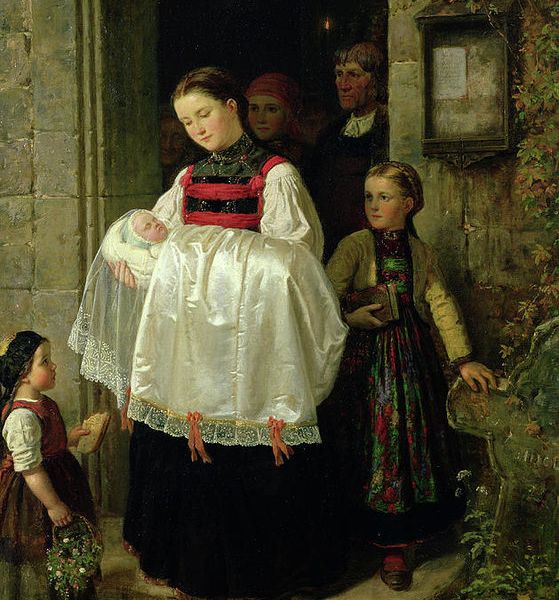
Baptism can take place as a "stand alone" ceremony, or in the context
of a Mass. The Rite itself is divided into 4 parts with different
sub-parts, each bringing the catechumen further into the church
building with each step, symbolizing initiation into the Church
Herself:
Part I: In the
Narthex of the Church:
The Questioning, the Exsufflation, The Sign of the Cross, The
Imposition of Hands, The Imposition of Salt
Part II: Admission into the Church Building:
Exorcism,
The Sign of the Cross, The Imposition of
Hands, The Admission into the Church, The Credo and Pater
Part III: In the Nave:
The Solemn Exorcism, The Ephphetha, The Renunciation of Satan, The
Annointing
Part IV: At the Font:
The Profession of Faith, Baptism, The Annointing with Chrism, The White
Linen Cloth, The Lighted Candle, The Last Words of Good Will
(Note that if a person is to be baptized during the Easter Vigil, the
first 3 parts above might take place some time earlier than the Vigil
itself. Then, during the Vigil, the rite is continued again starting
with the Part IV.)
The Rite of Baptism

Part I: Outside the Church
|
|
The priest
(wearing a violet stole), sponsors, and the catechumen stand in the
narthex of the church, symbolizing that at this point, the candidate is
not a member of the Church.
|
|
The
Questioning
|
| Priest: N., what
do you ask of the Church of God? |
Priest: N., quid
petis ab Ecclesia Dei? |
| Sponsor/Catechumen:
Faith. |
Sponsor/Catechumen:
Fidem. |
| Priest: What
does Faith offer you? |
Priest: Fides,
quid tibi præstat? |
| Sponsor/Catechumen:
Life everlasting. |
Sponsor/Catechumen:
Vitam æternam. |
Priest: If then
you desire to enter into life, keep the commandments. ‘Thou shalt love
the Lord thy God with thy whole heart and with thy whole soul and with
thy whole mind; and thy neighbour as thyself.'
|
Priest: Si
igitur vis ad vitam ingredi, serva mandata. Diligis Dominum Deum tuum
ex toto corde tuo, et ex tota anima tua, et ex tota mente tua, et
proximum tuum sicut teipsum. |
|
The
Exsufflation
|
|
The priest then
breathes 3 times on the candidate in the form of a Cross, recalling the
Spirit (breath, wind, "ruach") of God.
|
| Priest: Go forth
from him (her), unclean spirit, and give place to the Holy Spirit, the
Paraclete. |
Priest: Exi ab
eo (ea), immunde spiritus, et da locum Spiritui Sancto Paraclito.
|
|
The Sign of
the Cross
|
|
The priest now
makes the Sign of the Cross with his thumb on the candidate's forehead
and breast.
|
| Priest: Receive
the Sign of the Cross both upon your forehead + and also upon your
heart +; take to you the faith of the heavenly precepts; and so order
your life as to be, from henceforth, the temple of God. |
Priest: Accipe
signum Crucis tam in fronte, quam in corde, sume fidem cælestium
præceptorum: et talis esto moribus, ut templum Dei iam esse possis. |
| Priest: Let us
pray: Mercifully hear our prayers, we beseech Thee, O Lord; and by Thy
perpetual assistance keep this Thine elect, N, signed with the sign of
the Lord's cross, so that, preserving this first experience of the
greatness of Thy glory, he (she) may deserve, by keeping Thy
commandments, to attain to the glory of regeneration. Through Christ
our Lord. |
Priest: Oremus:
Preces nostras, quaesumus, Domine, clementer exaudi; et hunc electum
tuum (hanc electam tuam), N. crucis Dominicae impressione signatum
(-am), perpetua virtute custodi; ut magnitudinis gloriae tuae rudimenta
servans, per custodiam mandatorum, ad regenerationis gloriam pervenire
mereatur (-antur). Per Christum Dominum nostrum. |
| Sponsor/Catechumen:
Amen. |
Sponsor/Catechumen:
Amen.
|
|
The
Imposition of Hands
|
|
The priest
places his hands on the candidate's head.
|
| Priest: Let us
pray: Almighty, everlasting God, Father of our Lord Jesus Christ, look
graciously down upon this Thy servant, N., whom Thou hast graciously
called unto the beginnings of the faith; drive out from him (her) all
blindness of heart; break all the toils of Satan wherewith he (she) was
held: open unto him (her), O Lord, the gate of Thy loving kindness,
that, being impressed with the sign of Thy wisdom, he (she) may be free
from the foulness of all wicked desires, and in the sweet odor of Thy
precepts may joyfully serve Thee in Thy Church, and grow in grace from
day to day. Through the same Christ our Lord. Amen. |
Priest: Oremus:
Omnipotens sempiterne Deus, Pater Domini nostri Iesu Christi, respice
dignare super hunc famulum tuum (hanc famulam tuam), N, quem (quam) ad
rudimenta fidei vocare dignatus es: omnem caecitatem cordi ab eo (ea)
expelle: disrumpe omnes laqueos Satanae, quibus fuerat (-ant)
colligatus (-a); aperi ei, Domine ianuam pietatis tuae imbutus (-a),
omnium cupiditatum foetoribus careat (-ant), et ad suavem odorem
praeceptorum tuorum laetus tibi in Ecclesia tua deserviat, et proficiat
de die in diem Per eundem Christum Dominum nostrum. Amen. |
| Priest: Through
the same Christ our Lord. |
Priest: Per
eundum Christum Dominum nostrum. |
| Sponsor/Catechumen:
Amen |
Sponsor/Catechumen:
Amen
|
|
The
Imposition of Salt
|
|
Now the priest
puts a little blessed salt in the candidate's
mouth. Salt is the symbol of that wisdom which gives a relish for the
sweetness of divine nourishment; preserves, by the teaching of the
Gospel, from the corruption of sin, and prevents evil passions from
growing in men's souls. Adult catechumens might be signed on the brow,
ears, eyes, nostrils, mouth, breast, and between the shoulders before
the imposition of salt. If this procedure is followed, afterwards the
candidate will kneel, recite the Our Father several times, and a Cross
is made on his forehead, first by the sponsor and then by the priest.
|
| Priest: N.,
Receive the salt of wisdom; let it be to thee a token of mercy unto
everlasting life. May it make your way easy to eternal life. |
Priest: N.,
accipe sal sapientiæ: propitiatio sit tibi in vitam æternam. |
| Sponsor/Catechumen:
Amen. |
Sponsor/Catechumen:
Amen. |
| Priest: Peace be
with you. |
Priest: Pax
tecum. |
| Sponsor/Catechumen:
And with your spirit. |
Sponsor/Catechumen:
Et cum spiritu tuo. |
| Priest: Let us
pray: O God of our fathers, O God the Author of all truth, vouchsafe,
we humbly beseech Thee, to look graciously down upon this Thy servant,
N., and as he (she) tastes this first nutriment of salt, suffer him
(her) no longer to hunger for want of heavenly food, to the end that he
(she) may be always fervent in spirit, rejoicing in hope, always
serving Thy name. Lead him (her), O Lord, we beseech Thee, to the laver
of the new regeneration, that, together with Thy faithful, he may
deserve to attain the everlasting rewards of Thy promises. Through
Christ our Lord. |
Priest: Oremus:
Deus patrum nostrorum, Deus universae conditor veritatis, te supplices
exoramus, ut hunc famulum tuum (hanc famulam tuam) respicere digneris
propitius, et hoc primum pabulum salis gustantem, non diutius esurire
permittas, quo minus cibo expleatur caelesti, quatenus sit semper
spiritu fervens, spe gaudens, tuo semper nomini serviens. Perduc eum
(eam), Domine, quaesumus ad novae regenerationis lavacrum, ut cum
fidelibus tuis promissionum tuarum aeterna praemia consequi mereatur.
Per Christum Dominum nostrum. |
| Priest: Through
the same Christ our Lord. |
Priest: Per
eundum Christum Dominum nostrum. |
| Sponsor/Catechumen:
Amen |
Sponsor/Catechumen:
Amen
|
Part II: Admission into the
Church Building
|
|
The Exorcism
|
|
The priest makes
the Sign of the Cross over the
candidate three times and says:
|
| Priest: I
exorcise thee, unclean spirit, in the name of the Father + and of the
Son, + and of the Holy + Spirit, that thou goest out and depart from
this servant of God, N. For He commands Thee, accursed one, Who walked
upon the sea, and stretched out His right hand to Peter about to sink.
Therefore, accursed devil, acknowledge thy sentence, and give honor to
the living and true God: give honor to Jesus Christ His Son, and to the
Holy Spirit; and depart from this servant of God, N. because God and
our Lord Jesus Christ hath vouchsafed to call him (her) to His holy
grace and benediction and to the font of Baptism.
|
Priest: Exorcizo
te, immunde spiritus, in nomine Patris + et Filii + et Spiritus +
Sancti, ut exeas, et recedas ab hoc famulo (hac famula) Dei N.: ipse
enim tibi imperat, maledicte damnate, qui pedibus super mare ambulavit,
et Petro mergenti dexteram porrexit. Ergo, maledicte diabole,
recognosce sententiam tuam, et da honorem Deo vivo et vero, da honorem
Iesu Christo Filio eius, et Spiritui Sancto, et recede ab hoc famulo
(hac famula) Dei N, quia istum (-am) sibi Deus et Dominus noster Iesus
Christus ad suam sanctam gratiam, et benedictionem, fontemque
Baptismatis vocare dignatus est. |
|
The Sign of
the Cross
|
|
The priest again
makes the Sign of the Cross on the candidate's forehead
|
| Priest: And this
sign of the holy Cross, which we make upon his (her) forehead, do thou,
accursed devil, never dare to violate. |
Priest: Et hoc
signum sanctae Crucis, + quod nos fronti eius damus, tu, maledicte
diabole, numquam audeas violare. |
| Priest: Through
the same Christ our Lord. |
Priest: Per
eundum Christum Dominum nostrum. |
| Sponsor/Catechumen:
Amen |
Sponsor/Catechumen:
Amen
|
|
The
Imposition of Hands
|
|
For the final
time, the priest lays his hand on the candidate's head
|
| Priest: Let us
pray: O Holy Lord, Father Almighty, Eternal God, Author of light and
truth, I implore Thine everlasting and most just goodness upon this Thy
servant N., that Thou wouldst vouchsafe to enlighten him (her) with the
light of Thy wisdom: cleanse him (her) and sanctify him (her), give
unto him (her) true knowledge; that, being made worthy of the grace of
Thy Baptism, he (she) may hold firm hope, right counsel and holy
doctrine. |
Priest: Oremus:
Aeternam, ac iustissimam pietatem tuam deprecor, Domine, sancte Pater
omnipotens, aeterne Deus, auctor luminis et veritatis, super hunc
famulum tuum (hanc famulam tuam) N, ut digneris eum (eam) illuminare
lumine intelligentiae tuae: munda eum (eam), et sanctifica: da ei
scientiam veram, ut, dignus (-a) gratia Baptismi tui effectus (-a),
teneat (-ant) firmam spem, consilium rectum, doctrinam sanctam. |
| Priest:Through
Christ our Lord. |
Priest: Per
Christum Dominum nostrum. |
| Sponsor/Catechumen:
Amen. |
Sponsor/Catechumen:
Amen.
|
|
Admission
into the Church Building
|
|
The priest lays
the end of his stole on the candidate as a symbol of his priestly
authority, and admits him into the church building, which is the symbol
of the Church of Christ. If the catechumen is an adult and was
annointed in Part I above, he may be asked to lie prostrate before the
Altar in adoration of Christ before this next step.
|
| Priest: N.,
enter thou into the temple of God, that thou mayest have part with
Christ unto life everlasting. |
Priest: N.,
ingredere in templum Dei, ut habeas (-ant) partem cum Christo in vitam
aeternam. |
| Sponsor/Catechumen:
Amen. |
Sponsor/Catechumen:
Amen.
|
|
The Credo and
Pater
|
| Sponsor/Catechumen:
I believe in God the Father Almighty, Creator of heaven and earth, and
in Jesus Christ his only Son our Lord, who was conceived by the Holy
Ghost, born of the Virgin Mary; suffered under Pontius Pilate, was
crucified, dead, and buried. He descended into Hell. On the third day,
He rose again from the dead. He ascended into heaven, and sitteth at
the right hand of God the Father Almighty; from thence shall He come to
judge the living and the dead. I believe in the Holy Ghost, the holy
Catholic Church; the communion of saints; the forgiveness of sins; the
resurrection of the body, and life everlasting. Amen. |
Sponsor/Catechumen:
Credo in Deum, Patrem omnipotentem, Creatorem cæli et terræ. Et in
Iesum Christum, Filium eius unicum, Dominum nostrum: qui conceptus est
de Spiritu Sancto, natus ex Maria Virgine, passus sub Pontio Pilato,
crucifixus, mortuus, et sepultus: descendit ad inferos; tertia die
resurrexit a mortuis; ascendit ad cælos; sedet ad dexteram Dei Patris
omnipotentis; inde venturus est iudicare vivos et mortuos. Credo in
Spiritum Sanctum, sanctam Ecclesiam catholicam, Sanctorum communionem,
remissionem peccatorum, carnis resurrectionem, vitam æternam. Amen.
|
| Sponsor/Catechumen:
Our Father, who art in heaven, hallowed be thy name. Thy kingdom come.
Thy will be done on earth as it is in heaven. Give us this day our
daily bread. And forgive us our trespasses, as we forgive them that
trespass against us. And lead us not into temptation: but deliver us
from evil. Amen. |
Sponsor/Catechumen:
Pater noster, qui es in cælis, sanctificetur nomen tuum. Adveniat
regnum tuum. Fiat voluntas tua, sicut in cælo, et in terra. Panem
nostrum cotidianum da nobis hodie. Et dimitte nobis debita nostra,
sicut et nos dimittimus debitoribus nostris. Et ne nos inducas in
tentationem: sed libera nos a malo. Amen.
|
Part III: In the Nave of the
Church
|
|
The Solemn
Exorcism
|
| Priest: I
exorcise thee, every unclean spirit, in the name of God the Father +
Almighty, in the name of Jesus + Christ, His Son, our Lord and Judge,
and in the power of the Holy + Spirit, that thou be depart from this
creature of God N, which our Lord hath deigned to call unto His holy
temple, that it may be made the temple of the living God, and that the
Holy Spirit may dwell therein. Through the same Christ our Lord, who
shall come to judge the living and the dead, and the world by fire |
Priest: Exorcizo
te, omnis spiritus immunde, in nomine Dei + Patris omnipotentis, et in
nomine Iesu + Christi Filii eius, Domini et Iudicis nostri, et in
virtute Spiritus + Sancti, ut discedas ab hoc plasmate Dei N, quod
Dominus noster ad templum sanctum suum vocare dignatus est, ut fiat
templum Dei vivi, et Spiritus Sanctus habitet in eo. Per eundum
Christum Dominum nostrum, qui venturus est iudicare vivos et mortuos,
et saeculum per ignem. |
|
The Ephpheta
|
|
The priest takes
a little spittle and touches the ears and nostrils of the candidate
with it. For health reasons, the use of spittle may be omitted. This
rite comes from Mark 7:33-35, when Jesus healed the deaf-mute: "And
taking him from the multitude apart, he put his fingers into his ears:
and spitting, he touched his tongue. And looking up to heaven, he
groaned and said to him: Ephpheta, which is, Be thou opened. And
immediately his ears were opened and the string of his tongue was
loosed and he spoke right.".
|
| Priest:
Ephpheta, that is to say, Be opened, for an odour of sweetness. Be
thou, devil, begone; for the judgement of God shall draw near.
|
Priest:
Ephpheta, quod est, Adaperire. In odorem suavitatis. Tu autem effugare,
diabole; appropinquabit enim iudicium Dei. |
|
The
Renunciation of Satan
|
| Priest: N., do
you renounce Satan? |
Priest: N.,
abrenuntias Satanæ? |
| Sponsor/Catechumen:
I do renounce him. |
Sponsor/Catechumen:
Abrenuntio. |
| Priest: And all
of his works? |
Priest: Et
omnibus operibus eius? |
| Sponsor/Catechumen:
I do renounce him. |
Sponsor/Catechumen:
Abrenuntio. |
| Priest: And all
his pomps? |
Priest: Et
omnibus pompis eius? |
Sponsor/Catechumen:
I do renounce him.
|
Sponsor/Catechumen:
Abrenuntio. |
|
The Annointing
|
|
The priest
annoints the candidate with the oil of
catechumens on the heart and between the shoulders in the form of a
Cross, saying:
|
| Priest: I
annoint you + with the oil of salvation in Christ Jesus our Lord, that
you may have everlasting life. |
Priest: Ego te
linio Oleo salutis in Christo Iesu Domino nostro, ut habeas vitam
æternam. |
| Sponsor/Catechumen:
Amen. |
Sponsor/Catechumen:
Amen.
|
Part IV: At the Font
|
|
The priest
removes his violet stole and puts on a white one.
|
|
The
Profession of Faith
|
| Priest: N., do
you believe in God the Father Almighty, Creator of Heaven and Earth? |
Priest: N.,
credis in Deum Patrem omnipotentem, creatorem cæli et terram ? |
| Sponsor/Catechumen:
I do believe. |
Sponsor/Catechumen:
Credo. |
| Priest: Do you
believe in Jesus Christ, His only Son our Lord, Who was born and Who
suffered? |
Priest: Credis
in Iesum Christum, Filium eius unicum, Dominum nostrum, natum, et
passum? |
| Sponsor/Catechumen:
I do believe. |
Sponsor/Catechumen:
Credo. |
| Priest: Do you
believe in the Holy Ghost, the Holy Catholic Church, the communion of
Saints, the forgiveness of sins, the resurrection of the body and life
everlasting? |
Priest: Credis
et in Spiritum sanctum, sanctam Ecclesiam catholicam, Sanctorum
communionem, remissionem peccatorum, carnis resurrectionem, et vitam
æternam? |
| Sponsor/Catechumen:
I do believe. |
Sponsor/Catechumen:
Credo.
|
|
Baptism
(Matter and Form of the Sacrament)
|
|
If the one to be
baptized is a baby, the godparents take him to the font (the godmother
holds him in her arms, the godfather touches the baby's shoulder with
his right hand); if he is an adult, the sponsor puts his right hand on
the shoulder of the one to be baptized.
|
| Priest: N., will
you be baptized? |
Priest: N., vis
baptizari? |
| Sponsor/Catechumen:
I will. |
Sponsor/Catechumen:
Volo. |
|
The priest pours
water over the head of the candidate three times, once after each
mention of the Divine Persons. The water he
uses will have been consecrated during the Easter Vigil or on the Eve
of the Pentecost. As he pours the water, the priest says these words
(or the words of a conditional Baptism):
|
| Priest: I
baptize you in the name of the Father + and of the Son + and of the
Holy + Spirit. |
Priest: N, ego
te baptizo in nomine + Patris, et Filii, +, et Spiritus + Sancti. |
|
The
Annointing with Chrism
|
| Priest: May the
Almighty God, the Father of our Lord Jesus Christ, Who hath regenerated
thee by water and the Holy Spirit, and who hath given thee the
remission of all thy sins, may He Himself + anoint thee with the Chrism
of Salvation, in the same Christ Jesus our Lord, unto life eternal. |
Priest: Deus
omnipotens, Pater Domini nostri Iesu Christi, qui te regeneravit ex
aqua et Spiritu Sancto, quique dedit tibi remissionem omnium
peccatorum, ipse te + liniat Chrismate Salutis in eodem Christo Iesu
Domino nostro in vitam aeternam. |
| Sponsor/Catechumen:
Amen. |
Sponsor/Catechumen:
Amen. |
| Priest: Peace be
with you. |
Priest: Pax
tibi. |
Sponsor/Catechumen:
And with your spirit.
|
Sponsor/Catechumen:
Et cum spiritu tuo. |
|
The White
Linen Cloth
|
|
This priest
takes a white linen cloth -- symbolizing the purity of a soul cleansed
from all sin, and a relic of the days when the newly baptized wore
white albs for 8 days -- and places it on the head of the candidate.
|
Priest: Receive
this white garment, which mayest thou carry without stain before the
judgment seat of our Lord Jesus Christ, that thou mayest have life
everlasting.
|
Priest: Accipe
vestem candidam, quam perferas immaculatam ante tribunalem Domini
nostri Iesu Christi, ut habeas vitam æternam. Amen. |
|
The Lighted
Candle
|
|
The priest gives
the candidate or the sponsor a lighted candle.
|
| Priest: Receive
this burning light, and keep thy Baptism so as to be without blame:
keep the commandments of God, that when the Lord shall come to the
nuptials, thou mayest meet Him together with all the Saints in the
heavenly court, and mayest have eternal life and live for ever and
ever.
|
Priest: Accipe
lampadem ardentem, et irreprehensibilis custodi Baptismum tuum: serva
Dei mandata ut cum Dominus venerit ad nuptias, possis occurrere ei una
cum omnibus Sanctis in aula caelesti, habeasque vitam aeternam, et
vivas in saecula saeculorum. |
|
Last Words of
Good Will
|
| Priest: N., go
in peace and the Lord be with you. Amen. |
Priest: N., vade
in pace et Dominus sit tecum. Amen. |
| Sponsor/Catechumen:
Amen. |
Sponsor/Catechumen:
Amen. |
Thus ends the Rite of Baptism. 1
If the newly baptized one is an adult, the Rite
of Confirmation typically immediately follows. Then, if
this all takes place during a Mass, he is given his First Holy
Communion after the Consecration.
One's Baptismal candle should be kept so it may be used during one's
wedding and funeral. It should be stored with the Sick Call set so that it might be used,
too, for one's Unction (if one's baptismal
candle becomes unusable or is lost, another blessed candle may be used,
such as one blessed at Candlemas).
Renewal of Baptismal
Promises
During the
Easter Vigil Mass each year, all the baptized renew their Baptismal
promises. At this Mass, we recite the Litany
of the Saints, but stop halfway through (after the prayer to "All
ye holy Saints of God"). At this point, the Baptismal waters are
blessed, and then follows the renewal of our baptismal promises. We
renew our promises by answering the questions (as a group) posed in the
Renunciation of Satan and in the Profession of Faith above. The Pater
is recited, and then a prayer that God keeps us in Christ. This is
followed by a sprinkling of the congregation with the baptismal waters,
and then finishing the Litany of All Saints.
Two Other Ways the Fruits of this
Sacrament may be Received
In addition to
the normative Baptism by water and Spirit that Christ commands, there
are also the merciful "Baptism of Desire" and "Baptism of Blood." While
Christ has given us the Sacrament as outlined above, and we are bound
to obey Him, the fruits of sacramental Baptism may be had through these
two other means. We must remember that while we are bound by
the Sacraments, God is not, and He can pour out His graces in other
ways.
Baptismus flaminis sive Spiritus Sancti --
"Baptism of Desire" (also called "Baptism of Fire") -- is the
supernatural benefits of the Sacrament of Baptism granted, by the grace
of Christ, to someone who explicitly or implicitly vows to receive
Baptism but who, through no fault of his own, is unable to receive
water Baptism as Christ desires and commanded. In order to be
"baptized" in this way, one must have faith in God, be penitent, be
animated by charity, and have the will to obey God's commands
(which includes the command to be baptized in water and Spirit), even
if not properly catechized. This sort of Baptism is summarized by St.
Augustine (A.D. 354-430) in City of God:
For whatever
unbaptized persons die confessing Christ, this confession is of the
same efficacy for the remission of sins as if they were washed in the
sacred font of baptism. For He who said, "Except a man be born of water
and of the Spirit, he cannot enter into the kingdom of God," made also
an exception in their favor, in that other sentence where He no less
absolutely said, "Whosoever shall confess me before men, him will I
confess also before my Father which is in heaven;" and in another
place, "Whosoever will lose his life for my sake, shall find it." And
this explains the verse, "Precious in the sight of the Lord is the
death of His saints." For what is more precious than a death by which a
man's sins are all forgiven, and his merits increased an hundred fold?
It is formally
mentioned in Session 7, Canon 4 of the Council of Trent:
If anyone says
that the sacraments of the New Law are not necessary for salvation, but
that they are superfluous; and that men can, without the sacraments or
the desire of them, obtain the grace of justification by faith
alone, although it is true that not all the sacraments are necessary
for each individual, let him be anathema.
Baptismus
sanguinis -- "Baptism of Blood" -- is the supernatural benefits of
the Sacrament of Baptism granted, by the grace of Christ, to someone
who is martyred in defense of the Faith. This sort of Baptism is
explained by St. John Chrysostom (A.D. 347-407):
Do not wonder
that I called martyrdom a baptism: indeed there too the Spirit comes
with much abundance, and words there the remission of sins and a
wonderful and astonishing purification of the soul; and as those who
are baptized by waters are washed, so those who suffer martyrdom are
washed in their own blood.
"Baptism of
Desire" is a much-abused concept in the Novus Ordo world, twisted
beyond recognition such that it leads to the false idea of universal
salvation, to a denial of the need to be a part of the Church to be
saved, and to disobedience to Christ's command to preach the Gospel and
to baptize. 2 Its meaning must
be kept crystal-clear: the Church's teaching is that Baptism -- which
includes "Baptism of Desire" and Baptism of Blood" -- is necessary for
salvation, as it is how one enters the Church, outside of which there
is no salvation. Those who are able to be baptized by water and
Spirit must be baptized by water and Spirit. Those who are unable
to receive the Sacrament in the normal way, but would receive
the Sacrament if he were able, might receive sanctifying grace,
under the conditions above, and be united to the soul of the Church.
Meanwhile, we are to preach the Gospel and bring all to the Church --
the source of the Sacraments which are media of grace. This is what
we were told to do by Christ, and what we must do! Those we
can't reach are left to the mercy of God, and we can only pray -- but
never presume -- that their souls are illuminated before death so they
are contrite for their sins and filled with a love for God that can
save them per the sanctifying grace of "Baptism of Desire," thereby
uniting them with the soul of the Church outside of which there is
no salvation.
Trivia
In many old
churches you might find a door on the "North" side of the Church -- to
your left as you face the sanctuary -- known as the "Devil's Door." Due
to popular custom, this door would have been kept open during Baptisms
so that the devils driven out during the Exorcism would have a portal
through which to depart.
Also, see the infamous Baptism scene from "The Godfather" (1972) off
the Fun Stuff page.
Footnotes:
1 In the revised version
of Baptism, there are two separate Rites of Baptism, one for children
under the age of 7, and one for adults. The primary focus of the new
rite is initiation into the Church community rather than the remission
of sins. The two exorcisms and the imposition of blessed salt are
omitted.
2 Because of the abuse of the
notion of "Baptism of Desire," a good and holy priest, Father Leonard
Feeney (d. 1978), came to deny this teaching altogether. His position,
which became known as "Feeneyism," was formally condemned under the
pontificate of Pope Pius XII in 1949; he was excommunicated in 1953,
and then the excommunication was lifted in 1972. His spiritual
children, known perjoratively as "Feeneyites," tend to be, other than
regarding this one issue, wonderful traditional Catholics who act out
of a misunderstanding and a noble desire to fight the watering down of
Catholic teaching by those who abuse the idea of "Baptism of Desire"
and deny the dogma of extra ecclesiam nulla salus ("outside the
Church there is no salvation"). Their extreme wariness of the denial of
extra ecclesiam nulla salus was prescient,
especially in light of the harm caused by the post-conciliar Church's
false ecumenism.
|
|