``Where
the Bishop is, there let the multitude of believers be;
even as where Jesus is, there is the Catholic Church'' Ignatius of
Antioch, 1st c. A.D
Feast of St. Birgitta (Bridget) of Sweden
Birgitta1
-- often referred to as Bridget in the Anglosphere -- was born
A.D. 1303 with a sliver spoon in her mouth, as they say. Her father,
Birger Persson, was governor, judge, and the biggest landowner of
Uppland, a province on the Eastern coast of Sweden.
Her pious mother died when Birgitta was around 10, but an Aunt
stepped in to care for her, and she received a very good religious
education. It was also when she was around 10 that she had her first
religious vision after having heard a sermon on Christ's Passion. She
saw Christ on the Cross and asked Him who had done this to Him. He
replied, "Those who despise Me and are insensible to My love for them."
This vision -- there would be many, many more throughout her life --
shaped her spirituality forever, focusing her devotion on Christ in His
Passion.
When she was 13, she was married to the 18-year old Ulf Gudmarsson, and
they went to live in a castle in Ulvåsa (formerly known as Ulfåsa) in
Östergötland, Sweden, the ruins of which can still be seen today at Birgittas udde (Birgitta’s Point),
a peninsula on Lake Boren
Over the years, she bore him eight children, but ran in ritzy circles, even
becoming lady-in-waiting for Sweden's Queen, Blanche of Namur, when she
was in her early 30s. None of that went to her head, though: she was
well-known for her charity, especially her work for women with children
born out of wedlock. She also taught women of her estate needlework,
and would read spiritual readings to them as everyone sewed to make
things needed by churches and by the poor. Further, she set up a small
hospital for the poor, taking care of the needy sick herself.
In 1341 she and her husband went on the first of the many pilgrimages she would take in her life,
first to visit the tomb of St. Olaf in Norway, then a trip to
Compostela in Spain, a pilgrimage site centered on St. James the Greater. En
route, they stopped in Cologne, Germany to reverence the Magi, and then traveled to Tarascon, France to
venerate St. Martha.
Not long after they returned from Compostela, though, her husband died
among the Cistercians, in Östergötland's Alvastra Abbey, now in ruins,
sadly. Birgitta now turned her life to prayer, becoming a Third Order
Franciscan.
Birgitta was known for her piety, but not everyone liked her because of
it. She had a good influence on the king's morals -- which lessened the
ability of evil-doers to influence him. Those evil-doers would
sometimes take revenge on Birgitta, for ex. Knut Folkesson, a
man who resented her good influence on the king, saw her walking down a
street in Stockholm and dumped the contents of a chamber pot all over
her from a window. Another time, a priest got involved in
tax-collecting, a very unseemly thing for a cleric. Birgitta talked to
the king and got the man fired from his position, greatly angering him
and causing him to resent her. Birgitta warned him that if he didn't
get his act together, God would punish him severely. Not long after, he
was killed when the mould for a church bell burst, covering him in
molten metal and burning him to death. And then there was the time that
the abbot of Alvastra Abbey allowed a Requiem Mass for someone who was
excommunicated: Birgitta was told in a vision that he did it out of
greed, so she talked to the abbot about it. He repented, thankfully,
but died three days later. She also predicted the death of a certain
Cistercian monk, and, of course, what she foresaw happened. Because of
such predictions, she became known as a prophetess.
And she became known as a great mystic as well. Over the course of her life,
she had visions -- many, many visions about Christ's Nativity and His
Passion, and of His mother, and she would write these down in a book
called Revelationes (Revelations).
She went to live in a secluded retreat at Alvastra Abbey, and began
wearing a horsehair shirt and fasting four days a week. On Fridays, she
would consume only bread and water, but would also chew very bitter
gentian roots to experience what Christ experienced when given gall to
drink on the Cross.She prayed the Rosary daily, sometimes while
prostrate on the floor.
After recovering from a serious but relatively brief illness, she
decided to act on an idea she'd long had in the back of her mind, even
when her husband was still alive: to start a new religious order. King
Magnus and Queen Blanche gave her property in Vadstena on which to build a
double monastery -- i.e., one for both women and men, living in
separate cloisters. This Order was to be focused mainly on Christ in
His Passion, and on Our Lady and her sorrows.
She received a vision from Christ, written down as the Regula Salvatoris (Rule of the
Savior), as to how this Order -- Ordo
Sanctissimi Salvatoris; known in English formally as the Order
of the Most Holy Savior, but commonly called the Brigittines2--
was to be structured, and it involved a lot of numerical symbolism:
The sisters
shall be sixty and no more. The priests shall be thirteen, according to
the number of the thirteen apostles, of whom Paul the thirteenth was
not the least in toil. Then there must be four deacons, who also may be
priests if they will, and they are the figure of the four principal
[Latin] Doctors: Ambrose, Augustine, Gregory, and Jerome. Then eight
lay brothers, who with their labours shall minister the necessaries to
the clerics. Therefore, counting three-score sisters, thirteen priests,
four deacons, and the eight servitors, the number of persons will be
the same as the thirteen Apostles and the seventy-two disciples.
60 + 13 + 4 + 8 = 85: the number of the 12 Apostles plus Paul
(13) added to the number of disciples (72) Christ sent out after the Transfiguration
according to Luke 10:1. Each monastery would consist, when full, of 85
people.
Their habits were to be distinctive as well, with priests wearing on
the left side of their mantles a red Cross with a round piece of white
cloth in the middle, representing the Host. The deacons would, instead,
wear a white ring there, topped with four pieces of red cloth
representing tongues of flame from the Holy Ghost. The lay brothers
would wear the same, but with five pieces of red cloth. And the sisters
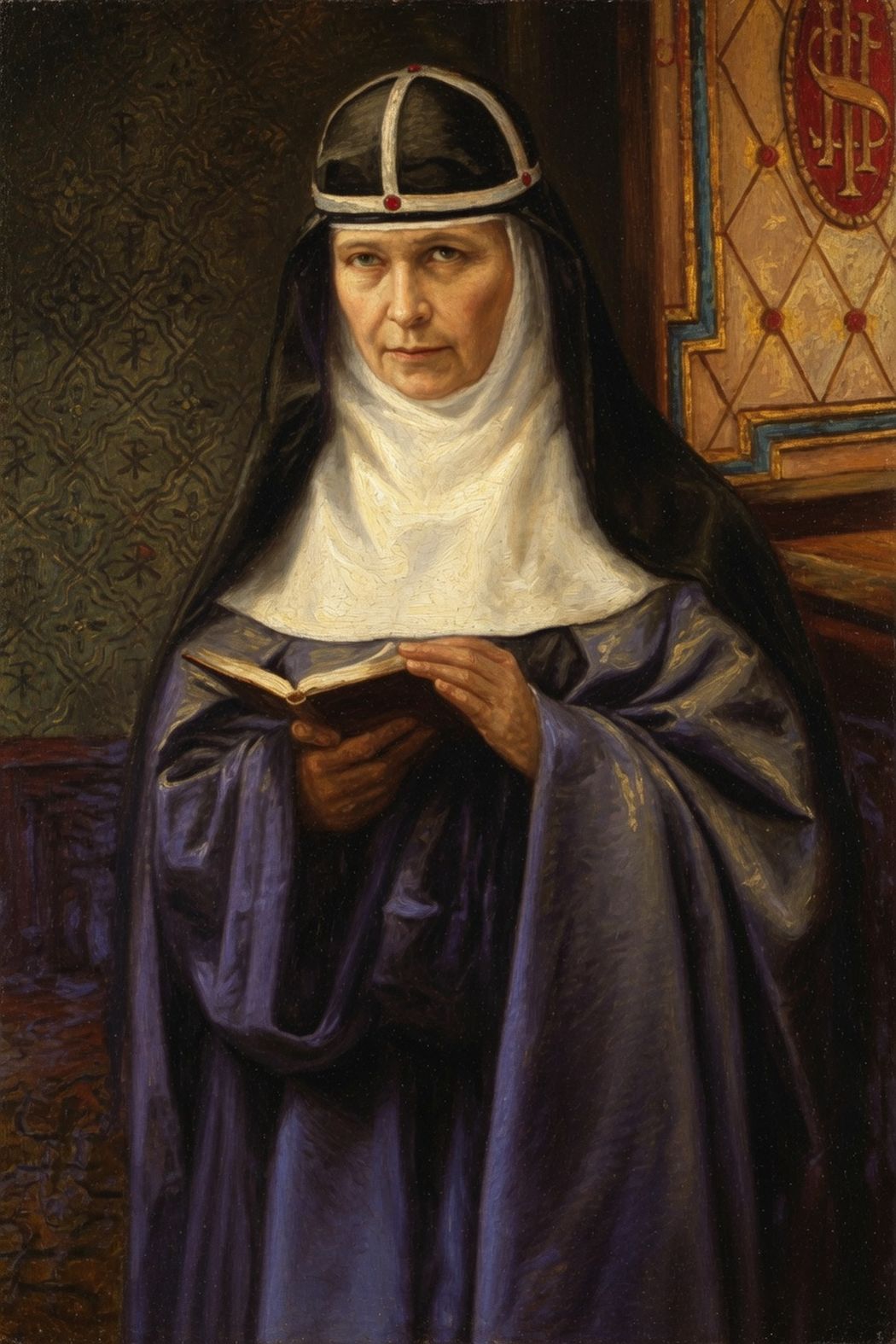
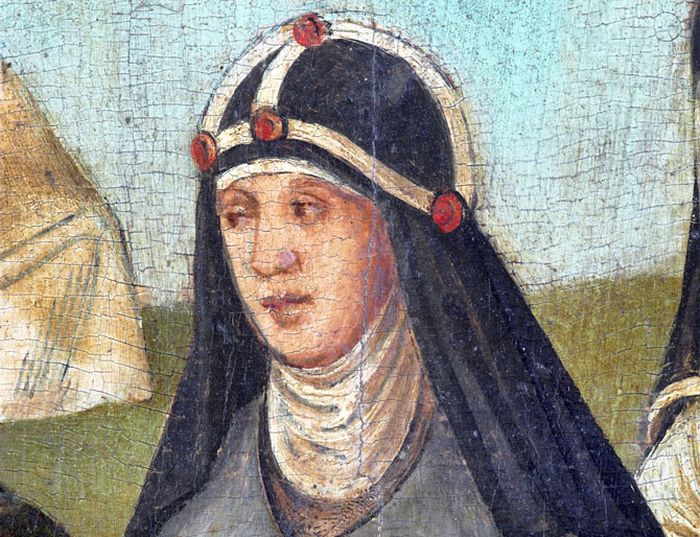
would wear a very distinctive linen headpiece over their black veils,
the "Crown of the Five Holy Wounds." Picture a circle of white linen
with a white linen Cross inside of it. Then picture this fitted over
the head such that the foot of the Cross was at the center of the
forehead. Now imagine a round red piece of cloth sewn at each place the
four arms of the Cross meet the circular piece of linen, and a round
red piece of cloth at the place where the arms of the Cross meet. Each
of the red pieces of cloth represents one of the
Five Wounds of Christ.
Now she had to get papal approval of her plans. It was, though, the
time of the Avignon Papacy, when the Popes lived in Avignon, France
instead of Rome in part because of the nefarious goings-on between
Roman nobles that made life in Rome at the time unpleasant, to say the
least, and in part because of pressure from the King Philip IV of
France. Birgitta, like St. Catherine
of Siena, wanted to end this state of affairs and get the Popes
back in Rome. But 1350 was to be a Jubilee Year,
so instead of going to Avignon, she went to Rome -- and she did this in spite of it being the height of the Black
Death era.
She and her fellow Swedish pilgrims moved into a place near the church
of San Lorenzo in Damaso, and
there she lived as she did in Sweden: ascetically. From 4PM to 6PM,
vespers and night prayers were prayed, followed by bedtime. From 4AM to
8AM, she prayed the Office. And from 10AM to 4PM, she engaged in whatever
work was needed, including caring for the needy, for pilgrims, and for
the sick. One story that comes down to us is that of one of the sons of
the noble Orsini family being felled by the plague, and his mother
wishing for Birgitta to heal him. Without being summoned, Birgitta
showed up, asked to be alone with the boy to pray, and when he woke up,
he was healed. As can be seen from the Orsini mother wanting Birgitta
to come heal her son, Birgitta had a reputation for working miracles,
including casting demons out of sinners. And that reputation grew all
over Europe.
While in Rome, she also spent time visiting many of that city's
churches, including San Paolo fuori
le Mura (St. Paul Outside the Walls) -- the site of St. Paul's
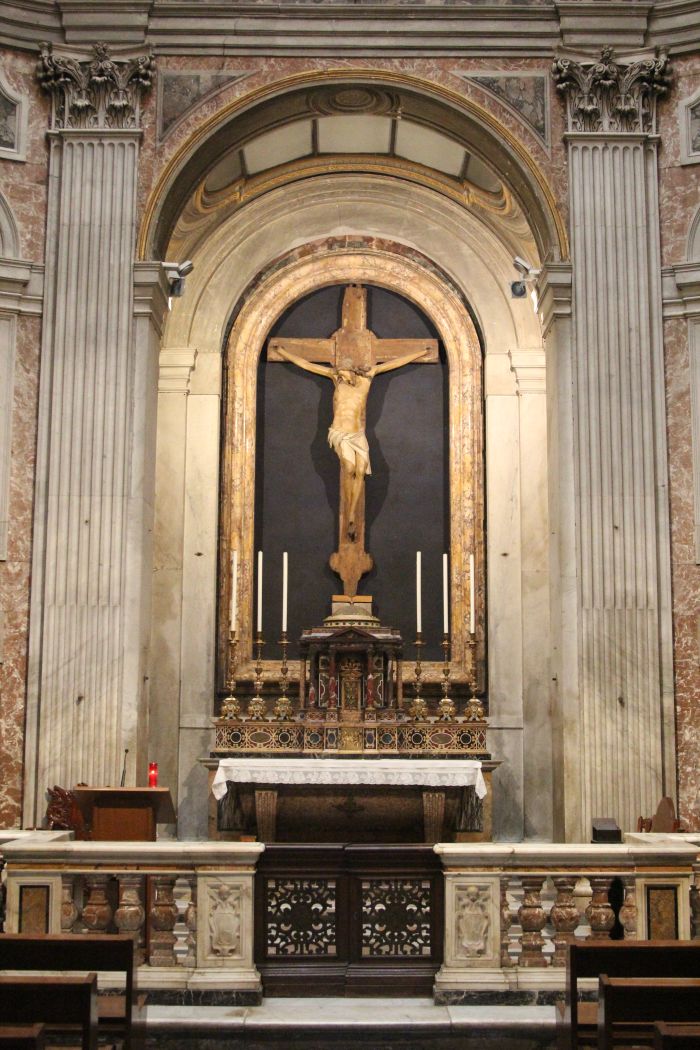
tomb -- where something momentous took place: she was praying before a
Crucifix which seemed to come to life, promising her reward if she were
to pray a set of prayers we know as "the Fifteen Oes,", "the
Fifteen Prayers of St. Bridget," or "the Magnificent Prayers." Christ
said to her,
I received 5,475
blows on My Body. If you wish to honor them in some way, say fifteen
Our Fathers and fifteen Hail Marys with the following Prayers for a
whole year. When the year is up, you will have honored each one of My
Wounds.
These
prayers (see below) are to be prayed once a day for a year, which would
equal 5,475 prayers -- a prayer for each of the wounds Christ received
during His Passion. San Paolo fuori
le Mura burned down in 1823, but was rebuilt -- and the
Crucifix before which St. Birgitta prayed is still preserved in the
Blessed Sacrament Chapel there.
The Crucifix
upon which St.Birgitta gazed when receiving the Fifteen Oes
Along with her many admirers of all classes, she earned some enemies as
well. The Papal Legate, Cardinal da Ceccano, grew concerned about the
situation in Rome, worrying about a lack of food given the huge influx
of pilgrims for the Jubilee. He instituted measures to slow the flow of
visitors, thereby earning the animosity of Roman businesspeople who
stood to make less money because of his restrictions. So angry were
they that they even attacked his home, injuring some of his household.
Birgitta took his side, so many came to see her as an enemy as well. She was
slandered and insulted, even accused of being a witch and a heretic.
Not knowing what else to do, she prayed. And she had a vision of Christ
and His Blessed Mother. The Lord told her, "“It doesn’t matter if they
plot Thy death. My power will break the malice of Thy enemies: if
Mine crucified Me, it is because I permitted it.” Our Lady told her,
“Sing as a group the Ave
Maris Stella and I’ll guard you from every danger," a practice
the Brigittines keep to this day.3
It worked (listen to this Marian hymn below). Resentment toward her disappeared, and she became more
beloved than ever. She did, though, move to live in the great
Benedictine Abbey of Farfa in the town now known as Castelnuovo di
Farfa, about 37 miles northeast of Rome (the Abbey of Farfa is still an
active monastery to this day). Ever relatively low in the trait of
agreeableness, though, she took issue with the abbot there who set a
terrible example of what a monk should be.
Thou, reverend
abbot, who shouldst be a model for the other monks, art a worshipper of
courtesans, as witness thy sons, for the sake of whom thou art in ill
repute. Thou shouldst be an example for the poor and take care of the
needy, but thou showest thyself as a great man, thanks to the alms that
thou hast received. Thou livest rather in palaces than in a monastery.
Thou shouldst be a teacher and as a mother to thy brethren, but thou
hast become a church warden and a stepmother. Thou amusest thyself in
pleasures and magnificence, but they repine in sorrow and affliction
all day long. Therefore, if thou dost not return to the paths of
rectitude, God shall drive thee out of the palace, thou shalt not
commune even with the least of thy brethren, but thou shalt not, as
thou believest, return to thy native land (France), nor enter the
kingdom of God.
He paid her no mind, and ended up dying an unholy death. The
abbey, though, was cleaned up after her visit. Then she went to
Bologna, met with her daughter, Catherine, who'd come to visit with her, and went to stay at the Convento
di San Domenico in Bologna -- St. Dominic's own convent. She
cleaned that monastery up as well (this monastery, too, is still in
existence as a monastery), and the way it happened is rather amusing.
The prior greeted her warmly and treated her well, carrying on as if there weren't a problem in the world. She told him
that his artifice wasn't working, that she knew, in the way St.
Birgitta mysteriously knew things, that his monastery was a mess. And he
knew what happened to the last man she talked to that way, so fell on
his knees and offered to resign. She, in essence, told him to repent,
man up, and get busy reforming the place. And he did.
After a while, Birgitta and Catherine went to Rome, where Catherine got
the news that her husband had died. They moved into a house owned by
the brother of Pope Clement VI -- and Catherine had to pretty much hide
out there: she was only 18 when she came to Rome, and was beautiful,
with blonde hair and blue eyes. Her youth and beauty attracted a lot of
unwanted attention.4 One day, she was crossing through a
vineyard on her way to attend Mass at San
Sebastiano fuori le mura (St. Sebastian Outside the Walls) and
found a rejected suitor stalking her. A stag suddenly showed up out of
nowhere and chased the man off.
When Birgitta wasn't protecting her daughter from love-struck men, she
set about reforming the Church and rebuking the wordliness of too many
of Her clerics. She received guidance on these reforms through her
visions, and her advice based on them was spread far and wide. She
didn't spare even the Pope himself, urging him, as St. Catherine of
Siena did, to return to Rome.
During her time in Italy, she also made pilgrimages to, among many
other places, Assisi to venerate St. Francis, Mt. Gargano in
honor of St. Michael the
Archangel, Bari to honor St. Nicholas,
and Amalfi in honor of St. Andrew. Then
she spent some time in Naples, the guest of Queen Joanna, and returned to
Rome where, finally, she received from Pope Urban V approval for her
Order, which was to abide by the
Rule of St. Augustine. It was now 1370. She was around 67 years old.
St. Birgitta, though, never returned to Sweden; she remained in what is
now Italy for the rest of her life except for a pilgrimage to the Holy
Land, which was to have been made with Catherine, her two sons (Birger
and Karl), her confessor, and a few friends. Except that her son Karl
couldn't make it. The story: Queen Joanna of Naples, who greatly
admired Birgitta, helped her pilgrimage efforts by funding it all in
large part. Now, upon meeting the Queen of Naples, it was customary to
kiss her foot. Joanna, though in her forties, was still a woman men
found attractive -- and when Birgitta's son, Karl, met her, instead of
kissing her foot, he kissed her lips. Queen Joanna -- a married woman
-- was totally charmed by his move and said, undoubtedly jokingly, that
she'd like to marry him someday; Birgitta was mortified. And within two
weeks, Karl fell ill and died. A great funeral procession was held for
him in Naples, with the Queen and St. Birgitta walking side-by-side.
She made her pilgrimage to the Holy Land when she was 70, taking with
her, aside from the companions listed earlier, a hawthorn wood staff
and a boxwood drinking cup (they are now in possession of a German
museum -- Museumsforum Altomünster in Bavaria, Germany -- and have been
since the last Brigittine Abbey closed there in 2017). Of all the
things she saw, she especially loved visiting the Church of the Holy
Sepulchre.
After a few months in the Holy Land, she returned to Naples, then went
on to Rome, moving into a house at Piazza Farnese 96 -- a house known
now as la Casa di Santa Brigida (House of St. Bridget) and which can be
visited today and is now a part of a complex including a church
named after St. Birgitta, the Brigittine motherhouse, and a guest house
for pilgrims.
It is now 1373, and she was old and becoming quite ill.
She went through a dark period of doubt and temptation during Lent of
that year, but by Easter she was granted consolation. On July 17, she
had a vision of Christ, Who told her that she would soon be joining Him, and
on July 23, just after receiving Viaticum,
she died. Her last words were, "Domine, in manus tuas commendo animam
meam" ("Lord, into Thy hands I commend my spirit.").
About a year after Birgitta's death, her body was taken back to Sweden.
Writer Sven
Magnus Gronberger describes the scene of her return to her native land:
[T]he
funeral procession, accompanied everywhere by vast crowds of people,
proceeded to Linkoping, the ancient seat of the Bishop of the diocese,
and here Bishop Nicholas Hermansson received the pilgrims and the
relics, which were afterward exposed for public veneration in the
renowned Cathedral of that city. On July 4, 1374, as tradition has it,
the procession reached Vadstena, Bridget's home town. The pilgrims
carrying the remains of the famous saint proceeded to the convent
gates, which were thrown wide open, the bells sounded their solemn
salutation from the tower of the convent church and all the monks and
nuns assembled to receive them. According to tradition, the relics were
exposed for public veneration in the church for eight days, but the
actual enshrinement did not take place until June 1, 1393.
Very soon
after the approval of her Order, Brigittine convents had risen up in various
parts of Euurope, an
important one being Syon House at Isleworth, in England. The most
important convent, though, is the one built on the property given to
her so
long ago by the King and Queen of Sweden -- the convent in Vadstena.
Birgitta's beautiful and literally saintly daughter, Catherine, became
its abbess
in 1374. Birgitta's relics (and those of her daughter, whom we know as St. Catherine of
Sweden) can be venerated at the abbey's church to this day.
Birgitta
was canonized on October 7, 1391 by Boniface IX, and is the
patron saint of widows, of Sweden, and of Europe, along with SS
Benedict, Cyril, Methodius, Catherine of Siena, and Teresa Benedicta of
the Cross (Edith Stein). She can be recognized in art by her
distinctive habit or the presence of pilgrim gear (staff, hat, bag,
etc.). Often, she is shown writing down her visions. Her feast is on
October 8 per the 1962 calendar, but on July 23 in the Novus Ordo.
Alas, Vadstena Abbey and its associated church -- called Blåkyrkan or
Blue Church because of the bluish-gray limestone from which it is made
-- are now in Lutheran hands. But in the early 20th century,
Brigittines were re-established in the near vicinity of the church, at
a
convent called Saint Bridget's Convent of Pax Mariae.
Customs
Some Catholics may prepare for this feast by praying the Novena to St. Birgitta (Bridget) of Sweden,
starting on September 29 and ending on October 7, the eve of this
feast. For her feast itself, try this prayer :
O Lord, our God,
Who through Thine only-begotten Son didst reveal heavenly secrets to
blessed Bridget, grant us, Thy servants, by her kind intercession, to
rejoice and be glad in the revelation of Thine eternal glory. Through
our Lord Jesus Christ, Thy Son, Who lives and reigns with Thee in the
unity of the Holy Spirit, God, forever and ever. Amen.
Those living in Europe might want to make a pilgrimage today. Vadstena,
the site of the original Brigittine convent, has been a very big
pilgrimage site since the end of the 14th century. There is a modern
pilgrim path set up by Lutherans, called the Birgittalederna. One could make it,
I suppose, and skip any Lutheran aspects there may be. One could also
make pilgrimages to sites in Rome, especially to St. Paul Outside the
Walls to see the famous Cross before which St. Birgitta received the
"Fifteen Oes." And speaking of them...
Today would be a good day to consider taking up one or more of the various devotions
associated with St. Birgitta, above all the Fifteen Oes, the 12-Year
Prayer, the Brigittine Rosary(also called the Carmelite Rosary), and/or the nightly singing of Ave Maris
Stella. A bit about each of these devotions:
The Fifteen Oes (also known as "The Magnificent Prayers" or, simply, "The Fifteen Prayers of St. Bridget")
These prayers in
honor of Christ's wounds -- all 5,475 of them -- are the prayers that
were given to St. Birgitta by Christ Himself. This set of fifteen
prayers, each accompanied by a Pater and an Ave, are to be prayed once
a day for for 365 days -- i.e., one year. 15 X 365 = 5475 prayers in
total, one for each of the wounds Christ received during His Passion.
These prayers are called the fifteen "Oes" because each begins with "O,
Jesus."
Note that these prayers are typically presented with "promises"
attached. These "promises" should be ignored.
The 12-Year Prayer
These prayers in
honor of seven times Christ shed His Blood for us are associated with
St. Birgitta and are very often said to have come from her. It may be, though, that
they were simply inspired by her.
In any case, they are an old tradition.
These prayers are prayed once a day for 12 years.
Note that these prayers, too, come with "promises" that should be
ignored. I also present these prayers off this site's page about The
Five Wounds: The
12-Year Prayer and they can be downloaded in pdf format here: The Twelve Year Prayer
(pdf)
The Brigittine Rosary (also called the
Carmelite Rosary)
St. Birgitta's method of praying the Rosary is different from the standard
Dominican method (the method the average Catholic-in-the-pews uses), and it was adopted by the Carmelite Order. This
Rosary has six decades instead of five, making for 63 Ave beads in all.
And instead of praying the Gloria, the
Apostles Creed is recited. There being 63 Ave beads is said to be
representative of the 63 years St. Birgitta believed Mary lived on
earth before her Assumption.
The extra decade means, too, that seven Paters are prayed in all, one
for each of the Seven Sorrows of
Mary.
The nightly singing of Ave Maris Stella
You'll recall that the Blessed Virgin told St. Birgitta to sing the Marian hymn Ave Maris Stella (Hail,
Star of the Sea) with her group each night, and she would protect them
from danger. Perhaps she will do the same for you! You can download this hymn's classic chant notation or modern notation here--
-- and below, you can hear
the
hymn sung by the Benedictines of Mary, Queen of Apostles:
Ave Maris Stella
Dei Mater alma,
Atque semper virgo,
Felix coeli porta.
Sumens illud ave
Gabrielis ore,
Funda nos in pace,
Mutans Evae nomen.
Salve vincla reis
Profer lumen caecis
Mala nostra pelle,
Bona cuncta posce.
Monstra te esse Matrem
Sumat per te preces
Qui pro nobis natus
Tulit esse tuus.
Virgo singularis
Inter omnes mitis
Nos culpis solutos
Mites fac et castos.
Vitam presta puram
Iter para tutum,
Ut, videntes Jesum
Semper collaetemur.
Sit laus Deo Patri,
Summo Cristo decus
Spiritui sancto:
Tribus honor unus.
Hail thou star
of ocean
Portal of the sky
Ever virgin Mother
Of the Lord Most High.
O! by Gabriel’s Ave,
Uttered long ago,
Eva’s name reversing,
Established peace below.
Break the captives’ fetters,
Light on blindness pour,
All our ills expelling,
Every bliss implore.
Show thyself a Mother,
Offer Him our sighs,
Who for us incarnate
Did not thee despise.
Virgin of all virgins
To thy shelter take us,
Gentlest of the gentle
Chaste and gentle make us.
Still, as on we journey,
Help our weak endeavor,
Till with thee and Jesus
We rejoice forever.
Through the highest heaven,
To the almighty Three
Father, Son, and spirit,
One same glory be.
As to music for the day, aside from the Ave Maris Stella above, there is much to choose from! The Brigittine
nuns have a weekly system of monophonic, unaccompanied chant for the
divine office that is all their own -- chant called the Cantus
sororum (“Songs of the Sisters”). Two samples
are below, both sung by a duo called Vox Silentii. The first is Jesu benigne redemptor; the second
is Maria summe trinitatis:
There are no special foods for the day that I know of, but if you want
to have a Swedish feast, try these recipes for Västerbottenpaj (a cheese pie) or Laxpudding (a baked salmon and potato dish), along with Äppelkaka (apple cake) with Vaniljsås (vanilla custard sauce) for dessert:
Västerbottenpaj
1 1/4 c. flour (plus more for dusting)
1 1/2 tsp sugar
1/2 tsp salt
8 TBSP (1 stick) cold unsalted butter cut into half inch cubes
3 TBSP ice water
2 TBSP sour cream
Filling:
3 large eggs
1/2 c. whole milk
1/2 c. heavy cream
1/4 tsp salt
1/4 tsp pepper
8 ounces Västterbotten cheese, shredded (about 2 cups) (substitute with Gruyere or an aged white cheddar, if needed)
Mix
the flour, sugar, and salt. Cut in the butter until you get pea-sized
bits. Stir the ice water and sour cream together, then mix it into the
dry mixture. Knead it together until you get a pie dough, adding more
ice water as needed. Form a ball, press it down lightly, wrap it in
saran, and chill for at least an hour.
Roll the dough out into a 12" disk on a floured surface. Put it in a pie tin. Chill for 30 minutes.
Preheat
the oven to 375F. Prick the bottom of the dough all over with a fork,
cover the edges with foil, fill the inside with pie weights or dried
beans, and blind bake for about 25 minutes until light golden in
color. Remove the foil and weights/beans, and turn oven down to
350F.
Mix
together the eggs, milk, cream, salt, and a pepper. Sprinkle the cheese
over the bottom of the warm crust and pour the egg mixture over the
top. Transfer to the oven and bake until just set and browned on top,
about 25-30 minutes. Cool slightly and serve warm -- cut into wedges,
each topped with a dollop of creme fraiche or sour cream mixed with
dill and chopped onion -- alongside salmon, a green salad or dilled
cucumbers in a vinaigrette, and bread (or even better, a big knäckebröd
with the hole in the middle).
Laxpudding
1 1/2 lb salmon fillet
3 TBSP sea salt
2 TBSP brown sugar
zest of 1 lemon
1 tsp black peppecorns
____________________
1 1/2 lb potatoes
butter
2 medium onions, sliced
5 eggs
1 1/3 c. heavy cream (whipping cream)
3/4 oz dill, chopped (about 1/4 c. chopped)
white pepper
sea salt
Mix
together the sugar, pepper, salt and lemon zest and cover the salmon
fillet with it. Let it sit for 24 hours in the fridge. The next day,
rinse the fish with cold water and then soak in milk for 4 hours.
Remove the skin, pat dry, and cut into thin slices.
Boil
the potatoes in salt water until just tender (al dente), then drain
them and let them cool. Peel and slice, making them the same thickness
as the salmon.
Butter a 9X13 pan. Heat oven to 350F.
Saute the sliced onions in butter until just soft (not caramelized).
Spread
a single layer of potatoes in the baking dish. Top with a layer of
onion and salmon, and sprinkle with some of the dill and white pepper.
Add another layer of potatoes, then another layer of salmon, onion,
dill, etc., making sure you have a potato layer on top.
In
a bowl, beat the eggs then add the cream and season with
salt. Pour over the layered potatoes and salmon until just covered. Top
with a few bits of butter. Bake for about 45 minutes until the egg
mixture has set and it's all golden on top.
Äppelkaka
3 or 4 apples, peeled, cored, in medium slices
3 eggs
1 1/4 c. granulated sugar
1 3/4 c. flour
2 tsp baking powder
1 tsp vanilla
1 pinch salt
7 TBSP butter
3/4 c. milk
4 TBSP brown sugar
1 tsp ground cinnamon
Preheat oven to 350°F. Grease the sides of the spring form and line the bottom with baking paper.
Whisk together the eggs and sugar. Sift in the flour, baking powder and vanilla and stir until smooth.
Melt
the butter and stir in the milk. Add this milk mixture to the egg
mixture. Spread the batter your pan and arrange the apple slices on top
in circles. Sprinkle the top with brown sugar and cinnamon. Bake for
about 45 minutes until the cake tests done. Cool and then remove from
pan. If desired, serve with vaniljsås (vanilla custard sauce).
Vaniljsås (vanilla custard sauce)
1 1/2 c. milk
4 large egg yolks
1/3 c. sugar
1 TBSP cornstarch
1 1/2 tsp vanilla
Pinch of salt
In a bowl, beat the egg yolks, sugar, and starch together until pale and smooth. Set aside.
In a saucepan, heat the milk, salt, and vanilla just until it begins to simmer.
Slowly
pour a small splash of hot milk into the egg mixture while whisking
fast so the eggs don't curdle. Pour the warmed-up egg mixture back into
the pot over low heat, stirring constantly with a wooden spoon or
spatula until it thickens enough to coat the back of the spoon (don't
let it boil!). Cool and serve over the cake.
Finally, a few things to consider for your children:
Make
a
Brigittine veil and crown for your daughter to play dress-up: Get a
large white handkerchief and tie it over her head "do-rag style," secured
in the back. For the
veil, you'll need a simple lightweight piece of black fabric long
enough to fit over her head and go down to the small of her back.
Measure from the middle of her forehead, over her crown of her head,
and down the back of the head to a point that is equidistant from the
crown as the middle of her forhead is to her crown. Add 1/2" to this,
and call this measurement X". Cut two strips of white fabric about 3/4"
wide and X" long. Now measure around her head at the middle of her
forehead and add 1/2". Call this measurement Y". Now cut a strip of
white fabric about 3/4" wide and Y" long. Make a circle out of the
fabric that is Y" long, overlapping the ends no more than 1/8", and sew
the ends together. Now make a + shape out of the strips that are X"
long and stitch them together where they cross. Then stitch the tip of
each arm of the cross piece to the circle of linen. Now cut five 3/4"
circles out of dark red cloth. Stitch one of the circles to the top of
the crown where the arms of the cross intersect. Then stitch one onto
the circular piece of white linen at each of the places where an arm of the cross is
sewn to it. Place the black veil on your girl's head over the white "do-rag" (formally called a cuffia), then slide the
crown on top, situating it so that one of the red circles sits over the
middle of her forehead. Put her in a long gray dress, and you have a
little Brigittine
nun.
Can your
children find Sweden on a map? How about getting out a globe or atlas
and tracing St. Birgitta's travels from Sweden to Cologne to Rome to
Naples to the Holy Land, etc.?
“Who, O Lord, has treated Thee thus?” “They that despise Me and forget
My love.” This was the first revelation of the Son of God to Bridget of
Sweden. Francis of Assisi, raising before the world the standard of the
cross, had announced that Christ was about to recommence the dolorous
way; not now in His own Person, but in the Church, who is flesh of His
flesh. The truth of this declaration Bridget experienced from the very
opening of that fatal fourteenth century, during which such innumerable
disasters, the results of crime, fell at once upon the west.
Born in the year when Sciarra Colonna, a new Pilate’s servant, dared to
strike the Vicar of Christ, Bridget’s childhood was contemporaneous
with those sad falls, which caused the Church to be despised by her
enemies. There were no saints in Christendom comparable to the great
ones of old; in the preceding age the Latin races had exhausted their
vitality in producing flowers; but where were the promised fruits?
Ancient Europe had nought but affronts for the Word of God; this feast,
this apparition of Jesus in cold Scandinavia, seems to point to His
flight from the habitual center of His predilection. Bridget was ten
years old, when the Man of sorrows sought a resting place in her heart:
and at that very time, the death of Clement V and the election of John
XXII in a foreign land, fixed the papacy in its seventy years’ exile.
Rome meanwhile, widowed of her Pontiff, appeared the most miserable of
cities: “The ways of Sion mourn, because there are none that come to
the solemn feast.” Sacked by her own sons, she was daily losing some
remnant of her ancient glory; her public roads were scenes of
bloodshed; solitude reigned amid the ruins of her crumbling basilicas;
sheep grazed in St. Peter’s and the Lateran. From the seven hills
anarchy had spread throughout Italy, transforming the towns into haunts
of brigands, and the country parts into deserts. France was doomed to
expiate, in the horrors of a hundred years’ war, the captivity of the
sovereign Pontiff.
Unfortunately, the captivity was loved; the court of Avignon did not
mourn like the Hebrews by the rivers in Babylon; richer in gold than in
virtues, it were well, had they not, for a long time, shaken the
influence of the Holy See over the nations. The German empire and Louis
of Bavaria could easily refuse obedience to the ward of the Valois; the
Fratricelli accused the Pope of heresy; while, countenanced by the
doctors of the law, Marsillus of Padua attacked the very principle of
the papacy. Benedict XII discouraged by the troubles of Italy,
abandoned his design of returning to Rome; and built upon the rock of
Dome the famous castle, and once fortress and palace, which seemed to
fix the residence of the Popes forever on the banks of the Rhone. The
misery of Rome, and the splendor of Avignon, reached their height under
Clement VI who entered into a contract with Jane of Naples, Countess of
Provence, securing to the Church a definitive possession of Avignon. At
that time the papal court surpassed all others in luxury and
worldliness. God in His justice visited the nations with the scourge of
the black death; while in His mercy He sent warnings from heaven to
Pope Clement (chapter 63):
“Arise; make peace between the kings of France and England; and go into
Italy to preach the year of salvation, and to visit the places watered
by the blood of saints. Consider how, in the past, thou hast provoked
My anger, doing thy own will and not thy duty; and I have held My
peace. But now my time is at hand. If thou wilt not obey, I shall
require of thee an account of the unworthiness wherewith thou hast
passed through all the degrees by which I permitted thee to be exalted
in glory. Thou wilt be answerable for all the avarices and ambition
that have been rife in the Church in thy days. Thou couldst have done
much towards a reformation, but being carnal-minded thou wouldst not.
Repair the past by zeal during the rest of thy life. Had not My
patience preserved thee, thou wouldst have fallen lower than any of thy
predecessors. Question thy conscience, and thou wilt see that I speak
the truth.”
This severe message, dictated by the Son of God to the prophetess
Bridget of Sweden, came form that northern land where sanctity seemed
to have taken refuge during the past half century. Though incurring
such reproaches, the Pope still had great faith, and he accordingly
received with generous courtesy the messengers from the princess of
Nericia. But, though he promulgated the celebrated Jubilee of the
half-century, Clement VI allowed the holy year to pass away without
getting himself to prostrate at the tombs of the apostles, to which he
convoked the entire world. The patience of God was at an end. The
judgment of that soul was revealed to Bridget; she saw its terrible
chastisement, which however was not eternal, and was tempered by hope
(chapter 44).
Hitherto wholly engaged with the supernatural interests of her own
country, Bridget suddenly found her mission embrace the whole world. In
vain, by her prayers to God, by her warnings to princes, had the saint
striven to avert from Sweden the trials that were to end in the union
of Calmar. Neither Magnus II nor his consort Blanche of Dampierre, took
to heart the menaces of their noble relative (chapter 31): “I saw the
sun and the moon shining together in the heavens, until both having
given their power to the dragon, the sky grew pale, reptiles filled the
earth, the sun sank into the abyss, and the moon disappeared, leaving
no trace behind.”
The criminal coldness of the south had been the occasion of grace for
the north; but the latter in its turn did not profit by the time of its
visitation: and Bridget quitted it forever. She herself was a city of
refuge to our Lord. Taking up her abode in Rome, she there, by her
holiness, prepared the way for the return of Christ’s vicar. There for
twenty years she, as it were, personified the eternal city, enduring
all its bitter sufferings, knowing all its moral miseries, presenting
its tears and prayers to our Lord; continually visiting the tombs of
the apostles and martyrs throughout the peninsula; and at the same time
never ceasing to transmit to Pontiffs and kings the messages dictated
to her by God.
At length the horizon appeared to be brightening; while the just and
inflexible Innocent VI reformed the papal court, Albornoz was restoring
peace in Italy. In 1367 Bridge had the great joy of receiving in the
Vatican the blessing of Urban V. Unhappily, in three short years Urban
quitted the threshold of the apostles to return to his native land;
but, as Bridget foretold, he re-entered Avignon only to die. He was
succeeded by the nephew of Clement VI, Roger de Beaufort, under the
name of Gregory XI, who was destined to put an end to the exile and
break the chains of the Roman Pontiffs.
But Bridget’s hour had come. Another was to reap in joy what she had
sown in tears; Catharine of Siena was to bring back to the holy city
the vicar of our Lord. As to the valiant Scandinavian, who had never
lost courage or faltered in faith through the failure of her missions,
she was inspired by her divine Spouse to visit the holy places, the
scenes of His Passion. It was on her return from this last pilgrimage
that, far from her native land, in that desolate Rome whose widowhood
she had striven in vain to terminate, she was called to her heavenly
reward. Her body was carried back to Scandinavia by her daughter St.
Catharine of Sweden. It was laid in the yet unfinished monastery of
Vadstena, mother-house of that projected Order of our Savior, the
foundations of which, like all the undertakings imposed by God upon
Bridget, was not to be completed until after her death. Twenty-five
years before, she had received almost simultaneously the command to
found, and the command to quit, this holy retreat; as though the Lord
would give her a glimpse of its blessed peace, only to crucify her the
more in the very different path into which He immediately led her. Such
is God’s severity towards His dear ones, and such His sovereign
independence with regard to His gifts. In the same manner, He had
allowed the saint, in her early years, to be attracted by the beautiful
lily of virginity, and had then signified His will that the flower
should not be here. “When I cry,” said the prophet, in a captivity
figurative of that whereof Bridget felt all the bitterness, “when I cry
and entreat, He hath shut out my prayer. He hath shut up my ways with
square stones, He hath turned my paths upside down.”
Before reading the liturgical legend, let us call to mind that St.
Bridget died on July 23, 1373; October 8 is the anniversary of the
first Mass celebrated in her honor by Pope Boniface IX on the day
following her canonization (October 7, and 8, 1391). Martin V confirmed
the Acts of Boniface IX in her honor; and approved her Revelations,
which had been violently attacked in the Councils of Constance and
Basle, only to come forth with a higher recommendation to the piety of
the faithful. Many Indulgences are attached to the rosary which bears
the saint’s name. These are now, by the favor of the apostolic See,
frequently applied to ordinary rosaries; but it must be remembered that
the true rosary of St. Bridget is composed of the Ave Maria recited
sixty-three times, the Pater noster seven times, and the Credo seven
times, in honor of the supposed number of our Lady’s years on earth,
and of her joys and sorrows. It was also from a desire of honoring our
Lady, that the saint vested in the abbess the superiority over the
double monasteries in the Order of our Savior.
Bridget was born in Sweden of noble and pious parents, and led a most
holy life. While she was yet unborn, her mother was saved from
shipwreck for her sake. At ten years of age, Bridget heard a sermon on
the Passion of our Lord; and the next night she saw Jesus on the cross,
covered with fresh blood, and speaking to her about his Passion.
Thenceforward meditation on that subject affected her to such a degree,
that she could never think of our Lord’s sufferings without tears.
She was given in marriage to Ulfo prince of Nericia; and won him, by
example and persuasion, to a life of piety. She devoted herself with
maternal love to the education of her children. She was most zealous in
serving the poor, especially the sick; and set apart a house for their
reception, where she would often wash and kiss their feet. Together
with her husband, she went on pilgrimage to Compostella, to visit the
tomb of the apostle St. James. On their return journey, Ulfo fell
dangerously ill at Arras; but St. Dionysius, appearing to Bridget at
night, foretold the restoration of her husband’s health, and other
future events.
Ulfo became a Cistercian monk, but died soon afterwards. Whereupon
Bridget, having heard the voice of Christ calling her in a dream,
embraced a more austere manner of life. Many secrets were then revealed
to her by God. She founded the monastery of Vadstena under the rule of
our Savior, which was given her by our Lord himself. At his command,
she went to Rome, where she kindled the love of God in very many
hearts. She made a pilgrimage to Jerusalem; but on her return to Rome
she was attacked by fever, and suffered severely from sickness during a
whole year. On the day she had foretold, she passed to heaven, laden
with merits. Her body was translated to her monastery of Vadstena; and
becoming illustrious for miracles, she was enrolled among the saints by
Boniface IX.
O valiant woman! support of the Church in most unhappy times, mayst
thou now be blest by all nations! When the earth, grown poor in virtue,
no longer paid its debts to the Lord, thou wast the treasure discovered
and brought from the uttermost coasts to supply for the indigence of
many. Thou didst earn the goodwill of heaven for the hitherto despised
north. Then the holy Spirit was moved by the prayers of apostles and
martyrs to lead thee to the land which their blood had not sufficed to
render fruitful for the Spouse; thou didst appear as the merchant’s
ship bringing bread from afar to countries wasted and barren. At thy
voice, Rome took heart again; after thy example, she expiated the
faults which had wrought her ruin; thy prayers and hers won back to her
the heart of her Spouse and of His vicar.
Thine own portion was one of suffering and labor. When, to the joy of
all, thy work was consummated, thou hadst already quitted this world.
Thou didst resemble the heroes of the old Testament, saluting from afar
the promises that others were to see fulfilled, and acknowledging
themselves to be strangers and pilgrims on the earth. Like them thou
didst seek, not the fatherland thou hadst abandoned and whither thou
couldst have returned, but the only true home which is heaven. Moreover
God made it a glory to be called thy God.
From the eternal city where thine exile is at an end, preserve in us
the fruit of thy example and teachings. Thy Order of our Savior
perpetuates them in the countries where it still exists though so much
diminished; may it revive at Vadstena in its primitive splendor! By it
and its rivals in holiness, bring back Scandinavia to the faith, now so
unhappily lost, to its apostle Anscharius, and of Eric and Olaf its
martyr kings. Lastly, protect Rome, whose interests were so specially
confided to thee by our Lord; may she never again experience the
terrible trial which cost thee a lifetime of labor and suffering!
Footnotes:
1 The name in Swedish is pronounced with a
hard G: beer-GEE-ta
2 Also written as Bridgettines,
Bridgettines, Birgittines, or Brigidines. The abbreviation for their
formal Latin name is OSsS.
3Ave
Maris Stella is an old hymn, possibly as old as the 6th century,
though some attribute its authorship to St. Bernard of Clairvaux who
lived in the 12th century.
4 Italian men and blondes. Whadyagonnado?
(I can ask this aloud; I have many vowels in my name.)