``Where
the Bishop is, there let the multitude of believers be;
even as where Jesus is, there is the Catholic Church'' Ignatius of
Antioch, 1st c. A.D
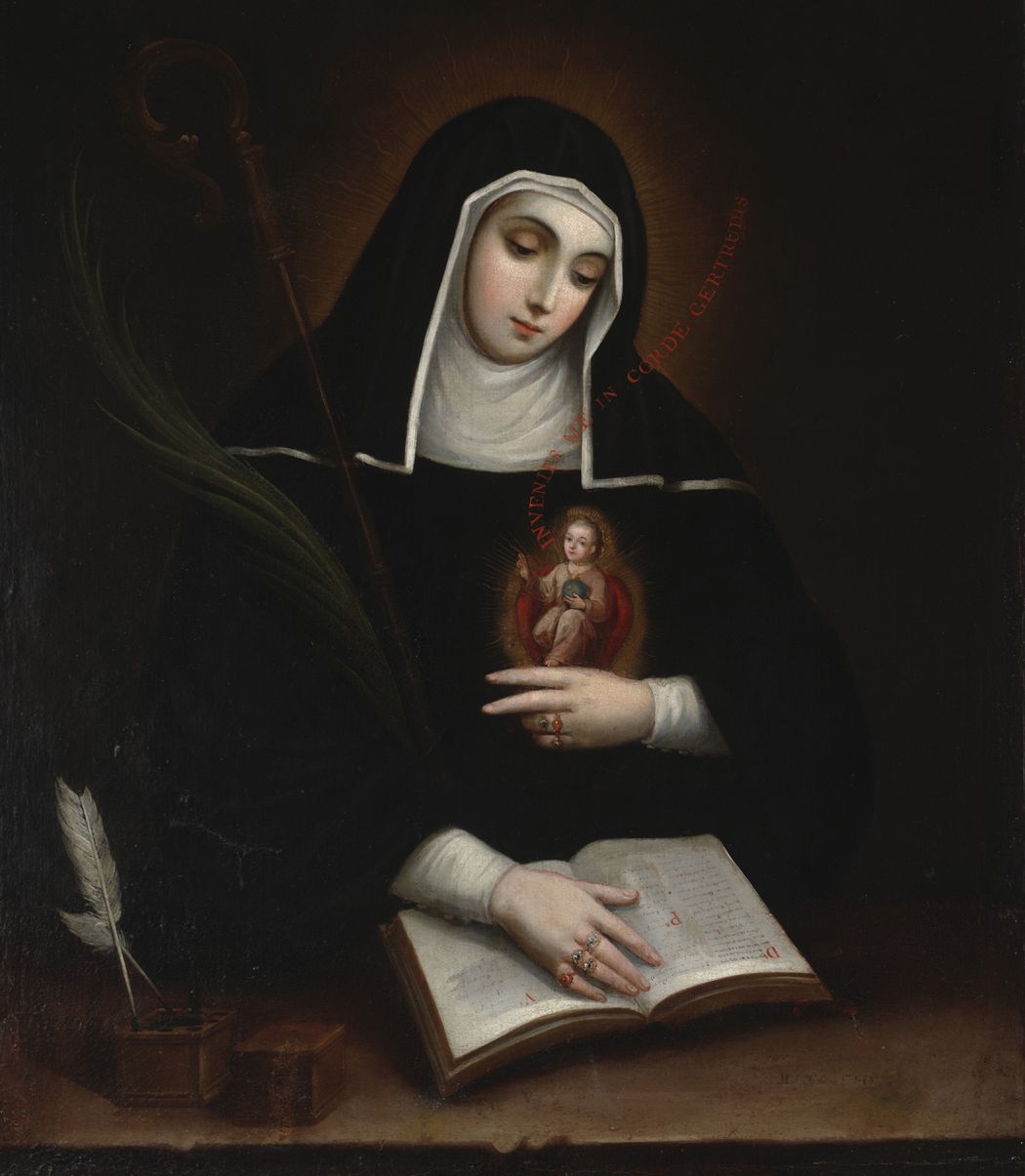
Feast of St. Gertrude the Great
Pretty
much the only thing known about St. Gertrude's origins is that she was
born on the Feast of the Epiphany -- January 6, 1256 -- in Saxony, now
a state in the eastern side of Germany. She was likely orphaned,
because at the age of four or five, she was given over to be cared for
by the monastery school at Helfta, now a district of the city of
Eisleben.
Little Gertrude couldn't have been in better hands: the Abbess of
Helfta was the very holy Gertrude of Hackeborn, and her sister, St.
Mechtilde of Hackeborn -- also a nun there -- took special care of the
girl.
Helfta was a very special place -- the crown of German monasteries, a
convent that focused on solid education in the liberal arts and Sacred
Scripture and which lived under the Rule of St. Benedict, but with Cistercian reforms.
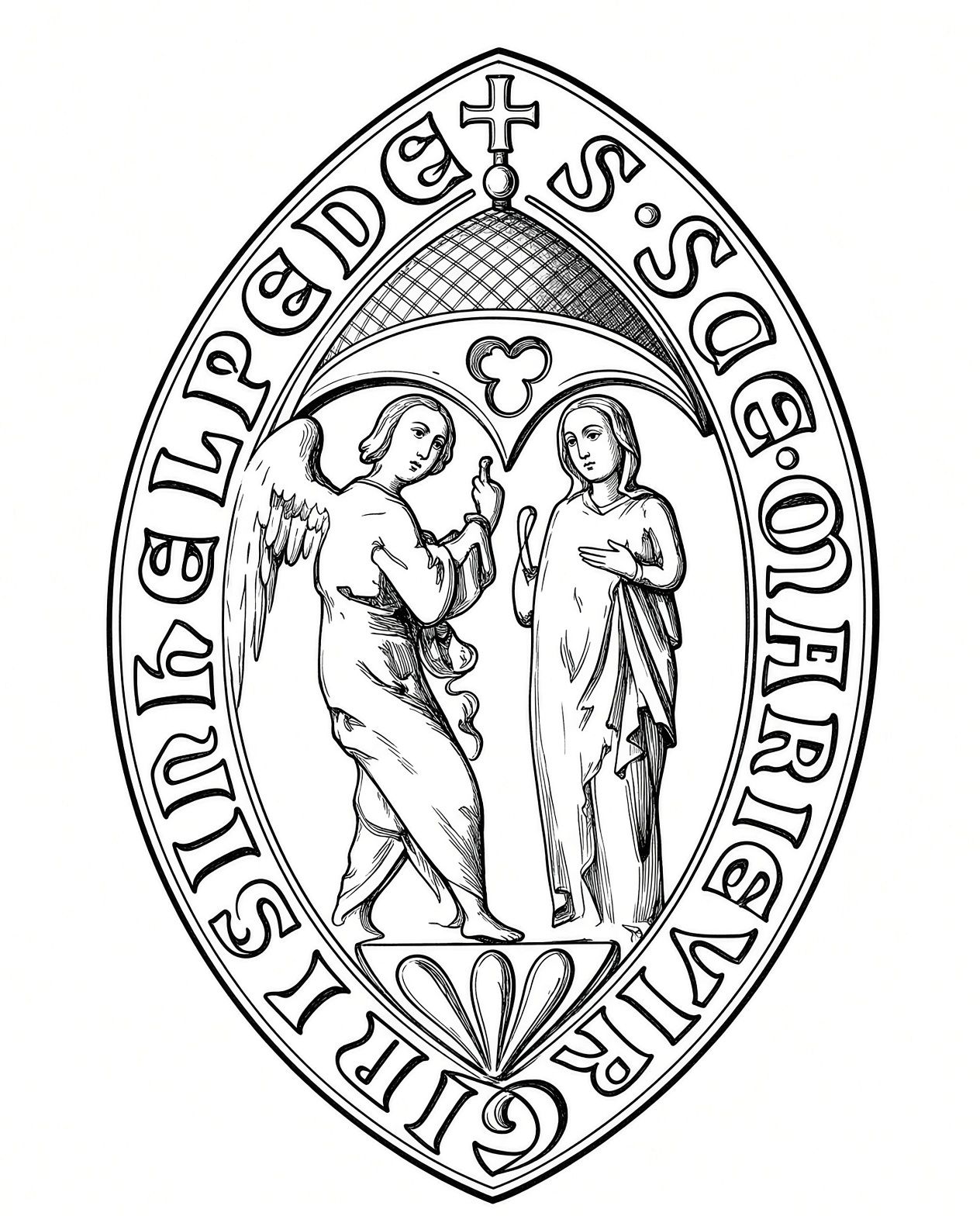
The seal of the convent at Helfta, depicting the Annunciation. Click to enlarge.
The intellectually gifted Gertrude thrived in this bookish
environment. But in January of her twenty-sixth year, she had a vision
that led her to see "the utter emptiness of all transitory things," as
the Catholic Encyclopedia puts it. It was the first of many visions,
and she'd record them in a book called "Herald of Divine Love," which
is written as if she is recalling her experiences while talking to
Christ Himself -- for example,
I
was in the twenty-sixth year of my age when, on the Monday before the
Feast of the Purification of Thy most chaste Mother, in a happy hour,
after Compline, at the close of day, Thou the true Light, Who art
clearer than any light, and yet deeper than any recess, having resolved
to dissipate the obscurity of my darkness, didst sweetly and gently
commence my conversion by appeasing the trouble which Thou hadst
excited in my soul for more than a month, which Thou didst deign to
use, as I believe, to destroy the fortress of vain-glory and curiosity
which my pride had raised up within me, although I bore the name and
habit of a religious to no purpose; but Thou didst will to use this
means, that Thou mightest thereby show me Thy salvation.
These writings are very nuptial in nature and reflect that the entire
focus of her life changed from the temporal to the eternal. Her
attention to God paid off. One winter, while sitting in the refectory,
she was rewarded with invisible stigmata after meditating on this
prayer about the Five Wounds of Christ:
O
Lord Jesus Christ, Son of the living God, grant that I may aspire
towards Thee with my whole heart, with full desire and with thirsty
soul, seeking only Thy sweetness and Thy delights, so that my whole
mind and all that is within me may most ardently sigh to Thee, who art
our true Beatitude. O most merciful Lord, engrave Thy Wounds upon my
heart with Thy most precious Blood, that I may read in them both Thy
grief and Thy love ; and that the memory of Thy Wounds may ever remain
in my inmost heart, to excite my compassion for Thy sufferings and to
increase in me Thy love. Grant me also to despise all creatures, and
that my heart may delight in Thee alone. Amen.
She wrote,
I
thought attentively on these things, when I perceived that the grace
which I had so long asked by the aforesaid prayer was granted to me,
unworthy though I am; for I perceived in spirit that Thou hadst
imprinted in the depth of my heart the adorable marks of Thy sacred
Wounds, even as they are on Thy Body; that Thou hadst cured my soul, in
imprinting these Wounds on it; and that, to satisfy its thirst,Thou
hadst given it the precious beverage of Thy love.
He
was clothed in a gold-coloured habit, covered with golden eagles; which
signified that, though this Saint was elevated to the highest
contemplation, even while in the body, he always sought to humble
himself by the consideration of his own unworthiness. As Gertrude began
to consider these ornaments, she perceived a red light shining from
under the golden eagles; from which she learned that St. John always
commenced his contemplation by the remembrance of the Passion of the
Lord, which he had beheld with his own eyes, and which he had never
ceased to mourn in his inmost heart; and thus by degrees he flew to the
sublimity of the Divine Majesty, which he contemplated without pain by
the eyes of his soul, as far as it is possible for man to do. He had
also two golden lilies on his two shoulders on the right was written,
in marvellous characters, the words of the Gospel Discipulus quem diligebat Jesus [the disciple whom Jesus loved]; and on the left, Iste custos Virginis
[guardian of the Virgin]; to mark the singular advantage which he
enjoyed of being called, and of being the disciple whom Jesus loved
above the rest of His Apostles, and of having been found worthy by
Christ Himself to receive from Him the charge of His Mother before He
expired, on account of his surpassing purity.
The
Apostle had a magnificent rational on his breast, to indicate his
prerogative of having reposed on the bosom of Jesus during the last
Supper. The words, In principio erat verbum [In
the beginning was the Word], were written on it in letters of living
gold, to show the marvellous virtue of the words contained in his
Gospel.
John said to her,
"Come,"
he replied, "come with me, thou elect one of my Lord, and let us repose
together on the sweetest bosom of the Lord, in which all the treasures
of beatitude lie hidden." Then, taking her up in spirit, he presented
her to our loving Saviour; and having placed her on His right, he
placed himself on the left, and reposed there. Then he exclaimed,
pointing reverently to the bosom of Jesus: "Behold, this is the Saint
of saints, who draws to Himself all that is good in heaven and on
earth."
After listening to and feeling the beating of Christ's heart, she asked
John if he'd felt those pulsations when he rested his head on Christ's
chest at the Last Supper. When John told her he had, she asked him why
he didn't write of it. Interestingly, he told her,
Because
I was charged with instructing the newly formed Church concerning the
mysteries of the uncreated Word, that those truths might be transmitted
to future ages, as far as they would be capable of comprehending them,
for no one can comprehend them entirely; and I deferred speaking of
these Divine pulsations until later ages, that the world might be
aroused from its torpor, and animated, when it had grown cold, by
hearing of these things.
It seems the devotion to the Sacred Heart is a devotion meant for our time!
Her visions and insights were often very tied to the liturgical
calendar, leading to her teaching about such things as how to prepare
for the Feast of the Nativity, describing exercises to perform for the Feast of Our Lady's Nativity, praying for the Poor Souls in Purgatory -- to whom she had a great devotion -- on Rogation Days, etc.
She also had the gifts of prophecy (e.g., she predicted the coronation
and untimely death of Adolf , the Count of Nassau and King of the
Romans) and of miracles. The miracles attributed to her, by God's
power, are not raising the dead, levitation, and the
like, but more mundane things, such as these, as written about in "The
Herald of Divine Love":
"The
Saint once obtained the cessation of a frost, which was so severe, that
had it continued longer the fruits of the earth would have been utterly
destroyed."
"Once
also, when long and heavy rain threatened to destroy the harvest, all
the sisters were constantly offering prayers and penances to avert the
calamity. Gertrude at last, with the holy confidence of extraordinary
sanctity, declared that she would not cease praying until she obtained
fine weather. Immediately the sky became serene and fair, though a few
moments before dark and heavy clouds had threatened a long continuance
of rain."
"'One
evening, after supper,' says her biographer, 'when the community went
into the court to finish some work, the sun, which was still above the
horizon, was suddenlycovered with clouds, which threatened to fall in
heavy rain. Gertrude sighed deeply, and I myself heard her, speaking
thus to God: 'O Lord my God, Creator of the universe, I do not pretend
to constrain You to obey my sinful will; on the contrary, if Your
infinite mercy wills not tooppose the degrees of Your justice, and
prevent this rain, except for my sake, I would rather that Your will,
whichI adore, should be accomplished, and that it should rain, if You
have willed it thus.'
"She said these things with a perfect resignation to the will of God,
having her mind occupied solely with the consideration of Divine
Providence, whose orders she desired to see executed. But, behold a
marvel! she had scarcely finished these words, when a clap of thunder
was heard, and large drops of rain began to fall rapidly. She, quite
overcome, and touched with compassion for the sisters, exclaimed again,
'Have pity on us, O God of clemency, at least for a brief space, until
we have finished the work which we have been commanded to do.'
"God, to show that He refused nothing to her prayers, caused the rain
to cease until all was finished." The community then returned to their
enclosure; but they had scarcely reached the door, when there came on
so violent a storm of thunder, lightning, and rain, that those who
remained in the court were perfectly deluged with it. "It is thus,"
continues the chronicler, "that God obeys the prayers of His elect, who
have entirely renounced their own desires for love of Him."
And
my favorite: her literally finding a needle in a haystack: "Thus it is
related of Gertrude, that even when she had lost a needle with which
she had been working, and had sought it for some time in tbe straw
where it had fallen, she turned to her Lord, for whose glory it had
been used, and asked Him to help her in her search; even as she spoke,
she put her hand once more into the straw, and found instantly what she
had so long looked for in vain."
By
the time Getrude was in her mid-40s, the Abbess Gertrude had died,
Mechtilde had died, and then it came time for her to go to her reward as well. She
was ill for a good while, even losing the capacity for speech during
her final months except for her ability to say "my spirit." When she
died, the sisters in the room heard Christ say, "Behold, now, you are
to be united to Me, and to become My own for ever, by the sweet embrace
which I will give to your soul, and in which I will present you to My
eternal Father by the close embrace of My Heart."
Sadly, we have none of her relics: Helfta Monastery was destroyed twice -- in the 14th and 16th centuries. Then, in the 20th
century, Saxony became a part of Communist East Germany. After the
reunification of Germay, though, Cistercian nuns re-established the Helfta monastery,
so the spirit of the place lives on.
Getrude the Great, St. Mechtilde of Hackeborn (the source of the Three Hail Marys devotion), and another contemporary
Mechtilde -- Mechtilde of Magdeburg -- are known as "the Three Mystics
of Helfta" and all came to play a great role in the honoring of the
Sacred Heart of Jesus, a devotion further developed by a Visitation nun -- St.
Margaret Mary Alacoque -- at Paray-le-Monial Convent, Paris in the 17th
century. Gertrude, through her writings, would also become a great influence on St. Teresa of Avila and St. Francis de Sales, among others.
The traditional date for the Feast of St. Gertrude is November 15, but
it's celebrated on November 16 per the Novus Ordo calendar.
O Gertrurde,
shrine of Divinity, united to the Spouse of virgins; grant us to
celebrate the chaste love of thy espousals.
Scarcely hadst thou completed thy fourth year when thou wast
espoused to Christ, and didst flee to the shelter of the cloister. Thou
didst put from thee the breast of thy nurse and seek the divine kiss of
thy Spouse.
Like a fair spotless lily thou does give forth a perfume
which gladdens heaven; and the splendor of thy virgin beauty draweth to
thee the King of Saints.
He who dwelleth in the bosom of the Father, surrounded with
everlasting glory, deigns to take His repose in thy love.
Thou woundest Jesus with love; and He woundeth thee in
return, and deeply graveth on thy heart the marks of His sacred Passion.
O peerless love, O wondrous interchange; He it is who
breatheth in thy heart, and thy life hangeth on the breath of His mouth.
Let the blessed choirs of virgins sing thy praise, O Jesus,
Spouse of virgins; and equal glory be ascribed to Father and to
Paraclete. Amen.
Antiphon: O most worthy spouse of Christ, on whom the
prophetic light hath shone, whose heart an apostolic zeal inflamed,
whose head the wreath of virgins crowned, whom the glowing fire of
divine love consumed.
Prayer: O God, Who has prepared for Thyself a dwelling-place
of delights in the most pure heart of the blessed virgin Gertrude;
deign, we beseech Thee, through her merits and intercession, to wipe
away all stains from our hearts, that they may become meet abodes of
Thy divine majesty. Through Jesus Christ our Lord. Amen.
It is a good day to consider emulating St. Gertrude by increasing your
devotions to the Sacred Heart and to the Poor Souls in Purgatory:
Devotions to the
Poor Souls might include praying the Chaplet
of the Dead; praying Litanies
for the Dead; visiting cemeteries to pray for those in Purgatory,
especially on All Souls
Day; gaining indulgences for the
dead; "offering it up" for the dead;
fasting for the dead; offering Masses for the dead; or simply praying for the dead in your nightly
prayers and/or by making a habit of praying the Prayer for After Meals when you are done
eating. And please adopt the Catholic practice of praying the Eternal Rest prayer whenever you pass
by a cemetery! And there is, too, the famous Prayer of St. Gertrude the Great:
Eternal
Father, I offer Thee the Most Precious Blood of Thy Divine Son, Jesus,
in union with the masses said throughout the world today, for all the
holy souls in purgatory, for sinners everywhere, for sinners in the
universal church, those in my own home and within my family. Amen.
Another
devotion one might wish to adopt is the praying of a Pater every day in
honor of St. John the Evangelist. Christ told St. Gertrude during one of her
visions of St. John, "If any person says a Pater noster daily in honour
of this Apostle, reminding him of the sweet fidelity with which his
heart was filled when I taught this prayer, he will not fail to obtain
for whoever prays thus the grace of persevering faithfully in virtue,
even to the end of his life."
There is no special music tradition that I know of for the
day, alas, aside from the Benedictine hymn from their Antiphonale
Monasticum, Gertrudis, arca Numinis, which is sung at vespers on her
feast:
Candéntis instar lílii
Odóre mulces sídera,
Et virginali caelitum
Regem decóre pértrahis.
Qui vivit in sinu Patris
Cinctus perénni glória,
Amánter, ut sponsus, tua
Recúmbit inter úbera.
Amóre Christum vúlneras;
Hic te vicíssim vúlnerat,
Tuóque cordi própria
Inúrit alte stígmata.
O singuláris cáritas,
Et mira commutátio!
Hic corde respírat tuo:
Tu vivis hujus spíritu.
Te, sponse Jesu vírginum,
Beáta laudent ágmina:
Patri, simul Paráclito,
Par sit per ævum glória. Amen.
Gertrudis, ark
of God,
From the virgins to the Husband united,
We sing to chaste love,
The preferred alliance.
Wife of Christ, at four years old,
You enter the cloister;
Left the breast of the nurse,
From the Husband the kiss you seek.
Like the lily in perfume,
From the stars of the rival sky,
Attract the king who governs them,
Your virginal song!
Who lives in the bosom of the Father,
Flooded with eternal glory,
Comes to recline on your chest,
For your fascinated love.
You hurt the Christ of love.
Love hurts you too;
The stigma already comes from your heart
In your record of yourself.
Oh singular charity,
What a strange exchange ensued:
Through your heart you breathe
And you live for yours!
You, Jesus, Bridegroom of virgins,
Let the hosts of the blessed praise:
Equal glory be to the Father
And to the Paraclete for everlasting ages. Amen.
There are no food traditions that I'm aware of either (though what's
offered on the Feast of the
Sacred Heart page may give you ideas), but given St. Gertrude's
devotion to the Poor Souls, the Italian dish "Eggs in Purgatory" comes
to mind as a fun dish for the day. The eggs are said to represent the Poor Souls, and the red
sauce stands for the cleansing fires of purgation.
Uova in Purgatorio (Eggs in Purgatory)
3 TBSP extra virgin olive oil
1 red bell pepper, coarsely chopped
1 small yellow onion, chopped
1 garlic clove, lightly crushed
Pinch red pepper flakes
1 (28 ounce) can chopped or whole tomatoes
Salt and pepper
4 large eggs
7 fresh basil leaves, torn
4 TBSP freshly grated Parmigiano-Reggiano or Pecorino
Heat the oil in a skillet (one you have a lid for) over medium-low heat, add
the bell pepper, and saute 3 minutes or so. Add the onion lightly and
saute 9 minutes or so, til tender. Add the crushed garlic clove and
heat until fragrant (don't let it brown). Remove the garlic.
Add
the tomatoes and mash (you can puree them and the rest of the vegetables if you prefer a smoother
passata-style sauce). Add the pepper flakes. Bring to a gentle boil,
then reduce the
heat: the sauce should simmer, not boil, for 15-18 minutes. Stir
occasionally, all the way to the bottom, as it cooks! It's ready when
the spoon's trail slowly
closes and the sauce is thick enough to hold the weight of an
egg. Season with salt and pepper.
Reduce the heat to low. Using the back of a spoon, make four
wells in the sauce, just deep enough to hold an egg in
place, without exposing the bottom of the pan. Crack an egg into each well so
their yolks stays whole.
Cover and cook over low heat, without stirring, for 4 to 8 minutes, depending on how well done you want the eggs. Top with basil and grated cheese. Serve with slices of chewy bread that've been crisped up in hot olive oil.
General Audience of Pope Benedict XVI
Wednesday, 6
October 2010
Dear Brothers and Sisters,
St Gertrude the Great, of whom I would like to talk to you today,
brings us once again this week to the Monastery of Helfta, where
several of the Latin-German masterpieces of religious literature were
written by women. Gertrude belonged to this world. She is one of the
most famous mystics, the only German woman to be called "Great",
because of her cultural and evangelical stature: her life and her
thought had a unique impact on Christian spirituality. She was an
exceptional woman, endowed with special natural talents and
extraordinary gifts of grace, the most profound humility and ardent
zeal for her neighbour's salvation. She was in close communion with God
both in contemplation and in her readiness to go to the help of those
in need.
At Helfta, she measured herself systematically, so to speak, with her
teacher, Matilda of Hackeborn, of whom I spoke at last Wednesday's
Audience. Gertrude came into contact with Matilda of Magdeburg, another
medieval mystic and grew up under the wing of Abbess Gertrude,
motherly, gentle and demanding. From these three sisters she drew
precious experience and wisdom; she worked them into a synthesis of her
own, continuing on her religious journey with boundless trust in the
Lord. Gertrude expressed the riches of her spirituality not only in her
monastic world, but also and above all in the biblical, liturgical,
Patristic and Benedictine contexts, with a highly personal hallmark and
great skill in communicating.
Gertrude was born on 6 January 1256, on the Feast of the Epiphany, but
nothing is known of her parents nor of the place of her birth. Gertrude
wrote that the Lord himself revealed to her the meaning of this first
uprooting: "I have chosen you for my abode because I am pleased that
all that is lovable in you is my work.... For this very reason I have
distanced you from all your relatives, so that no one may love you for
reasons of kinship and that I may be the sole cause of the affection
you receive" (The Revelations, I, 16, Siena 1994, pp. 76-77).
When she was five years old, in 1261, she entered the monastery for
formation and education, a common practice in that period. Here she
spent her whole life, the most important stages of which she herself
points out. In her memoirs she recalls that the Lord equipped her in
advance with forbearing patience and infinite mercy, forgetting the
years of her childhood, adolescence and youth, which she spent, she
wrote, "in such mental blindness that I would have been capable... of
thinking, saying or doing without remorse everything I liked and
wherever I could, had you not armed me in advance, with an inherent
horror of evil and a natural inclination for good and with the external
vigilance of others. "I would have behaved like a pagan... in spite of
desiring you since childhood, that is since my fifth year of age, when
I went to live in the Benedictine shrine of religion to be educated
among your most devout friends" (ibid., II, 23, p. 140f.).
Gertrude was an extraordinary student, she learned everything that can
be learned of the sciences of the trivium and quadrivium, the education
of that time; she was fascinated by knowledge and threw herself into
profane studies with zeal and tenacity, achieving scholastic successes
beyond every expectation. If we know nothing of her origins, she
herself tells us about her youthful passions: literature, music and
song and the art of miniature painting captivated her. She had a
strong, determined, ready and impulsive temperament. She often says
that she was negligent; she recognizes her shortcomings and humbly asks
forgiveness for them. She also humbly asks for advice and prayers for
her conversion. Some features of her temperament and faults were to
accompany her to the end of her life, so as to amaze certain people who
wondered why the Lord had favoured her with such a special love.
From being a student she moved on to dedicate herself totally to God in
monastic life, and for 20 years nothing exceptional occurred: study and
prayer were her main activities. Because of her gifts she shone out
among the sisters; she was tenacious in consolidating her culture in
various fields.
Nevertheless during Advent of 1280 she began to feel disgusted with all
this and realized the vanity of it all. On 27 January 1281, a few days
before the Feast of the Purification of the Virgin, towards the hour of
Compline in the evening, the Lord with his illumination dispelled her
deep anxiety. With gentle sweetness he calmed the distress that
anguished her, a torment that Gertrude saw even as a gift of God, "to
pull down that tower of vanity and curiosity which, although I had both
the name and habit of a nun alas I had continued to build with my
pride, so that at least in this manner I might find the way for you to
show me your salvation" (ibid., II, p. 87). She had a vision of a young
man who, in order to guide her through the tangle of thorns that
surrounded her soul, took her by the hand. In that hand Gertrude
recognized "the precious traces of the wounds that abrogated all the
acts of accusation of our enemies" (ibid., II, 1, p. 89), and thus
recognized the One who saved us with his Blood on the Cross: Jesus.
From that moment her life of intimate communion with the Lord was
intensified, especially in the most important liturgical seasons
Advent-Christmas, Lent-Easter, the feasts of Our Lady even when illness
prevented her from going to the choir. This was the same liturgical
humus as that of Matilda, her teacher; but Gertrude describes it with
simpler, more linear images, symbols and terms that are more realistic
and her references to the Bible, to the Fathers and to the Benedictine
world are more direct.
Her biographer points out two directions of what we might describe as
her own particular "conversion": in study, with the radical passage
from profane, humanistic studies to the study of theology, and in
monastic observance, with the passage from a life that she describes as
negligent, to the life of intense, mystical prayer, with exceptional
missionary zeal. The Lord who had chosen her from her mother's womb and
who since her childhood had made her partake of the banquet of monastic
life, called her again with his grace "from external things to inner
life and from earthly occupations to love for spiritual things".
Gertrude understood that she was remote from him, in the region of
unlikeness, as she said with Augustine; that she had dedicated herself
with excessive greed to liberal studies, to human wisdom, overlooking
spiritual knowledge, depriving herself of the taste for true wisdom;
she was then led to the mountain of contemplation where she cast off
her former self to be reclothed in the new. "From a grammarian she
became a theologian, with the unflagging and attentive reading of all
the sacred books that she could lay her hands on or contrive to obtain.
She filled her heart with the most useful and sweet sayings of Sacred
Scripture. Thus she was always ready with some inspired and edifying
word to satisfy those who came to consult her while having at her
fingertips the most suitable scriptural texts to refute any erroneous
opinion and silence her opponents" (ibid., I, 1, p. 25).
Gertrude transformed all this into an apostolate: she devoted herself
to writing and popularizing the truth of faith with clarity and
simplicity, with grace and persuasion, serving the Church faithfully
and lovingly so as to be helpful to and appreciated by theologians and
devout people.
Little of her intense activity has come down to us, partly because of
the events that led to the destruction of the Monastery of Helfta. In
addition to The Herald of Divine Love and The Revelations, we still
have her Spiritual Exercises, a rare jewel of mystical spiritual
literature.
In religious observance our Saint was "a firm pillar... a very powerful
champion of justice and truth" (ibid., I, 1, p. 26), her biographer
says. By her words and example she kindled great fervour in other
people. She added to the prayers and penances of the monastic rule
others with such devotion and such trusting abandonment in God that she
inspired in those who met her an awareness of being in the Lord's
presence. In fact, God made her understand that he had called her to be
an instrument of his grace. Gertrude herself felt unworthy of this
immense divine treasure, and confesses that she had not safeguarded it
or made enough of it. She exclaimed: "Alas! If you had given me to
remember you, unworthy as I am, by even only a straw, I would have
viewed it with greater respect and reverence that I have had for all
your gifts!" (ibid., II, 5, p. 100). Yet, in recognizing her poverty
and worthlessness she adhered to God's will, "because", she said, "I
have so little profited from your graces that I cannot resolve to
believe that they were lavished upon me solely for my own use, since no
one can thwart your eternal wisdom. Therefore, O Giver of every good
thing who has freely lavished upon me gifts so undeserved, in order
that, in reading this, the heart of at least one of your friends may be
moved at the thought that zeal for souls has induced you to leave such
a priceless gem for so long in the abominable mud of my heart" (ibid.,
II, 5, p. 100f.).
Two favours in particular were dearer to her than any other, as
Gertrude herself writes: "The stigmata of your salvation-bearing wounds
which you impressed upon me, as it were, like a valuable necklaces, in
my heart, and the profound and salutary wound of love with which you
marked it.
"You flooded me with your gifts, of such beatitude that even were I to
live for 1,000 years with no consolation neither interior nor exterior
the memory of them would suffice to comfort me, to enlighten me, to
fill me with gratitude. Further, you wished to introduce me into the
inestimable intimacy of your friendship by opening to me in various
ways that most noble sacrarium of your Divine Being which is your
Divine Heart.... To this accumulation of benefits you added that of
giving me as Advocate the Most Holy Virgin Mary, your Mother, and often
recommended me to her affection, just as the most faithful of
bridegrooms would recommend his beloved bride to his own mother"
(ibid., II, 23, p. 145).
Looking forward to never-ending communion, she ended her earthly life
on 17 November 1301 or 1302, at the age of about 46. In the seventh
Exercise, that of preparation for death, St Gertrude wrote: "O Jesus,
you who are immensely dear to me, be with me always, so that my heart
may stay with you and that your love may endure with me with no
possibility of division; and bless my passing, so that my spirit, freed
from the bonds of the flesh, may immediately find rest in you. Amen"
(Spiritual Exercises, Milan 2006, p. 148).
It seems obvious to me that these are not only things of the past, of
history; rather St Gertrude's life lives on as a lesson of Christian
life, of an upright path, and shows us that the heart of a happy life,
of a true life, is friendship with the Lord Jesus. And this friendship
is learned in love for Sacred Scripture, in love for the Liturgy, in
profound faith, in love for Mary, so as to be ever more truly
acquainted with God himself and hence with true happiness, which is the
goal of our life. Many thanks.