``Where the
Bishop is, there let the multitude of believers be;
even as where Jesus is, there is the Catholic Church'' Ignatius of
Antioch, 1st c. A.D
Lectio Divina
"Ignorance of Scripture is ignorance of Christ."
-- St.
Jerome, A.D. 340-420
"To get the full flavor of an herb, it must be pressed between the
fingers, so it is the same with the Scriptures; the more familiar they
become, the more they reveal their hidden treasures and yield their
indescribable riches."
-- St. John Chrysostom, A.D. 347-407
"The New Testament lies hidden in the Old and the Old Testament is
unveiled in the New"
-- St. Augustine, A.D. 354-430
"All troubles of the Church, all the evils in the world, flow from this
source: that men do not by clear and sound knowledge and serious
consideration penetrate into the truths of Sacred Scripture."
--
attributed to St. Theresa of Avila, A.D. 1515-1582
Lectio Divina (pronounced "Lec-tsee-oh Di-vee-nah") means "Divine
Reading" and refers specifically to a method of Scripture reading
practiced by monastics since the beginning of the Church.
The early centrality of reading of Sacred Scripture, and then
meditating and praying over its meaning, is evident in the 48th chapter of the Rule of St. Benedict
(A.D. 480-453), a book written by the Great Saint to guide monastic
life.
But it was an 11th c. Carthusian prior named Guigo 1 who formalized Lectio Divina, describing the
method in a letter written to a fellow religious.
This letter, which has become known as Scala Paradisi -- the
Stairway to Heaven -- describes a 4-runged ladder to Heaven, each rung
being one of the four steps in his method of Bible reading. Those
steps, and Guigo's brief descriptions of them, are:
lectio (reading):
"looking on Holy Scripture with all one's will and wit"
meditatio
(meditation): "a studious insearching with the mind to know what was
before concealed through desiring proper skill"
oratio
(prayer): "a devout desiring of the heart to get what is good and avoid
what is evil"
contemplatio
(contemplation): "the lifting up of the heart to God tasting somewhat
of the heavenly sweetness and savour"
Through the
practice of Lectio Divina by monastics in group settings, three other
steps are sometimes added to the four above such that the steps become:
statio (position)
lectio (reading)
meditatio
(meditation)
oratio (prayer)
contemplatio
(contemplation)
collatio
(discussion)
actio (action)
The Steps in Detail
Statio
First, arrange a place so it is restful, warm, and non-distracting.
This may involve the lighting of candles, the burning of incense, the
shutting of doors and drawing of curtains -- whatever makes you feel
calm and at peace. Then assume a bodily posture that is conducive to
prayer and reading. Breathe slowly, focusing on the Holy Name of
Jesus and nothing else, until you are relaxed and able to focus your
attention solely on Scripture. If your minds wander, gently
bring your attention back to the Holy Name
of Our Lord, breathing in and out rhythmically. Note that, unlike in
Eastern prayer in which one seeks to empty oneself to be open to some
great
"Nothing", we are ever mindful of the One Almighty Triune and
Transcendent God, and are trying to calm ourselves so that what He
might reveal to us through His Word may more easily be perceived.
It is good if the place chosen for Lectio Divina is a comfortable area
chosen just for this and other prayerful activities. The presence of
relevant icons and other visual aids to meditation can be of great
benefit. Now pray a prayer to the Holy Ghost, such as this one:
Come Holy Ghost,
fill the hearts and minds of Thy faithful servants,
and inflame them with the fire of Thy divine love.
O God, Who by the inspiration of the Holy Ghost, didst
instruct the hearts of Thy faithful servants; grant us in the same
Spirit, to discern what is right, and enjoy His comfort forever,
through our Lord Jesus Christ, Who liveth and reigneth, one God, with
Thee and the same Spirit, world without end. Amen.
Lectio
When you are relaxed and in a contemplative mode, trace the Sign of the Cross on the book of Scripture, kiss
the Cross you traced, and then open it to read. Some may want to focus
on Scripture from that day's Propers. Others may want to read the Bible
straight through, starting with Genesis. Others may want to focus only
on the New Testament or the Psalms. You aren't trying to "accomplish a
goal" of reading X amount; you read what is easily digested at that
time. Whichever selection you choose, read it with your mind,
slowly, gently, coming to an understanding of the words themselves.
Having a solid orthodox Catholic commentary (pre-Vatican II commentary
with Imprimatur or the rare, well-chosen
post-Vatican II commentary), a nice Concordance, etc., in order to get
a good grasp of the meaning of the actual words -- their historical
cultural context, their etymologies, the Fathers' thoughts on the
relevant Scripture, etc. -- is imperative. We should always approach
Scripture with the mind of the Church, in the spirit of the Ethopian
eunuch who asked Philip to guide him:
Acts 8:30-31
And Philip running thither, heard him reading the prophet Isaias. And
he said: Thinkest thou that thou understandest what thou readest? Who
said: And how can I, unless some man shew me? And he desired Philip
that he would come up and sit with him.
We should always
keep in mind Peter's admonition that "no prophecy of scripture is made
by private interpretation" (2 Peter 1:20) and that Scripture can be
difficult to understand, something "which the unlearned and unstable
wrest...to their own destruction" (2 Peter 3:16).
If you come to something you don't understand, look to the following in
this order: first turn to any magisterial teaching on the verses in
question (e.g., encyclicals); then look to the writings of the Church
Fathers if there are no magisterial writings; then check orthodox
Catholic commentaries if the Fathers were silent on the matter;
finally, look to the literal meaning of the words as understood at the
time and place they were written.
Know that any apparent contradiction between Scripture and
Catholic teaching is just that: apparent, and not real. As an
example, even a simple verse such as one that refers to Mary's
"firstborn" will be misunderstood if one is ignorant of Jewish law, as
are many Protestants who believe that reference to a "firstborn" means
there must be a "secondborn," and who then go on to deny Mary's
virginity. Seek a Catholic commentary which would refer you, in this
case, to the Old Testament law of the "firstborn" and will teach you
what that word really means (see Exodus 13:2, Exodus 13:14-15, Numbers
18:15 and research the term "pidyon ha-ben").
At any rate, in Lectio, you are reading for the literal sense of the
words, trying to understand the reality the writer of the text
intended to convey.
Meditatio
Now you meditate on what you have read, perhaps even reading it again,
visualizing it and listening for the aspect of it that reveals the
Divine Mysteries. You want the deeper, spiritual meanings of
the
words now, and read for its anagogical (or "eschatalogical") sense and
its typical (or "allegorical") sense using typology
-- i.e., consideration of types and anti-types, shadows and symbolism
in order to understand the deeper reality the Holy Ghost intends to
convey by arranging nature and history as He did, thereby inspiring the
writer of the text to write as he did.
Oratio
Ask God to for the grace to be changed by what you have read, to come
more fully into being what He wants you to be, and to help you apply
the
tropological (or "moral") sense of the Scripture to your life.
If you are engaging in Lectio Divina with others, you discuss with them
what you've
learned.
Actio
Now you live what you have learned.
Consider
engaging in Lectio Divina with your family, perhaps on the Lord's Day each week (if not daily). Discuss
Scripture together, encouraging even the littlest ones of your family
to participate (the very small can draw pictures of the stories you are
reading). Make the Bible a familar and integral part of their lives.
Bibles and Commentary
Finally, please,
please, use a solid translation of Scripture!
The Douay-Rheims version is the traditional Catholic standard in the
English language; the Latin Vulgate, translated from the Greek and
Hebrew by St. Jerome (A.D. 340-420 ), is the "official" Scripture of
the Church. I strongly encourage you to get a copy of the one
of these you are able to best understand, and use it exclusively for
Lectio Divina, family devotions, etc. Though the Vulgate and Douay are
not perfect translations, they are vastly superior to most modern
translations, even so-called "Catholic" ones, which can be quite
modernized -- not only with obvious things such as "inclusive
language," but with subtle changes that can profoundly affect one's
understanding of God's Truth. As an example: I Corinthians 9:5 reads:
Have we not
power to carry about a woman, a sister, as well as the rest of the
apostles, and the brethren of the Lord, and Cephas?
But in the 1991
New American Bible, a translation approved by American Catholic
Bishops, the same verse reads:
Do we not have
the right to take along a Christian wife, as do the rest of the
apostles, and the brothers of the Lord, and Kephas?
And which is the
right translation? The words translated as "a woman, a sister" in the
Douay, and as "Christian wife" in the NAB, are "adelphên gunaika" in
the Greek. "Gunaika" means both "woman" and "wife," just as "femme"
does in French; "adelphên" means "sister." St. Paul used "adelphên" to
modify "gunaika" in order to make clear that he was not referring to
"wives," Christian or not, but to female disciples such as those that
always followed Jesus -- women who are referred to as "gunaika" in
Matthew 27:55-56, Luke 8:1-3, etc. The new "Catholic" translation is
one written by "Catholics" who want to attack celibacy. And so it goes.
For more on the out and out heresies of the New American Bible -- the
Bible used as the basis for American Novus Ordo lectionaries -- see
this article (pdf format):New American
Bible: Is It Good for Catholics?.
As said, the best all around English-language Bible to have is the
Douay-Rheims, but if you can get the version of the Douay-Rheims that
includes commentary by Fr. George Leo Haydock, all the better. Printed
originally in 1812, this complete Bible comes in two volumes and
includes not only Fr. Haydock's commentary, but the commentary of the
Fathers and Doctors of the Church throughout.
For other commentaries, and writings from the Church Fathers, check out
this site's Catholic
Library. Pay special attention to: the four volumes of Aquinas's Catena
Aurea ("Golden Chain") commentaries on Matthew,
Mark, Luke, and John; Lapide's Great Commentary on all four
Gospels, John's Epistles, I and II Corinthians, and Galatians; and to
Bishop Frederick Justis Knecht's Practical Commentary on Holy Scripture.
This schedule of Bible reading that allows you to read the entirety of
Sacred Scripture in one year may be helpful to you. It was arranged by
Dr. Taylor Marshall: Read
the Bible in One Year (pdf)
Odds and Ends and Asides
A partial indulgence is granted to the faithful,
who, under the usual conditions and with the veneration due the divine
word, make a spiritual reading from Sacred Scripture. A plenary
indulgence is granted under the usual conditions if this reading is
continued for at least one half an hour.
See also the
eighth way of prayer listed in The
Nine Ways of Prayer of St. Dominic,
an account of the Saint's modes of prayer as recalled by his spiritual
children.
How about
reading a short, charming account of an 8th
or 9th c. Irish monk's study of Scripture -- with his kitty-cat? Read
this account here, off the "Catholics and the Animal World" page.
A song about
reading Sacred Scripture, written and sung by Blind Willie Johnson.
An
Interesting Use of
Sacred Scripture
While on the
topic of reading Sacred Scripture, I thought I'd include a few notes
about a sort of "bibliomancy" called sortes
biblicae -- that is, the use of
Sacred Scripture in a way that
seems" random" (nothing really is), but which is taken personally, as a
sign from God. It's
most often done, when one has a problem or question he needs answers
to, by rifling through the pages (or having someone else do it),
stopping "randomly," and, with closed eyes, pointing at a verse. Or
it's
done by holding the Bible, spine down, over a table, closing
one's eyes, allowing the Book to fall open as it will when you let go
of it, pointing "randomly" to a verse, and then reading that verse in
light of the question or problem you are having. The practice is
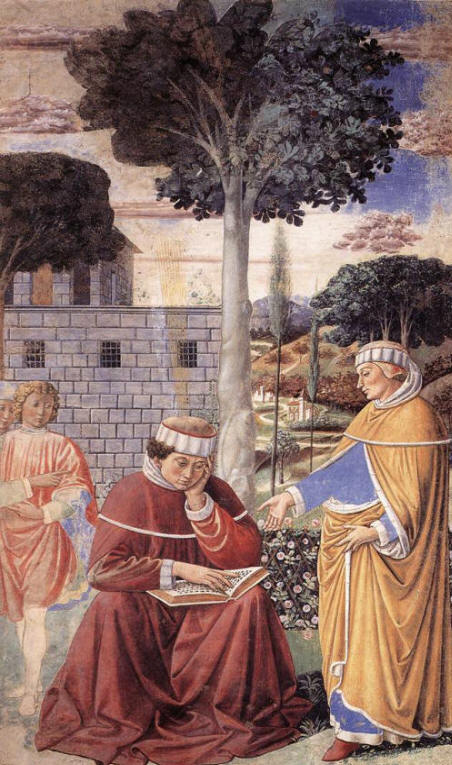
an old one, spoken of by St. Augustine. In fact, it is in
part, through this use of Scripture that he became a Christian in the
first
place. In Book VIII, Chapter XII of his "Confessions," he describes how
he was instructed to use this method in order to learn the Truths he
sought:
But when a
profound reflection had, from the secret depths of my soul, drawn
together and heaped up all my misery before the sight of my heart,
there arose a mighty storm, accompanied by as mighty a shower of tears.
Which, that I might pour forth fully, with its natural expressions, I
stole away from Alypius; for it suggested itself to me that solitude
was fitter for the business of weeping. So I retired to such a distance
that even his presence could not be oppressive to me. Thus was it with
me at that time, and he perceived it; for something, I believe, I had
spoken, wherein the sound of my voice appeared choked with weeping, and
in that state had I risen up. He then remained where we had been
sitting, most completely astonished. I flung myself down, how, I know
not, under a certain fig-tree, giving free course to my tears, and the
streams of my eyes gushed out, an acceptable sacrifice unto You.
And, not indeed in these words, yet to this effect, spoke I much unto
You—"But You, O Lord, how long?" "How long, Lord? Will You be angry for
ever? Oh, remember not against us former iniquities;" for I felt that I
was enthralled by them. I sent up these sorrowful cries—"How long, how
long? Tomorrow, and tomorrow? Why not now? Why is there not this hour
an end to my uncleanness?"
I was saying these things and weeping in the most bitter
contrition of my heart, when, lo, I heard the voice as of a boy or
girl, I know not which, coming from a neighbouring house, chanting, and
oft repeating, "Take up and read; take up and read." Immediately my
countenance was changed, and I began most earnestly to consider whether
it was usual for children in any kind of game to sing such words; nor
could I remember ever to have heard the like. So, restraining the
torrent of my tears, I rose up, interpreting it no other way than as a
command to me from Heaven to open the book, and to read the first
chapter I should light upon. For I had heard of Antony, that,
accidentally coming in while the gospel was being read, he received the
admonition as if what was read were addressed to him, "Go and sell that
you have, and give to the poor, and you shall have treasure in heaven;
and come and follow me." And by such oracle was he immediately
converted unto You. So quickly I returned to the place where Alypius
was sitting; for there had I put down the volume of the apostles, when
I rose thence. I grasped, opened, and in silence read that paragraph on
which my eyes first fell—"Not in rioting and drunkenness, not in
chambering and wantonness, not in strife and envying; but put on the
Lord Jesus Christ, and make not provision for the flesh, to fulfil the
lusts thereof." No further would I read, nor did I need; for
instantly, as the sentence ended—by a light, as it were, of security
infused into my heart—all the gloom of doubt vanished away.
Closing the book, then, and putting either my finger between, or some
other mark, I now with a tranquil countenance made it known to Alypius.
And he thus disclosed to me what was wrought in him, which I knew not.
He asked to look at what I had read. I showed him; and he looked even
further than I had read, and I knew not what followed. This it was,
verily, "Him that is weak in the faith, receive;" which he
applied to himself, and discovered to me.
"Take up and
read" -- in Latin, "tolle et lege." The Antony he refers to is St.
Antony of the Desert, whose life was described in St. Athanasius's
"Life of St. Antony," and whose method of sortes biblicae took a different
form.
Instead
of opening Sacred Scripture to a random page, he entered a church and
paid heed to the first words from Scripture that he heard. From "The
Life of St. Antony," which you find in pdf format in this site's Catholic Library (or read in
full here, off "The Religious Life"
page:
After the death
of his father and mother he was left alone with one little sister: his
age was about eighteen or twenty, and on him the care both of home and
sister rested. Now it was not six months after the death of his
parents, and going according to custom into the Lord's House, he
communed with himself and reflected as he walked how the Apostles left
all and followed the Saviour; and how they in the Acts sold their
possessions and brought and laid them at the Apostles' feet for
distribution to the needy, and what and how great a hope was laid up
for them in heaven. Pondering over these things he entered the church,
and it happened the Gospel was being read, and he heard the Lord saying
to the rich man, 'If you would be perfect, go and sell that you have
and give to the poor; and come follow Me and you shall have treasure in
heaven.' Antony, as though God had put him in mind of the Saints, and
the passage had been read on his account, went out immediately from the
church, and gave the possessions of his forefathers to the villagers—
they were three hundred acres, productive and very fair— that they
should be no more a clog upon himself and his sister. And all the rest
that was movable he sold, and having got together much money he gave it
to the poor, reserving a little however for his sister's sake.
In St. Gregory
of Tours's "Historia Francorum" (The History of the Franks), this
practice is mentioned several times. In Book II, 37 we read:
The king himself
sent envoys to the blessed church saying: "Go, and perhaps you will
receive some omen of victory :. from the holy temple." Then giving
them gifts to set up in the holy place, he said: "If thou, O Lord, art
my helper, and hast determined to surrender this unbelieving nation,
always striving against thee, into my hands, consent to reveal it
propitiously at the entrance to the church of St. Martin, so that I may
know that thou wilt deign to be favorable to thy servant." Clovis'
servants went on their way according to the king's command, and drew
near to the place, and when they were about to enter the holy church,
the first singer, without any pre-arrangement, sang this response:
"Thou hast girded me, O Lord, with strength unto the battle; thou hast
subdued under me those that rose up against me, and hast made mine
enemies turn their backs unto me, and thou hast utterly destroyed them
that hated me." On hearing this singing they thanked the Lord, and
paying their vow to the blessed confessor they joyfully made their
report to the king.
In Book IV, 16,
we read how "When they are ready to fight, Chramnus causes a report of
Clothar's death to be circulated and Charibert and Gunthram hasten off;
Chramnus marches to Dijon where he consults the Bible as to his
future." In Book V, 14, we read how the Book of Solomon was used:
But Merovech
followed Gunthram's advice and, desiring to avenge himself, he ordered
Marileif the chief physician to be seized as he was returning from the
king's presence, and after beating him most cruelly he took away the
gold and silver and other valuables which he had with him and left him
naked, and would have killed him if he had not escaped from the hands
of those who were beating him and taken refuge in the church. And later
we clothed him and having obtained his life sent him back to Poitiers.
Now Merovech charged many crimes to his father and stepmother. But
although they were partly true it was not acceptable to God I suppose
that they should be made known through a son. This I learned to be so
later on. For one day I was invited to dine with him and when we were
sitting together he begged urgently that something be read for the
instruction of his soul. So I opened the book of Solomon and took the
first verse that came which contained the following: " The eye of him
who looketh at his father askance, the ravens of the valleys shall pick
it out." Although he did not understand it, I believed that this verse
had been given by the Lord.
And again, in
Book V, 49, this sort of thing comes into play:
On the next day,
that is, the day before Easter Sunday, Leudast came to the city of
Tours and pretending to have other business, seized Plato the
archdeacon and Galien, and bound them and ordered them led to the
queen, loaded with chains and without their robes. I heard of this
while I sat in the bishop's house, and in sadness and worry I went into
the oratory and took the book of David's song, that when opened a verse
might give some consolation. And this is what I found: "He led them in
hope and they did not fear, and the sea covered their enemies."
St. Bonaventure,
in his "The Life of St. Francis," tells us how St. Francis's way of
life was affirmed by this method of using the Bible just after he began
to have followers:
Accordingly, as
many remarked in the man of God [St. Francis] alike the truth of his
simple teaching and of his life, certain of them began by his ensample
to turn their thoughts unto penitence, and, renouncing all, to join
themselves unto him in habit and life. The first of these was that
honour-worthy man, Bernard, who, being made a partaker in the divine
calling, earned the title of the firstborn son of the blessed Father,
both by being first in time, and by being of an especial holiness. For
he, having proved the saintliness of the servant of Christ, was minded
after his ensample to utterly despise the world, and sought counsel
from him how he might accomplish this.
Hearing this, the he servant of God was filled with consolation by
reason of his first offspring conceived of the Holy Spirit. "From God,"
saith he, "behoveth us seek this counsel." Forthwith, when it was
morning, they entered into the church of Saint Nicholas, and, having
first prayed, Francis, the worshipper of the Trinity, did thrice open
the book of the Gospels, seeking by a threefold witness from God to
strengthen the holy purpose of Bernard. In the first opening of the
book was discovered that saying: "If thou wilt be perfect, go and sell
that thou hast, and give to the poor." In the second: "Take nothing for
your journey." And in the third : "If any man will come after Me, let
him deny himself, and take up his cross, and follow Me."
"This," saith the holy man, "is our life and Rule, and that of all that
shall be minded to join our fellowship. Do thou go, then, if thou wilt
be perfect, and fulfil that which thou hast heard."
This practice
was a not uncommon phenomenon among the early and medieval
Christians,
and there were corollaries in the pagan world as well. For
ex., Sir William Smith writes in his "A Dictionary of Greek and Roman
Antiquities" (1857):
At Pharae, in
Achaia, there was an oracle of Hermes. His altar stood in the middle of
the market-place. Incense was offered here, oil lamps were lighted,
before it, a copper coin was placed upon the altar, and after this the
question was put to the god by a whisper in his ear. The person who
consulted him shut his own ears, and immediately left the market-place.
The first remark that he heard made by any one after leaving the
market-place was believed to imply the answer of Hermes.
So, what to make
of all this? I don't know, to be frank. To my knowledge, there is no
official church teaching on the matter. Divination is proscribed, of
course, but divination implies reliance
upon demons for signs. My take is that
appealing to God (not to Hermes or any other false god, obviously) and
using Sacred Scripture to find answers has never hurt anyone, but this
is something for you to discuss with your priest or spiritual advisor.
One thing is for certain, however: if one uses such a method to try to
decide whether to undertake an action or decide among two or more
actions, the actions must be moral and
equally so.
A Helpful Video
About Lection Divina
The 7:44 mark is
when talk of the steps of Lectio Divina begins. This video comes from Sensus Fidelium (the link to their Youtube channel
will open in a new browser window).
Footnote 1 Guigo lived A.D. 1083/4
- 27 July 1136/8. He was also known as "Guigues du Chastel" or "Guigo
de Castro" or "Guigo II"