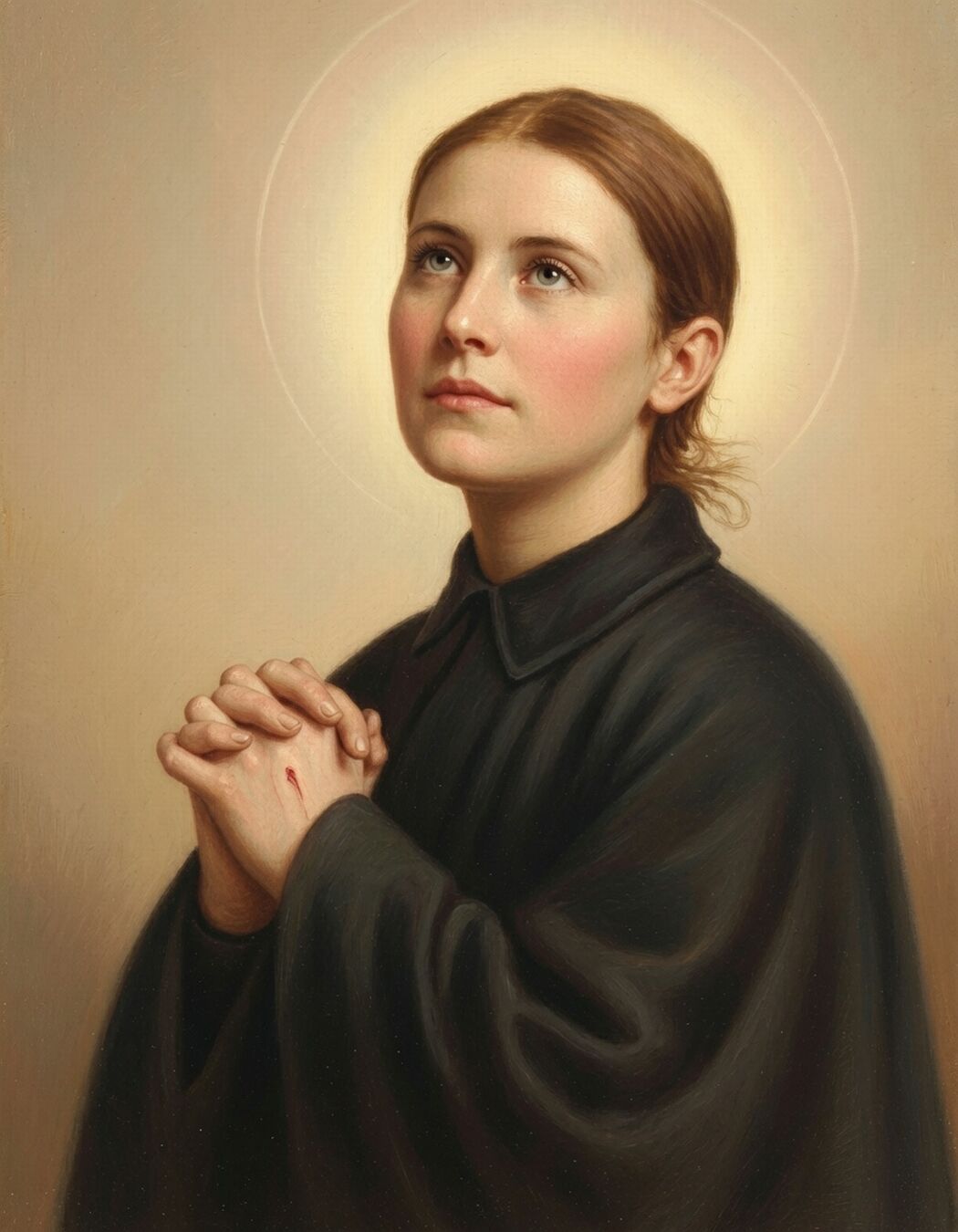
What can you say
about a twenty-five-year-old girl who died?1
Gemma Galgani was born on March 12, 1878, and would eventually become
the middle child of seven other children. She was born in a little
hamlet called Camigliano,
in Capannori, Tuscany, and baptized at the nearby Chiesa di San
Michele, but her family very soon moved to the town of
Lucca in Tuscany, just a few miles away,
because the Galganis thought their children would be better educated
there.
Her father was a kindly pharmacist who made a very good living, and her
mother was
sickly, having contracted tuberculosis, but she was hard-working and
pious, making sure her children were taken
to church and that they were well catechized. Her piety
certainly rubbed off on Gemma: a family friend who helped teach Gemma
the catechism said of Gemma,
I then began to
teach Gemma and her brother Tonino the catechism, after which I used to
bring Gemma to the Church to visit the Blessed Sacrament and say the
Rosary and the other prayers I knew . Nothing seemed as pleasing to
Gemma as to go to the Church to say her prayers. She never grew tired.
When she had said an Our Father, Hail Mary and Glory be to the Father
in honour of her Angel Guardian, she used to turn to me and say, "To
whom should I pray now?
Father Germano Ruoppolo related that even at the young age of five
Gemma knew how to read the breviary for the office of the Blessed
Virgin and of the dead.
Her brother, Gino -- two years older than she -- was also deeply
religious, and the two were very, very close, like twins born
separately. One of her younger sisters, Angelina, didn't seem to like
Gemma a lot, and would mock her for her piety.
When Gemma was 7, she heard her first heavenly locution. It was at her confirmation, in the basilica of San
Michele in Foro. She wrote in her autobiography,
I was assisting
as best I could, and praying for Mom, when on a sudden a voice in my
heart said to me: "Are you willing to give me your mother?" "Yes," I
replied," if you take me also!" "No," said the voice, " give me your
mother of your own will. For the present you must remain with your
father. I will take you to her in Heaven later." I had to say yes, and
when the Mass was finished I ran home.
When she arrived, she found her mother very ill -- so ill that Gemma
was sent to live with her uncle in nearby San Gennaro for a time.
Within four months, her mother died.
Not long after her mother's death, Gemma was sent to be educated by the
Oblates of the Holy Ghost -- the Zitine Sisters. It was during this
time that she turned her attention in a deep way to Christ's Passion.
Hearing the sisters speak of it moved something deep in her soul, and
she resolved to become a saint. To that end, she developed devotions to
the Blessed Virgin and the Sacred Heart, and
strove to develop the moral virtues.
Above all, the words
of Christ in John 6:57 -- "He that eateth My flesh, and drinketh My
blood, abideth in Me, and I in him" -- caused her to desire the
Eucharist intensely.2 She wrote,
These words
filled me with consolation, and I said to myself that when Jesus is
with me I shall live no longer, but Jesus will live in me. I was
burning with desire for the moment to arrive when I could say: "Jesus
lives in me."
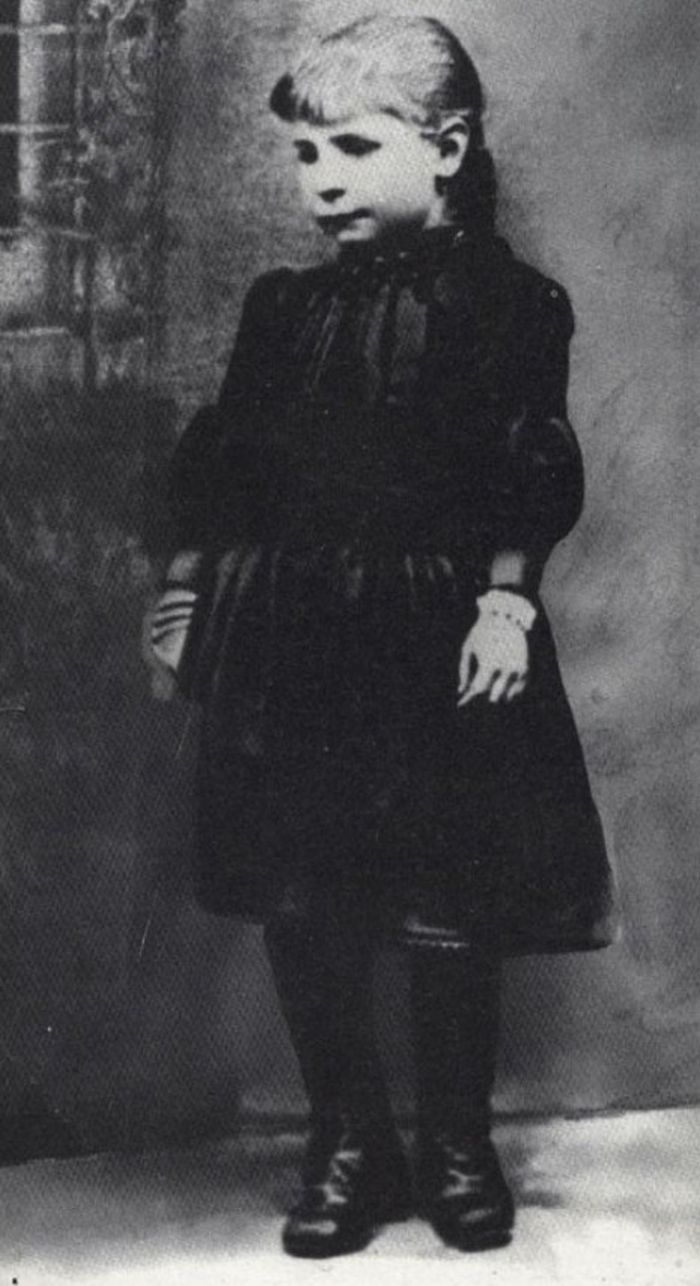
St. Gemma, age 7
At the age of nine, she was considered too young at the time to receive
Christ in that way, but she pleaded until John Volpi -- then a
Monsignor and the spiritual director of her school, later a Bishop --
gave in. And so, on June 17, 1887, the Feast of the Sacred Heart
that year, she had her first communion.
Of it she said,
I cannot express
in words what passed between Jesus and me in that moment. Jesus made
Himself felt, oh, so strongly, in my poor soul. I realized that the
delights of. heaven are not the same as those of earth. I desired
intensely to make that union with God continuous. I felt myself more
and more detached from the earth and more and more disposed to
recollection.
She decided to become a nun, and soon thereafter, she experienced her
first heavenly apparition. She was putting away a gold watch, and a
necklace with a gold pendant when her Guardian Angel appeared and said
to her, "'Remember, that the ornaments of a spouse of a Crucified King
are thorns and the Cross." She gave the jewelry away immediately.
For about a year, she was given no spiritual consolations, but still
soldiered on, willing herself to pursue sanctity in spite of the
heaviness of her heart.
Then, when she was 16, there came a great tragedy: her beloved brother,
Gino,
who by this time was studying for the priesthood at the seminary of San
Michele in Foro, got sick with tuberculosis. Gemma nursed him as well
as she could, but despite her best efforts, he died. She was
devastated. Her grief was so profound that she became ill herself. And
during this time as well, she developed a tumor of some sort on one of
her feet. She said nothing about it until a bench fell on it, bursting
the tumor and causing intense pain. Because of all this, she left
school, returned home, and began caring for her younger siblings,
leading them in morning and evening prayers, nightly rosaries, and
teaching them -- and neighbor children -- the catechism. She also
focused on the corporal works of mercy,
always carrying food and a little money for the poor, and visiting the
sick. But most of all, she meditated and prayed. Constantly.
The trials kept coming: her father went bankrupt due to his wife's
medical bills, credit extended to poor customers that they never paid
back, and bad investments made through misplaced trust. His assets were
seized. Then he got throat cancer and died. Gemma was so overwhelmed
that she fainted, something she reproached herself for, writing later,
"The day father died Jesus forbade me to give way to cries and useless
tears, and I passed the day in prayer, being very resigned to the will
of God Who had then become my earthly Father as well as my heavenly
Father."
The remaining Galganis were reduced to true poverty, even to the point
of hunger. Gemma embraced the situation and tried to encourage her
siblings, reminding them of Christ's love of the poor. She always took
the smallest portions of what little they had, trying to keep her
brothers and sisters fed. Aunts took up the slack, living there and
helping as they could. But then the family was broken up: Her younger
sister, Angelina, went to live with a local family, and Gemma went to
live for a few months with a paternal aunt and uncle in Camaiore, about
20 miles away to the northwest. Her cousin describes her routine while
she was living there:
Every morning
Gemma went with my sister Rosa to hear Mass and receive Holy Communion.
Afterwards they attended to their household duties and served in the
drapery shop with my uncle until about twelve o'clock, which was dinner
time. After dinner, at about half-past twelve, they visited the Church
called Badia, where they remained in prayer until a quarter to two.
They then returned to the shop until about six, when they again went to
pay a visit to the Blessed Sacrament. After the evening meal the family
recited the Rosary and other prayers together and then passed about a
half an hour in conversation before all retired to their rooms, and
this was done with a method and a precision proper to my Uncle
Dominic's home.
She'd been proposed to before, but when she was in Camaiore, she was
sought after romantically even more. She returned to Lucca to escape
all that, then became ill with
tuberculosis of the spine, a highly
painful disease that resulted in repated bouts with abscesses in her
back. For a year she was an invalid, forced to wear an immobilizing
iron corset. It was at this time that she developed a deep devotion to
St. Margaret Mary Alacoque and, most especially, to St. Gabriel
Possenti (St. Gabriel of the Sorrowful Mother), a Passionist seminarian
who'd died
young of tuberculosis. She had visions of him, first in a dream, then
while awake, and through his intercession, was granted the mystical
visions for which she is known. It was also through his intercession as
well
that she was cured physically. It happened while she was praying a
novena to St. Margaret Mary Alacoque (who then hadn't yet been
canonized), as Monsignor Volpi advised her to do. The third time she
was praying it, St. Gabriel Possenti came to her and told her to pray
with him a novena to the Sacred Heart after her novena to St. Margaret
Mary. For nine days he came to her, and they prayed together, and on
the ninth day she was cured.
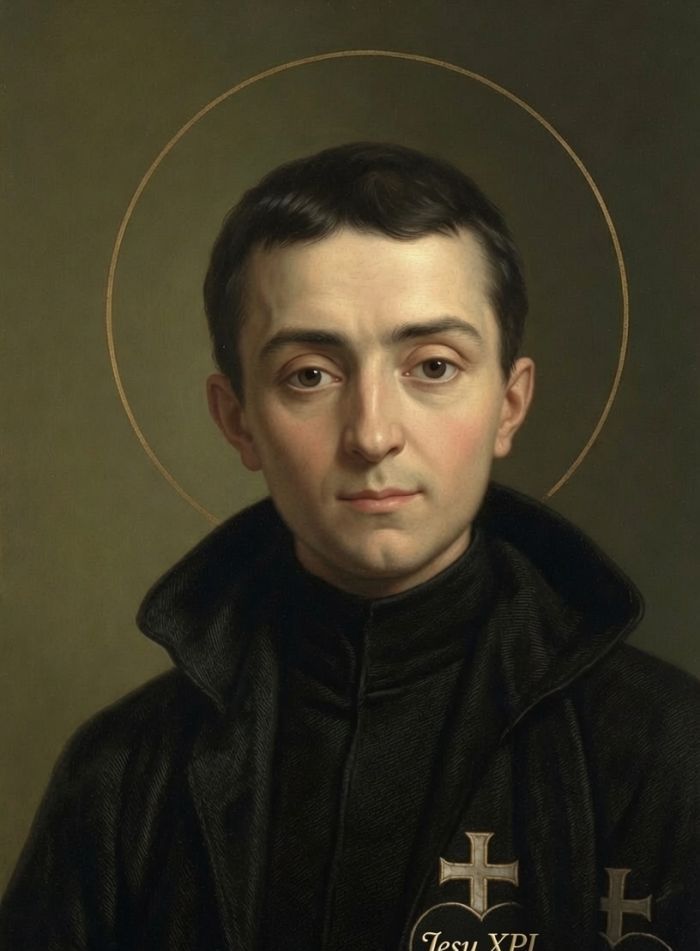
St. Gabriel Posseni (St. Gabriel of the Sorrowful Mother)
Something even more momentous happened during her prayers with St.
Gabriel: she was further convinced to become a religious, and the
moment she was cured, she decided to become a Visitation nun like St.
Margraret Mary Alacoque. As she was waiting to enter the convent, she
had a vision of Christ as she was making Holy Hour:
I
began therefore to make the Holy Hour for the first time out of bed,
but I felt such an intense sorrow for my sins that I spent days of
continual martyrdom. In the midst of this sorrow, however, I had one
consolation, one source of relief, namely, tears. I passed the whole
hour praying and weeping. Being extremely tired I sat down, the feeling
of sorrow continuing. A few moments later I felt my whole being wrapped
in recollection. Then, all of a sudden, I began to lose the use of my
senses. I tried with all my strength to get up to lock the door of my
room. Where was I I found myself there and then before Jesus Crucified.
Blood was flowing rom all His wounds. I lowered my eyes immediately,
and feeling very much disturbed I made the Sign of the Cross. Great
peace of mind followed, but I continued to experience intense sorrow
for my sins. Lacking courage I did not raise my eyes to look at Jesus.
I bent down with my forehead upon the ground, and remained in that
position for several hours. . Then I recovered, but from that time I
began to have a great horror for sin, and this is the biggest grace
that Jesus has granted me. The Wounds of Jesus remained so that I have
never since then forgotten them.
He appeared to her another time, showing her His Wounds and saying,
Look,
My daughter, and learn how to love! This Cross, these thorns, these
nails, these bruises, these scars, these wounds, this blood -- these
are the effects of an infinite love! See to what extent I have loved
thee! Do You really desire to love Me? Learn how to suffer first;
suffering will teach thee how to love.
After hearing this, she began intense mortifications of the flesh --
the wearing of a hair shirt, scourging herself with a cord, etc. And
then, on the eve of the Feast
of the Sacred Heart in 1899, she received the stigmata. She
describes how it happened:
It
was in the evening. Suddenly I began to feel a great interior sorrow
for my sins, so great indeed that I had never experienced anything like
it before. That sorrow, I might say, almost brought me to death's door.
Then I felt all the powers of my soul in recollection. One thought
alone possessed my understanding -- the thought of all the
transgressions by which I had offended God; my memory brought them all
before me, and at the same time I recalled all the torments which Jesus
endured for my salvation; my will detested all my sins, and I promised
that I would bear all possible sufferings to atone for them. Then one
thought rapidly succeeded another in my mind -- thoughts of sorrow,
love, fear, hope and consolation. This recollection was quickly
followed by a great rapture. I found myself in the presence of my
heavenly Mother, with my guardian Angel on her right. He bade me recite
an act of contrition, and when I had finished my loving Mother
addressed me in these words: "Daughter, in the name of Jesus, let all
thy sins be forgiven." Then she added: "Jesus my Son loves thee much,
and wishes to confer a favour on thee. Canst You render thyself worthy
of it?" My nothingness knew not what to answer. Whereupon she
continued: "I will be a Mother to thee; will You show thyself a true
daughter of mine? " She then opened her mantle and covered me with it.
The same instant Jesus appeared with all His Wounds open, but instead
of Blood, flames as it were of fire issued from them. In an instant
those flames touched my hands, feet and heart. I felt as if I were
dying, and had not my heavenly Mother supported me, under her mantle, I
should have fallen to the floor. I remained in that position for
several hours. . . . When I came to, I found myself kneeling upon the
floor. I still felt intense pain in my hands, feet and heart. As I
arose to lie down on my bed I became aware that blood was flowing from
those parts where I felt pain. I covered them as well as I could, and,
assisted by my Guardian Angel, I succeeded in reaching my bed.
The stigmata would appear every Thursday at around 8:00PM, would
bleed
until 3:00PM Friday, and then completely disappear, a phenomenon that
would go on until February, 19013 The
same month that she received the stigmata for the first time, Christ
appeared to her and
told her that she would be tested to the limits. She wrote that, as she
was making Holy Hour,
...Jesus
made me understand all that I would have to suffer during the rest of
my life. He said that He, would soon test me to see if I truly loved
Him and whether the offering I had made to Him was sincere. He told me
that He would know this when my heart would appear to have become like
a rock"; when I should experience nothing but aridity of spirit and be
afflicted and tempted; when all my senses would rebel and would become
like so many hungry wild beasts. He told me that my fidelity would be
shown when I felt myself inclined to evil, when the pleasures of the
world appear to be worth while and memory would recall to mind what I
did not desire; when what is contrary to God's law would perforce
present itself to me and it would seem that I had lost all relish for
the things of God. He said that He would not allow my heart to taste
comfort.
The
demons with My permission will make continual efforts to overcome your
soul. They will put evil thoughts into your mind, and give you a great
distaste for prayer, and you will never be without many terrors and
fears. You will suffer outrages and injuries; no one will believe in
you any longer. You will receive no comfort from anyone, not even from
your superiors. On the contrary everyone will mortify you, and you will
be greatly confused. What will pain you most will be that Heaven will
seem deaf to your pleadings. Jesus will seem to you to be so severe.
You will find it difficult to pray. When you will seek Jesus you will
not find Him; to you it will seem that He casts you from Him and
departs from you. You will desire to be recollected and instead you
will be distracted. You will call upon the Blessed Virgin and the
saints, but no one will have pity on you and it will seem that you have
been abandoned by all. When you receive Holy Communion or go to
confession, you will feel no fervor; these things will be wearisome to
you. You will go through your accustomed exercises of devotion as it
were through mere routine, and you will think it merely time lost.
Nevertheless you will believe, but as if you did not believe; you will
hope, but as if you no longer had hope; you will love Jesus, but as if
you did not love Him, because during all this time you will be without
feeling. Furthermore, you will grow tired of life and yet be afraid of
death; you will not be able to find refuge even in tears."
When I was about to finish the Holy Hour, Jesus said to me
that He was going to treat me as His heavenly Father had treated Him.
She was also blessed by visits from the Blessed Virgin and her Guardian Angel.
Now,
I'd written that she'd decided to become a Visitation nun, but
that Order turned out to not be a good fit for her. Neither was the
Servite Order, to whom she'd make many visits -- even overnight
visits-- so she could pray undisturbed. Soon enough, though, Divine
Providence stepped in: Pope Leo XIII had ordered that missions be given
in Italian cities, and so, men of the Passionist Order were sent to
Lucca. When Gemma saw them, she was amazed to find them dressed in the
same way that St. Gabriel Possenti was when he came to her. She was
smitten by the Passionists and their devotion to Christ's
Sacrifice. She'd found her religious order! Though her precarious
health and the disruptive nature of her ecstasies prevented her from
formally joining them, the Passionist Order is one she was always very
close to and desperately wanted to join,
and they claim her as one of their own to this day.
It was around this time that she became acquainted with a woman named
Cecilia Giannini. Cecilia and Gemma became very close -- so close that
Gemma thought of Cecilia as a second mother. Gemma even moved into the
house in which the very large, very pious Giannini family lived (five of their daughters had become nuns), and she would
spend the rest of her life there aside from the few months just before
her death. Her moving in with the Gianninis brought great relief as her
dealings with her family had become tense. Her siblings teased her.
There were hostility and fights. And there were her Aunts' reactions to
some of the supernatural goings-on. Once, her brother blasphemed, and
Gemma, horrified, began to sweat blood just as Jesus had in the Garden
of Gethsemani. One of her Aunts demanded an explanation. Gemma wrote,
When I arrived
home I went to my room. She followed me, very angry, and said: "This
evening Julia is not here to defend you, and you must let me see where
all that blood comes from or, if not, I shall beat you until you do."
As I remained silent, she grew angrier, and holding me by the throat
with one hand, with the other she tried to take off my clothes, but did
not succeed, for the bell rang and she left me... But the matter did
not end there. When I was going to bed she came to me and said it was
time I gave up all my tomfoolery, and that I had given people enough to
talk about. "Mind," she said to me, "if you do not tell me where that
blood comes from, I shall not allow you out of the house alone nor
shall I send you anywhere." As you can imagine, at these words I began
to cry, and I did not know what to do. At last I decided to tell her
and I answered in this way: "The blasphemies of your nephew are the
cause of it." "What!" my aunt said. "The blasphemies cause this blood
to flow?" "Yes," I answered. "When I hear blasphemies I see Jesus
suffering and I suffer with Him, and I suffer in my heart and the blood
comes." That appeared to calm her a little, and she said: "Is it only
when your brother blasphemes that you suffer and not when others do so
?" "I suffer always when I hear blasphemies, but there is a difference.
His blasphemies make me suffer much more." And in saying this I cried
bitterly.
With the Gianninis, especially with Cecilia, she was free from all that and had the support of
someone who deeply understood her. Cecilia would often not only
accompany Gemma as she went to Mass (often more than once a day,
visiting different churches to do so), attended Benedictions of the
Blessed Sacrament, made Holy Hour or the Stations
of the Cross, etc. (her life was filled with Catholic devotions!),
but she was patient witness to Gemma's ecstasies and the
supernatural happenings that marked her life. She describes Gemma in
ecstasy, sharing in Christ's Passion:
Some weeks she
suffered neither the Stigmata nor the crowning with thorns. I was
pleased. One evening, however, I saw that she was suffering very much,
and went to bed earlier than usual, and seeing this I watched her. I
thought she was ill and I was not thinking of the extraordinary things,
when suddenly I saw little streaks of blood on the backs of her hands.
I uncovered her neck and her arms, turning the sleeves of her
nightdress up a little. Gemma was in ecstasy. But I was not thinking of
what it could be, and believing that it was her own blood that was
trickling from her skin, I tried to wipe away the blood from the back
of the hand with a cloth which became stained. It was her own blood. I
could not imagine how the thing was happening, but I heard her say in
the ecstasy: "Are these Thy lashes, Jesus?" And that made me think it
was the scourging. This was on the first Friday of March, the
manifestation having commenced on the Thursday evening before. It
lasted until about four or five in the afternoon of Friday. This was
repeated on the Thursday and Friday of the next three weeks of March.
In these other ecstasies the scourging was more extensive. In the
second I noticed that the skin opened under the streaks of blood. In
the third the wounds were wider, and I counted eleven wounds of which
three were near the neck, two on the knees, and the others on the
calves of the legs and on the arms. I did not uncover from under the
neck to the knees, but I noticed that her nightdress was all stained
with blood. I did not uncover her shoulders nor her back. On the
shoulder of the nightdress, on the right shoulder, I believe, there was
a big blood-stain, and besides there was blood all over the bed... A
few days after the fourth Friday I said to her: " But tell me this. At
first there were only red streaks, and now there are cuts and wounds.
Why?" She answered: "At first they were whips, and now they are
scourges."
Imagine seeing a young woman in your home, deep in ecstasy, suffering
literally excruciating pain, dripping in blood, and yelling out the
following words:
O Jesus to what
a state You art reduced! Oh, the holy Person of Jesus has become a
plaything for all! They blaspheme Thee, my Jesus, they treat Thee
roughly, they curse Thee... O Jesus, I am surprised that although I see
Thee in the midst of these humiliations, I do not wish to hear them
spoken of. Oh, if I were able, Jesus, with .my blood I should wish...
I should wish to wash with my blood all those places where I see Thee
outraged! ... No more blows on Thee, O Jesus. You have not deserved
them; I, yes; You, no! It is I who am the sinner, You art innocent!
Tonight, O Jesus, I wish to suffer all; if You also wish to suffer, let
us suffer together. Let me be one victim with Thee. Art You pleased, oh
Jesus? Strengthen me for this, oh Jesus; I do not ask Thee anything
more. Poor Jesus! What a number of blows, poor Jesus! Those bad men are
not sparing Thee, but Thy patience is not exhausted. Leave Jesus alone,
beat me! Why revenge yourselves upon Jesus; revenge yourselves upon me.
More still, O Jesus; more, oh God! ...Still more, Jesus-and more,
Jesus, more! My Jesus, help me in this hour! Oh Jesus, to whom do You
wish that I go for help?
Some reading this might think Gemma sounds like an attention-seeking
hysteric. Some of her contemporaries thought the same thing, and some
priests thought the stigmata and other signs of Christ's Wounds might
be self-inflicted or demonic in origin instead of supernatural. But
then they investigated the situation and found her blameless, and the
phenomena not only geniuine and not preternatural, but from God. Father Peter Paul
Moreschini -- later an archbishop -- told Gemma to ask Christ to give
him two signs that what was happening to Gemma as supernatural. And he
didn't tell her what signs he had in mind. Though she otherwise only exhibited
the stigmata from Thursday to Friday, they appeared on her that very
day, a Wednesday, as did the sweating of blood -- the two signs Fr.
Moreschini asked for silently.
Monsignor Volpi, who'd known Gemma from her childhood, got a doctor
involved in investigating the situation -- a doctor who was convinced
it was all a matter of hysteria. He brought the doctor to the Giannini
home to meet Gemma, who was in an ecsasty. And then -- nothing
happened. Nothing at all. Msgr. Volpi was perplexed, and then received
this letter from Gemma:
If you had been
alone Jesus would indeed have convinced you. Today when I began to make
the exercise of the Three Hours' Agony I understood what had happened
to me. Yesterday evening Jesus let me know that you would come, but I
did not want you to come because I was ashamed. In the end I conquered
myself. At first I felt great repugnance; then Jesus said to me: "Do
you not remember that I told you some time ago that a day would come
when no one would believe you. That day has come! Oh, how much more
acceptable you are to me when you are despised than when everyone
regarded you as a saint !" Jesus then told me that there was another
person with you, a doctor, and that he saw nothing .... Today Jesus
desired that I should make a sacrifice, and I have willingly done so;
let them think that it is hysteria, as the doctor says it is; because
they call it that, Jesus loves me all the more. However, He said that
in comparison with what I must yet go through this is nothing. Later
when Jesus came back He told me that I was to tell you that He would
cause the things in such a way that no one would perceive them. Jesus
said that He is satisfied that some persons have seen what has taken
place but that for the present He wishes no one else to see those
things. You will be convinced.
But his doubts remained. Gemma then had a vision of the man Christ said
would be her new spiritual director, even naming him by name: Father
Germanus. He was, of course, a Passionist priest, and Msgr. Volpi
turned the spiritual care of Gemma over to him. Father Germanus went to
the Giannini house to meet his new spiritual child, all while under the
assumption that she was an hysteric. It was a Thursday. They prayed
together, ate together, and then Gemma went to her room and went into a
state of rapture. Father Germanus describes what happened next as he
watched her plead to Christ to save the soul of a certain sinner
(pleading for sinners is something she did throughout her life):
Her adopted
mother came to call me. I followed her and found the
maiden in ecstasy. The subject of the ecstasy was the conversion of a
sinner, and the form was a struggle between her and the Divine Justice
to obtain this conversion. I confess that I never beheld anything more
affecting. Gemma was sitting on her bed with her eyes, face and all her
person turned towards a part of the room where Our Lord appeared to
her. She was not agitated but earnest and resolute like one in a
struggle, who is determined to win at all costs. She began by saying: "
As You art here, Jesus, I renew my supplications for my sinner. He is
Thy child and my brother; save him, Jesus"; and she named him. He was a
stranger whom she had known in Lucca, and moved by spiritual impulse
she had already warned him a number of times by word of mouth and by
letter to listen to the dictates of his conscience and not be contented
with the mere reputation of being a good Christian. Jesus, seeming
disposed to deal as a just Judge with this man, remained unmoved by her
entreaties. But Gemma was not deterred by these refusals and continued:
"Why today do You not grant my request? For one soul only You have done
so much! Why then will You not save this one? Save him, O Jesus, save
him! ... Be good, Jesus. Do not say that to me. In Thy mouth, You who
art Mercy itself, that word, "abandon," sounds badly; You must not say
it. You have not measured the blood You have shed for sinners, and now
do You wish to measure the enormity of our sins? . . . Will You not
give in? To whom then shall I turn? You have shed Thy Blood for him as
well as for me. Will You save me and not him? I will not rise from here
until You save him; promise me that You will save him. I offer myself
victim for all, but particularly for him. I promise not to refuse Thee
anything. Will You not grant my request? Remember, O Jesus, a soul is
at stake! A soul, Jesus, that cost Thee so much. He will become good
and will not fall again."
‘In answer to all her pleading the Saviour put forward the
claims of Divine Justice. She, however, grew still more earnest, and
replied: "I am not seeking Thy justice; I am imploring Thy Mercy. My
Jesus, go and find this poor sinner; make him repent." And here to
prove to Gemma what reason He had for remaining firm, Our Lord began to
show her one by one, with the most minute circumstances of time and
place, the evil deeds of that sinner, adding that he had filled up
their measure. The poor girl showed her dismay; she let her hands fall
down and sighed deeply, as if she had lost hope of succeeding. But
recovering quickly from the shock, she returned to the attack. "I know,
O Jesus," she said, "I know it; that he has offended Thee thus
grievously; but I have done worse and yet You have shown me Mercy ....
What immense Charity, O Jesus, have You not lavished upon me! Treat my
sinner, I implore of Thee, with those delicacies of infinite Love with
which You have treated me. Remember, 0 Jesus, that I want him to be
saved. Triumph, triumph! I ask this of Thee; oh, do not refuse me."
In spite of all these efforts, Our Lord remained inflexible,
and Gemma, again becoming downhearted and discouraged, remained silent
as if she had abandoned the struggle. Then of a sudden another motive
flashed to her mind -- a motive that seemed invincible against all
resistance. Again becoming all animated she spoke thus: "Well, I am a
sinner; You Thyself have told me so; that worse than me You couldst not
find. Yes, I confess it, I am unworthy that You should listen to me;
yet I present to Thee another advocate for my sinner; it is Thine own
Mother who asks Thee to forgive him. Canst You say 'no' to Thy Mother?
Surely You canst not say' no' to her. Answer me now, O Jesus; say that
You have saved my sinner." The victory was gained, the whole scene
changed its aspect, the merciful Savior had granted the grace, and
Gemma, with a look of indescribable joy, exclaimed: " He is saved, he
is saved! Jesus, You have conquered; triumph always thus." Then she
came out of her ecstasy.
When the ecstasy was over, Father Germanus retired to his room. It
wasn't long before he was told he had a visitor: the fallen man for
whom Gemma had been pleading to Jesus. He begged Fr. Germanus to hear
his confession, and proceeded to confess all the sins that had been
revealed to Gemma and Father during the ecstasy. He forgot a few of the
sins, but Father Germanus reminded him of them given what he'd heard from Gemma, and the man repented of
those as well.
Fr. Germanus was convinced. And he knew, as did those who actually knew
her, that nothing else in her character suggested hysteria: she was
obedient, childlike, gracious, helpful, always concerned for others,
quiet, innocent, humble, exceedingly pious, ingenuous, disciplined,
chaste, modest,
and very simple. Her simplicity extended even to the way she dressed:
hair parted in the middle, tied back, and sometimes topped by a black
straw hat; black dress; black mantle; and underneath her dress, over
her heart, the symbol that Passionists wear on their habits.4 And from her person emanated a mysterious, beautiful fragrance, a scent the Church refers to as "the odor of sanctity."5
Though childlike, she was never stupid, and she was very concerned
about being deceived by her visions. She always "tested the spirits,"
and asked Fr. Germanus to test them as well. And then came attacks from
spirits that didn't need to be tested because they were quite obviously
evil spirit. She'd seen demons in her room at night -- often in the
form of cats, dogs, men, or black monkeys -- before she moved in with
the Gianninis. Now, though, they physically attacked her, scourging her
with ropes. She said to them, "I ought to scourge myself; you can do it
for me!" The Devil, whom she referred to as "Chiappino" ("Grabber"),
would show up as an old man outside of church, telling her, "Do not go
to receive Communion; you will commit a sacrilege. Last night you were
guilty of wicked things." Usually she would ignore him, but one day,
she doubted herself and refrained from receiving Christ because of his words. When she
exited the church, there the "old man" was, grinning at her. She
instantly went back inside the church and received the Eucharist as she
ought to have had in the first place.
She even became a victim of demonic
obsession. Fr. Moreschini describes what he saw:
Scarcely had she
begun to pray when, as I observed myself on two occasions within four
days, the Devil assaulted her, and obtaining dominion over her senses
made her behave like one obsessed. She was thrown down upon the earth;
she repulsed whoever offered her any object of devotion; she spat upon
the Crucifix and upon the picture of the Blessed Virgin, and I remember
that one day she caught hold of the rosary from my cincture and broke
it into bits. However, I must say this, that at such times neither I
nor any of those who saw her, ever perceived in her even the least act
against good morals. She never uttered words except, as I learned from
Signora Cecilia, to say: "Go away, go away! " when the latter drew near
to her. When I offered her any sacred object, she used the same words
to me. I exorcised her, but without result the first time, since
although she became calm after half an hour, the assaults were renewed.
The second time I used the exorcisms she remained calm, and then I gave
her a relic of the Holy Cross to put on and ordered her to ask Jesus to
free her from those attacks of the Devil. From that moment she was left
entirely free.
Another attack came when Fr. Germanus asked her to write down the story
of her life. Gemma relates what happened:
One night -- I
do not remember what night it was -- l was sleeping peacefully when the
Devil came with a temptation somewhat bad. I fought for more than an
hour or so; I prayed, made Signs of the Cross, etc. One invocation only
to the Immaculate Conception freed me altogether, but he, being
furious, wanted to have his revenge. He would have liked to strike me,
but as this had been forbidden him since that time the Father
Provincial chased him away, he could not do it. He cried out: "War upon
your Father; your manuscript is in my hands!” And he went away.
Old "Chiappino" went away -- and took her manuscript with him. Fr.
Germanus used prayers of exorcism to demand its return, and when it
came back, it was scorched, but still legible (this manuscript can be
see today at the General House of the Passionist Order in Rome, next
door to the Basilica dei Santi Giovanni e Paolo al Celio on the Caelian
Hill, about 3,000 feet southeast of the Colosseum.)
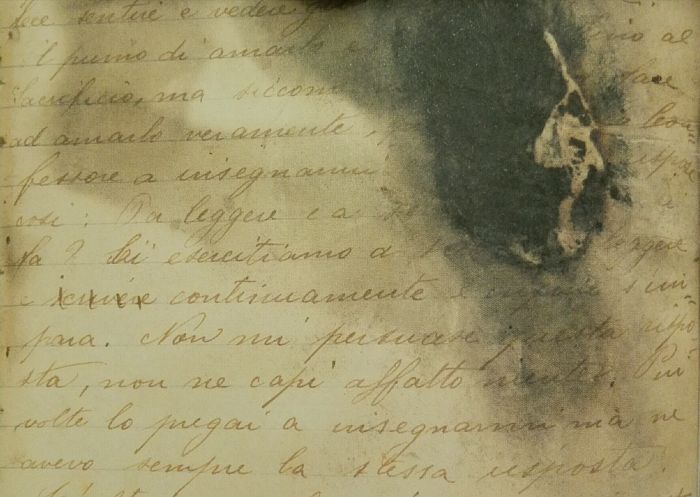
A scorched page from St. Gemma's manuscript
The Evil One or one of his minions would even appear under the guise of
Monsignor Volpi,
doing everything in its power to shake her confidence and ability to
trust her perceptions and the people in her life. These diabolical
attacks went on and on, and one can read about them in various
biographies of the Saint's life, but one important lesson from them is
this: Jesus Himself told her that when she wasn't sure if a spirit was
a holy one or an evil one, she should say to it, "Blessed be Jesus and
Mary!" If the spirit repeats the phrase back to her, it was a spirit of
God; if not, it was evil spirit (one evil spirit said back to her
"Blessed! Blessed!" without saying the names of Jesus and Mary. Gemma
knew immeditately what sort of spirit she was dealing with).
But after these attacks, her Guardian Angel would come to comfort here.
And, of course, these horrific incidents were interspersed with those
ecstasies of hers! Some were short, lasting only a few minutes; others
went on for hours. During the long ecstasies, she would cast her
unblinking eyes upwards and become impervious to what was going on
around her. Sometimes she would levitate: in one famous incident, which
took place in September 1901, she was setting the table for dinner in
the Giannini dining room which held a very, very large Cruficix -- a
church-sized Crucifix -- on one of its walls. She was distracted by it,
and suddenly cried out, "O my Jesus, let me come to Thee; I am all on
fire with thirst for Thy most precious Blood!'
And
behold, a marvel! Jesus detached an arm from the Cross and invited her
to come to Him. She darted forward, and embraced her heavenly Spouse,
and in His turn He embraced her; she placed her lips to that sacred
side and drank copiously from that divine fountain, and all the while
her feet were resting as if upon a cloud.
It is now 1902, her 24th year. Jesus had told her long ago that if she
joined a religious order, she would live until the age of 50, and that
if she didn't, she would die at the age of 25, so she must have known
what was soon in coming. Around the Feast of the Pentecost,
she became very ill with tuberculosis, and for two months could consume
nothing but a little wine and the Blessed Sacrament. Fr. Germanus
ordered her to get better out of obedience, and Lord Christ complied:
she rebounded for about a month, but then relapsed. In January of 1903,
because of the contagious nature of her disease, she was moved to a
house just across the street from the Giannini residence. Once more,
she could eat nothing but the Blessed Sacrament. She began coughing up
blood, and vomiting. She became blind. She languished in bed, asking
for nothing, complaining of nothing. Then came attacks from the Devil
as he vied for her soul, knowing his time was short. Her bed would
shake, and a fetid odor would fill the room. Cecilia described the
scene:
That
beast almost killed Gemma. I came away from her room weeping. The brute
was determined to have her and she had no protection. There were
deafening blows; and the Devil assuming the form of ferocious animals
tormented her. We used to help her by sprinkling holy water over the
room. The commotion would cease then, only to begin again worse than
ever. The few drops of liquid she could retain in her stomach were made
sickening and disgusting by the appearance in them of revolting and
horrible insects. Filthy animals used to crawl about under the
bed-clothes and a snake twisted itself round her from head to foot,
trying to suffocate her.
On Spy Wednesday she received Viaticum. , and on Holy Saturday
-- April 11, 1903 -- she went to be with her Spouse. The Barbantine
Sisters came to care for her body, dressing her in a black habit
with the Passionist symbol, and placing a Crucifix in her hands. On her
head they placed a black veil and a crown of flowers, and around her
neck they placed her grandmother's Rosary.
She was beatified in 1933, and canonized by Pope Pius XII in 1940.
St. Gemma Galgani is shown in art as she is shown in her photographs;
as a very pretty young woman. She is sometimes depicted with stigmata,
a Crucifix, lilies symbolizing purity, and is sometimes dressed in a
black Passionist habit or otherwise shown with the symbol of the
Passionists (like St. Maria Goretti), as below
("Jesu XPI Passio" is a Latin and Greek phrase meaning "The Passion of
Jesus Christ"):
Known
as "The Gem of Christ," the "Flower of Lucca," and the "Daughter of the
Passion," she's the patron saint of students, pharmacists,
parachutists,
paratroopers, spiritual warfare, and those suffering from back injuries
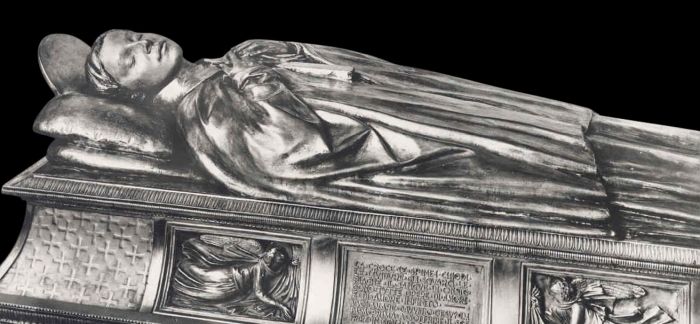
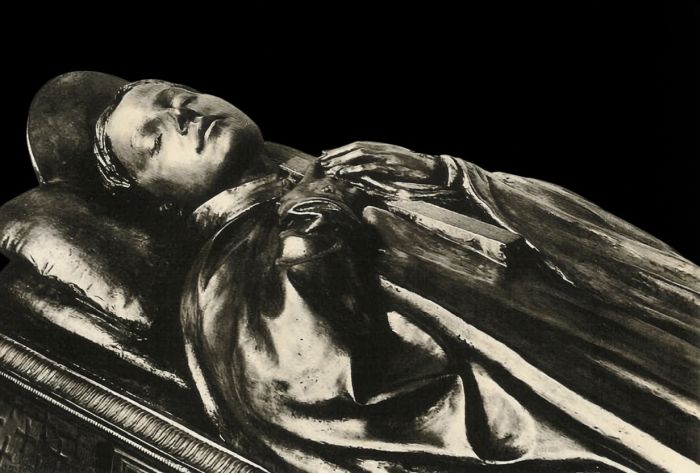
or migraines. Most of her relics can be venerated at the Monastero-Santuario di Santa Gemma associated with the Passionist
monastery in Lucca, Tuscany, Italy (pictures of her sarcophagus below),
but her heart is at the
Santuario de Santa Gema in Madrid, Spain.
Customs
Some may prepare for this feast by praying the Novena to St. Gemma Galgani starting on
April 2 and ending on April 10, the eve of her feast. Others might make
-- or also make -- the Triduum
in Honor of St. Gemma starting on April 8 and ending on the eve of
her feast (note that Passionists celebrate St. Gemma also on May
16, so the dates would be adjusted accordingly if you're celebrating
with them).
For her feast itself, there are the Litany
of St. Gemma Galgani, the Chaplet of
St. Gemma Galgani, and this prayer:
Oh holy Gemma,
I/we am/are near you, help me/us to pray. You know what I/we and those
near
me/us need; look after my/our urgent needs and my/our spiritual and
material wants. You take care of them! I/We confide in you and entrust
all to your loving care. Offer up to Jesus that tender and constant
care that you bore Him here on earth.
Oh holy Gemma, you who physically suffered all the pains of
the Passion of Jesus, I/we beseech of you the grace to meditate on and
live the Passion of Jesus, and the sufferings of Holy Mary. Pray that
I/we will be able to walk in the path of humility, simplicity, love and
sacrifice, fulfilling at all times and in all ways, the holy will of
God. Let me/us live united with Jesus, the Blessed Virgin Mary, and
you, for all eternity. Amen.
Those in Italy might make pilgrimages to some of the sites relevant to
St. Gemma's life, which you can see on the map below. One is in Rome;
the rest are in or very near Lucca (you'll have to zoom in very, very
closely on the city of Lucca to see them all).
There are no special foods or music for the day that I'm aware of, alas. But your children might enjoy these St.
Gemma Galgani Coloring Pages (pdf).
One
of the best uses of the day is to consider how you can best emulate
Gemma's intense love for Jesus. Ask yourself the question Gemma asked
of herself: "‘How sweet and good Jesus is to me, in spite of my being
so wicked! How shall I ever correspond with the mercy Jesus shows me?
What shall I give to Jesus in exchange for all the benefits He showers
upon me?" And ask yourself what you can give to Jesus or sacrifice for
Him for the conversion of sinners, especially sinners you have special
care for (i.e., family members and friends)?
One practice you might want to adopt is to make regular Holy Hour
devotions as St. Gemma did every Thursday. There are many different
ways to make Holy Hour, but to do so the way St. Gemma did, you can use
the following booklet, written by Blessed Elena Guerra, one of the
Zitine sisters who educated Gemma early on. St. Gemma used this method,
and Padre Pio -- who had a great devotion to St. Gemma -- had a copy of this booklet as well.
To learn more about St. Gemma, you can read these books, in pdf format,
from this site's Catholic Library:
Readings
Sanctitudinis Culmen
by Pope Pius XII, May 2, 1940
The distinguished servant of God, Gemma, earnestly committed herself to
the spiritual life. With her adopted mother, the notable Mrs. Cecilia
Gianinni, she had long discussions about Jesus and spiritual things.
Avoiding the traps of society life, she spent much of her time in
fervent contemplation of the passion of Christ. Day and night, she was
engaged in intimate communion with God. Reliable witnesses testify
that, during the last years of her life, the servant of God, Gemma, was
often in a state of rapture and was favored by God with prolonged
ecstasies and unusual gifts, like those we read about in the lives of
many saints. Among these Divine favors was the very special one of
manifesting in her virginal flesh the living image of Christ and
mysteriously sharing in the various sufferings of His passion.
She felt her hands and feet pierced by nails and her side wounded with
a lance. At times, the stigmata, or scars of the wounds were visible.
It is reported that she saw an apparition of the Lord Jesus himself and
also of the Blessed Mother. She experienced the presence of her
guardian Angel as a familiar friend, and she frequently held
conversations with him. There were other unusual manifestations of
grace, which Gemma described in detail at the order of her spiritual
director. They seem to indicate clearly that there was such a union of
mind and heart between this chosen virgin Gemma and Christ that she
could say with the apostle Paul: "I have been crucified with Christ,
and the life I live now is not my own; it is Christ living in me."
For some time, the servant of God had desired to enter a religious
community, and thought she was being called to the Passionist nuns. She
felt that God was inviting her to greater sacrifice and more intensive
contemplation of the passion of Christ. Since this is the main mission
and is a kind of sacred heritage that Saint Paul of the Cross left to
the religious that he founded, Gemma asked more than once to be
admitted into the cloistered Passionist convent at Tarquinia. But there
were obstacles, particularly that of her very poor health and the
publicity that had been caused by her extraordinary graces. Eventually
her illness progressed to such a point that it ruined all hope of her
entering.
However, even though she could not become a member of the Passionist
community, she deserves to be considered a member of It because she had
professed private vows. As a lay women under the guidance of such
spiritual directors of holy memory bishop Giovanni Volpe and Father
Germano of Saint Stanislaus, a Passionist priest, Gemma gave admirable
witness to the religious spirit and was a model of Christian
perfection. In fact, she practiced all of the theological and moral
virtues on a heroic scale, and we can say that her whole life was spent
in the continual exercise of virtue.
Footnotes:
1 It's likely only folks of a certain age
will pick up on what I did there. Sorry, I couldn't resist.
2 St, Gemma was confirmed before she
received her first communion. This wasn't uncommon in Italy at that
time.
3 Father Germanus describes St. Gemma's
stigmata:
Scarcely
had the ecstasy begun when there appeared on the back of both hands and
in the middle of the palms a reddish mark, and then one saw under the
epidermis a rent being made little by little in the flesh
inside-s-oblong on the backs of the hands and irregularly round in the
palms. A little later the skin itself broke and the opening took on all
the characteristics of a fresh wound-about a centimeter in diameter in
the palms and two millimeters in diameter and twenty millimetres in
length on the back of the hands. Sometimes the laceration appeared to
be only on the surface; at other times it was almost imperceptible to
the naked eye. As a rule, however, it was very deep and seemed that it
would pass through the hand and that the upper and lower wounds would
meet. One could not make certain of this latter appearance because the
apertures were filled with blood, in part congealed but for the most
part freely flowing, and when the blood stopped, they closed quickly;
being in ecstasy the violence of the pain caused her hands to be
convulsively closed. The wound in the palm became covered with a hard
fleshy protuberance in the form of the head of a nail, raised and not
adhering, about the size of a penny (soldo). In the feet, the wounds
were wider and surrounded towards the edges with livid flesh, and the
difference in size was the opposite to the wounds in the hands, the
wound on the top of the left foot being bigger than that of the sole of
the right foot. The aperture of the wound in the side was in the form
of a crescent lying on its back with the two points turned upwards. Its
length in a straight line was six centimetres and its width in the
middle, three millimeters, forming with its two opposite sides an angle
half a centimeter in length from top to bottom. The blood that came
from the aforesaid wound was copious, .as could be seen from her
under-garments, which were soaked with it. She did her best to hide
this fact and made use of several folds of linen, which' she applied to
her side repeatedly, but in a short time they were blood-soaked. She
would then hide them in order to wash them herself later on in secret.
The Friday ecstasy ceasing, the flow of blood from the side also
ceased, and the raw flesh on the hands and feet began to dry up, the
mass of lacerated tissues drawing in and becoming firmer little by
little. On the following day or on Sunday at the latest, not a trace of
those deep wounds remained, neither in the centre nor at the sides, the
flesh on top becoming quite natural and quite similar to that of the
parts that had not been torn. A white mark alone remained to show that
on the previous day there had been raw wounds in those places, which at
the end of five days would open again as before, and close again in the
same manner. Two years after the phenomena of the stigmata had ceased,
at the time of her death, the aforesaid marks still remained and could
easily be observed on her body, particularly on her feet, which when
she was alive and in ecstasy had been very difficult to uncover.
4 She wore this outfit to her brother's
wedding as well, angering his bride in the process. From Fr. Amedeo's
biography of St. Gemma:
At the time when
Gemma was dividing her day between the "Mantellate" Nuns and the
Giannini household, her brother Guido married. Gemma was invited to the
wedding, but nothing could induce her to go. However, she at length
took the advice of the Mother Prioress and went, but in the same
clothes as she always wore. The guests were very displeased, and so was
the bride, who then met her for the first time. Indeed the bride told
her to go away, never to return, and expressed a wish that no one
should bring her to the place again, because she was a stupid person.
It must be said, however, that later on her opinion of Gemma changed
and she conceived a great veneration for her. Guido indeed tells us
that his sister stayed at their house at Bagni di S. Giuliano for two
months during 1900 or 1901 , and that she behaved towards himself and
his wife "with all kindness and attention, never complaining and
considering excessive whatever was done for her." Gemma on this
occasion was accompanied by her Aunt Elisa who, in her testimony, does
not agree with her nephew, for she says that they remained there only
ten days. It was during her stay at this place that Gemma was seen to
be wearing gloves while she was at dinner. "What style!" her brother
remarked. "Eating your dinner with gloves on!" Gemma asked him to allow
her to keep them on, and his wife pleaded for her. But after dinner on
some pretext she induced her to take them off, and seeing the Stigmata
she ran weeping to call Aunt Elisa.
5
The phrase "odor of sanctity" can refer to a literal scent associated
with various Saints (the violet and tobacco fragrance that came from Padre Pio, the scent of roses that emanated from St. Rita of Cascia or St. Therese of Lisieux,
etc.), or it can refer metaphorically to a state of grace and holiness.
It's typically used to refer to someone dying a holy death -- e.g.,
saying that someone "died in the odor of sanctity" means he died a holy
death.
|