|
|
First a definition: a sacramental is a sacred sign that signifies
effects obtained through the Church's intercession. While all of the
seven Sacraments are Christ-instituted and always do exactly what they
signify ex opere operato ("from the deed done"),
sacramentals are usually Church-instituted (though some are
Christ-instituted). They work through the power and prayers of the
Church (ex opere operantis Ecclesiae) and, subjectively, ex
opere operantis, that is, through the pious disposition of the one
using them. Sacramentals drive away evil spirit, and when piously used,
remit venial sin and prepare the soul for grace.
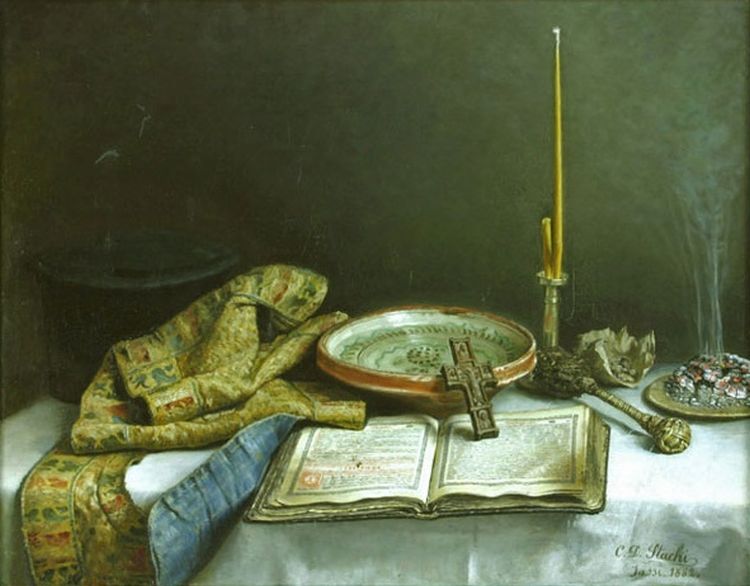
Sacramentals can be material things (blessed objects, such as scapulars, Rosaries,
Crucifxes, medals,
Holy Water, etc.) or actions (the Sign of the Cross, genuflection,
prayers, the washing of
the feet on Holy Thursday, etc.).
Note that only a priest has the power to bless an object and make it a
sacramental. Lay Catholics are free to bless objects, even using the
prayers priests use -- and we do so often in blessing our children,
blessing meals, blessing Advent wreaths
or Mary Gardens, etc. -- but our
blessings act as "mere" pleas to God. Priests alone have been given the
power to bless with a guarantee, as it were, and it is they and they
alone who can take a new Crucifix or Rosary and turn them into
sacramentals with the power and prayers of the entire Church behind
them.
Fr. Arthur Tonne, in his "Talks on Sacramentals" published in 1950,
sums
up how to view sacramentals:
Some years ago
two women were touring a desert region of our southwest. They wandered
off from their party and were lost. For two full days they tramped and
tramped in search of a road or dwelling. They found none. Completely
exhausted, aching with thirst and hunger, they could not walk another
step. One of them, in true womanly fashion, took out her compact to
repair the damage done by sun and dust. The sun flashed off the mirror.
She got an idea. Someone might see the reflected light. They flashed
the mirror in all directions. Rescuers saw the flashes, hurried to the
source, and saved the two ladies.
Who would have thought that such a simple thing as a mirror could save
human lives? This essential piece of female equipment did not directly
save their lives, but it was the means, the instrument for attracting
attention and bringing help.
The sacramentals are something like that. Of themselves they
do not save souls, but they are the means for securing heavenly help
for those who use them properly. A sacramental is a sacred object or
religious action which the Catholic Church, in imitation of the
sacraments, uses for the purpose of obtaining spiritual favors
especially through her prayer. A sacramental is anything set apart or
blessed by the Church to excite good thoughts and to help devotion, and
thus secure grace and take away venial sin or the temporal punishment
due to sin...
...We might divide the sacramentals into prayers, pious objects, sacred
signs, and religious ceremonies. Some sacramentals are a
combination--they fall into two or more classes. The Rosary, for
example, is a pious object and a prayer. The Sign of the Cross is a
prayer and a sign. The crucifix, pictures and statues are pious
objects. The ceremonies performed in the various sacraments are also
sacramentals, like the extending of the hands in Confirmation...
...Do we have to use sacramentals? Does a Catholic have to wear a
scapular, or use holy water, or pray the Rosary? Strictly speaking, no.
The sacraments are necessary for salvation; the sacramentals are not
necessary. Nevertheless, the prayers, pious objects, sacred signs and
ceremonies of Mother Church are means to salvation.
If you were lost in a desert, as were the two women of our story, you
don't have to have a mirror to be saved. But that lifeless, senseless
object was the means of saving their lives.
In a similar way the sacramentals, lifeless, helpless in themselves
[Ed. in terms of our sanctification and the fruits that we personally
derive from them], are helps to winning life-giving graces. They must
never take the place of the sacraments. You will find Catholics who
place more confidence and trust in these material objects than they do
in the reality of the sacraments.
For example, you may see a Catholic enter Church and go directly to the
vigil light stand without seeming to pay any attention to our Lord in
the Blessed Sacrament. That Catholic does not appreciate the difference
between a Sacrament and a sacramental.
It is with a desire and holy ambition to make you appreciate these aids
to spiritual life, the sacramentals, that we propose to explain some of
them on succeeding Sundays.
In the desert of daily life they are mirrors that will lead us to the
fountains of spiritual help and spiritual life. Amen.
Disposing
of Old, Worn-out Sacramentals & Consecrated Material
When a material
sacramental becomes so worn that it can no longer be used as a
sacramental, a Catholic won't casually toss it into the trash. To
prevent desecration, the sacramental should be returned to the earthly
elements. Holy water, for example, should be poured into a hole dug in
the earth, in a spot no one would walk over. Combustible sacramentals,
such as scapulars and holy books, should be burned and then buried.
Larger sacramentals that don't burn should be altered so that their
form no longer appears to be a sacramental (ex., a statue should be
broken up into small pieces) and then buried. Objects made of metals
can be melted down and used for another purpose.
Items lose their blessing or consecration if they are desecrated, are
substantially broken such that they can no longer be used for their
sacred purpose, or if they are publicly sold (if an item is sold by one
individual to another for only the price of the material itself
-- i.e., if no profit is made, the blessing remains. E.g., if you were
to give someone, say, a blessed rosary or sell it to him at cost, he
would not have to have it re-blessed; if you sell a blessed rosary to
someone for profit, he would need to take it to a priest.)
Note that on 23 June -- the Eve of the Feast of St. John the Baptist
--
it is custom to build large bonfires in which no longer useful material
sacramentals are burned. Read more about this tradition in the The Seasonal Customs area of this site.
The Blessed Sacrament
Be certain that
the Blessed Sacrament (the Eucharist and Precious Blood) is not a
"sacramental," but for the sake of information, here is how the Blessed
Sacrament is disposed of in case of corruption:
In the sacristy (also called "vestry") of a church -- the room where
vestments, vessels and oils are stored -- there is a special sink
called a "sacrarium" (also "piscina") which is used for cleaning sacred
vessels. This basin's drainage pipe doesn't lead to the sewer as do
those of most sinks; instead, it goes directly to the earth so that
liquid sacramentals, such as Holy Water and oils, or even the tiniest
morsels of the Blessed Sacrament or drops of the Precious Blood which
might be found on Patens or in Chalices, will be disposed of correctly
and with reverence. If the accidents of a consecrated Host or chalice
of the Precious Blood were to become contaminated in some way such that
it could not be consumed, they are disposed of in the sacrarium.
See also the
page on Relics.
|
|