The Sacrament of Penance
|
Matthew 9:3-8
"And behold some of the scribes said within themselves: He blasphemeth.
And Jesus seeing their thoughts, said: Why do you think evil in your
hearts? Whether is easier, to say, Thy sins are forgiven thee: or to
say, Arise, and walk? But that you may know that the Son of man hath
power on earth to forgive sins, (then said he to the man sick of
palsy,) Arise, take up thy bed, and go into thy house. And he arose,
and went into his house. And the multitude seeing it, feared, and
glorified God that gave such power to men."
John 20:19-23 "Now when it was late that same day, the first of the
week, and the doors were shut, where the disciples were gathered
together, for fear of the Jews, Jesus came and stood in the midst, and
said to them: Peace be to you. And when he had said this, he shewed
them his hands and his side. The disciples therefore were glad, when
they saw the Lord. He said therefore to them again: Peace be to you. As
the Father hath sent me, I also send you. When he had said this, he
breathed on them; and he said to them: Receive ye the Holy Ghost. Whose
sins you shall forgive, they are forgiven them; and whose sins you
shall retain, they are retained."
"The tears of the penitents are wine for the angels." -- St. Bernard
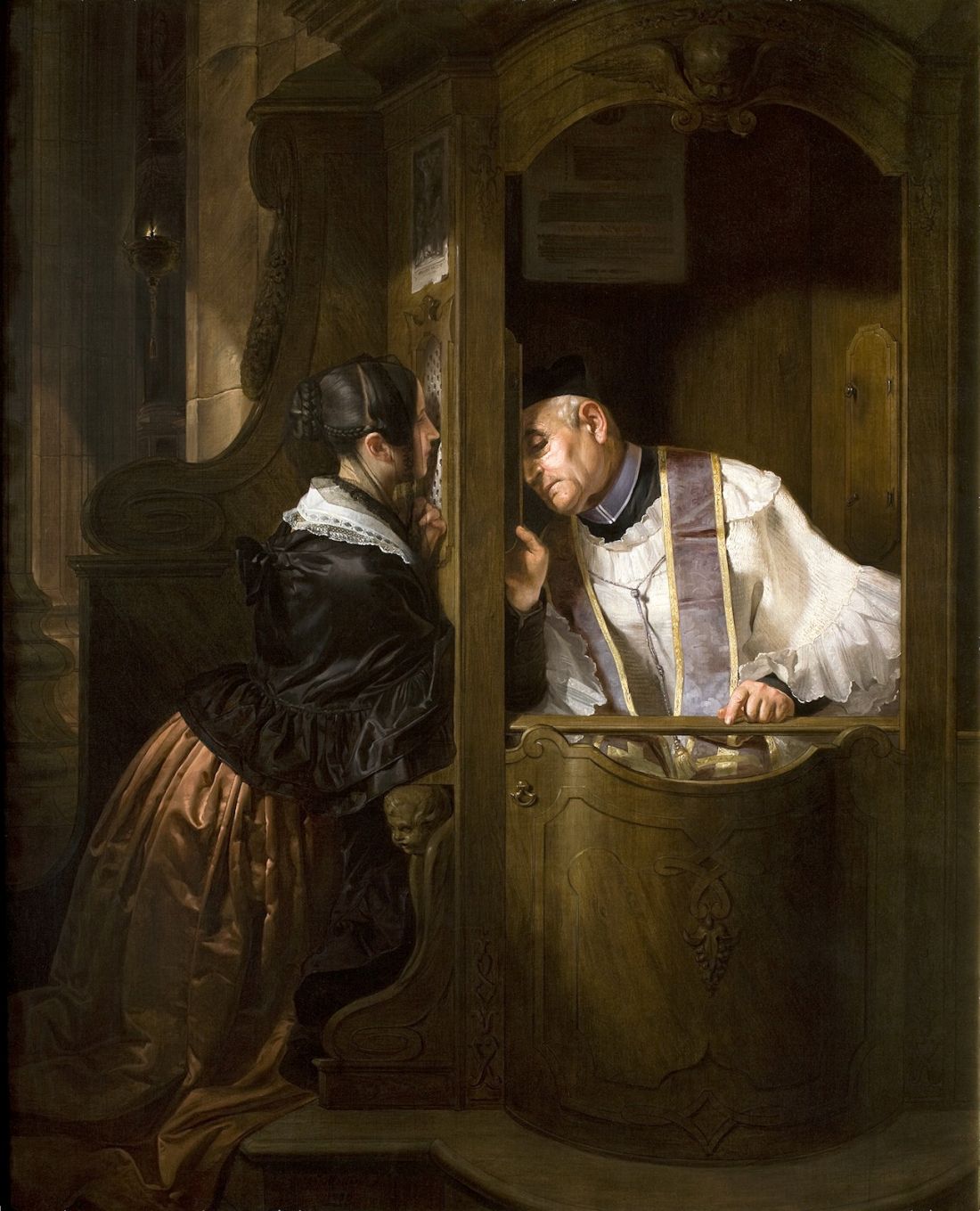
The Sacrament of Penance -- also known as "Confession" or, in the Novus
Ordo World, as "Reconciliation" -- is such a gift! It can be very hard
to do --
it can be intimidating, and feel embarrassing -- but once absolution is
given,
you will walk out of that confessional feeling like a trillion bucks.
Christ, in His most Holy Wisdom, gave us this precious Sacrament to literally
and truly bestow His grace upon us through His priests as a means
of forgiving us and assuring us of His mercy and love for us.
This psychological benefit of "feeling assured" and "clean again" stems
not only from the supernatural fruits of the Sacrament, but from our
human nature and our need to purge ourselves of those things that
plague our consciences. Christ, the Great Physician, knows us well and
knows that "confession is good for the soul," in both a supernatural and
psychological sense. As G.K. Chesterton wrote:
When a Catholic
comes from confession, he does truly, by definition, step out into that
dawn of his own beginning... in that brief ritual God has really remade
him in His own image. He may be grey and gouty; but he is only five
minutes old.
I have talked to
many people who've been terrified to go to Confession; all I can say is
be a brave soldier and buck up and "just do it." Christ Himself wants
this of you, so just resolve to do the right thing. Millions
of Catholics over the course of 2,000 years have braved the "little
dark box" (at least metaphorically; though Confession has been around
since Day 1, the Confessional is a 7th. century Irish gift to
the Church); you can, too. Priests have heard it all, trust me, and
nothing you say can ever be repeated to anyone in any way that
could identify you -- not to the police, not to another priest, not to anyone
under any circumstances -- even court orders, even if something is
revealed that could pose a danger to someone, etc. In fact, a priest is
automatically excommunicated if he were to violate
the "Seal of Confession"!
And if you're worried because you're "new at this," that's okay! It's
okay to be nervous! It's okay to be afraid because this is something
new and different to you. And it's okay to tell the priest how you
feel. Just let him know it's your first Confession; he will put you at
ease and help you through it and be so glad you've come to receive the
graces our Lord wants to pour out on you!
It's not as scary as it seems to so many people. Really. But if you're
still afraid, take a deep breath, pray for strength, go to Confession
and receive His wonderful mercy! You will not regret it, I promise you!
If you've just been validly baptized, you don't need
Confession, because Baptism wipes away all guilt of sin (and the
temporal effects of sin, by the way). If, however, you were validly
baptized years ago and are just now coming to this Sacrament for the
first time, or if you're a Catholic who's been away from the Church for
years, you might want to schedule an appointment with your priest
to make what's known as a "General Confession," which includes sins of
one's entire life, since it might take a bit longer than usual (general
Confessions are also often made before
before marriage or ordination). Normally, though, a person who's raised
Catholic makes his first Confession right before he receives his first Holy Communion, usually at around the
age of seven.
How to Go to
Confession
The steps to
Confession are:
- Examination of
Conscience (detailed procedure at bottom of page)
- contrition
- the actual
confessing of your sins to God through His priests
- the assigning of
penance
- Act of
Contrition
- Absolution
- carrying out
your penance
I will go
through each of these in detail below.
1. Examination of
Conscience
Before we get to
the church, we mentally review our sins and determine what needs to be
confessed. There are various methods of doing this, but one good way is
to consider your Duties to God, Church, family, society and to yourself
to see where you've failed to honor them. A detailed way of doing this
is provided in the "What to Confess: a guide to
Examination of Conscience" section at the bottom of the page.
After entering the Church and making his first confession, a Catholic is required
to go to Confession once a year (during
Lent) and also at any time of the year he has mortal sin on his
soul (is "not in a state of grace"), especially if he desires to
receive the Eucharist. But weekly -- at least monthly -- Confessions
are encouraged.
For standard, routine confessions, the Sacrament is usually offered
before Mass, at least on
weekends (see your parish or chapel's
bulletin, parish website, or call your parish's office to find out when
confession is offered). You can also call your priest to set up an
appointment for
the Sacrament (for "just reason" only, you have the option of receiving
the Sacrament face to face, outside of the Confessional, but this is
not standard and should not be treated as though it is). Be warned,
though, that because of the Modernism attacking the Church, many
non-traditionalist priests treat this Sacrament as, at best, "a little
chat"
(especially in the too common "face to face" confessions) or, worse, as
nothing at all and so simply don't offer it frequently enough or allow
only 15 minutes for the Confessions of an entire parish before Mass.
Some fail to follow the proper form so as to render your Confession
invalid! The solution to these problems is: find another parish or a
chapel with a traditional
priest and traditional Mass. Fast.
If you have a particularly long confession to make, or are looking for
major spiritual advice or to have a conversation, make an appointment
with your priest.
What Penance is: it is the Sacramental
pardoning of the eternal effects of our sins for which we are truly
contrite. It is effected by Christ, Who paid their eternal wages with
His Passion, Resurrection, and Ascension, through His priests using
proper form, which are the words "ego te absolvo" (or "I absolve you"
in English). Through the Sacrament, Christ gives us not only
forgiveness, but grace to remain steadfast.
What Penance is not: psychotherapy. While the
priest may give you some direction and advice in the Confessional, if
you have general problems or spiritual issues you want to discuss, you
should set an appointment to talk with him. This is especially true at
a Confession before Mass where people are in line behind you and time
is short. Be mindful of the priest's and others' time, and remember
"the three Bs of confession": Be sorry, be brief, be gone.
2. Contrition
Contrition is willful
regret for one's sins. It isn't a matter of one's "feelings" of guilt,
but of conviction of the evil of sin and the resolution to sin no more.
In other words, contrition is rooted in the will, not in the emotions.
For example, some people are more emotional than others: some get a
case of the "scruples" and feel shame or guilt over any little thing,
whether it's sin or not; others can have committed murder and never
"wallow" in guilt but are still truly contrite. The one is not
necessarily more "holy" or making a better Confession than the other.
What matters is their conviction -- their will to offend God no more,
and their resolution to make reparations as far as possible, do their
penance, and patiently bear the temporal effects of their sins. Without
contrition, Confession is not valid.
"Imperfect Contrition" (also called "attrition") is regret out of fear
of God's just punishments for sin; "Perfect Contrition" is regret for
having offended God. We must always strive for the latter, which always
absolves sin in itself if it is coupled with the will to also
receive the Sacrament.
One of the keys to confession is the desire to be rid of all of one's
sins. If this is your will, if this is your desire, if you are willing
to confess all of your sins and do your penance and resolve to sin no
more, then your sins will be forgiven -- all of them, even those you
may have truly forgotten about. But don't kid yourself,
either, and think you can skip mentioning this sin or that one because
you're embarrassed. Don't lie to yourself, to your priest, or to God,
by omission.
3. Confessing Your
Sins to God through His priests
When you get to
the church at the time the Sacrament is offered, you
may or may not find a line of people standing or lined up in a pew
outside the Confessional. Just take your place in line, keeping a wide
berth of the Confessional itself if it is occupied by a fellow
penitent. Please note that it is very rude to be near the Confessional
when someone else is using it! Though I've never overheard anyone in
the Confessional, it could feasibly happen. If this were to happen, the
one who overhears should take all steps to not hear, and should never,
ever repeat anything he might have heard.
Some confessionals have a green light shining when a priest is ready
and available in the Confessional, and a red light shining when someone
is in the Confessional with him, receiving the Sacrament. Others don't.
In any case, when it's your turn, enter the Confessional and kneel. You
may barely see the priest on the other side of the grille (the screen
which separates you).
When you are ready to begin, make the Sign of the
Cross and say, in a whisper, but loud enough so he can hear you:
Bless me,
Father, for I have sinned. It is (X days, weeks, months, years) since
my last Confession. I accuse myself of the following sins.
You then name
the sins you need to confess, indicating, in the case of mortal sins,
how many times you've committed them. If you're unsure of exact numbers
-- but only if you are unsure -- tell him "about how many" times you've
committed the sin. Ex., "I've lied to my mother twice, I stole a candy
bar from work once, I've had lustful thoughts too many times to count,
etc."
Don't go into a lot of detail (be brief!), don't name other people who
may have
sinned with you, but do tell him what he needs to know in order to
understand relevant circumstances of the particular sins -- that is,
circumstances that might mitigate your culpability or make you more
culpable. For example, telling him about stealing a loaf of bread
because you were starving will elicit a different penance and spiritual
direction than if you tell him you stole a stack of money because you
wanted to buy some porn. If you are unsure as to whether a particular
act was a sin, tell him. As you speak, he may stop you to ask you
questions for clarification.
When you are finished, indicate so by saying something like the
following traditional words:
For these and
all the sins of my past life, I ask pardon of God, penance, and
absolution from you, Father.
Don't panic if
you later recall sins you forgot to confess: remember that if you were
willing to confess all of your mortal sins but simply forgot a few,
they are forgiven. The same holds true for sins you hadn't known were
sins before you went to confession (which sins generally can't, by
definition, be mortal. See the page on Catholic
Moral Theology for more information). You should, though, confess
those sins at your next confession, but, please, relax
and know that you are forgiven if you truly willed to confess all
mortal sins but simply forgot about or didn't know were sins in the
first place.
4. Penance
Now the priest
will give you penance to help you pay for the temporal effects of your
sins. He might ask you to say certain prayers
(the old "Say three Hail Marys"), he may
ask you to read certain parts of Scripture. If there is restitution to
be made, he might ask you to do so. Whatever he asks you to do,
accomplish it as soon as possible after leaving the Confessional.
5. Act of Contrition
Now you will
make an Act of Contrition to express your sorrow at having offended God
and resolving to sin no more. The traditional way of doing this is to
recite aloud the prayer called "Act of Contrition":
O my God! I am
heartily sorry for having offended Thee, and I detest
all my sins, because of Thy just punishments, but most of all because
they offend Thee, my God, Who art
all-good and deserving of all my love. I firmly resolve, with the help
of Thy grace, to sin no more and to avoid the near occasions of sin.
Amen.
If you are
comfortable doing so, you may say the prayer in Latin:
Deus meus, ex
toto corde poenitet me omnium meorum peccatorum, eaque detestor, quia
peccando, non solum poenas a Te iuste statutas promeritus sum, sed
praesertim quia offendi Te, summum bonum, ac dignum qui super omnia
diligaris. Ideo firmiter propono, adiuvante gratia Tua, de cetero me
non peccaturum peccandique occasiones proximas fugiturum. Amen.
If you have a
hard time memorizing (which is OK!), you can pray aloud using your own
words to the same effect -- i.e., expressing your contrition for having
displeased God and resolving to sin no more and avoid the near
occasions of sin -- but you should try to memorize the traditional Act
of Contrition and teach it to your children. You can also have the
prayer written out or on a Holy Card to
carry with you in the Confessional. (Note: a "near occasion of sin" is
a situation in which you are likely to sin. For ex., going to the mall
might be a "near occasion of sin" for a kleptomaniac who hasn't learned
to control his behavior; keeping company alone with a girl he is
extremely attracted to in a sexual way might be a near occasion of sin
for a man, etc.)
6. Absolution
Now comes the
good part (it may come as you make your Act of Contrition, so
don't be confused if the priest starts whispering in Latin as you pray): Christ, through His priest,
grants you absolution in a form that includes the words below. Without
the words in italics (the very form of the Sacrament) in either
Latin or English (or whatever language is being spoken by the priest),
the
Sacrament is not valid:
Dominus noster
Jesus Christus te absolvat; et ego auctoritate ipsius te absolvo ab
omni vinculo excommunicationis (sespensionis) et interdicti in quantum
possum et tu indiges. [making the Sign of the Cross:] Deinde, ego
te absolvo a peccatis tuis in nomine Patris, et Filii, et Spiritus
Sancti. Amen.
English:
May our Lord Jesus Christ absolve you; and by His authority I absolve
you from every bond of excommunication and interdict, so far as my
power allows and your needs require. [making the Sign of the Cross:]
Thereupon, I absolve you of your sins in the name of the
Father, and the Son, and the Holy Spirit. Amen.
He will pray a
prayer for you:
Passio Domini
nostri Jesu Christi, merita Beatae Mariae Virginis et omnium sanctorum,
quidquid boni feceris vel mail sustinueris sint tibi in remissionem
peccatorum, augmentum gratiae et praemium vitae aeternae.
English:
May the Passion of Our Lord Jesus Christ, the merits of the Blessed
Virgin Mary and of all the saints obtain for you that whatever good you
do or whatever evil you bear might merit for you the remission of your
sins, the increase of grace and the reward of everlasting life.
The Sacrament is now complete. The priest will dismiss you, perhaps
with a final blessing. Thank him, cross yourself,
and leave the Confessional. (If it is before Mass and people were in
line behind you, it is kind to give the priest an idea as to how many
people are awaiting Confession).
7. Carrying out your
Penance
As soon as
possible, carry out the penance you were given. Do all you can to avoid
near occasions of sin, to bear patiently the temporal effects of the
sins you've committed, and to make restitution to anyone you've harmed.
You
may add penances of your own devising to the one(s) the priest gave
you.
Please know that if you accidentally do your penance incorrectly or,
God forbid, you don't carry out your penance at all, you are still
forgiven. It is Christ's absolution, through the priest, that forgives
your sins, not the penance. In other words, if the priest were to tell
you to pray three Hail Marys, and you miscount and pray only two, and
realize your mistake later, you are still forgiven. Go ahead and pray
the third Hail Mary and get on with your life. Don't worry about not
being forgiven.
(Read a "sample confession" so you can see how
easily it all goes)
After Confession
Rejoice and be
grateful! Consider what has been done for you! Savor the sweet
knowledge that you are forgiven. Praise the Lord Jesus Christ,
the Lamb of God Who takes away the sins of the world! He has said the
word, and you have been healed!
Now you must imitate Christ by forgiving others as you have been
forgiven:
Matthew 6:9-15
Thus therefore shall you pray: Our Father who art in heaven, hallowed
be thy name. Thy kingdom come. Thy will be done on earth as it is in
heaven. Give us this day our supersubstantial bread. And forgive us our
debts, as we also forgive our debtors. And lead us not into temptation.
But deliver us from evil. Amen. For if you will forgive men their
offences, your heavenly Father will forgive you also your offences. But
if you will not forgive men, neither will your Father forgive you your
offences.
Consider the Parable of the
Unmerciful Servant:
Matthew 18:21-35
Then came Peter unto him and said: Lord, how often shall my brother
offend against me, and I forgive him? till seven times? Jesus saith to
him: I say not to thee, till seven times; but till seventy times seven
times. Therefore is the kingdom of heaven likened to a king, who would
take an account of his servants. And when he had begun to take the
account, one was brought to him, that owed him ten thousand talents.
And as he had not wherewith to pay it, his lord commanded that he
should be sold, and his wife and children and all that he had, and
payment to be made.
But that servant falling down, besought him, saying: Have patience with
me, and I will pay thee all. And the lord of that servant being moved
with pity, let him go and forgave him the debt. But when that servant
was gone out, he found one of his fellow servants that owed him an
hundred pence: and laying hold of him, throttled him, saying: Pay what
thou owest. And his fellow servant falling down, besought him, saying:
Have patience with me, and I will pay thee all. And he would not: but
went and cast him into prison, till he paid the debt.
Now his fellow servants seeing what was done, were very much grieved,
and they came and told their lord all that was done. Then his lord
called him; and said to him: Thou wicked servant, I forgave thee all
the debt, because thou besoughtest me: Shouldst not thou then have had
compassion also on thy fellow servant, even as I had compassion on
thee? And his lord being angry, delivered him to the torturers until he
paid all the debt. So also shall my heavenly Father do to you, if you
forgive not every one his brother from your hearts.
Think of those
against whom you hold grudges. Consider vengeful feelings you might
have, or any petty ways you strike back at or undermine others. Make
peace with those you've wronged; forgive those who've wronged you. This
doesn't mean to be stupid, to "forget" that you've been wronged, or to
allow yourself to be abused. It means simply letting go of anger and
vengeance, and praying that the evil-doers stop doing their evil and
come to Christ.
And if you have a scrupulous mindset, if you agitate over sins you've
confessed, if you worry that you're not "truly" forgiven, consider
these words from Padre Pio, as related in
the book "Padre Pio, the Stigmatist" by Charles Mortimer Carty:
Someone
complained to the Father of being excessively distressed by the sins he
had committed. The Father replied to him: 'That which you feel is
pride; it is the demon which inspires you with this sentiment, it is
not true sorrow.'
The penitent replied: 'Father, how can you then distinguish
what comes from the heart and is inspired by Our Lord, and that which
instead is inspired by the devil?'
"'You will distinguish it' -- replied the Father -- 'always
by this: The Spirit of God is a spirit of peace, and also in the case
of grave sin, it makes us feel a tranquil, sorry humble, confident, and
this is due precisely to His mercy. The spirit of the demon, on the
contrary, excites, exasperates, and makes us in our sorrow feel
something like anger against ourselves, whereas our first charity must
be to ourselves, and so if certain thoughts agitate you, this agitation
never comes from God, Who gives you tranquility, being the Spirit of
Peace. Such agitation comes from the devil.'"
One other way the
grace of the Sacrament of Penance may be received
As indicated
above, perfect contrition absolves sin in itself. Thus, if one is sorry
for one's sins but is trapped on a desert island without a priest, one
needn't fear being damned if unable to confess in the normal way. We
are bound by the Sacraments; God is not, and He has many ways
of
pouring out His grace to us!
Perfect contrition, though, includes the desire to obey God and not
offend Him further -- and God wants us to confess our sins to Him
through one of His priests.
Therefore, if one can, one must go to Confession if
there is a mortal sin to confess, or at least once a year. If one is unable
to confess in the normal way, but would confess in the normal
way if it were possible, then merciful God provides.
Notes and Tidbits on
Confession
|

The rose is a
symbol for many things in Christianity (Mary, Mystery, Paradise,
martyrdom), the seal of the Confessional among them. The ancient Romans
believed that Cupid -- the Roman god of love -- gave a rose to
Harpocrates as a bribe for not letting on what his mother Venus, the
goddess of "love," was up to. Hence, the rose became a symbol of
confidentiality. This symbolism carried over into Christianty, and the
doors of Confessionals are sometimes decorated with the rose. From
these Roman and Christian associations comes the phrase "sub rosa" --
"under the rose," meaning "secretly" or "confidentially."
|
|
"General
Absolution" such as is given in "communal penance services" in which a
priest "absolves" an entire group of their sins is highly illicit
unless it is a serious emergency (you're all on the Titanic, you're a
group of soldiers getting ready to go into battle, etc.) If you are in
a group that receives such an "absolution," you are still required to
go to individual Confession if it is at all possible.
If, for serious
and just reason, you need to make a Confession to a priest outside of a
Confessional, kneel and carry on as above. The priest might lay his
stole on your shoulder as you confess.
Confession of venial sins to laymen is a sacramental and has
the same power to remit sins as does the use of such things as Holy Water. The practice is also healing to
human relationships, so if you've sinned against someone, confess your
sorrow to him in addition to confessing to your priest! There is a
beautiful Lenten custom practiced
before going to see the priest for
Confession during Lent: one bows before each member of the household
and to
any one has sinned against, and says, "In the Name of Christ, forgive
me if I've offended you." The one being asked for forgiveness responds
with "God will forgive you." This lovely practice doesn't have to be
for Lent only...
For inspiration, read how Christ forgives from the Cross (Luke
23:33-34), the story of Mary
Magdalen, the Parable of The Two Debtors
(Luke 7:36-50), and the Parable of the
Prodigal Son (Luke 15:11-32). See also St. Ephraem's "Homily on the Sinful Woman."
Finally, I want to add a thought for those who might feel that
confession is futile because we always ends up sinning again and need
to go
back to confession, especially when it comes to sins that are rooted in
bad habits (vices) that can be hard to overcome: think of this
sacrament in the same way
we think of cleaning the house. Yes, we have to keep dusting, moppping,
and doing the dishes when needed, and yes, it can be tiring and
sometimes feel "futile," like a never-ending battle. But the only other
option is to let the filth build up until our homes are unbearable.
Confession is a "house-cleaning of the soul," a cleaning that needs to
be repeated once in a while, but which we should embrace because the
alternative is a lot, lot worse than the work put in to keeping things
clean.
|
What to Confess?
A guide to Examination of Conscience
I John
5:16-17: He that knoweth his brother to sin a sin which is not to
death, let him ask: and life shall be given to him who sinneth not to
death. There is a sin unto death. For that I say not that any man ask.
All iniquity is sin. And there is a sin unto death.
As said above, one only needs to confess mortal sins
("sins unto death"), so a good grasp of what this means is imperative.
For a sin to be mortal, it has to meet three conditions:
- grave matter:
does it involve breaking one of the 10
Commandments, committing one of the Sins
that Cry out to Heaven, or failing to uphold the 6 Precepts of the Church?
- full
knowledge: did you know or should you have known that the
act was sinful?
- deliberate
consent: was your consent to this act sufficiently deliberate so as
to be a choice? Were conditions present that influenced your ability to
choose?
If you are
unclear as to whether a sin meets all of the requirements above for a
mortal sin, be safe and confess it, telling the priest of your lack of
clarity so he can teach you so you'll know when you make examinations
of conscience in the future.
As to venial sins (sins that don't meet the above requirements), you
are free to confess them or not. Confessing them is definitely
encouraged, but do be mindful of the priest's time and the time
others need who may be standing in line behind you. If your Confession
is before Mass, time is running short before Mass begins, there is a
long line behind you, and you are wanting to confess venial sins only,
you might want to hold off so that others who might have mortal sins to
confess can see the priest before Mass starts.
If you are plagued by feelings of "not being forgiven" or being
"unworthy" of the Sacrament of Penance, don't confess venial sins that
you are doubtful about lest you find yourself with a  case of
"the scruples." A "scrupulous" person is one who has an unwarranted
fear that something is a sin
when it is not, or that he didn't confess properly and, so, isn't
really forgiven. This
doesn't refer to isolated incidents, but to a habitual way of feeling
or thinking, an unwarranted fear, a sort of emotional obsession; it
doesn't refer to true questions as to whether such and such a behavior
is a sin or not. Anxiety is involved, and often a felt doubt as to the
power of confession, the genuine-ness one's contrition, and the extent
of God's Divine Mercy. If you have a
good, orthodox Confessor, trust him and his advice, and tell him about
any scruples you needlessly suffer from; he may be able to help you!
And pray to St. Alphonsus Liguori, the great moral theologian who
suffered from scruples himself and is now the patron saint of the
scrupulous. For some practical advice in dealing with scruples, see "The Ten Commandments for the Scrupulous"
written by Redemptorist priests. case of
"the scruples." A "scrupulous" person is one who has an unwarranted
fear that something is a sin
when it is not, or that he didn't confess properly and, so, isn't
really forgiven. This
doesn't refer to isolated incidents, but to a habitual way of feeling
or thinking, an unwarranted fear, a sort of emotional obsession; it
doesn't refer to true questions as to whether such and such a behavior
is a sin or not. Anxiety is involved, and often a felt doubt as to the
power of confession, the genuine-ness one's contrition, and the extent
of God's Divine Mercy. If you have a
good, orthodox Confessor, trust him and his advice, and tell him about
any scruples you needlessly suffer from; he may be able to help you!
And pray to St. Alphonsus Liguori, the great moral theologian who
suffered from scruples himself and is now the patron saint of the
scrupulous. For some practical advice in dealing with scruples, see "The Ten Commandments for the Scrupulous"
written by Redemptorist priests.
Now, below are some questions to ask yourself regarding our duties in
life, the answers to which might help you in examining your conscience
and deciding what to confess. At least, the answers might help you to
know where to focus your energies so you can become a better servant of
God. You can download these
questions in pdf format:
|
| Duties
to God and to Church: |
 |
Do
I love God with all my heart, soul, mind, and strength? |
|
Have
I given God the honor and time that is His due? |
|
Do
I pray? |
|
Do
I express my gratitude to God? |
|
Does
something or someone -- a material thing, a person, a behavior, an
attitude -- come between me and God? |
|
Have
I used God's Name as a curse word or cursed God? |
|
Have
I broken promises, oaths, or vows to God? |
|
Have
I failed to treat sacred things and places with respect? |
|
Have
I received the Eucharist while not in a state of grace? |
|
Have
I kept Sunday holy by attending Mass and refraining from servile
work? |
|
Have
I lied to a priest during the Sacrament of Penance or intentionally
failed to confess a sin I should have confessed? |
|
Have
I defended God and His Church when it was necessary? |
|
Do
I study my faith, according to my abilities, so I can defend the Church
when necessary? |
|
Do
I study my faith, according to my abilities, so that I have a conscience that is true, good, and certain? |
|
Do
I properly value the Church's disciplines and heritage? |
|
Do
I pray for the Holy Father and the Church, including those in
Purgatory? |
|
Have
I experimented with magic, the occult, spiritism, willful psychic
phenomena, ouija boards, etc.? |
|
Do
I keep Sundays and Holy Days of obligation? |
|
Have
I failed to go to Confession, at least once a year, traditionally
during Lent? |
|
Have
I failed to do my Easter Duty (i.e., receive the Eucharist at least
once during the Paschal Season)? |
|
Have
I failed to follow the laws of fasting and abstinence? |
|
Have
I failed to support the Church as my means allow? |
|
Have
I obeyed the Church's marriage laws? |
|
Do
I belong to a secret society such as Freemasonry, Skull and Bones, etc.? |
Duties to Family: |
|
Have
I failed to perform my duties to my parents, spouse, or children
-- as (mother/ father, daughter/son, wife/husband) and as a Christian
whose duty it is to lead them to Christ and to pray for them and, if
possible, with them? |
|
For
husbands: Do I treat my wife with the respect and tenderness I would
give to Our Lady? Do I treat her as less than my queen, bride, and
friend? Do I strive to provide for her, protect her, and help her to
feel cherished and needed without condescension or treating her as a
child? Do I undermine her in her role as mother? Do I try to make her
happy within the boundaries of God's laws? Do I express gratitude to
her for what she does? Do I use my headship as an
excuse for laziness, cruelty, arrogance, misogyny, or in any manner
inconsistent
with the way in which I would treat Our Lady or the manner in which
Christ treats His Church? Do I try to please and fulfill her sexually? |
|
For
wives: Do I treat my husband with less than the respect and tenderness
I would give to Christ? Do I treat him as less than my king, groom, and
friend? Do I strive to respect his headship, nurture him, and help him
feel
cherished and needed? Do I undermine him in his role as father? Do I
try to make him happy within the boundaries of God's laws? Do I express
gratitude to him for what he does? Do I nag or
provoke him? Do I talk to him as if he's a child? Do I speak ill of him
to others? Do I betray his privacy
with my girlfriends or others, including "the internet"? Do I try to
please and fulfill him
sexually? |
|
Is
Christ the King of my household? |
|
Do
I pray for my dead ancestors, family
members, and friends, and for the
souls of those in Purgatory who have no one to pray for them? |
|
Have
I helped cause members of my family to sin (by counsel, command,
consent, provocation, praise or flattery, concealment, partaking,
imprudent silence, or defense of the sin in question)? |
|
Do
I try my best to empathize with the members of my family and to love
them with a love grounded in Truth? |
|
Do
the members of my family know they are loved? If not, is this my
fault? |
|
Have
I caused any member of my family to get unrighteously angry or to
be unjustly hurt? |
|
Have
I failed to apologize to and seek forgiveness from members of my family
-- including children -- if there was need? |
|
Have
I forgiven my parents, spouse or children for past faults? |
|
Do
I respect my family members' privacy? (consider how you behave and what
information you reveal on social media) |
|
Do
I give my family my time and undivided attention when possible? |
|
Do
any of my habits -- spending habits, gambling, etc. -- deprive my
family of support? |
|
Have
I used artificial contraception or otherwise failed to keep my marital
acts open
to life?
Have I used N.F.P. (Natural Family Planning) for frivolous reasons? |
|
Am
I too lenient with my children? Do I set high enough but not
unreasonable standards and reasonable boundaries?
Do I use fair, reasonable, and consistent discipline? |
|
Am
I too harsh with my children? Do I squelch the joy out of my
children's lives with needless rules, "Pharisaic" attitudes, a lack of
mercy, and an authoritarian -- as opposed to an authoritative --
approach to discipline? Do I discipline them in a way that humiliates
them? |
|
Are
my spouse and I consistent and unified as a whole in our discipline of
our children? |
|
Do
my spouse and I sabotage each other with regard to disciplining our
children? Do I "force" my spouse to play the role of "mean parent"
while I play "fun parent"? |
|
Have
I been a good example for my children and/or the children of others,
especially in terms of how I treat others and honor God? |
|
Do
I have high enough and age-appropriate expectations of my children? |
|
Do
I over-praise or under-praise my children? |
|
Do
I prize goodness and grace in my children above anything else I prize
in them? |
|
Do
I teach my children the fullness of the Faith, encourage them to
pray to their Guardian Angels,
to their patron Saints, for the dead, etc.? |
|
Do
I inspire my children's imaginations, do
all I can to encourage healthy curiosity and the ability to marvel by
teaching them about God, His Church, His creation, the lives of the
Saints, etc., and by, to the best of my ability, exposing them to good
books, music, art, museums, etc.? |
|
Have
I found a good balance between protecting my child's innocence and
teaching him about the world, in an age-appropriate way, so that he is
not ignorant and naive or made to feel stupid or ridiculous about
himself when in the company of others? Have I
given him good weapons with which to resist the evils of the world
while
understanding and nourishing his social needs? |
|
Do
I treat male children and female children with equal dignity and with
respect for Natural Law and their God-given differences as male
and female? On the other hand, am I too rigid about sex roles and
ignore a given child's individual
gifts,
talents, sensitivities, or callings because they aren't stereotypical
or average in
terms of his sex (within the bounds of sane social order)? |
|
Do
I allow my children appropriate expression of their emotions and
help them to understand and become masters of their negative emotions? |
|
Do
I help my children come to a humble, healthy, true sense of
themselves as children of God, as individuals with unique vocations,
and as possessing both virtues and faults? |
|
Do
I instill in my children a sense of duty to God, to family, to
others, and to themselves? |
|
Do
I nurture the possibility of religious or priestly vocations in any of
my children who seem to possibly have such vocations? |
|
Have
I taught my children good manners and to be aware of the needs and
feelings of
others? Have I taught them to be especially courteous to the elderly,
the infirm, the pregnant, and the otherwise challenged? |
Duties to Society: |
|
Do
I love others as I love myself, with a love grounded in Truth? |
|
Do
I evangelize with prudence and
intelligence, and without being
annoying, nagging, or judgmental? |
|
Do
I pray for others, including for the dead, for those in authority and
for my enemies? |
|
Have
I taken anything I had no right to take? Have I failed to return
anything I may have stolen in the past or otherwise make restitution? |
|
Have
I cheated anyone out of anything that is rightfully theirs? |
|
Have
I been honest in business, including paying my employees a fair wage? |
|
Do
I treat my employees or those I supervise with dignity, respect, and
consideration? ~and/or~ Do I give my employer his due and perform my
job as best as I can? |
|
Do
I treat service personnel (waitresses, waiters, clerks, busboys,
maids, doormen, etc.) with dignity, respect, and consideration, and
without condescension? Do I consider their time and feelings?
|
|
Have
I engaged in or do I condone illicit usury? |
|
Have
I given to the poor as my means allow? |
|
Do
I act as if I've been given the authority to judge others' souls? |
|
When
engaging in fraternal correction, do I do so in the right way?
(see "Conversion of the Heart"
for more information) |
|
Have
I participated in the sins of others by counseling them to sin, by
commandmanding them to sin, by consenting to their sin, by provoking
them to sin, by praising or flattering them in their sins, by
concealing their sins that others have a right to know about, by
partaking in their sins, or by silence even when the cause
of charity demands I speak out? |
|
Do
I give others the benefit of the doubt whenever possible? |
|
Do
I impugn the motives of others, assuming the worst intentions with no
evidence? |
|
Do
I love the sinner while remaining truthful about sin? |
|
Am
I forgiving to the contrite? |
|
Have
I nurtured unrighteous anger in my heart? |
|
Am
I vengeful? |
|
Am
I a good, reliable friend to others? |
|
Have
I spoken anything untrue about another (calumny or slander)? Have I,
for no good
reason, said things that were true but were also damaging to another's
reputation
(detraction)? |
|
Do
I engage in malicious gossip? |
|
Do
I betray others' secrets that I had no right to betray? |
|
Do
I make promises I do not intend to keep? |
|
Have
I cheated on tests or homework at school or otherwise plagiarized
the work of others? |
|
Am
I greedy and selfish? |
|
Am
I envious of what others have? |
|
Am
I too materialistic? |
|
Have
I cursed another (i.e., called down physical or moral evil on a
rational creature, not for the sake of a good, such as justice or
punishment, but out of malice or for personal gain)? |
|
If
possible, if candidates are available, do I vote responsibly, with the
Kingship of Christ, the dignity of human life, and the principle of
subsidiarity in mind? |
|
Given
my station in life, my gifts, and vocation, do I care enough for
the sick, hungry, thirsty, poor, and imprisoned? |
|
Do
I show good stewardship by treating the earth as God's creation? Am I
careful to not litter or pollute the earth or waste resources? |
|
Do
I treat animals with care and appreciation
and refrain from needless
cruelty toward them? Do I go too far in the other direction and condone
treating animals as if they're as
beloved by God as human beings who are made in His Image and Likeness,
as if they have or should have rights (as opposed to our having duties
toward them which include treating them with great dignity and
compassion and not allowing their enduring any needless suffering,
etc.)? |
|
Do
I show reasonable patriotism for my country (that is "country," not
necessarily "government," and doesn't mean "blind patriotism")? |
|
Do
I use my God-given talents in a wholesome way and for the benefit of
others? |
|
Am
I mindful of how my behavior or passivity influences others and
conditions around me? |
|
Are there
things I should have done but failed to do? Are there things I should
have said but failed to say? |
|
Do
I exhibit any thoughts or behaviors rooted in the idea that God's and
our love
for others is or should be conditioned by ideas of race or genetics? Do
I treat all persons with dignity and charity no matter their ethnicity,
race, religion, or sexual persuasion? |
|
Have
I murdered anyone, including having an abortion, helping someone have
an abortion, or failing to do my best to encourage someone not to have
an abortion (abortion includes in vitro fertlization)? Have I
participated in or encouraged euthanasia? Have I encouraged embryonic
stem cell
research? Have I encouraged unjust war? |
|
Have
I intentionally and unjustly physically harmed someone? |
|
Have
I used alcohol or any other drug recreationally to to the point
where my judgment and will were affected? |
|
Have
I been chaste according to my station in life (been faithful to my
spouse, honored promises or vows as a religious or priest, not engaged
in fornication or other sexual acts if unmarried, etc.)? |
|
Have
I willfully looked at pornography for no legitimate reason (e.g.
law-enforcement) or supported it financially? |
|
Do
I dress and behave modestly and with
concern for how my
appearance and behavior may lead others to the sin of lust? |
|
Have
I engaged in solitary sexual sins (i.e., masturbation)? |
|
Have I intentionally
lusted after someone? (Note: random thoughts that come to mind unbidden
are not sinful. They should be treated as mere flies that should be
shooed away. What is sinful is deliberately
cultivating these thoughts, deliberately giving them your
salacious attention, etc. Know that many great Saints had thoughts like
these -- and even worse: it is quite common as one proceeds in holiness
for extremely blasphemous thoughts and thoughts of despair
to flash in the mind. Shoo them away, distract yourself from them, and
know that it is the Evil One
trying to make you feel hopeless. It is good at times like these to
call on the Holy Name of Jesus and fall
back on the short aspirations to
replace those
thoughts with holy ones.) |
|
Have
I engaged in homosexual or lesbian
acts? |
|
Have I been
kind
and
charitable to those who are struggling to overcome homosexual or
lesbian
temptations? Do I engage in name-calling, scapegoating, gossip, or
making
assumptions about those who suffer from same sex attraction? From
another angle, do I have such a soft heart for homosexuals that I am
unwilling to speak out against acting on
homosexual desires, or against gay "marriage," etc., when the time
calls for it?
|
|
Do I treat
those who are suffering from gender dysphoria with compassion and love,
refraining from name-calling, gossip, bullying, etc.? |
Duties to Yourself: |
|
Do
I trust in God's mercy and love for
me as a beloved child, or do I
wallow in guilt for sins I've been absolved of? |
|
Am
I too scrupulous and hard on myself, treating myself much more
harshly than I would others I love? |
|
Am
I too easy on myself? |
|
Am
I honest with myself about my gifts and limitations? |
|
Do
I overestimate or underestimate my importance? |
|
Do
I treat myself as an icon of God, made in His image? |
|
Do
I trust that God is in control or do I worry needlessly? |
|
Am
I able to appreciate the fruits of His Goodness? |
|
Do
I stand up for myself and my wholesome needs? |
|
Do
I feel guilty for simply having negative feelings? |
|
Do
I treat my body with care, try to eat well enough, sleep enough, etc.? |
|
Do
I have a good sense of humor? Does that humor apply to myself? Am I
able to laugh, especially at myself? |
|
Back to Being Catholic
Index
|

